
As he cruised through his hometown, he stared through windows in amazement as people he didn’t recognize waved at him from crowded sidewalks along State Street.
Nico Bustos felt a little overwhelmed that Saturday afternoon in November. He and his teammates on the Abington Heights boys soccer team had won their first-ever PIAA Class 3A championship a few hours earlier. He scored a goal in the 2-0 victory on a header in the second half. When het got home, he thought family, friends and fellow students would greet him at the high school to celebrate.
He didn’t anticipate the couple that weaved through an exuberant crowd of strangers in the parking lot just to tell him they appreciated what he and his teammates did for the sport. Nor did he expect to see videos of children and families, who were watching the game at Tully’s restaurant, counting down the final seconds of the game like it was New Year’s Eve before erupting into jubilation over plates of chicken tenders.
“I didn’t know we had people in this area, even through Scranton, who enjoyed the sport that much,” Bustos said. “There are so many people who love soccer and understand it.”
 Abington Heights’ Nico Bustos walks off with the trophy after winning the PIAA Class 3A championship in Manchester on Saturday, Nov. 15, 2025. (JASON ARDAN / STAFF PHOTOGRAPHER)
What Bustos and his teammates experienced then, many around Northeast Pennsylvania also have learned about soccer in the last month.
The sporting event of the summer, the 2026 FIFA World Cup, concludes Sunday afternoon, when Argentina faces Spain in the championship game at MetLife Stadium in East Rutherford, New Jersey.
The United States is no stranger to hosting the world’s most popular sporting event. It last held the men’s tournament in 1994, and the women’s competitions in 1999 and 2003. All three spurred immediate and tangible changes for the sport in the U.S., namely the creation of the National Women’s Soccer League and Major League Soccer, which debuted in 1996 and has become the longest-running top-flight soccer league in the nation’s history.
But as World Cup excitement winds down, local soccer aficionados like Bustos wonder what the future holds for the sport, here and nationwide.
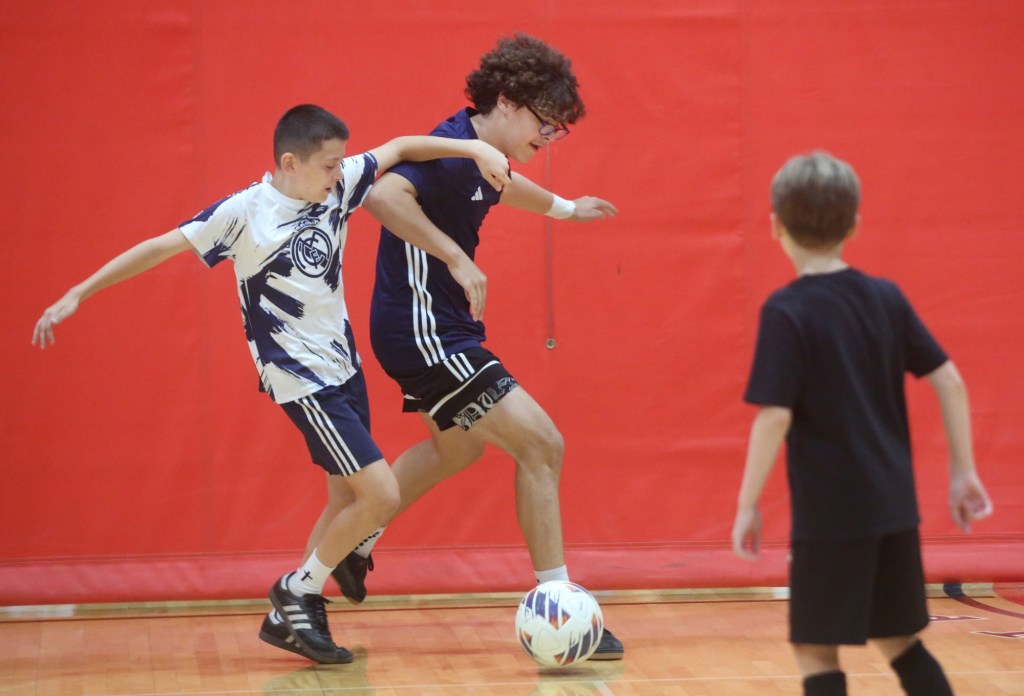
 Abington Heights’ Nico Bustos heads the ball during the soccer game at John Henzes/Veterans Memorial Stadium in Blakely on Wednesday, Oct. 01, 2025. (REBECCA PARTICKA/STAFF PHOTOGRAPHER)
“The World Cup has spurred a lot of interest and excitement in soccer, and I’m sure because of it there are a lot of families and children and parents watching soccer for the first time,” said Collen Pivirotto, the longtime head coach of the University of Scranton women’s soccer team. “But I also think that soccer is booming already. I think it’s already doing really well.
“I’m not sure if anything incredible is going to happen, or if there are any huge things that could change. But this has certainly been a huge positive in the United States in terms of soccer.”
That doesn’t mean there aren’t ways to tweak a great thing. Doing so might determine how exponentially the sport can grow at the local level, and whether the United States can ever be a contender for a World Cup championship of its own.
A better direction
“The beautiful game” still lags in popularity behind stalwarts like American football, baseball and basketball among U.S. sports fans. But for children, recreational soccer leagues have become every bit the introduction to sports participation as Little League or biddy basketball.
 James Skuba passes the ball as he is defended by Logan Berish during a shooting and passing drill at MMI Preparatory School’s summer soccer camp on Friday, July 17, 2026 at the school in Freeland.(John Haeger / Staff Photographer)
Thousands of children in Northeast Pennsylvania sign up annually, and just about every community has a program nearby to facilitate interest that boomed after the ’94 World Cup and the women’s national team’s rise to prominence a few years later. That, Pivirotto pointed out, has made soccer in the U.S. more accessible, more popular and played to a better quality than ever before.
Popularity also presents challenges.
Jack Nolan has coached varsity soccer in Wilkes-Barre for 27 years. In his days coaching the boys team at the former Meyers High School, he said he’d have been thrilled if he could field a 25-player roster.
Now at Wilkes-Barre Area, Nolan said almost 120 students signed up to play on his team in the fall. He expects only around 80 will show up when mandatory practices start Aug. 17, and concedes he’ll have to cut a quarter of them to get to a workable 55-60-player roster for the season.
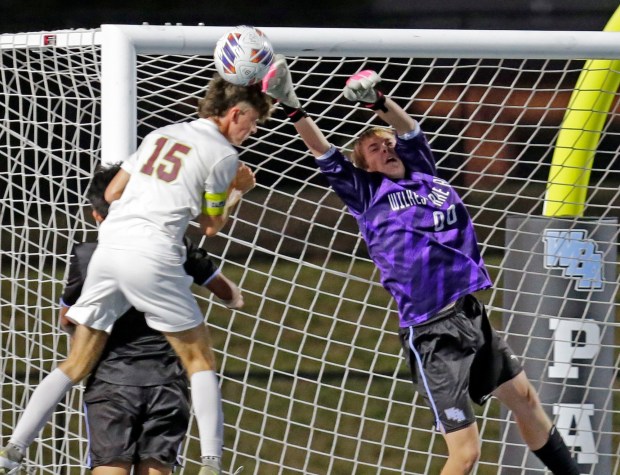 Wilkes-Barre Area goalkeeper Dylan Parry, right, blocks a header by Wyoming Valley West’s Luke Ginochetti in a boys soccer game at Wolfpack Stadium in Plains Twp. on Tuesday, Sept. 30, 2025. BILL TARUTIS / CONTRIBUTING PHOTOGRAPHER
Interest in playing soccer, he insists, is not an issue. Nor does he expect it to be one even after the excitement of the World Cup cools.
But the opportunity to become a top-level, difference-making competitor on the international stage is not-so-slowly becoming a problem in a system that inadvertently works to stifle it.
“Our (national) youth program needs a lot more development, and the problem on the youth side is cost,” Nolan said.
“A lot of these European countries, they develop their youth programs free of charge. Here, you’re paying to play. I coach at Wilkes-Barre Area, and a lot of our kids can’t afford the club teams that are out there. There are club teams who do scholarships and hardships and things of that nature, but a lot of my kids just can’t afford it.”
 Players of the Lackawanna Coal Miners play a game of soccer during the Scranton World Cup Fan Zone at the Lackawanna County Courthouse Square in Scranton, Pa., on Saturday, July 4, 2026. (ISAAC DIAZ/STAFF PHOTO)
The issue is infiltrating baseball and basketball at the youth levels too, but it’s especially challenging in soccer. To play for a high-level club soccer team, the average family typically spends between $5,000 and $20,000 annually on travel, club costs, equipment and uniforms, according to industry estimates.
The cost rises depending on the quality of the club, the level of competition and the location of the team. It’s typically going to be on the pricier side for the top players in Northeast Pennsylvania, because to face the best competition, they have to travel to Allentown or even Philadelphia, Nolan said.
While participation and interest in soccer steadily increases among children in all demographics, it is still essentially a sport for the economically well-off at the elite levels in the United States.
The feeling among those elbows-deep in the local soccer community is that organizations like U.S. Soccer or MLS would do well to capture the momentum of the World Cup, funnel more money into developmental avenues, and work to develop a more efficient feeder system that would make the cost of pursuing a long-term goal of playing at an elite level tenable for more young Americans.
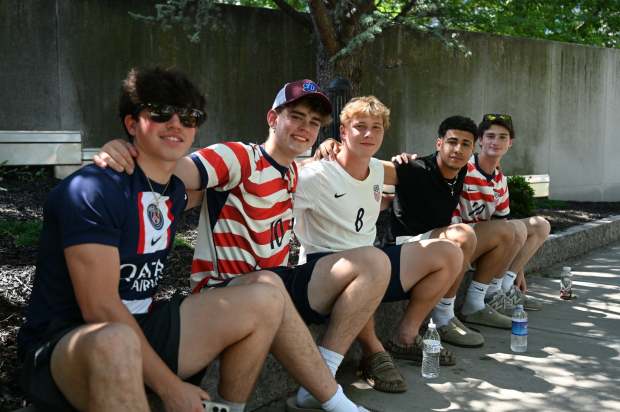 Young people from Dunmore gather in a shady area Saturday, July 4, 2026, during the World Cup Fan Zone event. (GERI GIBBONS/STAFF PHOTO)
“We’re like $50 in the spring and $50 in the fall, and we see families who can only pay for one session,” said Mike Slusser, club director for the South Wilkes-Barre Skyhawks rec league program. “We’re like, ‘Hey, you don’t need to pay for the fall,’ and they get that prideful, ‘We don’t want to do that.’ But with some of these kids, you’re thinking if they can’t afford $50, there’s no hope they can go play at a higher level. Some of them are at the level where I’d love to see them be able to play for those teams and get that three-day-a-week attention that would change them from a slightly undisciplined player to one who can really play.
“They have the talent, but you can’t install that discipline in two hours a week when you’re talking about working with all these kids.”
A new hope
When Bustos’ high school coach chats with his best soccer friends about these issues, there’s a hypothetical question he poses about soccer at the national level.
“There has been this feel of ‘the future is bright’ for such a long time,” Frank Dyska said. “But, aren’t we in the future now? What is it going to take to break through?”
Money spent properly is only one part of the answer. Others insist answers won’t come with a cost. But if the U.S. is ever to attain greatness on an international level, now is the time to harness possibilities.
The World Cup drew major buzz. And in the late summer, major streaming services will carry worldwide soccer matches into American homes, making top-flight soccer more accessible to local fans. Lionel Messi, the Argentina forward who is the biggest soccer star in the world, plays for Inter Miami in MLS. Arguably the most beloved comedy on American television over the last decade is “Ted Lasso,” the story of a midlevel college football coach who moved to London to coach in the Premier League.
Still, Nolan’s Wolfpack will open their regular season against West Scranton at 11 a.m. on Aug. 28, the only time that day the program can use the field because the football team needs it later that night. Few soccer matches at the varsity level receive media coverage before the playoffs, and stands rarely are occupied by anyone other than family, friends and the most rabid of soccer fans.
“When you look at other countries having a ton of success, it seems like soccer is just embedded in the culture from the time a kid starts walking to the time they can’t walk anymore,” Dyska said.
It has never been that way here. But, maybe the 2026 FIFA World Cup can be the impetus for that sort of revival, the creation of a greater demand for the game.
“Now that the World Cup is over, I hope these fans of the World Cup go and watch these players play for the club teams,” Bustos said. “I hope that support continues, that even more people start to watch now, and we can keep building that fan base. It will keep building the players, too, if they know they have a country that is supporting them. It will make the players better. That support will make the national team even better that it was now.”