
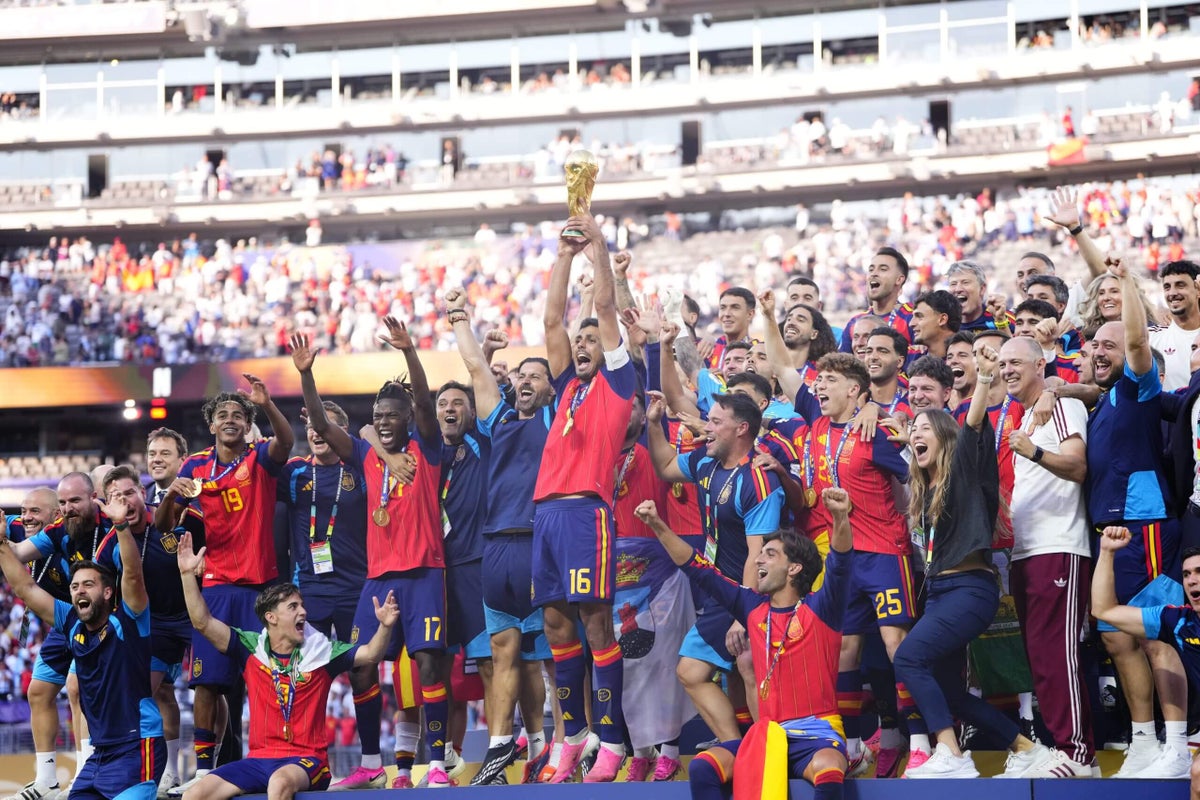
Had you closed your eyes, you might have thought you were sitting in Las Ventas, the famous bullring on the outskirts of Madrid. The fight wasn’t quite over yet, but it had reached the stage where the matador felt ready to tease the raging bull. “Ole!” the delighted Spanish supporters shouted. “Ole! Ole! Ole!”
After 104 games across three countries over five and a half weeks, the 23rd edition of the men’s World Cup was down to its closing stages. Spain had finally made the breakthrough in the final and glory was within touching distance. For a couple of minutes, they kept possession like it was a training-ground rondo, enraging their opponents. Argentina’s players saw red, their fury growing with every pass. Ole! Ole! Ole!
The late Cesar Luis Menotti, the cerebral coach who led Argentina to their first World Cup triumph in 1978, said in 2004 that Spanish football, having underachieved on the international stage for so long, needed to “forget its fury and decide if it wants to be the bullfighter or the bull”. It caused indignation in Spain at the time, but Menotti was right. In the past 18 years, since embracing possession-based football like never before, Spain’s men have won the European Championship three times and now the World Cup twice.
It is a remarkable run of success and, while the first five weeks of this World Cup were dominated by the exploits of star players such as Kylian Mbappe and Lionel Messi, few would dispute that Spain, after a slow start, asserted themselves as the outstanding team come the tournament’s business end. They beat Mbappe’s France 2-0 in the semi-finals and then, after 105 minutes of stalemate, a goal from Ferran Torres broke the increasingly fraught resistance of Messi’s Argentina in the final.
It was a triumph of teamwork, of intelligent, controlled possession football and of composure in contrast to their opponents’ aggression and paucity of attacking ambition. Argentina midfielder Enzo Fernandez was sent off for a second bookable offence just before the end of regulation time and the ugly antics of Leandro Paredes and Nahuel Molina at the end were in keeping with a performance that did not yield a single shot until the closing minutes of extra time.
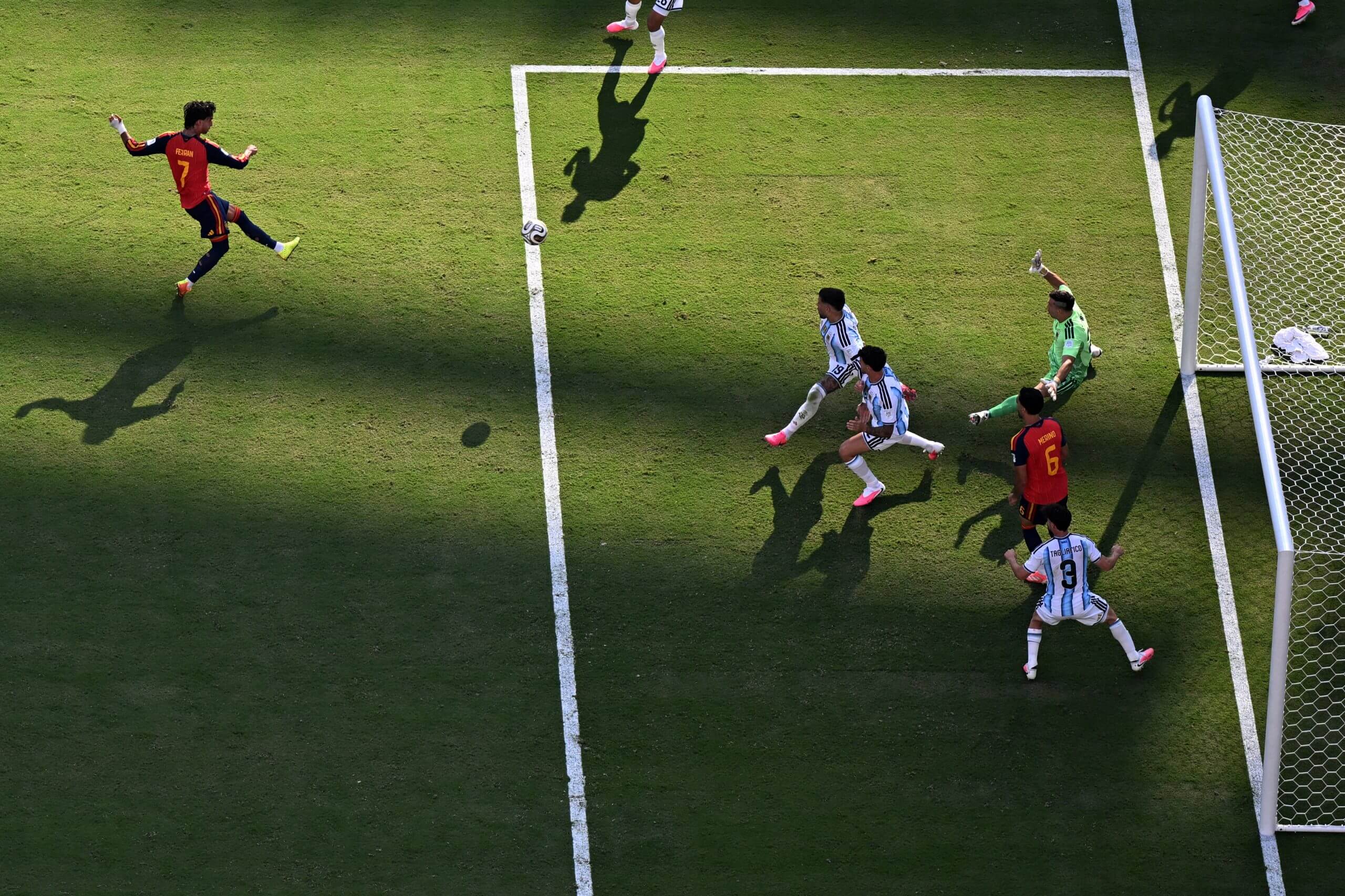
Ferran Torres hammers home the winning goal (Jewel Samad/AFP via Getty Images)
The way it unfolded called to mind two previous World Cup finals.
The first was the 1990 edition, when Argentina, as reigning champions, produced a mean-spirited performance that was finally punished by West Germany; that one ended in tears for Diego Maradona, as it did for Messi here, the greatest players of their respective eras finding there was a limit to just how far they could carry their vastly more limited team-mates. The other was in 2010, when Spain faced extreme aggression from the Netherlands, which they eventually overcame with a goal in extra time.
Long before he became FIFA’s chief of global football development, former Arsenal manager Arsene Wenger had a dim view of the international game, likening it to “fast food” as opposed to the haute cuisine produced by the best club teams. A national-team coach, he told reporters in 2010, “has to make a quick meal and he has little time to do it. There’s little time to practise, to work on the style of the team, so… it’s instinctive, quick-fix management”.
For the most part, it is. But this Spain team, like the one that dominated the international game in the late 2000s and early 2010s, is one that has emerged organically, based on a clear identity and a way of playing.
Argentina were carried to Sunday’s final by a wave of emotion and by the genius of their 39-year-old captain. Spain, by contrast, were a calm, controlled, measured side, built on sound footballing principles. Their win was a victory for method over the madness that always threatened to be Argentina’s undoing.
After a strong start to the tournament, the reigning champions teetered on the brink of elimination throughout the knockout stage, trailing Egypt and England until the closing stages, needing extra time to overcome Cape Verde and Switzerland. Spain stumbled in their opening group match, a 0-0 draw with Cape Verde, but thereafter they found their rhythm and grew in confidence and authority. They conceded just one goal in the eight games.
Where does the greatest credit lie? Their captain Rodri, of Manchester City, won the FIFA Golden Ball award as the tournament’s outstanding player, looking back to something like his best form in midfield nearly two years after rupturing the anterior cruciate ligament in his right knee.
Pau Cubarsi beat his fellow Barcelona teenager Lamine Yamal to the young-player award after another outstanding performance alongside Aymeric Laporte in central defence. Full-backs Pedro Porro and Marc Cucurella excelled at both ends of the pitch. Fabian Ruiz, Mikel Merino, Pedri, Nico Williams, Mikel Oyarzabal and others have made big contributions along the way, as did Torres by coming off the bench to score the World Cup-winning goal.

Pau Cubarsi, Rodri and goalkeeper Unai Simon, who won the Golden Glove, with their awards after the final (Carl Recine/Getty Images)
But more than any of that, it comes down to the collective, to what is not just a coherent playing style in the senior team but a joined-up approach to developing players — and indeed coaches. Two of the most successful club coaches of this era, Pep Guardiola and Luis Enrique, are Spanish, as are the coaches of five Premier League teams, including champions Arsenal (Mikel Arteta), Europa League winners Aston Villa (Unai Emery), Chelsea (Xabi Alonso), Fulham (Alvaro Arbeloa) and Liverpool (Andoni Iraola).
English football, with all the wealth it has accumulated through the Premier League’s unrivalled commercial success, keeps looking for quick fixes, the dopamine hits of the transfer market and short-term coaching hires.
England reached the World Cup semi-finals this summer under a successful and high-profile German coach, Thomas Tuchel, whose approach to the tournament seems to reflect the “fast food” approach of Wenger’s description. Spain have entered another golden era under a coach, Luis de la Fuente, who spent nine years coaching their under-19 and under-21 national teams.
“I never imagined anything like this,” De la Fuente, 65, told reporters after Spain’s victory yesterday. “I always just wanted to enjoy those moments I was experiencing (with the development teams). I always worked and coached where I wanted to be. When you look at this process, we couldn’t have achieved anything on this journey without these players and with the knowledge of the raw materials and the way Spanish players play and compete.”
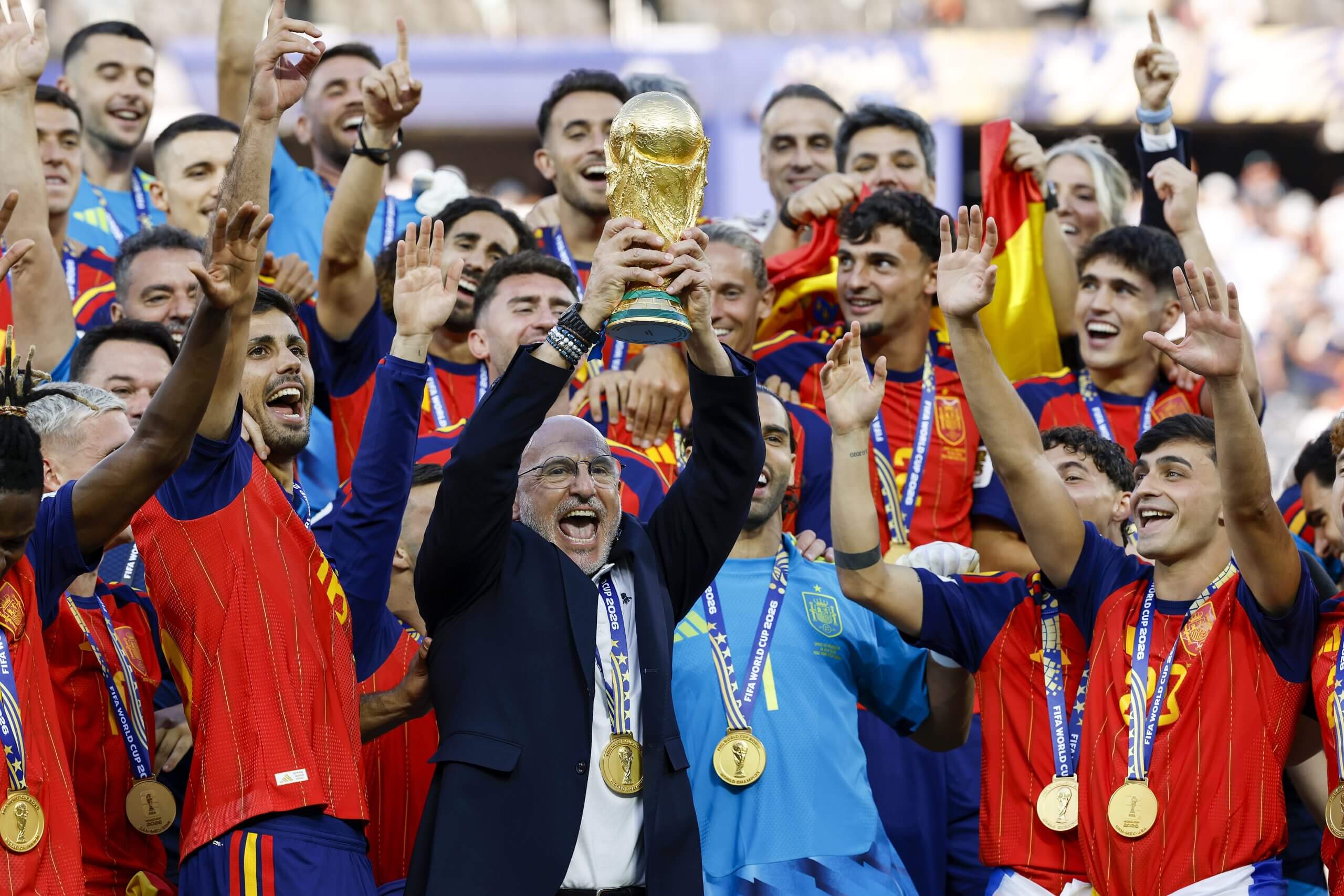
Luis de la Fuente has now guided his team to the European Championship and World Cup double (Maurice van Steen/ANP via Getty Images)
In other words, the knowledge and the connections that De la Fuente has built up over time. Unai Simon, Rodri and Merino were all in the Spain squad that he led to winning the European Under-19 Championship in 2015. Simon, Merino, Fabian Ruiz, Dani Olmo and Oyarzabal were all in the squad he led to the European Under-21 Championship crown four years later. This is how national teams are meant to develop. In practice, they all too rarely do.
It has not been uninterrupted success, or anything like it. There were painful learning experiences between winning Euro 2012 under Vicente del Bosque and reclaiming that title 12 years later with De la Fuente. Neither is the modern team a facsimile of the generation built around a Barcelona midfield of Sergio Busquets, Xavi Hernandez and Andres Iniesta; this one can look a little more functional, until it comes to the flamboyant threat of Williams and particularly Yamal on the wings.
But eventually they dominated this World Cup final. By the end of 90 minutes, they had recorded 66.2 per cent of the possession and 15 shots to Argentina’s zero. Extra time continued in the same vein and, while they were accused of being too devoted to their passing game in that group-stage draw against Cape Verde (just as they were when they were knocked out of the previous World Cup in 2022 on penalties by Morocco after recording 77 per cent possession in that match), their patience and confidence in that style has sustained through the rest of the tournament.
Spain defeats Argentina to win the World Cup
David Ornstein and Lia Griffin
There was a direct element to the goal — a hanging cross from Porro, a clever and determined far-post header by Williams and an emphatic Torres finish — but it was a product of a controlled, composed performance that always looked likely to wear Argentina down eventually.
Not only are Spain now reigning men’s European and world champions; they are the first nation to hold the men’s and women’s World Cups simultaneously. They are reigning European Under-19 champions in both the men’s and the women’s games. And that is while seeing a player as precociously gifted as Yamal fast-tracked into the senior squad, a European champion and now a world champion who only turned 19 last week.
Yamal is the face of this Spain team, the one who will be on billboards for years to come, but that word “team” overrides everything else. In a World Cup that was so often illuminated by the game’s biggest stars, glory was claimed by the strongest collective.
It goes back to the message De la Fuente said he gave his players before the game.
“I told them, ‘Gentlemen, we have an appointment with history — and we want to be there first’,” he said.
It took a while, but in the end they got there with a flourish. Ole! Ole! Ole!