
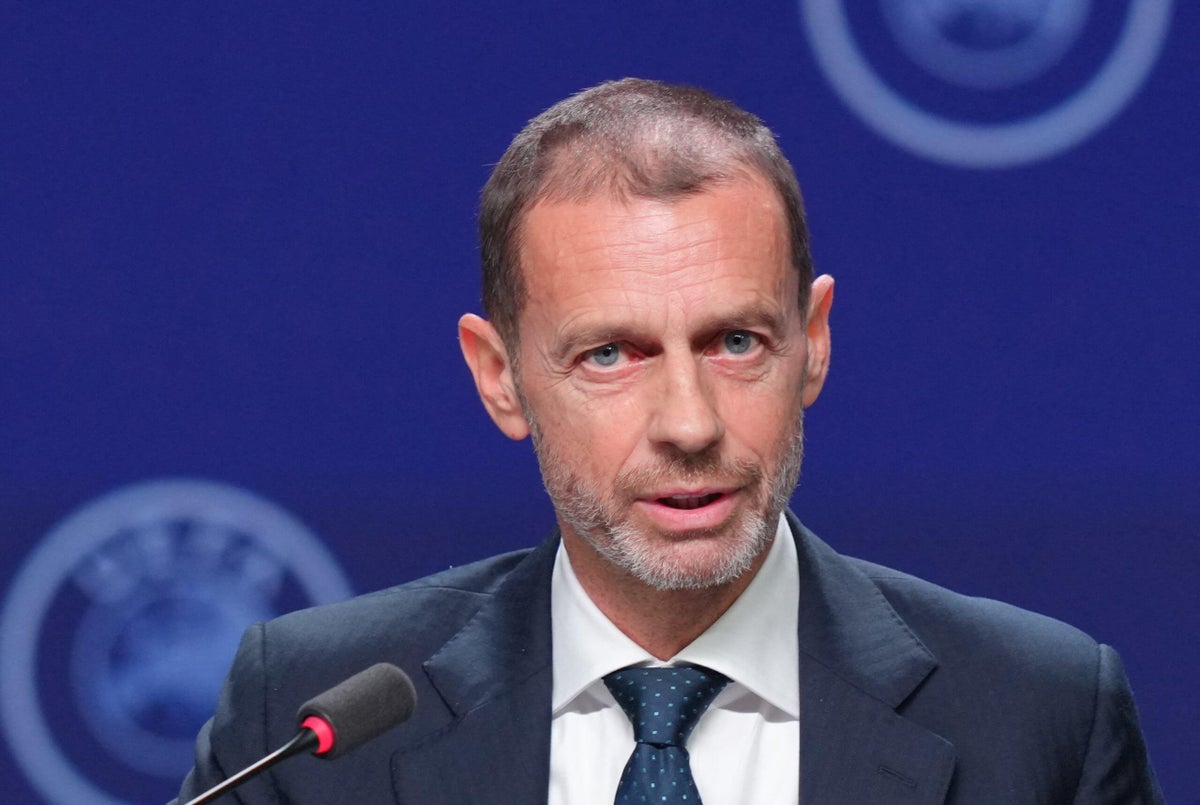
UEFA president Aleksander Ceferin stayed away from Sunday’s World Cup final in protest over FIFA’s handling of Folarin Balogun’s suspension, among other disagreements with football’s global governing body.
Along with the rest of the FIFA Council, the European football chief went to the tournament’s opening game in Mexico City on June 11 and had planned to attend the Spain-Argentina finale, too.
But, as first reported by UK newspaper The Times, the Slovenian changed his mind after FIFA’s disciplinary committee suspended the one-match ban U.S. striker Balogun earned for a red card in the round-of-32 game against Bosnia and Herzegovina on July 2.
This hugely controversial decision, which FIFA says was made by the committee’s Emirati chairman Mohammad al-Kamali, followed a phone call from U.S. President Donald Trump to Gianni Infantino in which he asked the FIFA president to reverse the ban.
In a statement, UEFA described this move as “unprecedented, incomprehensible and unjustifiable” and said FIFA had “crossed a red line” in allowing, at the very least, the perception of political interference in the game itself.
The decision was also heavily criticised by several UEFA member associations, most notably Belgium’s, which posted the simple message “overturn this” following their 4-1 win over the U.S. in the next round.

Infantino and Ceferin’s organisations have been at odds in the past (Pau Barrena/AFP via Getty Images)
The Athletic has contacted FIFA and UEFA for comment.
The Balogun affair is only one point of contention between FIFA and UEFA, who have a frosty relationship at the best of times and are currently going through one of their chillier spells.
Speaking before the tournament, Ceferin criticised FIFA’s high ticket prices, saying they risked “taking the game away” from the game’s most “serious, dedicated fans”. UEFA, unlike FIFA, will not use the dynamic-pricing model at any of its tournaments and has said at least 40 per cent of the tickets at Euro 2028 in the United Kingdom and Ireland will cost approximately £60 ($80) or less.
Ceferin also took a dim view of FIFA’s failure to persuade the U.S. immigration authorities to let Somalian referee Omar Artan take part in the World Cup. Two days after he was sent home, UEFA announced that Africa’s top-ranked referee would officiate the Super Cup final next month. How Iran’s team were treated during the tournament is another point of difference between FIFA and UEFA, with the latter believing the former could and should have done more to ensure a level playing-field for the Asian side at the World Cup.
But the differences between the organisations go beyond their off-field disputes, as UEFA has also made it clear that it does not approve of mandatory hydration breaks, extended half-times to allow for musical extravaganzas or giving red cards to any players who cover their mouths while speaking on the pitch.
In another example of UEFA’s desire to follow its own path, it has told its video assistant referees not to treat potential simulation, the official term for diving or flopping, as cases of mistaken identity. There were two instances of this at the World Cup, where a yellow card for U.S. defender Tim Ream was overturned and given to Paraguay’s Miguel Almiron, and, more significantly, Switzerland’s Breel Embolo was sent off when he received the yellow card that was initially given to Argentina’s Leandro Paredes.
However, while all these disagreements between FIFA and UEFA are current and real, it should also be noted that Ceferin has been steering clear of FIFA events for some time. He has spent as little time as possible at FIFA’s annual congresses in recent years, despite being a FIFA vice-president thanks to his role as a confederation boss, only attended the opening game of the last Women’s World Cup and did not go to any games at the Club World Cup.
Despite UEFA’s issues with FIFA, even if it votes as a bloc, it only accounts for 55 of FIFA’s 211 member associations and many others have seemed content with Infantino’s leadership.