

What happens when the greatest of all time moves on?
The body of the 2026 World Cup is not yet cold, and Argentina are in the early stages of coming to terms with their defeat against Spain in Sunday’s final.
There might be something even bigger for them to adjust to, though, in the near future. Lionel Messi has given little indication about his international future, but despite his brilliance throughout most of the tournament, at 39 years old he probably doesn’t have long left at this level.
You wouldn’t rule out Messi continuing, and there is the sentimental pull of the next World Cup having at least one game in Argentina. If Gianni Infantino’s wheeze to expand the tournament to 64 teams comes off, then there might be a whole group there. Is that enough to keep him going?
Perhaps. But Argentina have to at least consider the possibility that Sunday was his last game. They’ve had to confront this concept before… although admittedly only for two months, in which time they didn’t play any games: he retired after the Copa America in June 2016, but reversed his decision before the World Cup qualifiers in September that year.
This time, though, presumably a decision will be more permanent. So how will they cope without him? The evidence of Sunday’s final suggests the answer will be ‘not well’, but it’s worth looking at examples from sporting history of when a team’s greatest player has left them, and how well they dealt with it.
First, ‘the greatest’ is obviously subjective. Some of the examples we use here will not necessarily be exactly, definitively the greatest to ever play their particular sport. They are more generational players around which teams were built, after which those teams had to figure out how to do things.
It’s also worth pointing out the ‘correlation is not necessarily causation’ caveat: none of this is to say that what happened to these teams after their greatest left is because they left.
How Lionel Messi has defined this World Cup
Asli Pelit and Rachael Tinde
The logical place to start is Argentina. The parallels between this team and the ones in 1986 and 1990 are clear: a genius No 10 took them to glory, then an increasingly aggressive and self-destructive side reached the final four years later, only to be defeated by a single goal. Diego Maradona wasn’t nearly as much of a factor in 1990 as Messi was in 2026, but the sense that they still depended on him was strong.
To a point, it reached the state of national delusion: when Argentina were beaten 5-0 by Colombia in World Cup 1994 qualification, the public demanded Maradona’s return, even though by that stage he was long past his peak. It was even stranger considering they had won the Copa America in 1991 and 1993 without Maradona: admittedly, in the latter case at least, they actually won only two games in standard play, getting through the quarter and semi-finals on penalties.
That slice of history brings good news and bad news for Argentina: the good news is those teams showed it was possible to win without their talisman. The bad news is they didn’t win anything of any consequence again until the 2021 Copa America, losing five finals along the way.
Similarly, it took Brazil quite a while to get back to their previous heights after the retirement of Pele. They won the World Cup three times during his era, but after his last victory in 1970 they had to wait 19 years to win another Copa America, and 24 to lift the World Cup again. They did go on a hell of a run after that, admittedly: between 1989 and 2007 they won the Copa America five times and the World Cup twice, reaching three other finals. So perhaps Argentina need to brace themselves for an immediate fallow period, but sit tight for a couple of decades and the trophies will come.
The U.S. women’s team is an interesting case: Abby Wambach is generally regarded as their greatest ever, but she was surrounded by so many other all-time greats, both team-mates in her peak years and in the generation that came immediately after her, that the impact of her departure was mitigated. She had a reduced role at the 2015 World Cup, which the U.S. still won, as they did without her completely in 2019. It remains to be seen whether their failure in 2023 is a blip or the sign of a deeper malaise, but whatever it is, it is tough to trace it to Wambach.
Best 2026 World Cup fan moments
In other sports, the Chicago Bulls are not an example to follow. After Michael Jordan left in early 1999, it took them six years to even have another winning season, and they haven’t reached the NBA finals since, never mind won a title. They have only won their division twice since then, and haven’t won a play-off series since 2015, the longest drought in team history.

The Chicago Bulls struggled to adapt to life without Michael Jordan (Vincent Laforet/AFP via Getty Images)
Talk to different people and you’ll get different answers as to why, from terrible ownership to awful luck, notably when Derrick Rose tore his anterior cruciate ligament in the 2012 play-offs, leading to the top-seeded Bulls losing to the Philadelphia 76ers. But the shadow of Jordan must be a factor, even if it is one you would expect a club to get over in the best part of three decades.
Let’s not delve too deeply into the debate about who the best quarterback of all time is, and this example might be more of a player-coach combination. But no NFL team has won the Super Bowl more often than the New England Patriots. They won all of their six Super Bowls with Tom Brady under center (coached by Bill Belichick). They had only reached the Super Bowl twice before their time, and once since. But won it none of those times.
They came close in 2025, so it would be hard to say they have been a complete disaster without Brady (and Belichick), but again: they have never won a Super Bowl without them. For the record, Brady won the seventh Super Bowl of his career in his first season away from New England with the Tampa Bay Buccaneers.
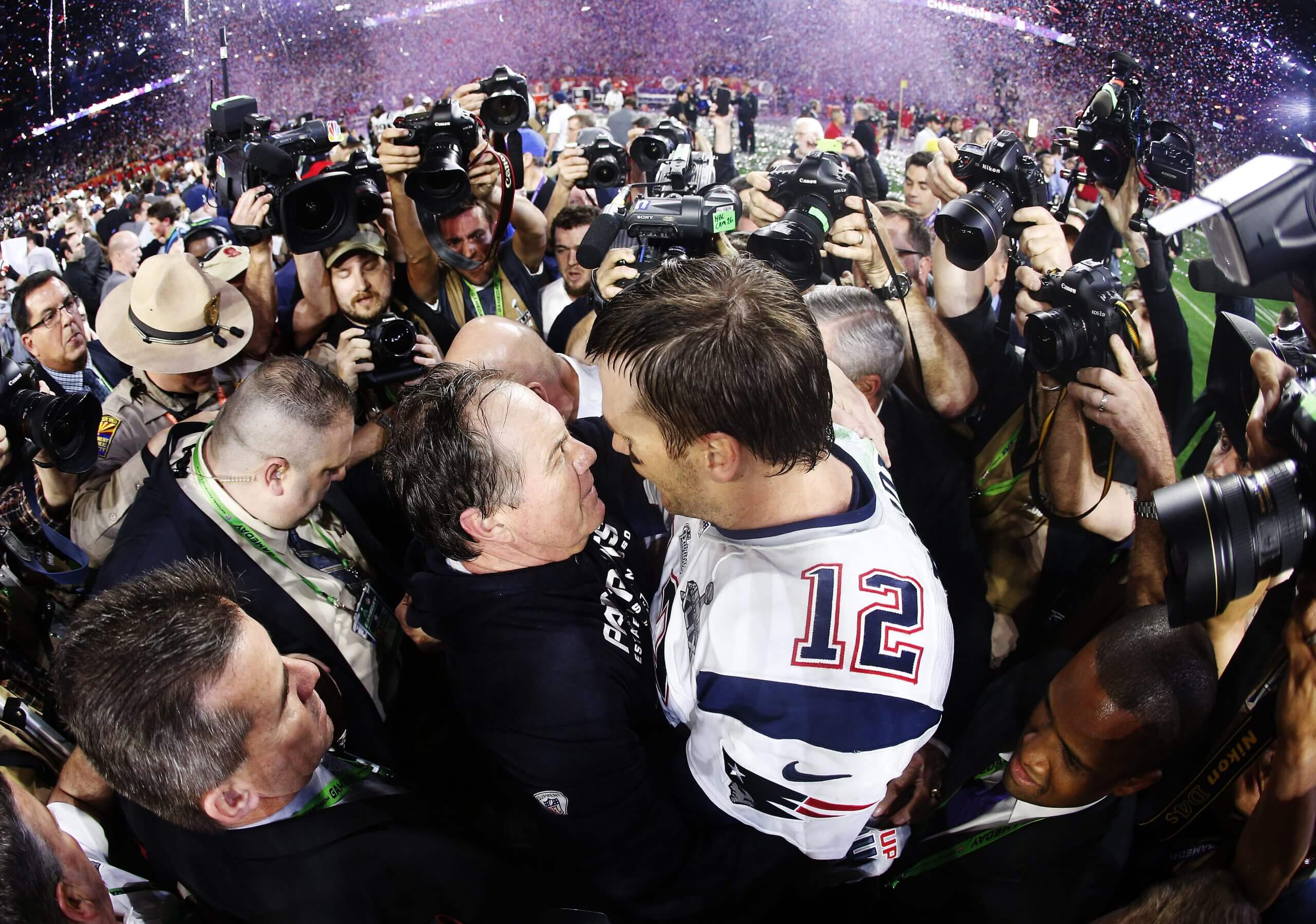
Bill Belichick and Tom Brady celebrate the fourth of their six Super Bowl wins with the Patriots in Glendale, Arizona (Christian Petersen/Getty Images)
The Edmonton Oilers coped slightly better in the post-Wayne Gretzky era, famously winning the Stanley Cup in 1990, two years after ‘The Trade’ which took Gretzky to the Los Angeles Kings. That said, it took them another 16 years to win another conference championship, and they haven’t lifted the big one since.
In motorsport, Ferrari reacted to Michael Schumacher’s departure in 2006 by resting their hopes on younger drivers, specifically Kimi Raikkonen and Felipe Massa. It worked initially, as Raikkonen won the drivers’ championship in 2007 and they took the constructors’ crown in 2008, but haven’t won either since.
Sometimes teams take it upon themselves to ‘freshen things up’ and move on from the greats. After Stuart Broad retired from international cricket in 2023, England’s response a year later was to drop the other half of their greatest bowling partnership, record wicket-taker Jimmy Anderson, in the name of progress. The theory was that they needed younger, faster bowlers for the Ashes tour of Australia in 2025-26. They lost 4-1. Since Anderson was eased out, England have won 13, drawn one and lost 13 Test matches.
All of these are broadly negative examples, where teams have floundered upon the departure of their great star. But there are some success stories: sticking with cricket, after Don Bradman — by consensus the greatest batsman in the history of the game — retired in 1948, Australia won the next three series they played, and lost only four of the next 22.
Returning to football, Real Madrid sold Cristiano Ronaldo to Juventus in 2018 and unlocked the best football of Karim Benzema’s career, regenerated their squad and won three league titles and two Champions Leagues in the next few years.
Then there’s the San Francisco Giants: they didn’t win a single World Series during the 14-year tenure of Barry Bonds, but after he left in 2007 they won three, in 2010, 2012 and 2014. If you want to go further back, Babe Ruth leaving the New York Yankees in 1934 didn’t slow them down particularly, winning titles in 1936, 1937, 1938, 1939, 1941 and 1943 over the following decade.
There will be countless other examples of successes and failures, in sports wide and varied. Argentina won’t want to lose Messi, but there are enough examples to suggest it might not be the end of the world.