
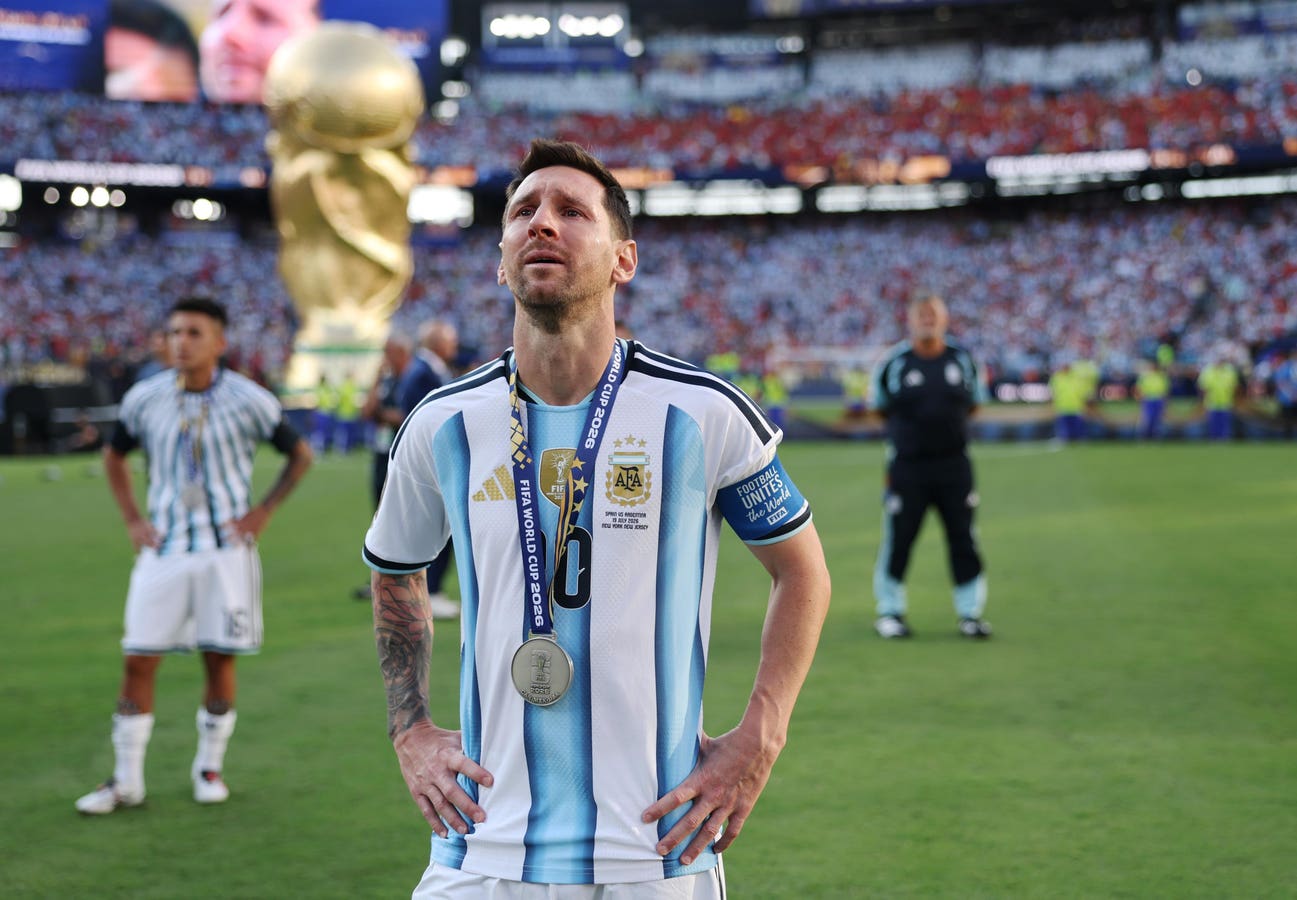
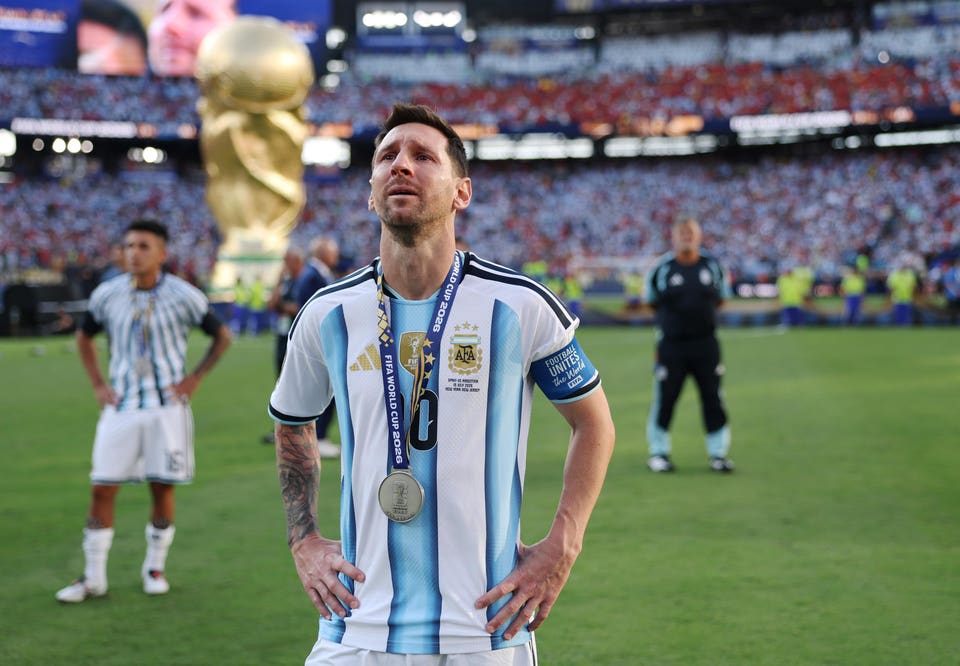
EAST RUTHERFORD, NEW JERSEY – JULY 19: Lionel Messi #10 of Argentina reacts after the 0-1 loss during the FIFA World Cup 2026 Final match between Spain and Argentina at New York New Jersey Stadium on July 19, 2026 in East Rutherford, New Jersey. (Photo by Maja Hitij – FIFA/FIFA via Getty Images)
FIFA via Getty Images
For a decade, one player’s genius bought the Albiceleste the world’s affection. His exit leaves the rest of the team standing there without it.
One image did the rounds after the 2026 World Cup Final: eleven men turning their backs on the winners, rather than facing them as tradition and basic grace require.
On July 19, in a stadium in New Jersey, the defending world champions stood in a row and stared at the grass while Spain lifted the trophy a few feet away. Not one of them watched. Behind them, Leandro Paredes had already grabbed a Spanish player by the throat and, per Alan Shearer, “threw two or three haymakers” into someone’s face. Enzo Fernández had been sent off before extra time even started. Nahuel Molina reportedly took a swing at Rodri. FIFA has since appointed a prosecutor. That image, far more than the 1-0 scoreline, is what most of the planet took home from this final.
EAST RUTHERFORD, NEW JERSEY – JULY 19: Players scuffle after the FIFA World Cup 2026 Final match between Spain and Argentina at New York New Jersey Stadium on July 19, 2026 in East Rutherford, New Jersey. (Photo by Lars Baron/Getty Images)
Getty Images
Which is a problem, because for about a decade Argentina has been the most romantic, most watchable, most forgiven team in football. Every great side collects grievances, but Argentina collected affection at the same rate it collected enemies, and the affection kept winning. This tournament, it stopped.
Argentines Might Not Think Much Of It
The read, popular in Buenos Aires right now, is that none of this is real. It’s an orchestrated pile-on, a bot swarm, jealousy dressed up as principle. Sports journalist Pedro Rosemblat spoke for a lot of the country when he wrote that the world calls Argentines “cocky, cheaters, dirty. And we love it.” The folclore defense. Passion misread as malice by people who don’t get us.
Sure. Except a reputation is whatever other people can’t stop noticing about you, no matter what you’d prefer they saw instead. And the things people noticed did not require a single bot to invent them.
The File Argentina Would Rather You Forget
Start with the chant. After the 2022 final, and again on a team bus after the 2024 Copa América, Argentine players sang a song mocking French players’ African heritage, with a transphobic jab thrown at Kylian Mbappé for good measure. Enzo Fernández filmed it himself, live, then cut the feed a beat too late. His own Chelsea teammate Wesley Fofana called it “uninhibited racism.” France’s federation went to FIFA. Enzo apologized. Then, in this final, the same player flew into a challenge so reckless the referee had no choice, and walked off having handed Spain the game.
Add the goalkeeping pantomime. Emiliano Martínez spent the last World Cup cycle holding a minute of silence “for Mbappé who is dead” in the dressing room, then parading a baby doll with the kid’s face glued on it. FIFA opened proceedings for that, too. It played as cheeky in Argentina and as something uglier everywhere else, which is exactly the gap we’re talking about.
Then the dirty-play file, which is thicker than Argentina wants to admit. This is a side that spent the whole tournament being accused of grappling, time-wasting, and refereeing luck, and then produced a final where its first shot on goal arrived in the 115th minute. The Telegraph’s verdict was “ungracious in victory, disgraceful in defeat.” Stuart Pearce, watching the trophy snub, said the backs-turned moment “probably tells you a great deal, doesn’t it?” His talkSPORT colleague Adrian Durham was blunter: “no class, whatsoever.” These are the people who narrate the sport to the world, not anonymous X accounts.
Yes, The Bot Campaign Is Real
Now, the strongest version of the Argentine defense deserves real credit, because it happens to be partly true. A researcher named Mercedes did an actual digital ethnography of the anti-Argentina wave and found genuine coordination underneath it: hundreds of accounts posting the identical phrase, “disgusting human beings,” auto-translated into a dozen languages, from profiles that otherwise sell sex toys and spam. That is a manufactured campaign. It exists. Anyone who’s watched a narrative get gamed on that platform can recognize the fingerprints.
But the comfort runs out fast. Bots don’t burn without fuel. The reason a copy-paste smear about a football team caught fire in Algeria and Egypt and France is that it was landing on top of things people had already seen with their own eyes: the chant, the doll, and now the haymakers and the turned backs. Manufactured outrage still leaves a residue on the brand. You can prove the mob was rented and still lose the argument about whether it had a point. Even the level-headed voices in Argentina know it. Ezequiel Fernández Moores, about as sober a football writer as the country has, admitted the trophy snub was simply “not right,” and that sometimes Argentines behave as if God himself carries an Argentine passport.
The Messi Halo
So if the hate is partly fake and the behavior is fully real, why did none of this dent Argentina for the previous ten years?
One answer. The same one every headline keeps writing without noticing it’s the whole story: save for Lionel Messi. Every piece ripping the team pauses to exempt him. Every neutral who loathes the Albiceleste makes a carve-out for the little genius. He has been the halo the entire brand lived inside — the single asset whose salience was so overwhelming that a decade of chants, dolls, brawls, and general antagonism registered, to the wider world, as the price of admission for watching him. You didn’t root for Argentina. You rooted for Messi, and Argentina came stapled to him.
That is a spectacular thing to have. It is also the single most fragile brand structure there is. Ask any company that quietly panics every time its founder gets on a plane. When your equity sits in one person, you have a hostage situation with a happy ending, renewed match by match.
A Reputation You Rent
The problem is that the founder is (most likely) leaving. Messi stood crying in front of the Argentine fans with a runner-up medal, at 39, in what he had already called his last World Cup. When he goes, the carve-out goes with him. There is no “save for” clause waiting behind him — no De Paul, no Martínez, certainly no Enzo who can absorb the world’s irritation and convert it back into love. The team that’s left is the one the cameras caught this month: talented, aggrieved, and, without its anesthetic, genuinely disliked.
Argentina thinks it just lost a final. What it actually lost is the one man who made everyone agree to like it anyway.