
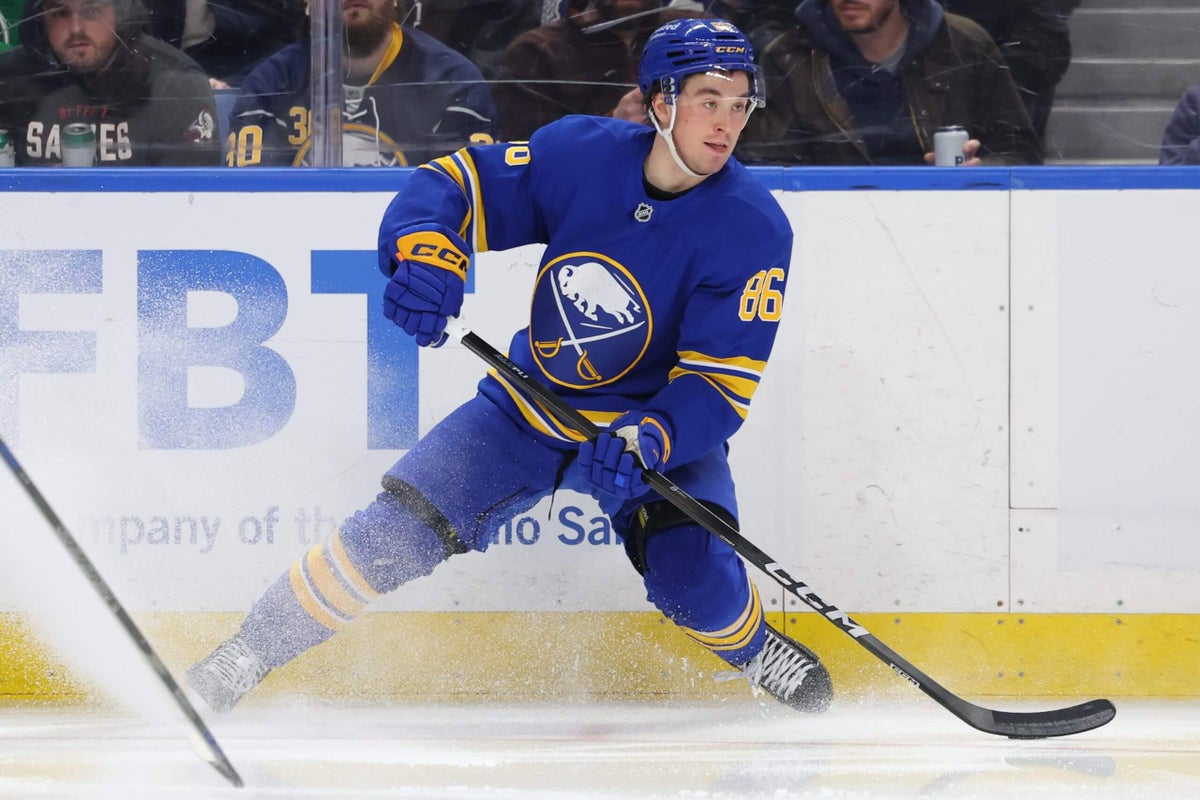
BUFFALO, N.Y. — The 2022 NHL Draft in Montreal was an epic scene. It was the first in-person draft since before the pandemic. It was a celebration of the sport in one of the league’s most passionate markets.
And it was also the biggest night of Jerry Forton’s professional career. He had been promoted to director of amateur scouting by then-GM Kevyn Adams a year earlier, just before the 2021 NHL Draft, when the Buffalo Sabres took Owen Power with the No. 1 pick. But the 2022 draft was Forton’s first full draft cycle in the role. Junior hockey had returned to some normalcy coming out of the pandemic, allowing Forton and his staff to hit the road for more in-person scouting. And after trading Jack Eichel and Sam Reinhart, the Sabres had three first-round picks.
“The ‘22 draft and subsequent drafts were a huge part of the plan that Kevyn put in place,” Forton said. “That was a lot of pressure, and it was nerve-racking in some sense.”
With so much trade talk leading into the draft, Forton was prepared for every scenario, including getting into the top two picks. With picks Nos. 9, 16 and 28 in the first round, including plenty of draft capital beyond Round 1 and in future drafts, Forton knew he had to be ready for anything.
The night was a whirlwind. The Canadiens started the draft by taking Slovakian winger Juraj Slafkovský with the No. 1 pick. Shane Wright, the presumed No. 1 pick for much of the season, slid to No. 4. Buffalo didn’t end up making any trades, using the three picks on centers Matt Savoie, Noah Östlund and Jiri Kulich. After a calendar year of agonizing over their list, Forton was finally able to exhale at the end of the night.
“All three of those players we had very close to each other on our list, if not side by side, and we had them all on the top 10 of our list,” Forton said.
Four years later, the Sabres ended the franchise’s 14-season playoff drought. They also have a core of emerging young players that could help Buffalo be competitive for years to come. Östlund and Kulich, drafted that night in Montreal, are part of that. So are Zach Benson and Konsta Helenius, the Sabres’ first-rounders in the next two drafts. The Athletic recently spoke with Forton about the scouting process behind each of those players to understand how this core was built and get a closer look at the philosophy behind Forton’s scouting methods. This summer, we’ll have stories on each of those players with Forton’s insights.
We begin with Östlund, an undersized Swedish center who started to stand out to Forton in November of his draft year. Playing for Sweden at the Five Nations Under-18 tournament in Switzerland, Östlund didn’t have a single point. But Forton thought he was the best player on his team and might have been the best player in the tournament.
So he had the analytics staff dig deeper into Östlund’s numbers. There’s a fine line in scouting between finding rational reasons for a lack of production and making excuses for a player. Östlund was clearly a play driver, and the metrics showed that. He was also underdeveloped in terms of both size and strength. Because of that, his shot needed a lot of work.
“He’s always been very good at scoring in tight and around the net, a little bit like a poor man’s Jake Guentzel in that regard,” Forton said. “His hockey sense, his edges, his compete and tight areas skills would have reminded us of a Jake Guentzel type but a different player projecting him at the NHL level. We view Noah as a pure center and more of a distributor and pass-first guy. But we all agreed, as scouts, his shot needed to get better. We tied that to a lack of physical development as well. Our analytics staff saw it the same way.”
Forton tries to keep the analytics staff and scouting staff independent of one another until about midway through the season to ensure each side is coming to its own conclusions. Then the two are better able to collaborate, debate and come to a group conclusion on a prospect. Östlund was a player the two sides were closely aligned on. In addition to needing to work on his shot, the Sabres didn’t view Östlund as an elite skater in his draft year. He needed to get a lot stronger.
But there were also easy-to-spot explanations for Östlund’s lack of production. One was his hockey sense. Often, Forton sees players who have elite hockey sense at the lower levels, and they don’t have teammates who can think the game at the same pace.
“You could just tell there were plays to be made and he didn’t have the right player playing with him at times that could think it and execute it at his level,” Forton said.
The other piece of Östlund’s game that helped explain the lack of points was the way he played away from the puck. He wasn’t chasing offense.
“The guy played to win all the time and probably sacrificed a little offense to play such a solid two-way game,” Forton said. “You could see it was in his makeup and core to play at both ends of the rink.”
Forton’s evaluation was cemented as the season went along. In the playoffs for Djurgården’s under-18 team, he had seven points in four games. For the U20 team, he had five goals and two assists in five games. Then at the U18 tournament for Sweden, Östlund’s production caught up to his play earlier in the year. He had four goals and six assists in six games. And he capped it off with a clutch goal in Sweden’s win against USA in the gold-medal game. Four players from that Sweden team were drafted in the first round, but Forton always had Östlund as the best Swedish player in his age group.
“To me, he was the motor and the engine and the thinker that drove all of those teams,” Forton said. “The production maybe lagged behind at times, but we didn’t have any question it was going to come eventually. He just makes other players better. That’s always been the case. No matter who you play him with, other really good players want to play with him, and he makes others better. That’s a testament to his playing the game the right way and his elite, elite hockey sense.”
Östlund’s maturity was evident off the ice, too. Moments after the Sabres drafted him with the No. 16 pick, Östlund was speaking to reporters and didn’t hesitate when saying he wanted to go back to Sweden for two years to continue to develop as a player and a human being. He felt he needed that to be ready to make the jump to North America.
And he was right. He put up 49 points in 75 games in the SHL over the next two seasons and then jumped into the AHL in 2024-25, putting up 36 points in 45 games. The same traits that made him stand out to Forton made him a quick favorite of Rochester Americans coach Mike Leone. From day one, he loved Östlund’s quiet work ethic. He was always at the rink early, working in the shooting room. And when he started his first season in Rochester with one point in 10 games, Leone kept saying the same thing Forton did two years earlier: just wait. Shortly after he returned from a hand injury, Östlund took off. He was AHL player of the month two months in a row. He had 35 points in his final 35 games of the season.
While Östlund is still undersized and has struggled to avoid injuries as a pro, he’s already proven to be a fearless player. He’s only 5-foot-11 and 180 pounds, but he’s often going to crowded areas and coming away with the puck. And he’s not afraid to play in traffic.
“It’s his compete and his edges,” Forton said. “Those things are elevated by hockey sense as well. A guy can have great mechanics and edges in terms of his technique. But a guy with great hockey sense makes other players miss all the time. Sometimes that actually makes their edges and quickness seem even better than they are.”
Östlund has an innate ability to recognize patterns on the ice and dictate the game with his vision and passing. In his playoff debut against Boston, Östlund grabbed a puck in the neutral zone, carried it into the offensive zone with ease and pivoted to buy time in the corner. He slid a perfect pass to Bowen Byram for a game-tying goal.
“He just makes other players better,” Forton said. “That’s always been the case. No matter who you play him with, other really good players want to play with him, and he makes others better. That’s a testament to his playing the game the right way and his elite, elite hockey sense.”
Now Östlund looks like a big piece of Buffalo’s future. His season ended with a high-ankle sprain in the playoffs. And he missed time before the playoffs with an upper-body injury. He needs to prove he can hold up to the grind of the NHL. Added strength should help him in the faceoff circle, too. He was just 31.9 on faceoffs last season, limiting his ability to be a full-time center.
But so far, he’s made the Sabres look good for picking him in the middle of the first round. Though Forton admits that the pick was one they agonized over. They had Östlund and Kulich side by side on their list.
“We went back and forth probably 30 times flipping those two players on our list,” Forton said. “We made a decision probably two days before the draft because we thought there was a chance Kulich would be there later in the first, and we didn’t think Noah would. Part of that was Sweden won the gold medal at the Under-18s. Noah had a great playoff.”
As it turned out, Forton and his staff were right. They took Östlund and sweated it out for the next 12 picks before getting to call Kulich’s name, too. The Sabres ended up with both players.
“We were stunned,” Forton said.