
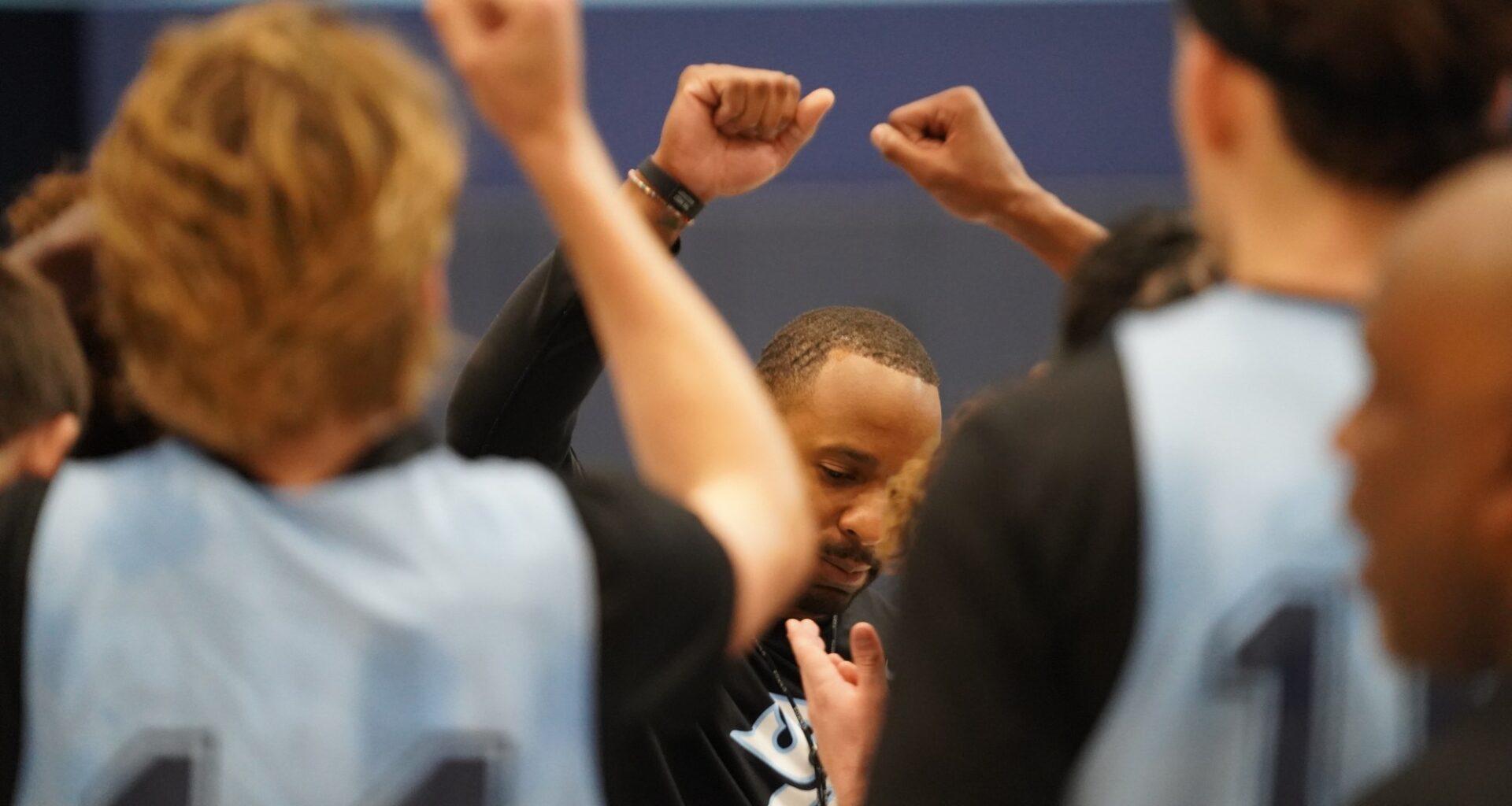
New coach JR Blount gathered his University of San Diego men’s basketball team last month for its first day of summer workouts.
There were no balls.
First there was a two-hour meeting to outline standards, philosophies, identity, rules, expectations. Then they walked outside and discussed how they would enter the practice facility each day, how they addressed each other, how they dressed, how they shook hands, how they looked people in the eye, how they carried themselves.
Then they went into the clutter-free locker room and learned how it would stay that way.
Next stop was the practice facility court. There were no chairs.
“I don’t want guys coming to the court to sit down,” Blount explained. “It’s not what we’re doing. You come to the court to get work done. Our whole mentality is when you’re stepping into the gym, you’re coming to work. It’s time to get better.”
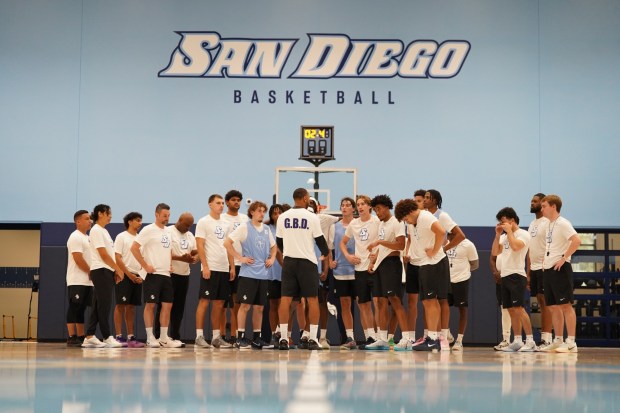 USD men’s basketball coach JR Blount addresses his players during a recent early-morning practice on campus. (USD athletics)
Oh, and practice would be at 6:30 each day – 6:30 a.m.
It doesn’t take long to realize there’s a new sheriff in town, that this is no longer Steve Lavin’s program with his California casual attitude and offensive-minded approach. Blount, in many ways, represents the polar opposite — strict, punctual, defense, defense, defense.
Practices, despite the zero-dark-thirty starts, are loud, intense, energetic, active, physical. The first drills Monday focused on rebounding, the next half-dozen on various aspects of their pressuring, helping, swarming, trapping defense.
“I’m not going to be some kind of offensive savant,” said Blount, who was the de facto defensive coordinator as an assistant at Iowa State before coming to Alcala Park. “I’m not trying to be that. We’re going to be a defensive, physical team, and that will be our identity. Everyone’s like, ‘Yeah.’ I’m like, ‘Well, the school down the road (San Diego State) did it and went to the national championship game.’
“I know it can be done. I know it works. Obviously, you have to have the personnel. But to me, it’s more the mentality. And these guys have bought into it. They know what it is. They know what they signed up for, so there are no surprises. We know who we are.”
If Blount accomplished that as his team breaks before the start of the fall semester, that is it.
Coaches talk about setting the culture.
Culture, set.
“I can already sense this is going to be a winning program,” said Sekou Konneh, a 6-foot-9 transfer from Milwaukee who admittedly was a night owl who went to bed at 1 or 2 a.m. before arriving at USD. “It’s how intentional we’ve been with everything, being on time, whether it’s a study hall or (ankle) taping or showing up at 6 a.m. for your first workout before practice.
“I think all of that is part of winning, and we have that here. I haven’t experienced things like that before.”
A couple weeks in, someone was two minutes late for study hall. Someone else was five minutes late for class.
“There has not been any since, because there was some running that happened,” Blount said.
“It was crazy, it was crazy,” said Terry McMorris, a 6-6 transfer from Eastern Illinois. “Never again.”
 Members of USD’s men’s basketball team talk with coach JR Blount at midcourt during a recent practice. The Toreros are practicing in T-shirts that read “G.B.D.,” short for “Get Better Daily.” (USD athletics)
Practices are followed by a trip to the weight room, classes, individual workouts, study hall and film sessions, then a daily team meeting each afternoon followed by a team dinner.
Players wear practice shirts not with their names but the letters “G.B.D.” on the back. Get Better Daily.
Only four members of last season’s roster returned, and just one of those — 6-9 Puerto Rican forward Alejandro Aviles — played meaningful minutes (and he’s not currently practicing after back surgery). The other 11 are all new, handpicked by Blount and his staff for their talent and character, not necessarily in that order.
“The character piece is huge for me,” said Blount, whose alarm goes off at 4 a.m. each morning. “They came to the house the other day, and my wife said after they left: ‘Those are some good dudes. I don’t know if they’re any good at basketball, but they’re good guys.’
“That’s the most important thing. A lot of these guys in the portal, juco, high school, they’re good at basketball. But we got lucky because they’re great guys and I’m not worried about them off the court. They have totally bought in to everything we’ve done. It’s been special. I’m not telling you we’ll be great. I’m telling you we’ll be connected.”
 Iowa State assistant coaches JR Blount and Kyle Green watch from the bench during the second half of an NCAA college basketball exhibition game against Creighton, Sunday, Oct. 19, 2025, in Omaha, Neb. (AP Photo/Bonnie Ryan)
Blount spent the previous five seasons at Iowa State under T.J. Otzelberger, preceded by three at Colorado State on Niko Medved’s staff. The influence of both bosses is apparent.
The roster composition is similar to those Iowa State teams that made deep runs in the NCAA Tournament — strong, long, tough, junkyard dogs who are interchangeable parts on, in Blount’s words, a “dictating and disrupting” defense annually ranked among the best in Division I.
The Cyclones are not known for plucking five-star recruits but flipping over rocks to uncover gems, and Blount’s transfers come from Ball State, Grand Canyon, Grambling State, UC Riverside, Maryland-Baltimore County, Milwaukee, Eastern Illinois, a Division II school in Missouri and a junior college in Florida.
Otzelberger regularly practiced at 7 a.m. Blount is going at 6:30 a.m. “because I want to work harder than them.”
From his trips to SDSU’s Viejas Arena with Colorado State, he learned what good defense can do to good offense.
“Niko is a top 10 offensive coach in the country,” Blount said, “and we had all this stuff; we’d do all this preparation. We would come here and couldn’t run any of it.”
Konneh was asked what the returning players told him about the difference from prior seasons.
“They said the intensity is different, getting up early, being everywhere on time is important,” he said. “Everyone is on point with everything we do. We have 12-hour days. We’re here with each other constantly. They were telling me they didn’t do that. They would practice and then go about their day.”
McMorris was asked to describe his new team’s identity.
“How together we are,” he said. “We connected so fast. Usually it takes months. The whole team is a bunch of dogs that want to kill whatever is in front of it, honestly. We all know anybody can go for 20 on any given night, but we’re going to be the hardest-playing defensive team in the country.
“I’m a defense-first guy. I love it, I love defense. But it’s not for everybody.”