
Monday night’s 2-1 Red Sox loss to the Blue Jays in Toronto included a delay of over 15 minutes for one of the most obscure scenarios possible in a Major League Baseball game.
The top of the seventh began more promisingly for the suddenly ice-cold Boston bats, as second baseman Anthony Seigler and catcher Connor Wong opened with back-to-back singles off reliever Simeon Woods Richardson. The go-ahead run came to the plate in the form of leadoff man and shortstop Nick Sogard, who scorched a low toward first baseman Vladimir Guerrero Jr., who fielded it on a short hop so subtle the official scorer initially announced a double play.
In truth it was only a force-out that erased Wong at second. But the Rogers Centre scoreboard, controlled by MLB, showed two outs despite Sogard remaining on first base.
As centerfielder Ceddanne Rafaela flied out to Brett Bateman in center, the scoreboard corrected mid-play. Seigler and Sogard began to advance to home and second, respectively. Bateman then threw to second baseman Josh Smith, who flipped it to Guerrero for the double play, and the Blue Jays walked back to their dugout.
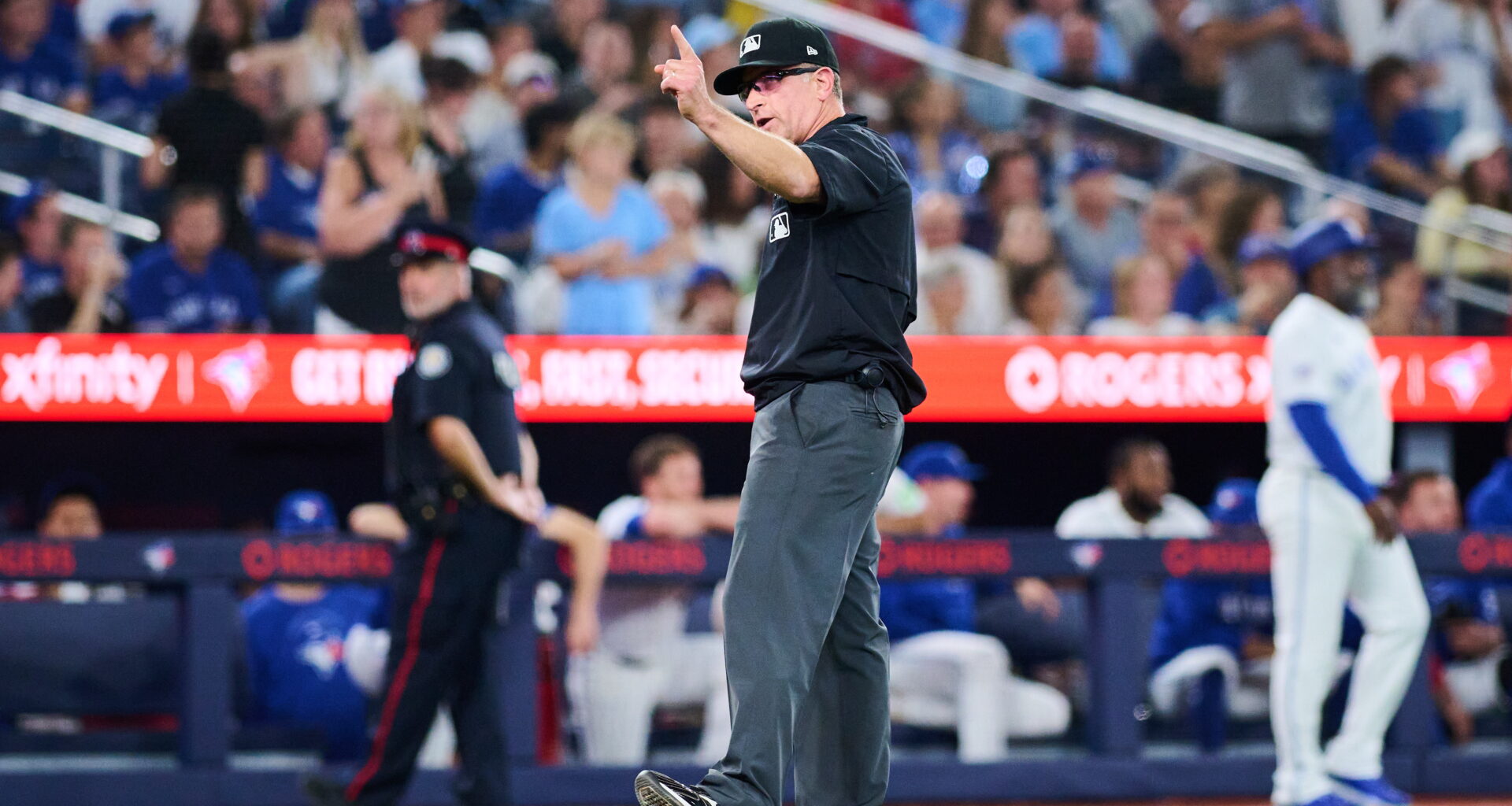
At first it looked like an unacceptable mistake by Seigler and Sogard. But then the inning didn’t turn over for more than 15 minutes. The umpires deliberated, then crew chief Chris Guccione, the game’s third-base umpire, spoke separately with Blue Jays manager John Schneider and Red Sox interim manager Chad Tracy. Guccione then addressed the crowd of 42,511 and countless more confused viewers watching around the world.
“OK,” Guccione began, as if bracing for a typhoon of bafflement and chaos. “What we have here is we have a time play, meaning the third out was made at first base with the runner not tagging up, the runner that was on third base also did not tag, but crossed home plate before the third out was made at first base. So we’re going to New York to do a rule check.”
“Going to New York” thankfully did not mean a group road trip over the board to the Big Apple. But it did mean several more minutes of waiting for clarity regarding Rule 5.09(c)(4).
At last, Guccione delivered the verdict: “After calling New York and getting it all straightened out, the run is going to score. End of the inning. Two runs for Toronto, one run for Boston.”
Rafaela was credited with a sacrifice fly and an RBI.
It’s the “fourth out rule,” and it ranks among the game’s rarest rarities and oddest oddities. Throwing to third on an appeal after making the out at first would have negated Seigler’s run. But Seigler had crossed home before the out on Sogard, and the Blue Jays subsequently left the field without asking for an appeal. The latter aspect is also detailed in Rule 5.09(c)(4):
“For the purpose of this rule, the defensive team has ‘left the field’ when the pitcher and all infielders have left fair territory on their way to the bench or Clubhouse.”
Here are the postgame takes and explanations from the men themselves:
Crew chief Chris Guccione
“In this situation, we had one out,” Guccione explained to a pool reporter. “Fly ball to the center fielder. Both Boston runners, thinking there were two outs, just took off. When the second out was made, now we have two runners that have failed to return and tag up correctly. At that time, the guy from third had crossed home plate and the guy at first was standing at second. Toronto knew that he hadn’t tagged up and threw to first base to make the third out.”
“Well, that’s a time play, meaning it’s not a force play,” Guccione continued. “If it’s a force play, the run does not score automatically. If it’s a time play, meaning ‘Was the out made before or after the runner crossed home plate?’ In this case, being a time play, the runner crossed (home) before the out was made. In this case, it’s what you call ‘an apparent fourth out.’ In order for the run not to score, Toronto would have had to make an appeal at third base before the infielders left the infield. Once they left the infield, at that point, the run scores.”
Red Sox interim manager Chad Tracy
“I don’t know that I’ve seen it personally,” said Tracy postgame. “They’re very rare, but we saw one tonight.”
“The umpires caught that,” Tracy continued. “As he’s coming off the field because he didn’t tag a third, that they when they vacate the field, that if you don’t appeal to third before the players are off the line, that the run counts, so we kind of got a break there. … They watched the play unfold, saw what the rule was, which is their right to invoke, and saw what had happened, and said ‘That’s going to be a run because there was no appeal at third.’ ”
Tracy said “it was strange” that so many people on both sides of the diamond got turned around by number of outs, or lack thereof. He clarified he knew there was one out, because he saw Guerrero’s play, and saw his own leadoff man standing on first base.
“Obviously the ball was picked by Vladdy, I don’t know if there was confusion … but Sogie’s still at first, so we got to know there’s one out, regardless of what’s on the board or not,” Tracy continued. “It was a weird, very weird situation … Both sides seemed to be confused on the outs.”
Blue Jays manager John Schneider
“Before the out is recorded at first, the run counts,” Schneider told reporters postgame. “Now, if we had just thrown the ball to third instead of first, obviously different story. To my knowledge, Boston did not challenge the time play. The inning was deemed to be over. … Everyone assumed that that was that.
“So we can appeal that, if we stayed on the field to appeal to third and then challenge the play where he didn’t tag up, and that would’ve negated the run. And no one was given that opportunity to do so, based on reaction from the four umpires, players, and yeah, it was confusing. First time for me.
“But I think the rule is the rule, and it was just tough because they didn’t challenge the play initially. It happened in the middle of an inning when (Jovani) Morán is coming in to warm up. And I think players just react – players and coaches and managers react to what is being said to them, right? So after consulting with MLB, they told me that all of my players were across the third-base line before (home plate umpire Charlie Ramos) waved off the run, which I 100-percent disagree with. I don’t know if (first baseman Vladimir Guerrero Jr.) is that fast, after he got the ball at first. So we weren’t given the opportunity to appeal at third. And going forward, when that play happens again in the next 100 years, if it’s us, we will record the lead out at third.”
Red Sox’ Nick Sogard
“Yeah, that’s a weird one,” Sogard said. “You gotta know the outs, that’s where it starts. So there’s no excuse there. You got to know the outs. That’s it.”
Pressed about the fact that those in charge of the scoreboard didn’t seem to know there was only one out, Sogard remained firm.
“For me, like my personal routine, I always check the scoreboard between every pitch,” he said, “but the scoreboard’s been wrong dozens of times in my career, and I’ve known the out. So, you gotta know the outs. That’s it.”
Incorrect scoreboards may be nothing new for the utility-man, but Monday’s saga was a first.
“The only thing I could think to compare it to is I’ve seen on sac flies when they go to like, appeal the base if another runner breaks to avoid that appeal occurring, I’m assuming it’s something similar to that,” he said, “but I’ve never seen something like that before.”
Red Sox’ Anthony Seigler
Seigler confirmed third-base coach Chad Epperson told him the correct number of outs when he reached the hot corner.
“Like Sogie said, we just got to know the outs right there,” Seigler said. “The ball was hit, I saw– I looked up as it was going to the outfield. I looked at the scoreboard like, coincidentally, and saw two outs, so I just took off. But no excuse, no excuse there. No excuse there. It’s unacceptable.”
The incident was a first for Seigler, too.
“Never seen it, never heard of it,” he said. “But like I said, we got to know how many outs there are. I do, I take full responsibility, because I mean, we could have been in a better situation. We still could have got that run and then produced off of that. So that’s on me right there.”
Blue Jays’ Charles McAdoo
“It didn’t cross my mind until I walked into the dugout, remembering that the timing play exists,” third baseman Charles McAdoo, whose fifth-inning home run gave the Blue Jays the lead, told Sportsnet’s Hazel Mae postgame. “And right when I walked in the dugout, I was like, ‘Darn it, I missed it.’ ”
Sonny Gray
Red Sox starter Sonny Gray summed up how everyone felt in one brief, terse answer:
“Yeah, I didn’t know what was happening.”