
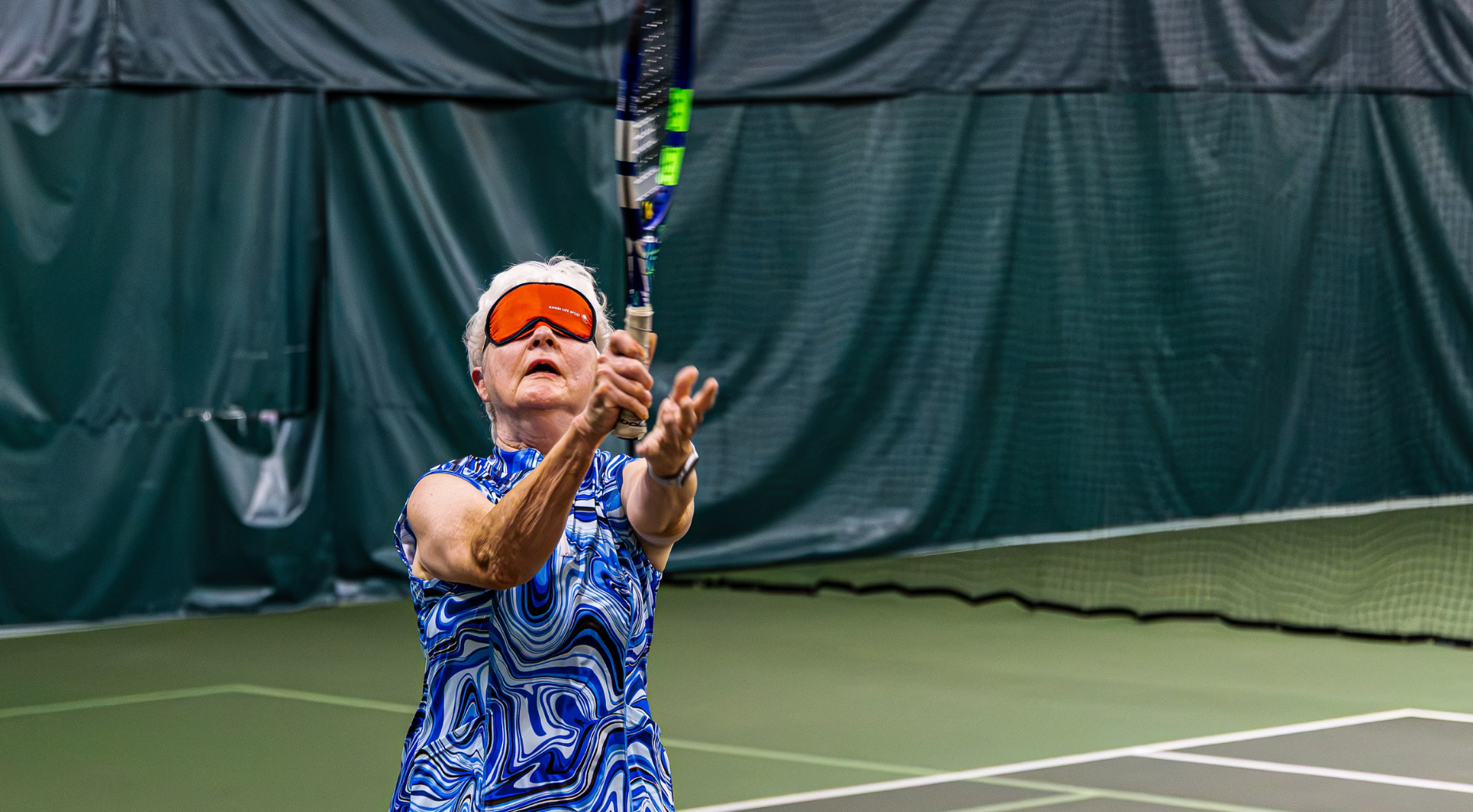
In their first drill, the tennis players didn’t swing their racquets. They just worked their way around the court.
“Shuffle, shuffle, shuffle, shuffle … ,” coach Glenn McIntyre tells player Maggi Ostrowski during a clinic before the first U.S. Blind Tennis National Championship, held last Friday through Sunday on indoor courts at Brady’s Run Park in Brighton, Beaver County.
With her racquet and her sneakered feet, Ostrowski, of Bellevue, felt for a raised, tactile out-of-bounds line.
“Back, back, back, back … ,” says McIntyre. “There it is! There you go!”
The championship drew 18 players and several coaches and volunteers from Greater Pittsburgh, Mississippi, California, Mexico and elsewhere, despite storms that delayed some flights. The players were eager to up their game at Brady’s Run and promote it back home, recruiting more opponents and sharing its benefits.
“I want to set an example for other people to get moving,” says player Vencer Cotton.
Enthusiasts says that the sport boosts fitness, balance and coordination, which can be challenges for people with low vision. They also called it great fun with great company.
“I used to be shy. It’s opened a lot of doors,” says Dante Alejandro, who plays on a top team, sometimes overseas. “I like teaching others about the sport. You show them it’s not so hard after all.” He says that top players can exchange 20 pairs of shots or more during a point.
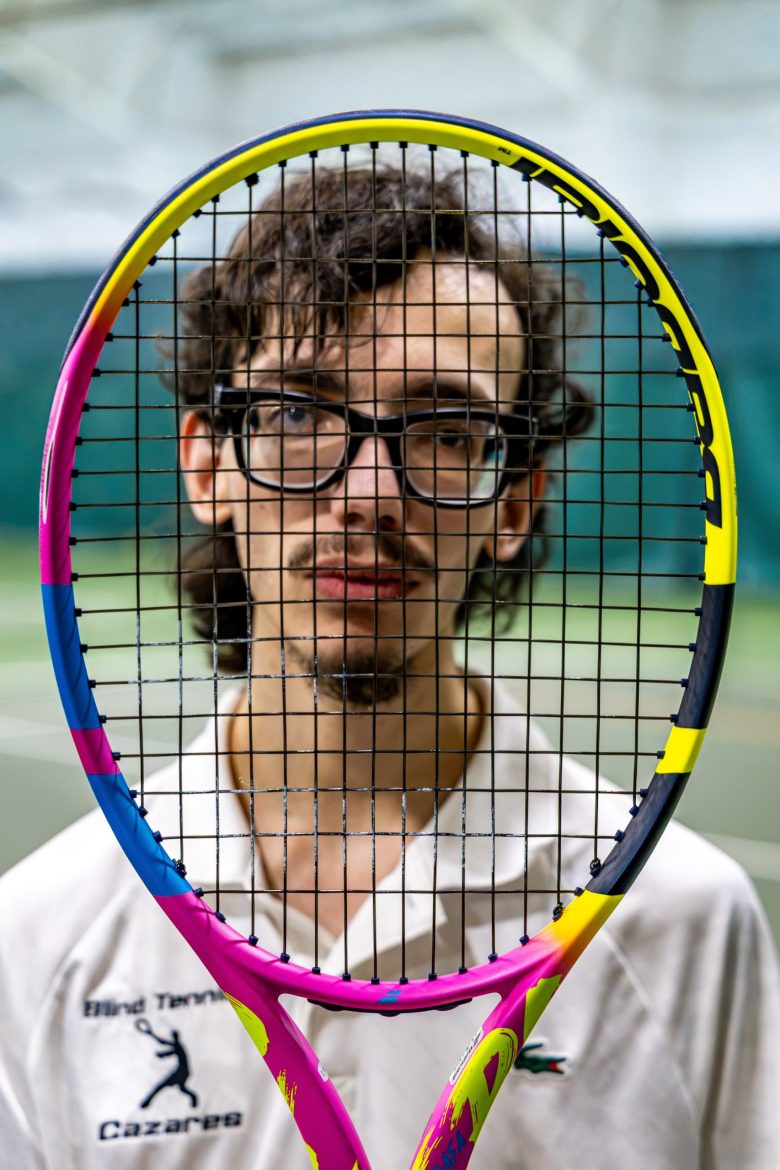 Dante Alejandro of Rio Grand Valley, Texas, holds a Top 10 International Blind Tennis Association world ranking. He came to Pittsburgh to play in this past weekend’s tournament. Photo by Rob Liggett.
Lisa Cornack’s declining vision was still a little too strong to compete for the championship, but she came for the clinic and some unofficial games. “I’m working and playing with people who I will end up becoming,” she says. “It’s very empowering to learn that, as my vision declines, I’ll still lead a full, active life.”
Pittsburgh leads in blind tennis
Pittsburgh was chosen for the championship’s premiere because it’s a national leader in the sport, says Murray Elbourn of Spokane, Wash., president of the U.S. Blind Tennis Association. The city’s Highland Park Tennis Club, which works to diversify tennis, added a version for blind players about seven years ago. Elbourn says that Highland Park was the rare club to keep blind tennis alive during the Covid-19 pandemic.
In 2024, prompted by club leaders, Allegheny County laid down what are believed to be the nation’s first permanent markings for blind tennis. They’re on one court each at Boyce, North, Settlers Cabin and South parks.
 Maureen Esposito makes moves for the ball at the U.S. Blind Tennis National Championship. Photo by Rob Liggett.
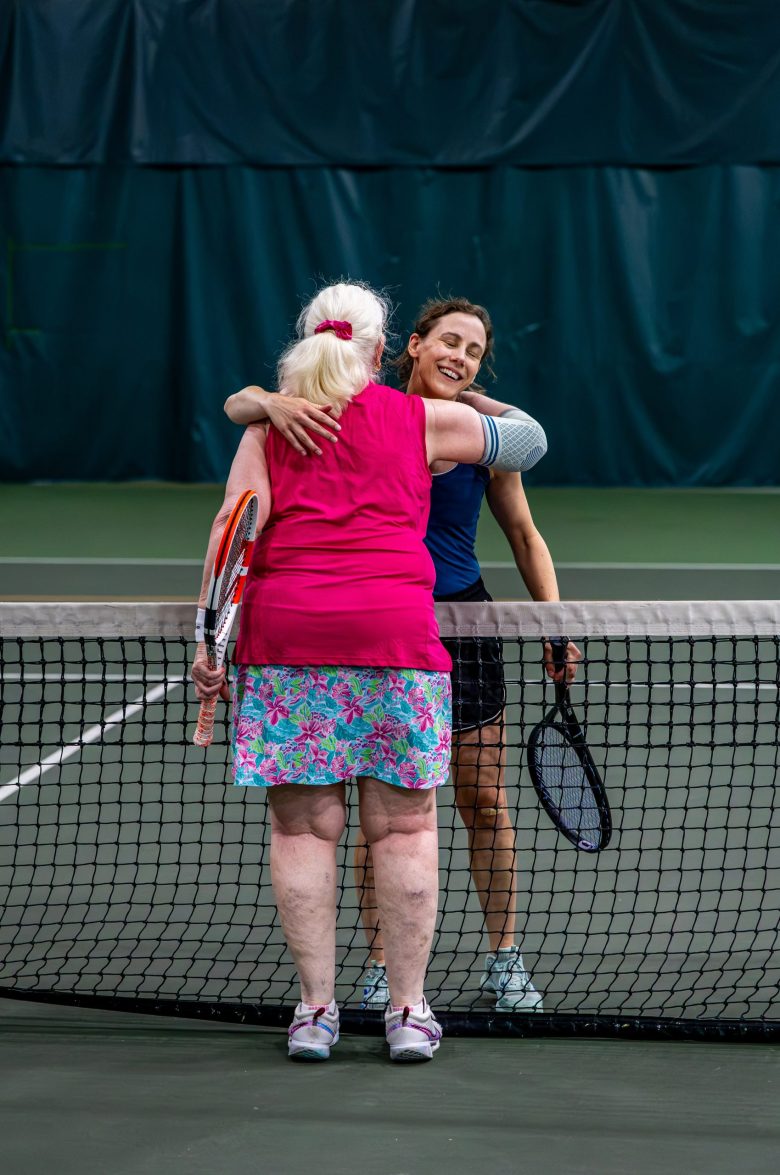 Maureen Esposito hugs coach Dana Aravich after a match. Photo by Rob Liggett.
Blind tennis was invented in 1984 by Miyoshi Takei of Japan with slightly bigger, softer balls than in mainstream tennis. They rattle when struck or bounced, revealing their locations.
The championship’s players were grouped by gender and three levels of vision. The levels used different court sizes, net heights and rules. For instance, the players with lowest vision could return a shot after three bounces.
The International Blind Tennis Association was formed in 2014 and its U.S. counterpart in 2022. The USBTA has more than 500 members and runs programs for about 4,000 players per year.
Several of the weekend’s players and coaches work in related fields, and two such Pittsburghers hold national offices. Dana Aravich, the USBTA’s vice president, is an occupational therapist helping patients with low vision. Jennifer Roth of East Liberty, the USBTA’s secretary, is a psychology professor at Carlow University who researches the sport and invented the type of lines used for the championship. She has also patented balls that make noise longer than the current kind, but has not found a manufacturer yet.
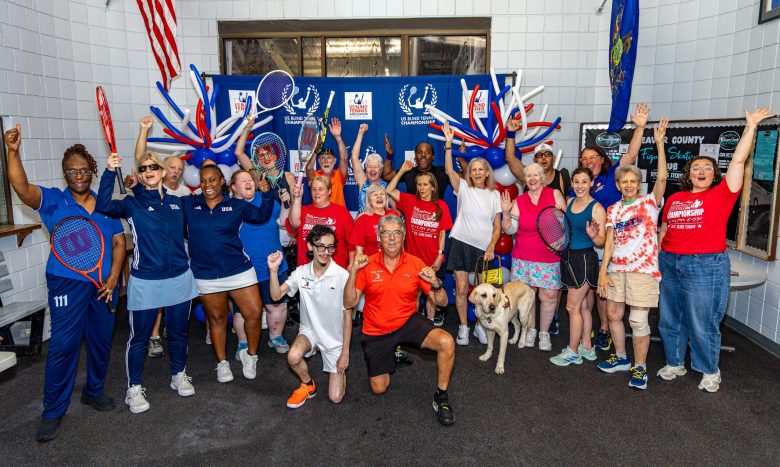 Players and event organizers celebrate the results of the blind tennis tournament at Brady’s Run Park in Brighton, Beaver County. Photo by Rob Liggett.
Trophies and pride
The Highland Park Tennis Club normally hosts blind tennis outdoors at its namesake park and indoors at the South Side Market House. Indoor players have an easier time hearing the ball.
The club supplies equipment and lessons for free. It will announce its fall schedule soon.
The USBTA’s Elbourn says he hopes to stage five tournaments next year that give out points toward a championship. He promises that one of the tournaments will be in Greater Pittsburgh, with a date and a site to be determined.
At Brady’s Run, no prize money was at stake, just trophies and pride. Several players doubled as coaches, helping players with weaker sight. A couple of volunteers practiced while wearing dark glasses to better understand the sport’s challenges.
 Shannon Dillion came from Southern California to participate in the tournament. Photo by Rob Liggett.
When the time finally came to swing racquets, coach Roth tells the lowest vision group, “The ball is going to be very low. Keep that racquet low. Have your strings facing upwards. You’re going to do a scoop shot.”
“Sweet!” McIntyre cries after a shot. “That was unreturnable! Guaranteed points!”
They also preach positivity. “You punished yourself after a shot,” Roth says to a player. “You did a quick ‘Ugh!’ You’re going to lose a split second of recovery time. Skip that. Learn from your errors later, not on the court. Just joyfully play.”