
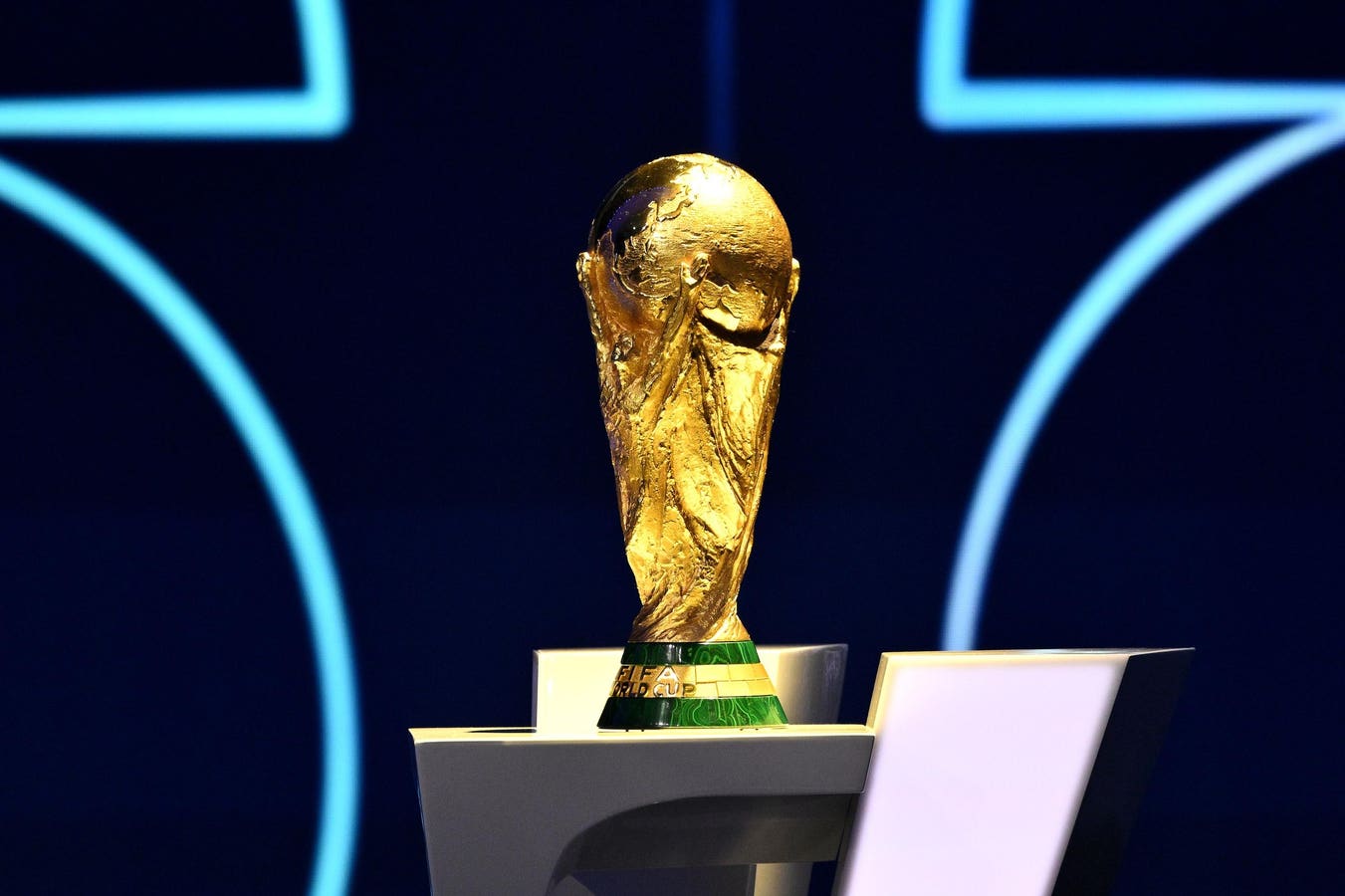
WASHINGTON, DC – DECEMBER 05: FIFA World Cup Trophy is displayed during the FIFA World Cup 2026 Official Draw at John F. Kennedy Center for the Performing Arts on December 05, 2025 in Washington, DC. (Photo by Mandel NGAN – Pool/Getty Images)
Getty Images
The 2026 World Cup drew 174.3 billion illegal stream views. Ninety-five percent of them carried advertising for unregulated gambling, according to Gaming Compliance International, which monitored pirate feeds across the tournament.
“What surprised us most, though, was not an individual match,” Ismail Vali, president of Gaming Compliance International, wrote in responses to questions before the report’s release. “It was the sheer consistency and scale of the relationship between illegal streaming and unregulated gambling.”
A qualifying view means at least 90 seconds of watching, and it counts stream views, not unique viewers. The tournament averaged 1.68 billion such views per match. “There were extraordinary peaks,” Vali wrote. The Spain-Argentina final drew 6.2 billion. Even the England-France third-place match pulled 2.0 billion.
“When 95% of qualifying illegal stream views carry advertising for unregulated gambling, illegal streaming is not simply stealing content,” Matt Holt, GCI’s chief executive, said in a statement. “It is providing one of the world’s largest sporting audiences as an acquisition channel for the unregulated gambling economy.”
A Cut Of The Losses
Before the tournament, Vali predicted $593 billion would be wagered on the World Cup online, $409 billion of it unregulated. He also predicted Spain would win. Spain won. “It is still too early to make a definitive assessment of the $593 billion estimate,” Vali wrote. “What is already clear is that this was a record World Cup for regulated gambling, and everything we are seeing tells us it was an even bigger event for unregulated and unacknowledged gambling.”
Play Puzzles & Games on Forbes
The commercial engine is the affiliate deal. “Illegal streaming sites can receive affiliate payments for referring customers to unregulated gambling operators, with arrangements we observe offering between 25% and 50% of the net gaming revenue subsequently generated by those customers,” Vali wrote. “The illegal streamer doesn’t simply receive payment for showing an advert. It can participate in the gambling losses of the viewer it converts into a customer.”
The operators buying that exposure go beyond offshore sportsbooks. GCI’s report found sweepstakes casinos, social casinos and prediction markets operating outside the U.S. advertising across illegal streams. “Unregulated gambling is sustained by an ecosystem, not a website,” Vali wrote. That economy runs to $5.9 trillion a year by GCI’s count and settles heavily in crypto, on stablecoin rails that power offshore casinos and in America’s $67 billion shadow betting market.
“We need to understand and disrupt the ecosystem: the money, product supply, affiliates, advertising, search, social media, hosting, streaming infrastructure, payments and other supply-chain services that allow illegal streamers and unregulated gambling operators to acquire and monetize consumers,” he wrote.
Crypto’s own freeze lists show how leaky that plumbing is. “There was a case where Israel government seized some wallets in their official documents,” Dmitry Machikhin, founder of crypto compliance firm BitOK, said in an interview. Exchanges were supposed to block them. “But this didn’t happen,” he said. Blockchains that Tether watches less closely remain, he added, “kind of a safe haven.”
One Marketplace
Fans said online that the BBC’s stream buckled during the England-France match. “I would be careful about attributing that directly to the BBC outage,” Vali wrote. “Our data establishes the scale of illegal streaming around a match; it does not establish that a particular proportion of those views migrated specifically because a legal streaming service failed.”
“There were some shifts in that match, but that happens in all matches,” Vali said in an interview. “So I can’t look at the one match and say, oh, for definite, that happened because of the crash at the BBC.”
“Consumers experience one marketplace. They don’t think in terms of a legal streaming sector and an illegal streaming sector. They want to watch the football,” he wrote. “The danger is what happens next. Displacement can become replacement.”
Vali also described a tactic the report leaves out: denial-of-service attacks on broadcasters’ streaming platforms, surfacing in chatter on criminal forums during the tournament. “A lot of those people suffered denial of service attacks during the period of the World Cup,” he said. “Didn’t report it widely at all, but there’s lots of chatter about it on criminal forums.”
The tactic makes commercial sense to him: “you can basically attack a platform. They can’t serve the content that’s exclusive to them.” He saw the extortion version in his poker years, when denial-of-service attacks hit before PokerStars’ big Sunday tournaments. “I can’t say there’s a smoking gun there yet,” Vali said.
The Myth Of Mister Big
StreamEast, the biggest name in pirate sports, was taken down in raids in September 2025. “StreamEast is not dead. StreamEast is alive and well,” Vali said. That takedown involved the Alliance for Creativity and Entertainment and Egyptian authorities; GCI’s report says the brand and its copycats rebuilt their audience during the World Cup.
“You can’t be going after these individual URLs, and you can never believe in this myth of Mister Big,” he said. “What you have to look at is the ecosystem and what facilitates that ecosystem.”
FIFA brought betting brand Betano on board as a sponsor this cycle, but Vali argues the pirates still out-innovate on product. He rattles off the consumer’s view of an illegal service: “It’s HD 4K. It’s got all the feeds I need. Never falls over.” “It’s not picture with odds, and there’s more and more of that happening in illegal streaming,” Vali said. “So it’s almost like the legal stuff is playing catch up with the innovation that’s coming from the illegal sector.”
“Crime does not need to create the football, own the rights or stage the World Cup. It simply needs to steal the content, capture the audience and monetize both,” Vali said in the statement accompanying the report. “And what does crime do with the money it makes? It makes more crime.”