

We are knee-deep in preseason prognostication time, a silly annual ritual where I put my name beside a bunch of predictions — which will inevitably prove to be wildly off — and broadcast them to the world.
And I often share them in multiple articles and podcasts, all of which live on the internet forever.
But I’d rather be immortalized for that than be a Heisman winner who permanently blowtorched my relationship with my former school due to a petty grievance over a jersey number.
In the long history of the 12-team Playoff, only four teams have made back-to-back appearances (Ohio State, Indiana, Oregon and Georgia). If we use this ongoing trend for 2026, which four teams from last season’s Playoff do you feel most confident will return? — Ryan S
No. 1 on my list would be Miami, mostly because the Canes are a level or two above everyone else in their conference. Even if they lose at Notre Dame, they could get in either by running the table in ACC play or losing once but winning their conference championship. (Because each Power 4 champion is now guaranteed a berth).
Next up: Indiana. The Hoosiers’ conference schedule is tough but not suffocating. Their floor is 10-2, which would require winning two of four against Ohio State, at Michigan, vs. USC and at Washington, which seems very doable. And they’re getting in at 10-2.
Then Ohio State, though a bit cautiously. If the Buckeyes lose at Texas in Week 2, they won’t have much wiggle room against a Big Ten schedule that includes games at Indiana, Iowa and USC, and home against Oregon and Michigan. But when’s the last time Ohio State failed to go at least 10-2? (The answer is 2011.)
The last one is tough. I believe Oregon, Notre Dame and Texas can all win the national championship, but their schedules are tricky for different reasons. The Ducks and Longhorns face daunting slates. One or both could go 9-3. Conversely, the Irish’s schedule looks so light they could get left out again if they lose to both Miami and BYU.
But here’s the thing: There is going to be at least one 9-3 Big Ten or SEC team in the Playoff this year, because the SEC’s ninth game will depress those teams’ records. And I would be shocked to see a 10-2 ACC/Big 12 team get in above a 9-3 Big Ten/SEC team with at least a couple of big wins.
So give me Oregon, which means a three-peat for the Hoosiers, Buckeyes and Ducks. Georgia could certainly join them. But the difference between Texas/Georgia and the next four or so teams in the SEC feels thinner than the gap between Indiana/Ohio State/Oregon and the rest of the Big Ten.
Why History Hates Ohio State This Year
Stewart Mandel and Ralph D. Russo
Hey Stew, last year I asked you a question that you (eventually) answered, so I thought I’d pose the same question for this season.
If you want to attend the best game every week this season, but it can’t involve a Big Ten or SEC team, and you can only go to each stadium once, where would you go? — Ryan W.
I regret that I initially blew off your question, because I enjoyed compiling the answer. So, I’m happy to write a 2026 edition.
Aug. 29: NC State at Virginia. Thankfully, they relocated this one from Brazil, so we can open ACC play on campus. Do the Cavaliers have another 11-win season in them?
Sept. 3 (Thursday): Colorado at Georgia Tech. It’s a prove-it game, both for Deion Sanders coming off 3-9, and for new Yellow Jackets QB Alberto Mendoza.
Sept. 12: Memphis at Boise State. I love the Broncos’ backfield tandem of Dylan Riley and Sire Gaines. And you don’t have to sell me on a trip to the Blue.
Sept. 19: SMU at Louisville. Two of the ACC’s three ranked teams meet early. We know all about SMU’s Kevin Jennings, but what about Louisville’s Lincoln Kienholz?
Sept. 26: Oklahoma State at West Virginia. These could be the two most improved teams in the Big 12. And the final score could be 59-56.
Oct. 3: Miami at Clemson. While I’m pessimistic about Clemson, this will still be one of Miami’s bigger games. Also: The Tigers running down The Hill never gets old.
Oct. 10: North Dakota State at UNLV. I’ve got to catch the Bison during their first FBS season, and watching them in Sin City against the Mountain West’s preseason favorite works well.
Oct. 17: Notre Dame at BYU. How great for BYU that Lincoln Riley’s “no Notre Dame after Week 2” gimmick opened the door for the Irish’s first visit to Provo since 2004.
Oct. 24: Texas Tech at Cincinnati. Call it the Brendan Sorsby Revenge Game — I cannot wait to see how the Bearcats’ student section comes out for this one.
Oct. 31: Miami at North Carolina. I can’t imagine a better Trick-or-Treat scenario than Bill Belichick trying to ruin Miami’s Playoff chances.
Nov. 4 (Wednesday): Toledo at Sacramento State. As a Bay Area resident, why not drive two hours and catch a #MACtion game? (Yes, this is a ridiculous thing.)
Nov. 7: Miami at Notre Dame. Easily the no-Big Ten/SEC Game of the Year and a perfect opportunity to take in The Grotto and Touchdown Jesus.
Nov. 14: My own Big 12 flex week. I’m going to exercise a 12-day window for either Texas Tech at Oklahoma State, Utah at Arizona or Houston at Colorado.
Nov. 21: Stanford at Cal. It’s alums on both sides of the Big Game now with the schools’ new coaches, Cal’s Tosh Lupoi and Stanford’s Tavita Pritchard.
Nov. 28: The Pac-12’s flex week. This is an actual thing for the league. Potential matchups include San Diego State at Fresno State or Boise State at Utah State.
Dec. 5: American championship game. I’m safe here because I didn’t hit any of their campuses during the season. Navy? Memphis? UTSA? East Carolina?
Dec. 12: Army-Navy at MetLife Stadium. Maybe they’ll let me borrow a tank to navigate the New Jersey Turnpike.
Stew: What do you think of the state of the Michigan vs. Ohio State rivalry? Kyle Whittingham said at Big Ten Media Days he doesn’t hate Ryan Day. Then backtracked to talk about the intensity of the rivalry. But then Day changed Senior Day to Week 1 to avoid distractions before The Game. Are these guys the most normal coaches in the rivalry history or is this a modern way this rivalry has changed? — Patrick
No one would call either of those guys normal, especially Whittingham. The Day comment doesn’t surprise me, because that’s just how he talks, but Big Ten fans are only now finding that out because they weren’t watching Utah the last 20 years.
The rivalry was bound to soften a bit post-Jim Harbaugh, because how could it not? He did more to fan the flames than any coach of those schools since Woody and Bo, first by saying Day was born on third base; then by beating the Buckeyes three times in a row; and by hiring Connor Stalions, who upped the nastiness by about 10 times.
But also, let’s not forget that for three years in a row, from 2021-23, Ohio State and Michigan met as top-five teams, including 11-0 vs. 11-0 in both 2022 and 2023, with four-team CFP berths on the line. The Buckeyes were ranked higher in all three meetings, and the Wolverines won all three. You can’t ask for better drama than that.
The stakes cooled considerably the past two seasons with Michigan out of Playoff contention and Ohio State safely in the 12-team field both years (even after suffering a second loss in that inexplicable 2024 game). Realistically, you’re not going to get many win-or-go-home meetings going forward. Not that it lessens the stakes for the two fanbases, but it might feel a twinge less heightened nationally.
It shouldn’t be controversial that Whittingham played nice about Day. Has any coach in recent history come out and said they DO hate the opposing coach? But it probably put Michigan fans on alert for signs their new coach doesn’t care enough about the rivalry. As in, when he said the following week, “Do we have a better chance to win if I hated them?” Before going on to say, “It is a huge game. Gigantic. And it’s something that we all have in the back of our minds 24/7.”
All of it is juxtaposed against Day deciding the game is too important to let the seniors walk out with their parents for five minutes beforehand.
If the Wolverines win in Columbus this year, all this will seem like ancient history. If they lose, though, I’m sure people will accuse him of not hating Ohio State enough.
Curt Cignetti does not shy away from conflict, as seen at Big Ten Media Days with his SEC jabs, and now with his scheduling comments about Notre Dame. If he keeps winning in January, it won’t matter who he schedules in September. But if you are going to go out of your way to not schedule any P4 non-conference opponents, why cancel a series with Notre Dame and then say you’d love to play them? — Luke W.
Cignetti is becoming this generation’s Steve Spurrier. Zingers galore. To which I say, keep ‘em coming.
But the Notre Dame line was poorly constructed. No one believes that he actually believes the Irish should play a 2-for-1 with the Hoosiers. I guess it was supposed to be a dig about ND being an independent, but it’s an independent that handed Indiana its most recent loss in the 2024 CFP, and did so decisively. So the punch fails to land.
Here are some alternative versions I came up with:
“We’re the 2025 national champions. Why would we bother playing someone that hasn’t won it since the ‘80s?”
“We’re a national brand now. We don’t need more games in Indiana.”
“You disrespect the Pop-Tarts Bowl, you disrespect us.”
None of which would excuse the fact he ducked Notre Dame. But just like Spurrier in the “You can’t spell Citrus without U-T” days, you get to talk smack when you win a lot.
Stew, how high (or low) would you be on Texas Tech if the Brendan Sorsby situation never came to light and he started for them this season? What do you think that team’s ceiling or realistic outcome would be? — Asher
I’d be higher than I am now, for a couple of reasons. 1) Sorsby wasn’t Peyton Manning, but he would have been an upgrade from Behren Morton. But perhaps more so: 2) I fear the upheaval from that whole episode could negatively affect Tech’s season.
Players don’t “block out the noise” as much as coaches would have us believe. Ten days after the Red Raiders left the field at the spring game, their QB1 went into rehab for a gambling addiction. Sorsby’s status was in limbo for nearly two months, and then when he got that injunction in early June, he and the program became the pariah of college football. That’s a lot of noise for guys to deal with while preparing for a season.
Football-wise, though, I’m fine with Will Hammond as Sorsby’s replacement, and the Red Raiders will be the Big 12’s most talented team again. The offense could be better, both up front and in the backfield, where former USC transfer Quinten Joyner is back after missing last season.
But it’s unrealistic to think their defensive front can lose five NFL draft picks — including No. 2 overall pick David Bailey and fellow All-Americans Jacob Rodriguez and Lee Hunter — and still be that dominant. They did retain another likely All-American, DT A.J. Holmes Jr., and brought in a pair of productive G6 pass-rushers in Trey White (San Diego State) and Adam Trick (Miami of Ohio). But last year’s unit was the best in the country. This one could be very good and still not come close.
Don’t take this as me saying Tech is going to collapse without Sorsby. I probably would have picked them to go 10-2 before that, and this week I said 9-3.
What do Big Ten teams have to fear from Indiana other than their head coach and their new QB? Is it enough to put them in the Playoff, really? — Jeffrey A.
I can’t tell if this is satire? Either way, the new QB, Josh Hoover, is actually the Hoosiers’ biggest question mark. It’s the rest of the team the Big Ten should be very concerned about. Especially the offensive and defensive lines, the three-headed rushing attack (Khobie Martin, Lee Beebe Jr. and Boston College transfer Turbo Richard) and the receivers (2025 breakout star Charlie Becker, Tyler Morris and Michigan State transfer Nick Marsh).
There’s also been a notable under-the-radar development in Bloomington this month.
When I visited an IU practice this spring, I was struck most by their pass rushers, led by Kansas State transfers Tobi Osunsanmi and Chiddi Obiazor, who joined Notre Dame transfer Josh Burnham and returning D-tackles Tyrique Tucker and Mario Blandino. Well, that unit may soon be even more loaded.
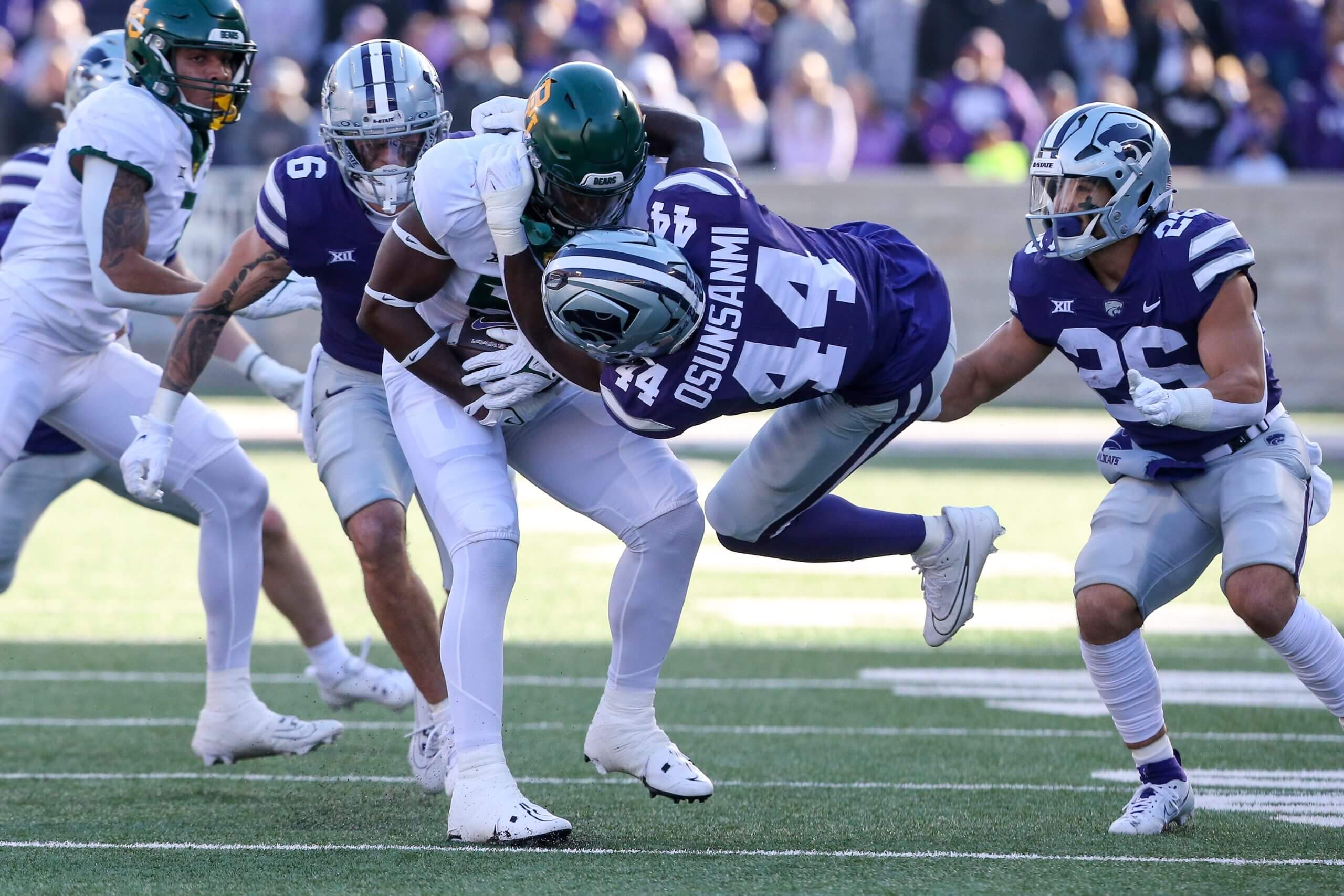
Kansas State transfers Tobi Osunsanmi and Chiddi Obiazor are major additions to the Hoosiers’ defensive front. (Scott Sewell / Imagn Images via Reuters Connect)
You might be aware by now that a federal judge in Colorado recently issued an injunction granting class of 2022 recruits a fifth season. While most schools are in a holding pattern pending the NCAA’s appeal, Indiana wasted no time welcoming back departed seniors Stephen Daley, who led the Big Ten in TFLs last season (19.0) despite missing the entire CFP run, and former starter Kellan Wyatt, who had 8.0 TFLs in seven games before suffering a season-ending knee injury. Neither guy was drafted or signed as a free agent, so both should be eligible if the ruling stands.
Good luck to opposing offensive lines if that happens.
OK Stewart, there has been a lot of debate about this in the comments; settle it for us once and for all. Are you biased toward the Big Ten or the SEC? — Brian S.
I think it’s more accurate to say I’m biased against both of them. No one has yet instructed me as to which league I’m supposed to favor instead of them.
Hoping, based on The Athletic’s article this week on agents, that it is not too late for off-the-field questions.
I’ve always read that universities are against their athletes being employees of the schools, despite their newly professionalized status. But I’ve never seen an enumeration of why they are against this? It would seem like the quickest route to collective bargaining, that golden land where all solutions seem doable. — David T.
First of all, read that agent article by Adam Kilgore and Zak Keefer on uncertified college NIL agents. Some of the quotes will blow your mind.
The issue David raises is extremely complicated, but it mostly boils down to this: Schools fear it will bankrupt their athletic departments. And they’re probably not wrong, especially at the lower levels.
Imagine if an edict came down from above tomorrow that says college athletes must be treated as full-time W-2 employees. It would not apply just to football and basketball. The average FBS athletic department sponsors around 20 sports (the NCAA minimum is 16) and comprises around 500 athletes. The federal minimum wage is $7.25 per hour, though many states set it much higher. For simplicity’s sake, let’s put it at $10 an hour across the board. Multiply that by 500 employees working 40 hours a week for 48 weeks a year. That’s nearly $10 million a year in payroll. Throw in employer taxes, unemployment, and workers’ comp, and the total comes out to about $11.5 million.
Every Power 4 school could afford that. The problem is it’s the same cost for every single NCAA member at every level. Would the smaller schools cut football? Keep football but cut most other men’s teams? (Title IX is still a thing.) Get rid of varsity sports entirely?
Or, there’s another dire option for everyone above Division III: No more scholarships. The top 2 percent of athletes making big NIL money might not care, but it would be devastating to the other 300,000-plus for whom a scholarship is worth far more than minimum wage. And it’s not like they could choose one or the other if it’s the law.
We are many years from this scenario becoming reality, due to a myriad of complications. But if I were running college athletics, I would try to be proactive rather than reactive for once and start devising a collective bargaining system that heads this off.
Do you get all amped for the start of the season like most fans do? Or because it’s your job, do you just have 365 days of numbness, never too high, never too low? — Todd B.
I’d say covering lawsuits, Senate bills, gambling scandals and private equity deals has left me numb for about 350 days a year.
But you know that hour-or-so window on 15 fall Saturdays, when all the 3:30 p.m. ET games are coming down to the wire at the exact same time, and the primetime games have already kicked off?
That’s when I feel the most alive.