

DULUTH — The future of the former Lester Park Golf Course is coming into focus.
On Monday, the city council will consider a resolution accepting a
produced by city staff that recommends development on the southernmost 63 acres of the former golf course while keeping the remaining 207 acres as natural and recreational areas.
An amendment to the resolution would reject a recommendation made last week by the Planning Commission that sought to keep the door open to development across the entire 270-acre site.
City councilors did not entertain the recommendation during the Thursday evening committee of the whole meeting, sticking instead to what the city’s study suggested.
“We’re going back to just accepting what the land use study is,” said Council President Lynn Marie Nephew.
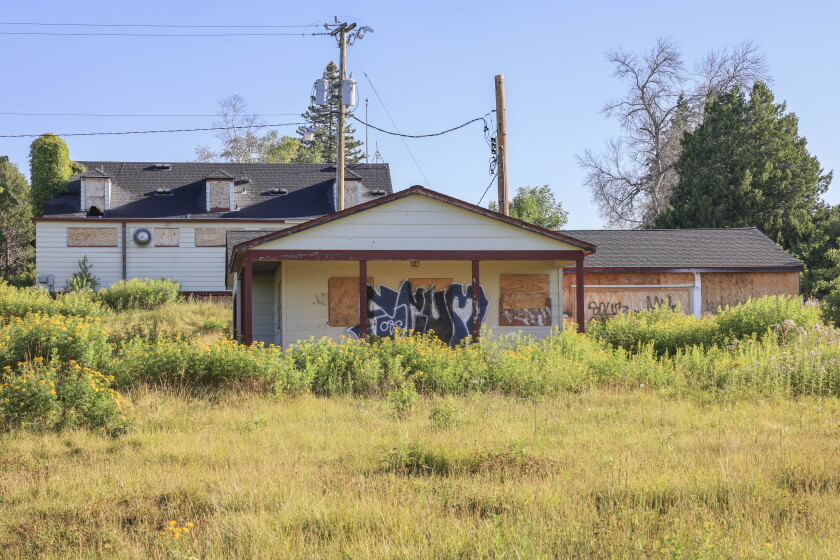
The clubhouse and cart garage at the Lester Park Golf Course on Aug. 5.
Clint Austin / Duluth Media Group
The potential development of the former golf course, idled since 2019, has been controversial, and the council’s decision will follow
asking voters whether the property should be rezoned to allow such development.
The Duluth Economic Development Authority already controls 37.5 acres of land on the lower side of the golf course but adoption of the land use study would allow for adjacent land to the north to be transferred too, bringing DEDA’s total area of developable land to 63 acres.
“The original agreement was to transfer all land that was developable to DEDA,” Ben Van Tassel, director of Duluth’s planning and economic development department, told councilors Thursday. “We are now at the stage of deciding on what is developable. It’s the lower quarter of the site, approximately 60 acres.”
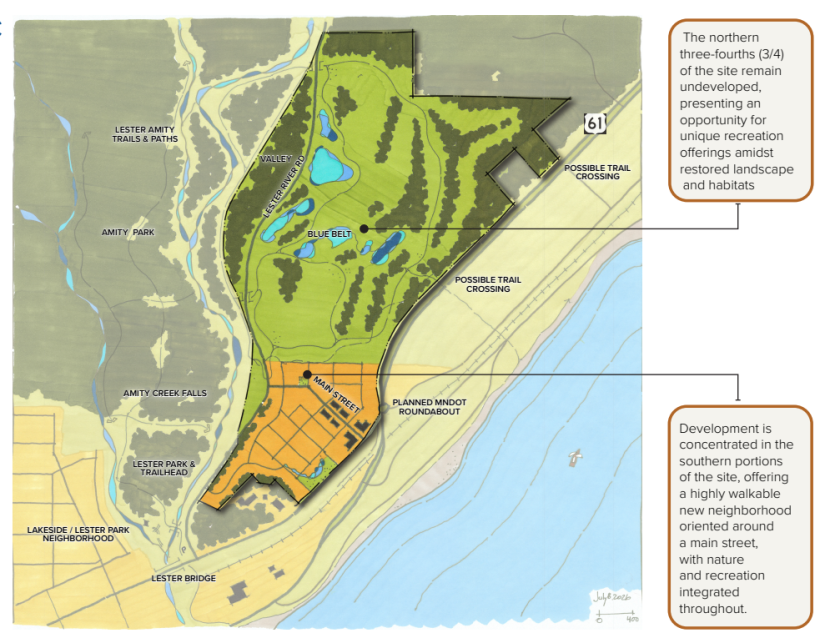
A map in the city of Duluth’s Land Use Study and vision plan shows plans to develop the lower 63 acres but maintain the rest as park and open space.
Contributed / City of Duluth
The 63-acre boundary ends at about 760 feet in elevation, which is as high as the current water system could support. Beyond that, the cost for building infrastructure to support the pumping and storage of water to higher elevations becomes too steep, according to Mike Thompson, a principal urban planner and designer with Bolton & Menk, who worked on the study.
Most of the lower portion of the former golf course is already zoned as a mixed-use neighborhood, but some of it would need to be rezoned ahead of development. The city sees potential for 700-900 housing units and several restaurants in that area.
The remaining 207 acres would remain under city ownership. It would also be zoned as park and open space, though much of it already is zoned as such, Van Tassel said.
The open space’s future use would be determined by the city’s parks and recreation department, which will be charged with determining what is possible with funding and what would fit well with any proposed development in the lower area, Thompson said.
“We didn’t want to preempt or make any potential promises that couldn’t be fulfilled in terms of what those uses should be, and rather reserve the right for the (parks and recreation) department to go through the proper master planning process,” Thompson said.

Jimmy Lovrien covers the City of Duluth, environment and Minnesota’s 8th Congressional District for the Duluth News Tribune. He can be reached at jlovrien@duluthnews.com or 218-461-9718.