
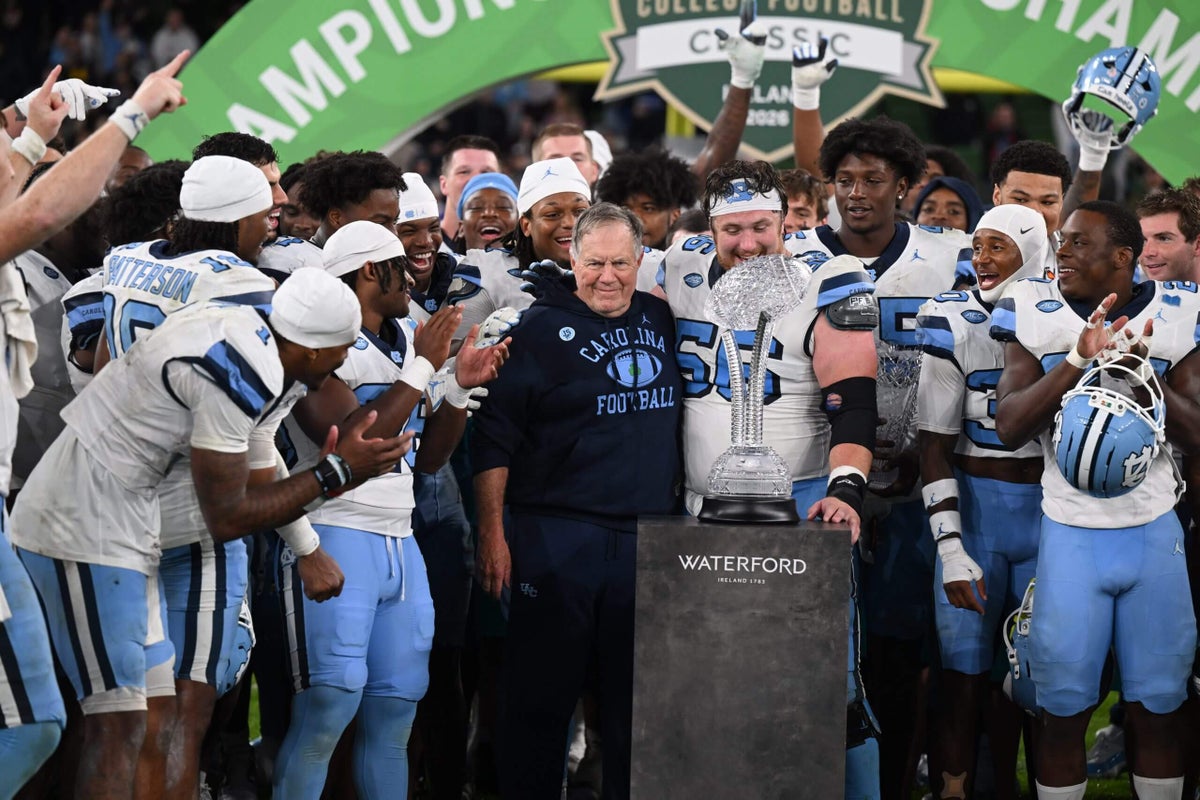
After spending much of Bill Belichick’s first season dealing with public embarrassments, North Carolina opened Year 2 by pulling off an upset against a team that beat the Tar Heels by 34 a year ago.
The Tar Heels outlasted TCU 15-10 on Saturday in Dublin, Ireland, with a defense that repeatedly bent without breaking, two field goals, a safety and just enough offense from journeyman quarterback Billy Edwards Jr. and new offensive coordinator Bobby Petrino.
“Happy to start the season off on the right note,” said Edwards, whose 2025 season at Wisconsin — the third of his four college stops — was cut short by a knee injury. “We got a lot of stuff to clean up, but at least we can do it in the victory column.”
TCU entered the first game of the FBS season as a 9 1/2-point favorite but gave the game away with 11 penalties for 100 yards, poor red zone execution, and failed fourth-down attempts. North Carolina lost two fumbles and outgained the Horned Frogs 322-312 on a sloppy, wet field.
UNC looks like totally different team in win over TCU
David Ubben and Jayne Orenstein
Here’s what we learned:
UNC sets a new tone
Around the time TCU scored its 41st consecutive point in last year’s opening game on UNC’s home field, excitement from the start of the Bill Belichick era had devolved into punchlines the Tar Heels never fully outran. Letting a Clemson team that finished 7-6 run up a 28-3 first-quarter lead in Chapel Hill a few weeks later didn’t help, either.
There’s still a lot to prove, but Saturday’s opener sets a very different tone for Year 2 under Belichick after another offseason of distractions, including general manager Michael Lombardi being put on administrative leave. The schedule is more difficult this time around with games against teams like Notre Dame and Miami, but Saturday’s debut in Dublin showcased a base-level competency that was absent in the first month of last year’s 4-8 campaign.
The defense played without coordinator Steve Belichick (who is on medical leave) but firmed up against TCU’s running game in the second half, and at times the pass rush embarrassed TCU’s offensive line. The offense wasn’t explosive and struggled in the red zone but was able to rack up 19 first downs and moved the ball more often than it didn’t. The Tar Heels also committed just four penalties for 25 yards, outperforming a mistake-prone TCU team on a slippery, rain-soaked field.
Beating TCU doesn’t make a season, but this time UNC didn’t start by setting fire to an offseason of anticipation. Instead, the Tar Heels offered reasons for optimism after an offseason largely devoid of them. — David Ubben
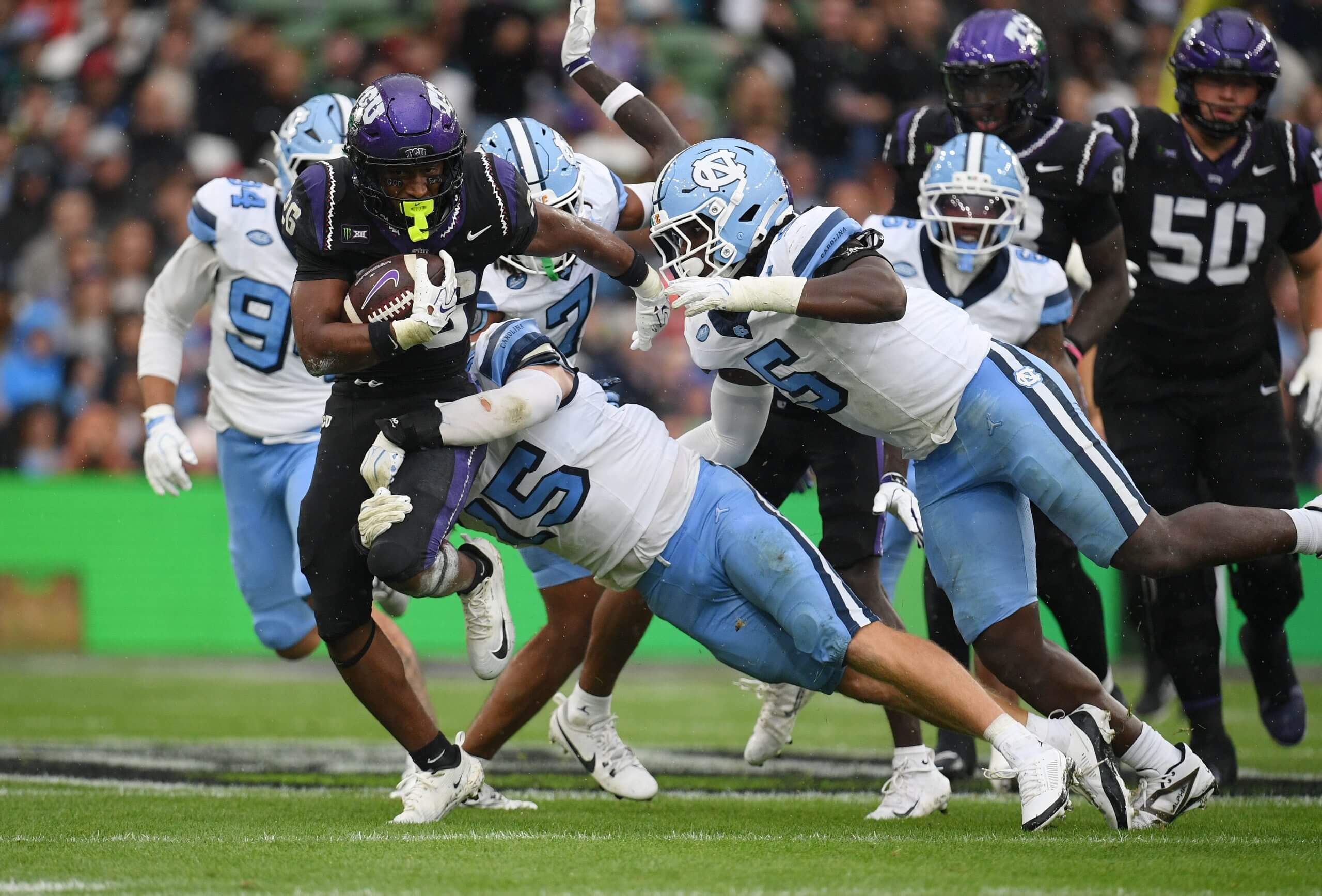
North Carolina held TCU to zero points after the first quarter Saturday. (Charles McQuillan / Getty Images)
How much of an upgrade is Petrino?
Petrino’s debut as Belichick’s offensive play caller didn’t produce a ton of points or yards, but it’s obvious North Carolina’s offense is headed in a better direction.
Petrino had success at his last stop, Arkansas, in taking a limited offense and rebuilding it around mobile quarterback Taylen Green. Despite going 2-10 last season, the Razorbacks ranked 23rd in scoring (32.9 points per game) and seventh in yards per play (6.94).
North Carolina ranked 120th in both scoring (19.3 points per game) and yards per play (4.94) last season with Freddie Kitchens calling plays.
Edwards — a well-traveled dual-threat quarterback with an injury history — isn’t on Green’s level as a playmaker. But the Wisconsin/Maryland/Wake Forest transfer proved to be more than serviceable in helping the Tar Heels get the win in Ireland, completing 16 of 28 passes for 232 yards.
North Carolina scored 10 points on its first three possessions in the opening quarter — something it accomplished only twice in the regular season last year (against Charlotte and Richmond). Petrino’s scripted opening drive was very good, including a 20-yard play-action pass to Ohio State transfer tight end Jelani Thurman on the first play. Edwards and Thurman hooked up four times for 94 yards. They resembled a new kind of connection that could become reliable.
At Arkansas, Petrino’s use of play-action, vertical routes, quarterback runs and multiple personnel packages consistently created explosive plays. The offense could move the ball, but the Razorbacks repeatedly undermined themselves with turnovers, sacks, penalties, empty possessions and a disastrous defense. North Carolina’s defense won’t be as bad as Arkansas’ was last year. — Manny Navarro
Tar Heels still have a lot to prove to justify Belichick hire
UNC fired Mack Brown after a 6-6 season and paid Belichick, his NFL legend replacement, $10 million annually — double what Brown made. Belichick, a six-time Super Bowl winner, has yet to show that value, and making a bowl game this season would be the bare minimum to show progress.
Brown’s teams qualified for bowl games in all six of their seasons and played for an ACC title in 2022. Belichick was hired to take the program to new heights, but last year featured wins over only Charlotte, Richmond, Syracuse and Stanford.
Saturday showed this team has made some major strides since its nightmare September a year ago, but there’s still a long way to go to rationalize a Belichick hire that’s brought far more troubling and embarrassing headlines than memorable wins to date. This TCU game provided one of the latter and can serve as a building block to flipping the bad vibes of the disappointing 2025 campaign. — Ubben
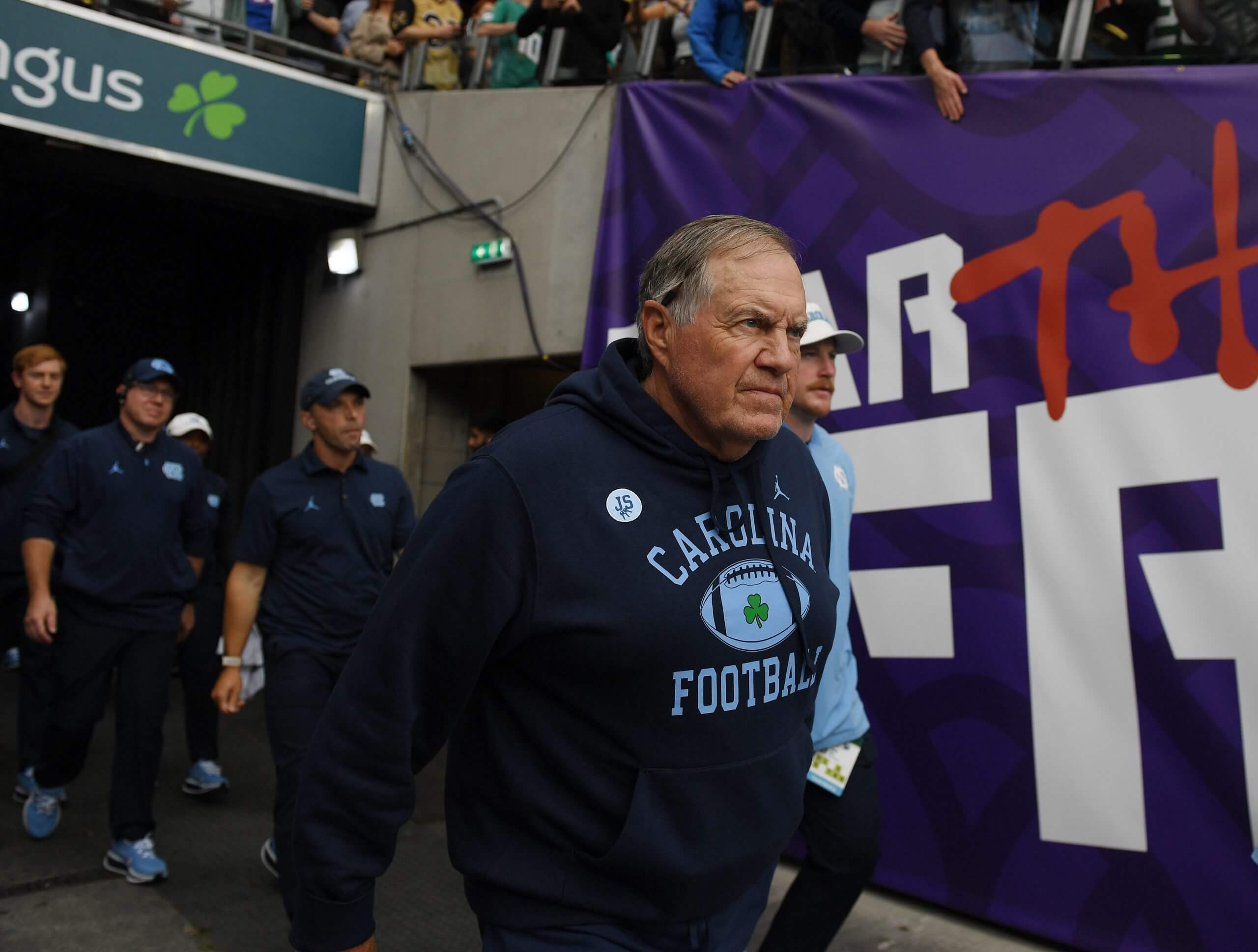
Bill Belichick improved to 5-8 as head coach at North Carolina by beating TCU. (Charles McQuillan / Getty Images)
What went wrong for TCU?
The Horned Frogs endured a lot of change on offense, bringing in a new offensive coordinator (Gordon Sammis, previously of UConn) and quarterback (Harvard transfer Jaden Craig).
In the first quarter, it all seemed promising. For the rest of Saturday afternoon, the Horned Frogs looked disjointed, taking one step forward and two steps back far too often to generate a cohesive attack. TCU scored 10 points on its first two drives, then failed to punch it in the rest of the day.
Running back Jeremy Payne (25 carries, 142 yards) served as the offense’s lone bright spot, and Sammis’ doses of pistol alignments set Payne and the offensive line up for a lot of ground success.
But Craig, who has had the eye of pro scouts, struggled at times with ball placement and occasionally looked indecisive. Ball security was questionable. He did show signs of why he appealed to TCU, showing off his mobility, arm strength and ability to throw on the run. But without leading receiver Jordan Dwyer, who missed Saturday’s game with an injury, there was no downfield passing game.
Pass protection also struggled, failing in three critical third-quarter moments: Left tackle Ben Taylor-Whitfield allowed Abou Jaoude to fly right by for an easy sack/fumble of Craig; the interior O-line couldn’t properly pick up a stunt on third-and-9 that led to a Craig intentional grounding near midfield; and when Dykes went for fourth-and-1 in the red zone, Payne never had a chance, met by a host of UNC defenders behind the line of scrimmage.
And though the run game performed admirably, the fact that TCU could never consistently threaten the Tar Heels’ secondary downfield made it that much easier for UNC to load the box and stop the run in key situations. The Horned Frogs need Dwyer back and a way to get something going downfield, whether that’s tight end Ka’Morreun Pimpton or someone else. And perhaps involving the athletic Craig in the run game could cure some of the offensive ills.
But if TCU’s offense looks anything like it did for the last three quarters against the Tar Heels, it’s hard to imagine the Horned Frogs, who went 9-4 last year, sniffing contender status in the Big 12. — Sam Khan Jr.
Should TCU regret its fourth-down decisions?
College football teams are growing more aggressive on fourth downs, especially in opponent territory, and TCU was a case in point on Saturday when it finished 1-for-5.
On two occasions with his team down 15-10, Sonny Dykes opted to go for it on fourth-and-short. Both times, the Horned Frogs failed.
Should he have settled for field goals instead?
Nothing is a given with college kickers, so it’s easy to say that settling for three each time changes the result (a 16-15 win instead of a 15-10 loss). In both cases, the call to go for it was understandable and defensible. The execution? Not so much.
On the first fourth-down failure, with 2:56 left in the third quarter, TCU gave the ball to Payne up the gut and the offensive line simply got beat. Credit to North Carolina’s defensive front, which had a stellar performance. Perhaps more creativity in the play call could have helped, but it’s hard to fault going to Payne in that scenario, considering how productive he was throughout the day.
On the second attempt — fourth-and-2 at the North Carolina 10 — time was of the essence. There was no guarantee the Horned Frogs would be in scoring territory again (UNC was able to close out the game with the ball on the ensuing possession). Craig, who was rolling to his left, missed Jeremy Scott in the end zone. If Craig kept it, he likely had enough speed to outrun the two UNC defenders chasing him and gain the two needed yards. Coaches and scouts laud Craig for his ability to keep his eyes up and escape the pocket to throw — not run — but he probably would have been better off tucking it and moving the chains in that moment.
More troubling than the fourth-down issues for TCU were the self-inflicted wounds. Dykes allowed the second-quarter clock to expire after a holding penalty, which prevented TCU from running another play or two before halftime. There was a late hit call when Edwards slipped and fell that cost TCU 15 yards. And in the game’s final moment, TCU jumped offside to allow the Tar Heels to run out the rest of the clock.
UNC gets TCU to jump on 4th & 1 to seal the deal 😤 pic.twitter.com/gaUKbiI37Y
— ESPN (@espn) August 29, 2026
The fourth-down decisions will spur questions, but it’s the sloppiness that TCU showed that should be most discouraging for Horned Frogs fans — and far too emblematic of issues that have popped up in recent years of the Dykes era. — Khan
What’s next for North Carolina?
The Tar Heels are off next week before their Sept. 12 home opener against East Tennessee State. They enter a tough stretch afterward, including at Clemson on Sept. 19 and. vs. No. 4 Notre Dame on Oct. 3
What’s next for TCU?
The Horned Frogs close nonconference play by hosting Grambling on Sept. 12 and Arkansas State on Sept. 19.
What’s next for college football internationally?
Plans for Saturday’s NC State-Virginia game to be played in Brazil were scrapped, and the game was moved to UVA. There is still another international game this season, as Kansas and Arizona State will meet Sept. 19 in the Union Jack Classic at Wembley Stadium in London.
College football will return to Ireland next year with Pitt vs. Wisconsin on Aug. 27, 2027.