
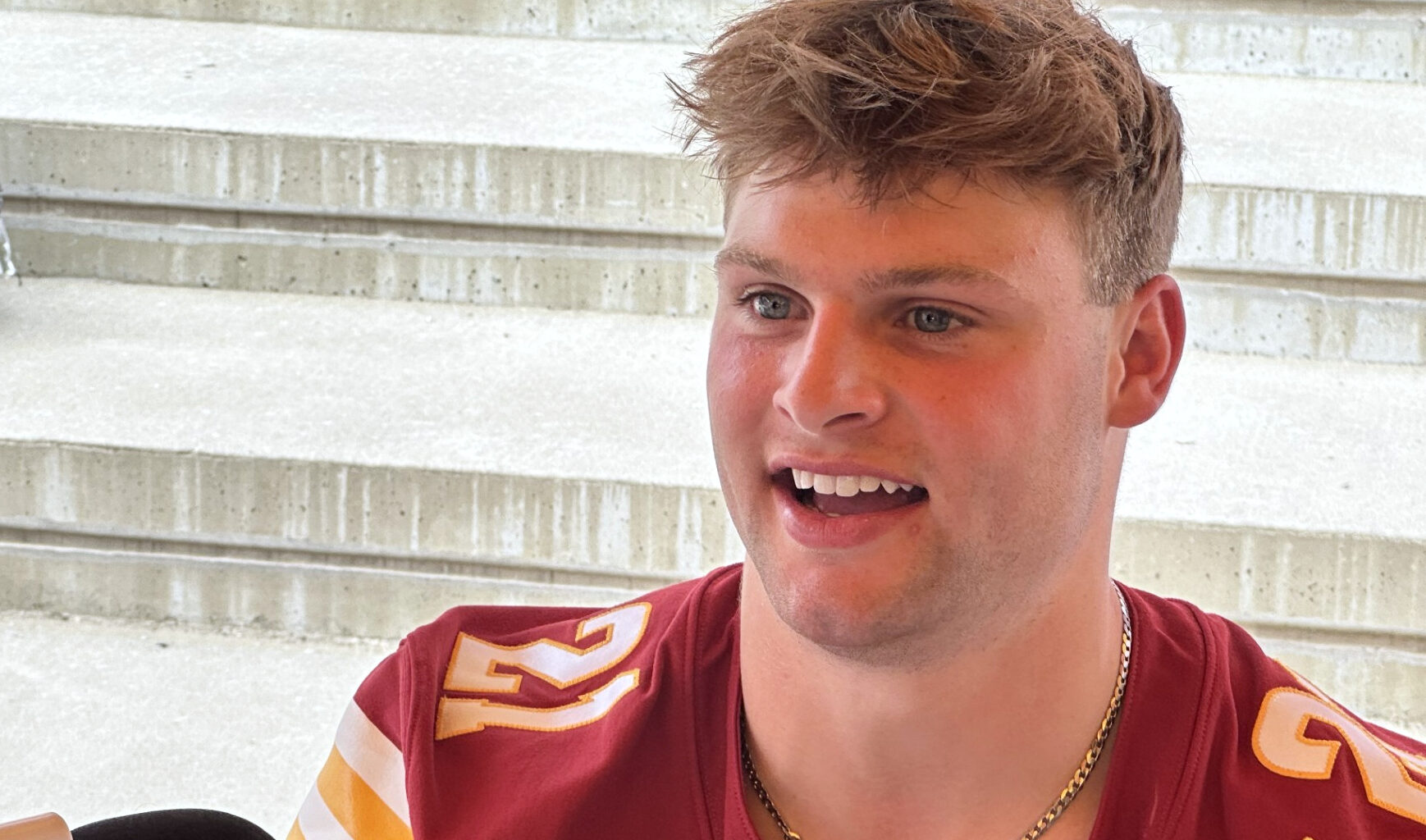
Iowa State running back Aiden Flora speaks to reporters at the team’s NCAA college football media day, Wednesday, Aug. 19, 2026, in Ames, Iowa.
Eric Olson/AP Photo/Eric Olson
This photo provided by Oklahoma State University Athletics shows Oklahoma State tight end Carson Kolb during the team’s spring NCAA college football practice, April 18, 2026, in Stillwater, Okla. (Cole Gueldenzoph/Oklahoma State University Athletics via AP)
Cole Gueldenzoph/Oklahoma State University Athlet
Carson Kolb is right where he wants to be in his football career. It just took him a couple years longer than he expected — and only because he was able to capitalize on an opportunity that’s become less available in this new era of college athletics.
Without a scholarship offer coming out of high school but determined to fulfill his dream of playing Division I football, Kolb walked on at Oregon State in 2024 and became a major contributor on special teams for two years. Believing he was capable of more, he entered the transfer portal in January and accepted an invitation to walk on at Oklahoma State.
He impressed his new coaches so much in the spring that he was put on scholarship in June. He’s in line to be the starting tight end when the Cowboys open the season Saturday at Tulsa.
Article continues below this ad
“I achieved the dream,” he said, “and now I’ve got some further goals.”
A year ago, it was feared that walk-ons like Kolb would be a casualty of roster limits tied to the $2.8 billion House settlement. Their numbers are indeed in decline because Bowl Subdivision schools are reaching or getting closer to the 105-man limit.
Walk-ons are the stuff of legend dating to the 1960s at programs such as Nebraska and they probably won’t be wiped out altogether. Some austere programs at the bottom of the FBS and in lower divisions won’t be able to give even a partial scholarship to every player. Some Power Four programs might keep a few spots open and sweeten the deal with offers of revenue-sharing money, as was the case with Kolb at Oklahoma State.
Walk-ons who receive rev-share typically get enough to pay rent, buy groceries or a portion of their tuition. Instead of rev-share money, some might get a tax-free, $5,980 per year stipend for qualified educational expenses, so-called Alston money.
Article continues below this ad
Iowa State has one of the larger rosters in the Bowl Subdivision. The Cyclones will carry 126 players, including 21 who don’t count against the limit because they are designated student-athletes allowed to complete their eligibility under the House settlement. All, if not most, of the 21 are among 35 walk-ons on the team.
First-year coach Jimmy Rogers, who in 2005 was set to walk on at Arizona State before he got a scholarship offer from South Dakota State, said he rues the day players in need of development won’t be given opportunities.
“There used to be more time where a player chose your school and was going to be a non-scholarship player,” Rogers said, “and it was his job to earn his keep and you were able to keep him in that spot and build over the years with that player. Now because of the cutthroat nature of college football and roster limit of 105, that’s going to be harder and harder in the future.”
One of those developmental players at Iowa State is Aiden Flora. He grinded for two years as a walk-on, turned into one of the top punt returners in the Big 12 last season and was put on scholarship in January. He’ll start at running back against Southeast Missouri State on Saturday, which wouldn’t happen if not for former coach Matt Campbell giving the kid from tiny Adel, Iowa, a chance.
“Whether they continue to do walk-ons, I really hope they do,” Flora said. “Just being a walk-on myself, it’s an opportunity for kids who may not have the (recruiting) stars or whatever.”
Article continues below this ad
Kolb was one of those kids who had no star ranking coming out of Horizon High in Scottsdale, Arizona. He primarily was a linebacker in high school, but recruiters projected him as a tight end. His insistence on playing linebacker caused them to back away.
“April of my senior year in high school I was calling a bunch of coaches, texting every D1 coach I know or my coaches know, and I’m begging for a chance because for me it was D1 or bust,” he said. “There’s no going juco, there’s no going D2, D3. I knew I was good enough to play at the D1 level.”
Kolb was growing more frustrated by the day when he got a surprise call from then-Oregon State tight ends coach Jon Boyer inviting him to walk on. The Beavers wanted him as a tight end, and Kolb figured he could do that if he were given an opportunity to play linebacker down the road. Though he played six snaps at linebacker in one game last year, he didn’t see a future for himself at Oregon State.
He entered the transfer portal and landed partial scholarship offers from Hutchinson (Kansas) Community College, UC Davis of the FCS and the invitation to walk-on with rev-share money from Oklahoma State. With some urging by family and friends, Kolb headed to OSU.
Kolb said he understands the need for roster limits because costs associated with maintaining super-sized rosters post-House settlement aren’t sustainable. But he also knows players such as himself probably won’t be given a chance to get a foot in the door of college football going forward.
Article continues below this ad
“That’s an unfortunate thing,” he said. “I think the walk-on is a beautiful part of this game. I think it’s a part of this game that should stay.”
Sign up for Top 25 poll alerts here, visit the Top 25 here and see AP’s full college football coverage here