
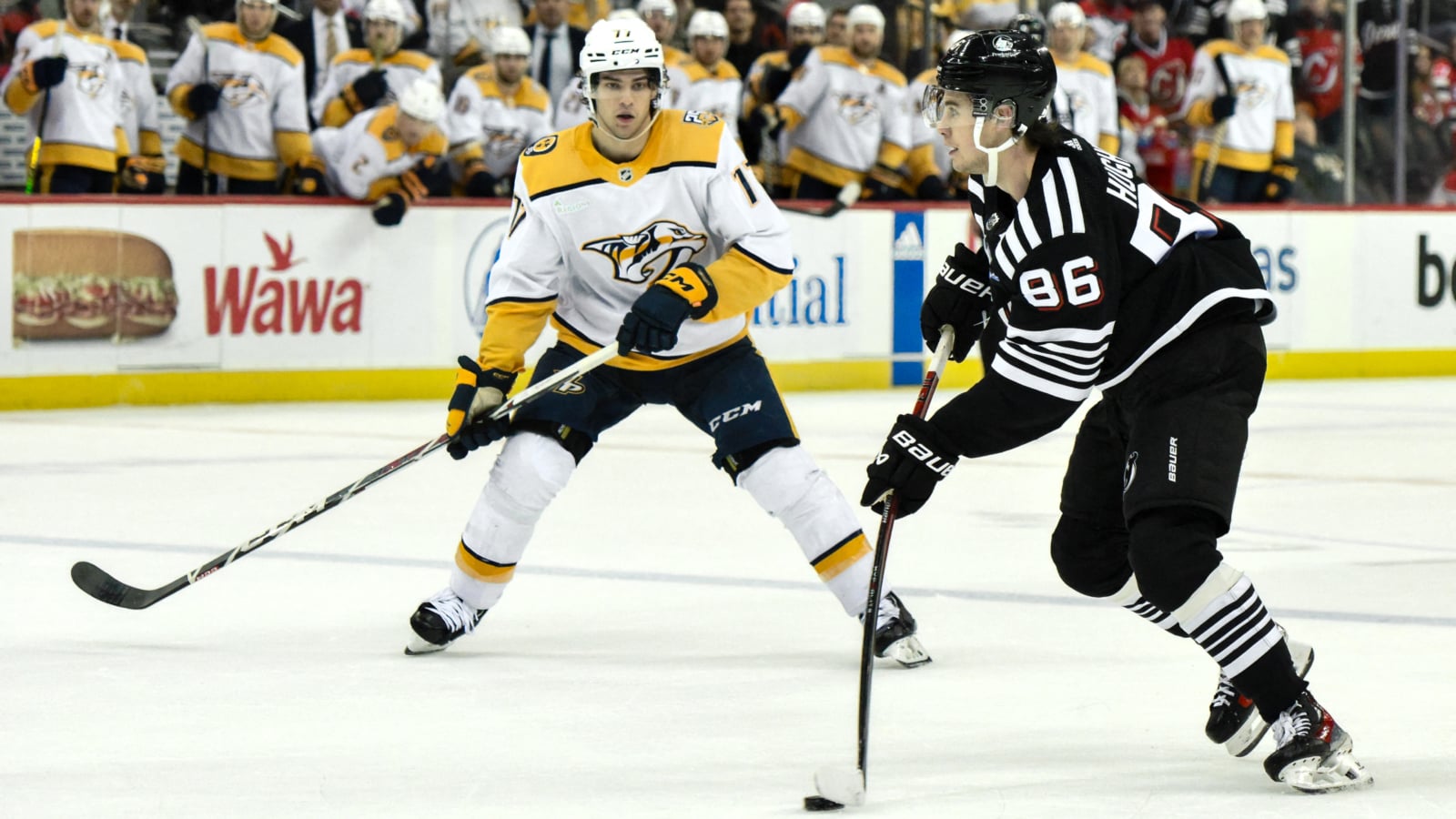
Sunny Mehta just flipped one of the Simon Nemec chips in an unexpected, but favorable New Jersey Devils trade.
The Devils Trade
Devils get: Luke Evangelista
Nashville Predators get: Colorado Avalanche’s conditional 2028 first-round pick (top-10 protected, with further conditions involving Toronto and a possible 2029 slide), New Jersey’s own 2028 second-round pick
Two months ago, the hanging question after the Nemec deal was what Mehta would actually do with the pile. He answered it on the first day of September.
Evangelista is 24, right-shot, and coming off a career year — 12 goals, 44 assists, 56 points in 81 games. He is not a volume finisher. He is a connector. New Jersey already hads players who can put the puck in the net. What it did not have enough of, at least not on cheap, movable paper, was a winger who can live on the half-wall, find the trailer, and keep a line in the offensive zone without needing the puck on a string from Jack Hughes.
That is the fit. The cost is real. The Devils just sent out the same Avalanche 2028 first they extracted from Calgary on June 23, plus their own 2028 second. That first is protected and could slide, but it was still one of the more valuable futures on the board. Mehta spent it on a player with one year left at $3 million who becomes an arbitration-eligible restricted free agent next July, although he’s controlled through 2029 as an RFA.
Cap-wise, it is almost frictionless. $3 million against a roster that suddenly looks stuffed down the wings. Jesper Bratt, Timo Meier, Dawson Mercer, Arseny Gritsyuk, Anthony Mantha, Connor Brown, Stefan Noesen, Evan Rodrigues, Jesper Boqvist — and now Evangelista. That is not a depth chart. That is a traffic jam.
It feels like somebody else is bound to move. Maybe a veteran for a pick. Maybe a left shot to rebalance. Maybe the next swing is bigger and this was just getting the extra body in the room first. Either way, the “too many forwards” problem is no longer theoretical.
Quinn Hughes? Connor Hellebuyck? Dylan Larkin? Or just another player who fits Mehta’s model that the new Devils GM saw an opportunity to strike for?
On the ice, the analytics support why New Jersey paid a first-plus. Evangelista sat in the 93rd percentile among forwards in even-strength offense last season and the 92nd in even-strength defense. Primary assists per 60 were 94th. Penalty differential was 87th. He skated 214.8 miles — 86th percentile — and spent 46 percent of his even-strength time in the offensive zone, 96th percentile. That is not a passenger. That is a winger who tilts the ice and then finds the guy who can finish.
What he will not do is overpower a goalie from range. Hardest shot? 80.4 mph, 22nd percentile. From mid-range he shot 2.1 percent. That part of the profile is real. The 12-goal total is not the whole story. Evangelista finished nine goals below expected last season. Put those back and last year is about a 65-point campaign. He shot 6.8 percent, 1.6 points under his career average, and posted a PDO under 100 for a third straight year. Even after a career season, the finishing still has room to bounce at just 24 years old.
He remains the passer on the line, not the trigger. Put him with Hughes or Nico Hischier and the assist totals should travel. If the shooting percentage simply comes back to his own norm, the 56-point season is the depressed version, not the ceiling.
The cleanest proof is who he played with in Nashville. Evangelista logged 268 minutes with Ryan O’Reilly and Steven Stamkos and another 277 with O’Reilly and Filip Forsberg. Those units sat above 57 percent expected goals and 60 percent actual goals. He is not the engine on those lines. He is the reason the cycle does not die. He finds the next pass a half-second early, and he does it without needing elite teammate talent every shift — his overall teammate-quality mark last year was only in the 25th percentile among forwards.
Style-wise, he is a give-and-go winger with his head up. He extends possessions along the wall, delays half a beat so the late man arrives, and uses an active stick to kill exits before they start. He is not a burner — 22.4 mph top speed is only 59th percentile — but he is on the ice, in the right layer, more than most skill wingers his size. He does not kill penalties. He is a passenger on the power play. Neither of those things is why the Devils bought him. They bought the five-on-five connector who still has a year at $3 million and another year of RFA control after that.
Nashville’s side is where this gets shakier. Chris MacFarland talked like a man collecting futures — two more high picks, seven selections in the first two rounds over the next two drafts, cap room, a runway for the kids. Fine. Look at what he actually sold.
Again, Evangelista is 24. He just put up a career high and still finished below expected in scoring. Trading that player with a year left at $3 million and another year of RFA control is not “selling high.” It is deciding you do not want to find out.
The late first Nashville acquired is not meaningfully different from an early second. It essentially feels like MacFarland acquired two mid-round tickets for a young playmaker who has already proven he can drive even-strength results next to top talent. That is how you talk yourself into a retool and wake up a year later needing the exact winger you just moved.
They got cheaper. They did not get better.
Devils grade: A-
Predators grade: C

James is a fully credentialed New Jersey Devils beat reporter for New Jersey Hockey Now on Sportsnaut and the … More about James Nichols