
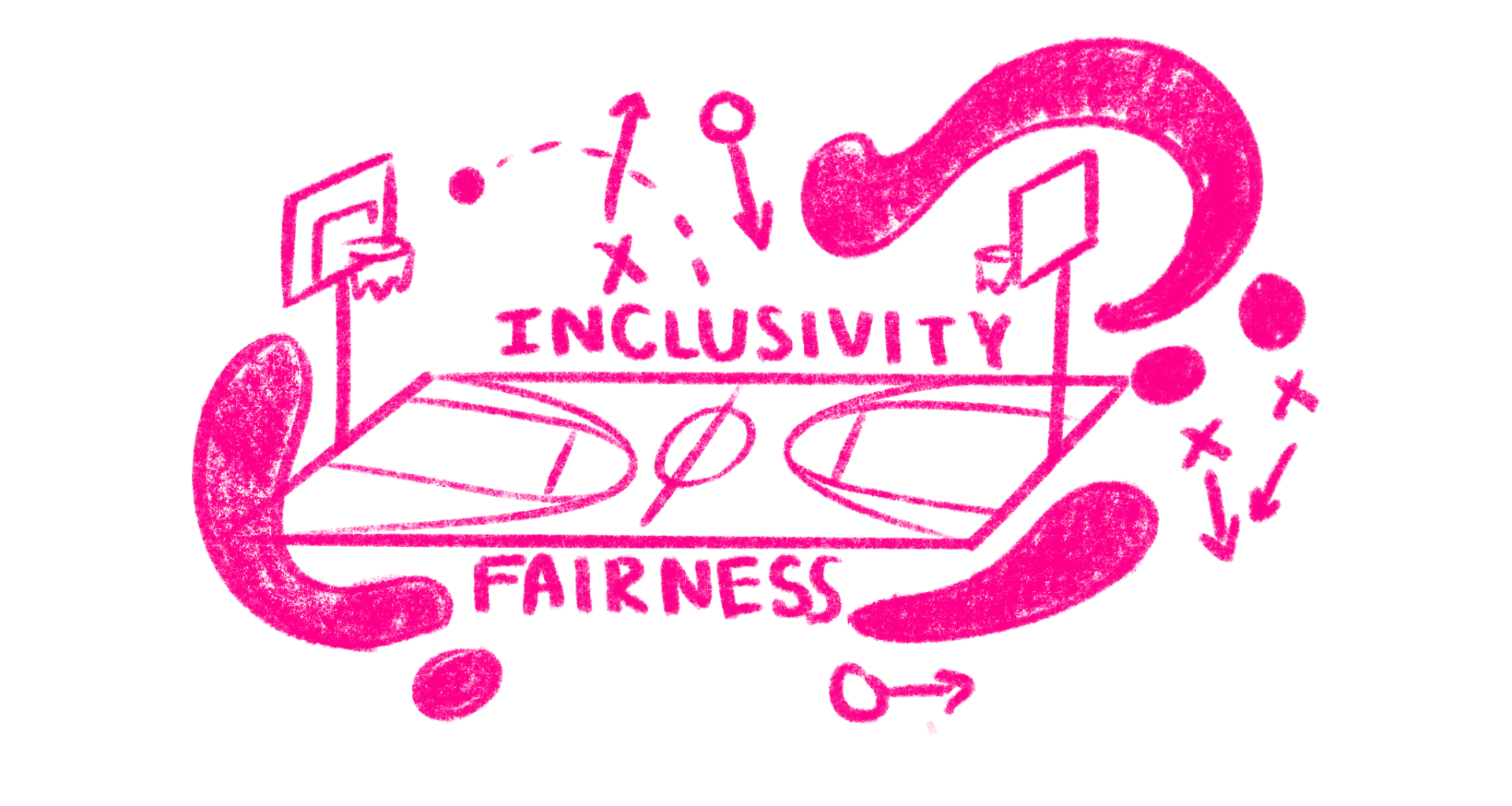
There has never been a transgender player in the Women’s National Basketball Association. So why is there an uproar around transgender players’ inclusion in the WNBA?
In July, ESPN ran a story about Indiana Fever guard Sophie Cunningham, dubbed ‘MAGA Barbie’ for her conservative political views. While the story covered many aspects of Cunningham as a player and a person, many viewers honed in on her comments that women should be able to “protect women’s sports” and “shouldn’t have to go against biological men.”
The league’s 2026 Collective Bargaining Agreement offers little clarification on gender eligibility. “Only players who are women are eligible to play in the WNBA,” the Women’s National Basketball Association 2026 Collective Bargaining Agreement states. Cunningham’s comments come at a time when gender in sports has come under a magnifying glass. Even cisgender players, such as Brittney Griner of the WNBA, have been accused of secretly being a “man in the league.”
Cunningham argued for separating competition largely on the basis of biological advantages. However, because of her reputation for leaning right politically, many interpreted her stance as anti-transgender. In June, the Supreme Court ruled that states could determine eligibility for women’s and girls’ sports teams based on biological sex. Capitalizing on the attention, a few ex-NBA players declared for the WNBA draft while identifying as women. Though these players were deemed ineligible to play in the WNBA, the ambiguity raises concerns about the future of the WNBA and sports more broadly, especially around inclusion. Do leagues dedicated to celebrating and showcasing women’s talent need to include transgender women? If so, how do you prevent abuse of the system?
Discussing identity is difficult, particularly given the complexities surrounding the term as used today. Gender identity can be defined as the “innermost concept of self.” Because we cannot determine another’s internal perception of self, we cannot definitively argue against how another person identifies. If an ex-NBA player claims to identify as a woman, there is no objective way to dispute their stated gender identity, unlike other potential sources of competitive advantage, such as performance-enhancing drugs, which can be tested for and regulated.
The issue with factoring identity into sports is the possibility of a physical advantage over the competition. Many studies suggest that athletic performance differs between biological sexes, especially after puberty. Men, on average, have a competitive advantage over women due mostly to testosterone differences and other physiological factors. However, gaps in research on women’s athletic performance may limit the ability to determine the magnitude of that advantage.
However, as a basis for excluding transgender women athletes from women’s leagues, physiological differences fall short of serving as an effective differentiator due to the need for talent alongside physical attributes.
Physical ability is not the only determinant of a good athlete. Michael Phelps may have been born with the ideal wingspan and torso-to-limb ratio for swimming, but he still had to master the freestyle stroke. In team sports like basketball, where the task is more complex than who can run the fastest or jump the highest, skill remains the biggest determinant of how good an athlete is.
Even identical twins possess different strengths and weaknesses as competitors. The Burge twins played basketball during the 90s. Both Heather and Heide were tall, 6-foot-5 forwards/centers, but their playing styles differed. While Heather was the more traditional big, excelling in the interior, Heide relied more on outside shooting.
Because of the need for talent, these sports leagues are accessible to a wide range of physiques. Just as a 6-foot-5 forward who flourishes on the inside is important, so is a 5-foot-10 point guard who can feed that forward. A transgender male-to-female player, while perhaps possessing greater physical prowess, still needs the talent and intangibles to succeed. So allowing these athletes to compete alongside other women does not mean female athletes will be disadvantaged.
If allowing athletes who were male at birth to compete in women’s leagues does not guarantee success, why not open the door to a more inclusive league? The WNBA exists to give women a platform to showcase their talent and compete among the best. If the league is to allow for transgender athletes, there needs to be a guarantee that showcasing women’s skill remains the focus. How can we be sure that male athletes are not claiming to identify as women for the sake of facing “easier” opponents?
Incorporating transgender athletes who identify as women is still highlighting women’s talent. Maybe they have a physical advantage, but physical advantages and differences exist among cisgender female athletes, and these transgender athletes are competing alongside those they identify with and respect. But what stops men who either were not talented enough to succeed in male leagues or are no longer good enough to compete from labeling themselves as women and using their physical advantages to renew their fame? Instead of respecting the competition and appreciating the opportunity to play alongside other great female athletes, such athletes could theoretically misrepresent their gender identity to gain a competitive advantage.
Hypotheticals aside, it is important to acknowledge that there are almost no transgender athletes competing in the United States, regardless of the sport—in the NCAA, trans athletes made up less than 0.1% of U.S. college athletes last year. Nevertheless, amid the current culture war and scrutiny of gender in sports, operating without formal definitions or regulations governing transgender eligibility will contort the WNBA and other women’s leagues away from showcasing female talent.
Unfortunately, it is difficult to determine someone’s intentions with absolute certainty. Perhaps an ex-NBA player truly feels they identify more with women. Perhaps they are looking for the right outlet to display their talents. There is no way to know for certain. But that ambiguity is threatening. Even if allowing transgender male-to-female athletes is a good step toward inclusivity, the WNBA must protect its main goal.
Tyler Dang ’28 (tylerdang@college.harvard.edu) is the Sports Editor of the “Harvard Independent,” and Caroline Stohrer ’28 (carolinestohrer@college.harvard.edu) is the Breaking News Editor.