
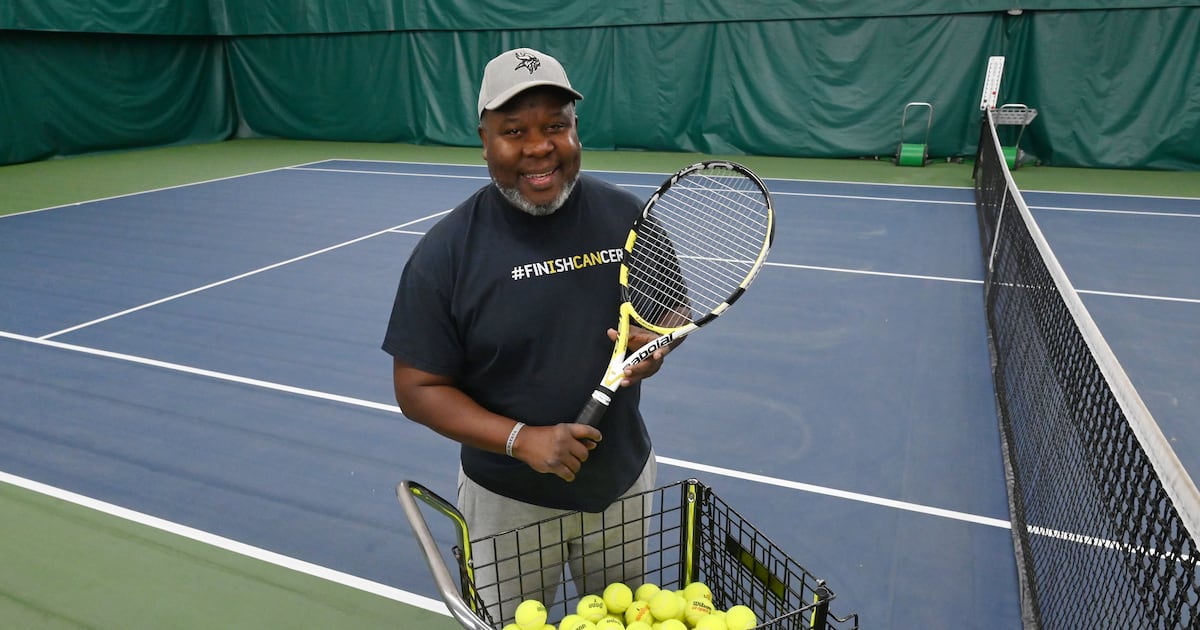
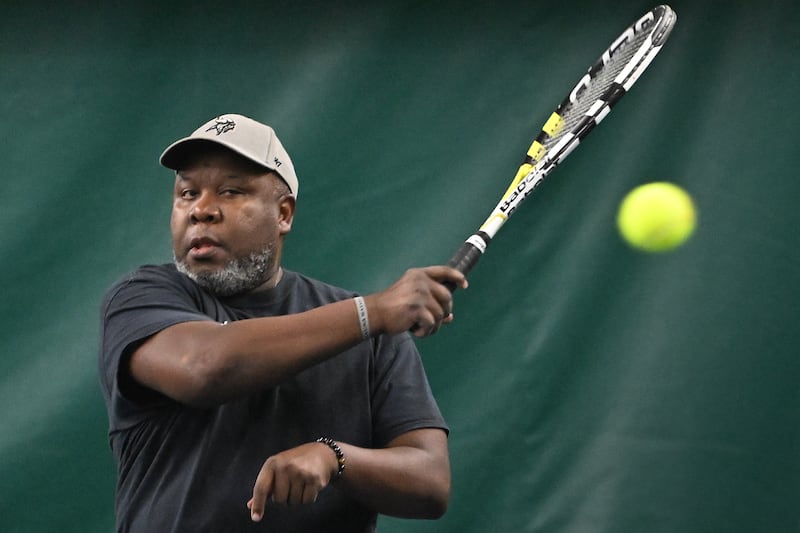
 Jimmy Kayongo, a tennis pro at The Alaska Club, received the USTA’s President’s Impact Award, which honors outstanding individuals who are making a meaningful difference in growing the game of tennis within their communities. Photographed on Wednesday, Sept. 2. (Bill Roth / ADN)
For the past 22 years, Jimmy Kayongo has been not only a faithfully engaged member of the tennis scene in Alaska at all levels, but also a teacher and cultivator.
In honor of his years of dedicated service as the tennis director for The Alaska Club East, Kayongo was recently named a recipient of the U.S. Tennis Association’s 35 x 35 President’s Impact Award.
It recognizes individuals who are making a meaningful difference growing the game within their communities and those who also show exemplary dedication and leadership.
“It’s not just me winning the award; it’s kind of like a collective effort, and there’s a lot of people that help me out,” Kayongo said. “The community is good, people are friendly and my job is easy. So it’s a group award, as far as I’m concerned.”
The recognition came as a shock. He had no idea who nominated him or that he was even in the running for the award to begin with.
“I just received an email and a plaque that I had won the award, so I was excited,” Kayongo said.
He first came to Alaska in 2004 with his wife, who was permanently stationed in the state through the military. Kayongo also served in the military, and the couple decided to make it their forever home after falling in love with the area.
Kayongo said there was just something about the people and how warm and welcoming they were that made it worth suffering through the long winters.
“It’s a place that I say is a big city with a small-city feel,” Kayongo said. “I kind of like that. The weather and all that stuff. Obviously, people don’t really enjoy it unless it’s summertime. But for me, I’ve got so used to it, it doesn’t matter.”
 Jimmy Kayongo has been a tennis pro at The Alaska Club for 22 years. (Bill Roth / ADN)
Originally, he is from Uganda and moved to the United States when he was 17 years old after his parents were hired as professors at South Dakota State University.
While he was an honorary Jackrabbit upon his arrival in the country, he was recruited to play tennis at Gustavus Adolphus College in St. Peter, Minnesota. There he competed for four years and joined the ROTC program, which jump-started his military career.
Over his two-decade-plus tenure in Alaska, he has seen the tennis community in the 49th state grow exponentially from the youth to senior levels in terms of talent and love for the sport, especially where he teaches at The Alaska Club.
“We’re small, but very vibrant,” Kayongo said. “That’s what I like about it. We have all sorts of players. We have very good players. We have young players, older players.”
One of the parts of his job he enjoys most is watching kids go from the grassroots level to winning state titles, contending at the national level and earning college scholarships.
“I have a program where we teach 5- and 6-year-olds, 7-year-olds, 9- and 10-year-olds, because tennis is all about bringing up the next generations,” Kayongo said. “It’s good to see them come from that level, grow, win the state championship, and then go to college.”
Some former students who made it to the collegiate level as players have returned home and become coaches themselves.
He has even hired a few, pitching to them the importance of giving back to the community that molded them into the players they grew up to be.
“I told them, ‘Hey, you got a lot out of what we did before. How about you give something back to the community?’ and some of them teach younger kids now,” Kayongo said.
The award he received is sponsored by the USTA’s growth strategy initiative, with a goal of growing the sport to where 35 million Americans — or about 10% of the population — are playing tennis by 2035.
“Every little bit helps,” Kayongo said. “I think with our community here, because the people are so friendly and encouraging and nurturing, we’re trying to allow the other members of the club that don’t play tennis an opportunity to come try tennis.”
Reluctantly falling in love with the game
Growing up, Kayongo didn’t necessarily want to play tennis. Like most kids from his home country, his primary sports of choice were soccer and rugby.
But after he kept coming home with injuries from playing those sports, his mother stepped in and forced him to take another, safer path.
“My mom made my dad take me to tennis,” Kayongo said. “That’s how I started.”
His passion for the game came from the competition, and it still burns hot to this day.
“It’s a lifetime sport,” Kayongo said. “You can play it at any age. That attracted me to it. Hand-eye coordination, pretty active, a lot of movement. I was excited about that as well. But I also am a very big competitor, so the chance to win a trophy or to win money or whatever really attracted me as well.”
Some of his favorite tennis players of all time include Pete Sampras, Roger Federer, Stefan Edberg, Serena Williams, Martina Navratilova and Gigi Fernandez, who recently visited Alaska. He joined forces with Fernandez to put on a clinic while she was here.
[Tennis legend Gigi Fernandez gives Alaska players a new doubles direction]
It’s one thing to be passionate about playing the game, but it’s another entirely to become a teacher.
As the son of two professors, he said the desire to pass on knowledge came naturally.
“It’s innate in me because of my parents,” Kayongo said. “I love teaching and I love teachers, so it’s definitely something that I enjoy doing. I enjoy seeing people succeed after you teach them something, enjoy the response you get from them. The ups and downs, the strategy, all that kind of stuff. I love teaching people. That’s why I stayed with it.”
His deep love for teaching is a big reason why he decided to stay in Alaska after his military service ended.
“This job gave me that opportunity to do that on this scale,” Kayongo said.
The oldest first-time student he’s ever taken under his wing is a 70-year-old woman who comes in for a lesson once a month.
The youngest first-time student he’s ever had was 5 years old, the goddaughter of a friend who wanted to learn how to play.
“I said, ‘I’ll do it.’ And it was absolutely humbling to coach a young person like that because it really allows you to help them mold themselves,” Kayongo said.