
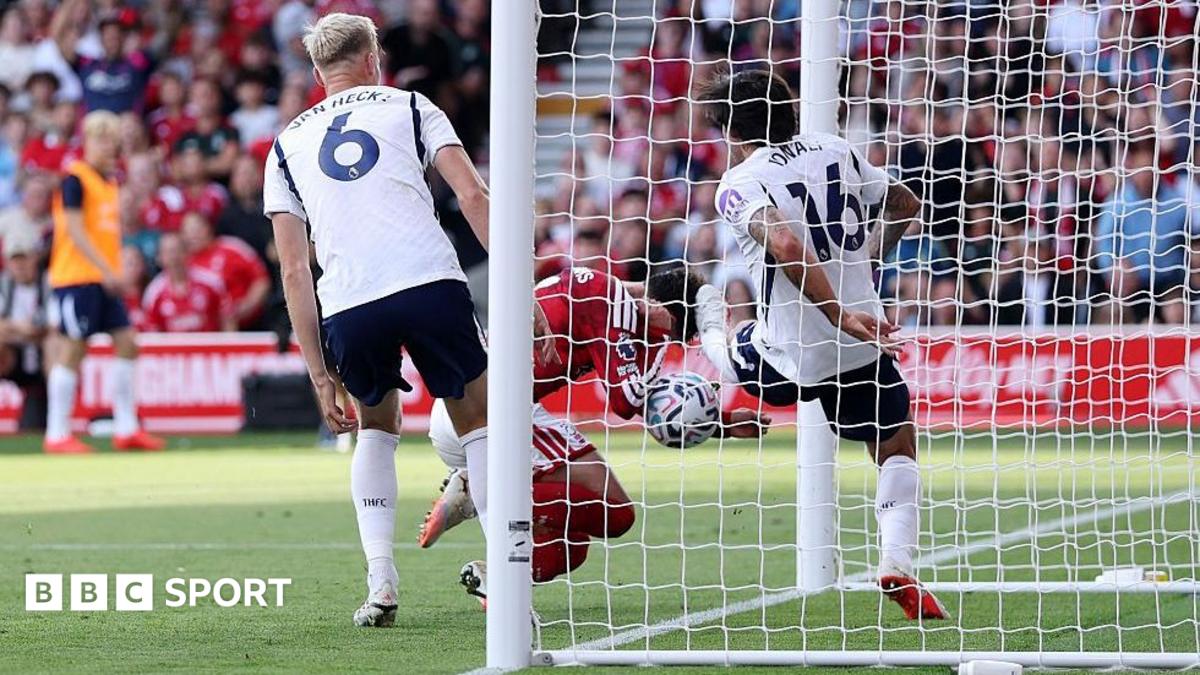
Much of the commentary on the incident has centred around the VAR not having evidence of a clear and obvious error as a reason to disallow the goal.
Glasner mentioned it and Williams posted on X to that effect too.
But clear and obvious errors only cover subjective incidents – those that require the referee to go to the pitchside monitor to review an incident.
Factual interventions, such as handball before a goal, are evidence-based judgements made by the VAR.
If the VAR feels they have the proof of an offence, they will disallow the goal.
For all Forest’s disquiet, there are plenty of people who believe you can see the handball, and Bankes was clearly one of those.
It shows one of the issues with VAR that can never be solved – even the factual interventions like this are, in truth, subjective. It is one person’s judgement that others can disagree with.
A case in point is Benjamin Sesko’s goal for Manchester United against Liverpool last season.
The ball looked as if it might have brushed the fingertips of the Slovenia striker before going into the goal, but the VAR Stuart Attwell felt he could not be certain and allowed the goal to stand.
Referees’ chief Howard Webb later said the ball “probably does hit the hand” but “the VARs need to see that conclusively”.
Attwell did not feel he had proof, but Bankes did.
During pre-season media briefings, Webb said attacking handball was one law he would change – which would mean goals like Williams’ would not be ruled out based upon the original evidence.
“The problem is the law forces VARs on every goal to look at what body part the ball went in off,” Webb said.
“If you were only to penalise when the attacker deliberately handles the ball or makes himself unjustifiably big – and not have that forensic examination – you could ‘check complete’ it more quickly.
“It is a law I would definitely look to change. So Pro Ref and the Premier League are going to try and lobby for that to be changed.”
VAR is being operated with a lighter touch this season. So far there have been just two subjective interventions at 0.06 per game, compared to 0.15 last season.
However the generally negative narrative around VAR and the tribal nature of football mean its involvement in key incidents attracts widespread attention.