
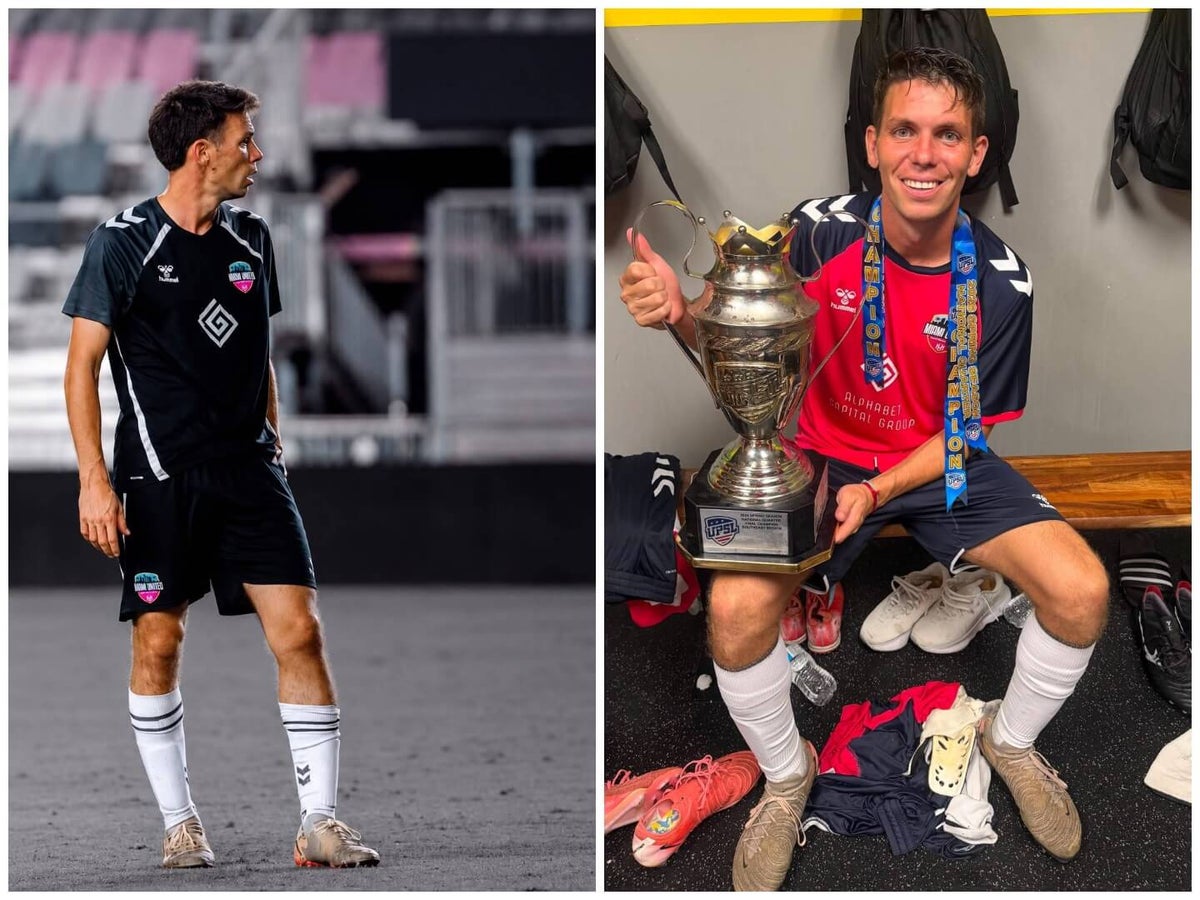
On August 6, Matías Pourrain, an Argentine-born U.S. resident, was at Fort Lauderdale-Hollywood International Airport with his Miami United teammates. The club is a perennial title contender in the semi-professional United Premier Soccer League. The players were in good spirits as they looked forward to a trip to Los Angeles for the Spring National semifinal against New York Renegades FC.
Pourrain, with his carry-on in one hand and his maté thermos in the other, walked over to a water fountain for a refill before the cross-country flight. He and his teammates had just cleared the Transportation Security Administration (TSA) screening process when, Pourrain said, two men in civilian clothes, without any visible police insignia, approached him and asked to see his identification.
Pourrain, a 34-year-old creative midfielder who signed with Miami United in January, has lived in South Florida since 2019. He said he came to the U.S. legally on a tourist visa and then secured a work permit. In July, he renewed his Florida driver’s license. Pourrain said he does not have a criminal background, with public records revealing only traffic violations. In April he played in the first-ever U.S. Baller League, a six-a-side indoor soccer tournament. He had mingled with Brazilian great Ronaldinho, singer J Balvin, and Olympic sprinter Usain Bolt, among other well-known athletes and digital creators.
At first, Pourrain wasn’t too alarmed. He handed the two men his driver’s license.
“Where’s your passport?” Pourrain recalled one of them asking. “Do you have any other identification?” said the other.
Pourrain gave the man his U.S. work permit. “Come with us,” one of the men said, as they both lifted up their shirts slightly to reveal their ICE (Immigration and Customs Enforcement) badges.

A U.S. Customs and Border Protection agent outside a detention center in Texas (Moises Avila / AFP / Getty Images)
Pourrain said he was told that they needed to check something “on the computer” related to his pending immigration case. It shouldn’t take more than 10 minutes, one of the officers said, and that after a quick check, Pourrain would be able to rejoin his teammates at the departure gate. Pourrain texted his head coach Claudio Frean.
“I’ll be back in 10 minutes,” he wrote in Spanish.
Two more ICE officers arrived and told Pourrain he would be arrested and taken into custody. He said he was not told why. “What did I do?” Pourrain asked desperately. A person with his immigration status, Pourrain said, would not have been able to secure a renewed driver’s license or a work permit if they had committed a crime.
“You’re coming with us the easy way or the hard way,” an ICE officer said. Pourrain said he did not resist. He was handcuffed and quickly ushered out of the airport. He overheard one officer tell an ICE agent to use a specific airport exit to avoid being seen by a local news crew that was on site.
As Pourrain recalls, he was placed inside an unmarked van, with his hands and ankles handcuffed. He was told that information would be given to him once he had arrived at the makeshift detention center in Miramar, Fla., roughly 20 miles to the southwest of the airport. His teammates and the Miami United coaching staff had no idea what had happened. He believes that his driver’s license was flagged by TSA officials. The Department of Homeland Security (DHS) released a statement after his arrest:
“On August 6, 2026, ICE arrested Matias Alejandro Pourrain, an illegal alien from Argentina, at the Fort Lauderdale International Airport. On November 12, 2019, Pourrain was legally admitted into the country at the Atlanta Intercontinental Airport, with permission to stay for six months. He chose to stay beyond May 11, 2020, in violation of our nation’s laws. Pourrain will remain in ICE custody pending his removal proceedings and will receive full due process.”
Pourrain was not back in 10 minutes. He would not see any of his teammates for 26 days.
From his apartment in Miami, Pourrain, visibly exhausted and gaunt, and at times emotional, told The Athletic that when he submitted to the authorities that day, he did so hoping that it was all a misunderstanding.
“I was not going to fight,” he said. “But at no point did they explain anything to me. They just said it had to do with my pending case. When I got to Miramar they’d explain.”
“Miramar,” Pourrain said, his voice trembling, “was the worst thing that’s ever happened to me in my life.”
At the Miramar processing center, Pourrain was placed inside a holding cell with nearly 70 other men. The room, he said, was roughly 160 square feet. He remembers the two urinals that faced each other inside the room. A water fountain that hardly worked sat inches away. Pourrain said he sat shackled to a chair the first 24 hours he was there and spent nearly three days without eating. He struggled to eat the food that the detention center officials gave the inmates.
“Hunger is the worst thing there is,” he said. “Hunger really hurts. The food they gave us had mold. I could see little black circles on the bread. It was not edible.” But when the hunger became unbearable, Pourrain ate it.
Twenty-four hours after being detained, he said, authorities allowed Pourrain to make a phone call. He called his wife, an Argentine whom he met in Florida. She urged him to stay strong, and more importantly, to eat and to stay hydrated. We’ll get you out of there, she told him. But drinking water was just as unsanitary, he said. “The water fountain was close to where people urinated,” Pourrain said. “And the water trickled along the spout where the urine had just passed. It was impossible. I couldn’t do it.”
“Guys would sleep right next to the toilet,” he continued. “Someone’s head would be right next to the toilet, so when you urinate, it would splash and the urine would land on the people sleeping there. It was inhumane.”
After four days, he said, the stench inside the room became intolerable. Pourrain was then moved, along with a large group of inmates, to the Krome North Service Processing Center in Miami before arriving at the Glades Correctional Facility in Belle Glade. By then, Miami United ownership had contacted attorney Regina Borges de Moraes. Pourrain was charged with overstaying a U.S. visa. She took the case pro bono.
“What they have (on Pourrain) right now is just allegedly overstay, which I have an issue with,” Borges de Moraes told The Athletic. “He entered legally in November of 2019 with a tourist visa. So it gives him the right to go in front of an immigration judge if they attempt to remove him, which is a good thing.”
According to Borges de Moraes, cases like Pourrain’s are increasing under the current administration.
“I would say beginning of June and of May, it became much more common,” Borges de Moraes said. “Usually for someone like Matías, if ICE encountered them, they would do what’s called catch and release, which is write them up for removal proceedings, but then let them go. Either have them pay a bond, put on an ankle monitor, or nothing, and just set them up for court.”
Borges de Moraes is also currently handling the case of Cuban national team midfielder Neisser Sandó, who defected to the U.S. while he played for Cuba at the 2023 Concacaf Gold Cup. Sandó has lived in Miami since and was recently detained at Miami International Airport on the same visa charge as Pourrain. Sandó is in the process of obtaining a U.S. green card through the Cuban Adjustment Act. Borges de Moraes said he is being detained at an ICE detention center in Rio Grande, Texas.
Pourrain’s description of his time in detention is not uncommon. Three days before Pourrain was detained, Venezuelan national Claudia Rodríguez, 28, was released from ICE custody after being held for 20 days. Rodríguez, like Pourrain, was detained at the Fort Lauderdale airport before boarding a domestic flight and taken to the same Miramar detention center. After her release on August 3, Rodríguez detailed the conditions she experienced.
“I (felt) like I was an animal in a zoo on the floor, dirty,” Rodriguez told reporters at a news conference on August 4, where she was joined by U.S. Rep. Debbie Wasserman Schultz. “So everyone is sleeping, eating, pooping, going to the bathroom in this small detention room, ” Wasserman Schultz said. “(DHS) told me they only keep people (at Miramar) for 72 hours. Claudia was there for eight days.” Rodríguez has been in the U.S. since 2017. She does not have a criminal record and has a pending political asylum case.
Also in August, five U.S. congress members visited the Stewart Detention Center in Columbus, Ga., following reports of poor living conditions inside the ICE detention facility. A detainee died in custody at the facility in April.
When approached for comment by The Athletic, DHS disputed Pourrain’s claims about the facility’s conditions.
“Claims that there are subprime conditions at ICE detention centers are FALSE,” DHS wrote. “ICE has higher detention standards than most U.S. prisons that hold actual U.S. citizens. All detainees are provided with 3 meals a day, clean water, clothing, bedding, showers, soap, and toiletries. Illegal aliens also have access to phones to communicate with their family members and lawyers. Certified dietitians evaluate meals.”
Borges de Moraes offered her own assessment.
“Detention centers do have higher standards and Matías was treated much better at the detention centers,” she said. “But not at Miramar processing. Not at a freaking building where they have cages basically in the basement and they have 68, 69 men handcuffed and leg-cuffed with chains from legs to hand, sleeping sitting up. The conditions that these individuals are in are horrendous. Horrendous.”
At Glades, Pourrain said, he was given an orange jumpsuit to wear. Orange was reserved for inmates that posed a medium risk, while anyone in a red jumpsuit was considered dangerous and high risk.
“Try to relax,” his wife would tell him over the phone. “You have a right to bail.”
Any hope that he would soon be released was extinguished after Pourrain was removed from the Glades facility and placed inside an unmarked van along with other inmates. He assumed he would be moved to another facility in South Florida, but unbeknownst to him, he was on his way to the airport.
“I managed to finally fall asleep inside the van,” Pourrain said. “I was calm because I knew I had an immigration appointment in Miami in September. As I’m falling asleep I overhear one of the (inmates) say “airport” and I jumped up from my seat. I was in handcuffs, my hands, ankles and waist. I tried to look out of a small window to see where we were going.”
Hours passed and the van arrived at an airport in Louisiana. Pourrain and the others were led onto an airplane. It was then, he said, that he was told that he would be sent to a detention center near Laredo, Texas. Pourrain had never heard of Laredo, but on the flight, an ICE agent told him it was near the U.S.-Mexico border.
Up until that moment, Pourrain had not feared that this situation would lead to him being sent to another country. But now panic had set in. “They could just throw me over the border and then what?” Pourrain remembered asking himself. “I wasn’t able to make any calls. I couldn’t contact anyone.
“I became desperate during that drive to the prison in Laredo. I was scared.”
Pourrain didn’t know it at the time, but his family and attorney were unaware of his location. Borges de Moraes could not find his name in the ICE immigration system.
“He didn’t show up on the ICE locator,” Borges da Moraes said. “It took almost 24 hours for him to get to Laredo. Rio Grande is the detention facility. But Laredo Court has jurisdiction for Rio Grande. I had to refile my bond motion.”
Pourrain said he felt a sense of relief when he saw the facility and realized that he was still in the U.S. At Rio Grande, he swapped his orange jumpsuit for a blue one, a color that identifies inmates as having a pending immigration case. He was given outdoor recreational time once a day. There was a flat soccer ball that inmates would use to play pick-up.
When Pourrain joined in one day, he subtly flashed his talent, which he said earned him some respect.
“I wanted to stay to the side,” he said. “I didn’t feel comfortable getting close to the people who’d been there a long time, because you don’t know, you know? You don’t want problems with anyone.”
He was released from the Rio Grande detention center on August 28 after his family paid a $20,000 bond. Just days ago, as he sat on his apartment balcony with his wife, sharing a maté and eating a piece of toast, he felt that he was eating the best meal of his life. And while he was in ICE custody, Pourrain’s story had spread in Argentina and the U.S. He believes that soccer saved him.
“Soccer helped me outside as well, in that this went viral,” he said. “So many people supported me and thank God I got to leave. If it hadn’t been for soccer, maybe I wouldn’t even have gotten out, no one would’ve known about my story. I don’t know what would have happened.
“There are people who don’t have that luck, who are locked up today, who were denied bail,” he said. “They have to wait inside because a lot of people choose to wait inside rather than go back to their country. My message to them is have faith and fight to the end.
Pourrain described his ordeal bluntly. “It was torture,” he said. “Mentally, it was pure terror.” Pourrain’s idea of life in America took a turn that will stay with him forever. But, he said, he loves this country, and he plans to continue to pursue his immigration case legally.
“Unfortunately something happened that’s also the worst thing I’ve ever gone through in my life,” he said as he fought back tears. “I’ve also gone through beautiful moments here. I don’t know, it’s mixed. It’s strange. I just went back to the academy in Key Biscayne where I coach, and the support I received from the parents, from the community — from so many American citizens, was overwhelming.”