

Editor’s note: A version of this story was originally published in 2024.
James Blake has a story.
It’s around 1990, and he’s trying to play in a regional under-12 tennis tournament in central Connecticut. He doesn’t have a ranking and there are more players than available spots, so he has to enter a lottery to get in. His number doesn’t get picked.
Don’t worry, the organizers tell him. Everyone who missed out this time automatically gets into the next tournament.
So Blake shows up a few weeks later. The same tournament director won’t let him in.
Blake’s mother realizes what is happening to her son, who is Black.
“My mom pitched a fit,” Blake, who would eventually rise to No 4 in the world, said during an interview.
Blake won that tournament. He remembers the tournament director being there at the start of the finals, but someone else handed him the trophy when it was over.
A little more than three decades later, Coco Gauff has another story. It started when Chris Eubanks, her close friend and surrogate big brother, called her just a few days before the start of the 2024 Paris Olympics. Eubanks had nominated Gauff to serve as the female flag bearer for the United States during the opening ceremony. The athletes have voted, he tells her. She’s won.
The tears start to flow.
In 2024, Gauff, then 20 and the defending U.S. Open champion and still one of the biggest stars in American sport, is sitting in a quiet room in the middle of Paris, reflecting on all this. She is proud and amazed and humbled that a young Black woman from what she described as a “predominantly White sport” would end up holding the American flag for the biggest moment of the world’s largest sporting event.
She knows this isn’t about just about her. During her lifetime, Black Americans have become some of the biggest stars in tennis and in some cases have transcended the sport, especially in the U.S.
“Each one of them would tell you that Serena and Venus has played some part in their story,” she says, paying homage to the ground-shifting Williams sisters, who changed tennis as arguably no one else has before or since. She says there are so many more who bear mention too, including two mid-20th-century players that a lot of people her age may not know — Arthur Ashe and Althea Gibson.
“They’ve all played some part of our story.”
Now, that story has another chapter. On Sunday, Ben Shelton will become the first Black man to compete in the U.S. Open final since since 1972, when Arthur Ashe, the 1968 champion whose name is on the stadium, made the championship match.
How Frances Tiafoe and Ben Shelton made tennis history
Ava Wallace and Johnny Sweet
Shelton has become the latest male star in a uniquely American story that enjoyed its latest inflection point over the course of 24 hours Thursday and Friday.
Late Thursday, Coco Gauff played in yet another Grand Slam semifinal, her second at the U.S. Open, which she won in 2023, following in the footsteps of Althea Gibson, the Williams sisters, and Sloane Stephens, all of them Black American trailblazers in what had long been thought of as largely white, country club sport.
The next day, Taylor Townsend paired with Kateřina Siniaková of the Czech Republic to win the women’s doubles title; Robin Montgomery paired with Ashlyn Krueger on the other side of the net in the final. Both Townsend, who completed the career Grand Slam in doubles, and Montgomery, a 22-year-old on the rise after recovering from a wrist injury.
That night, Shelton beat Frances Tiafoe in the first Grand Slam semifinal between two Black men, both of them Americans. All of them know they are doing far more than playing tennis.
“I’m so proud to be able to click on the TV and watch Frances and Ben,” Townsend said in a news conference after her win.
“It’s been a phenomenal U.S. Open for people of color, and just being able to show people, like, it’s possible. But we’re not the first; we’re definitely not going to be the last. Even being here and being able to watch even the juniors, and I’m like: ‘Wow, there are so many more people than even when I was coming up.’
“It’s just such a beautiful thing to see, because the more that I can be out here and present authentically myself and inspire people to pick up a racquet and try something that they never tried, or feel like they can, or that it’s possible, or give the inspiration that they want to do it and say, ‘Hey, like, I want to try this,’ then that’s what it’s about.”
There is nothing quite like the you-can-be-it-if-you-can-see-it effect when it comes to sport, or really any pursuit. Martin Blackman, the former pro who leads the Junior Tennis Champions Center, in Washington, D.C., remembers his well. Blackman runs the development academy that produced Tiafoe, Montgomery, and Hailey Baptiste, the world No. 37, who is rehabilitating a torn ACL. He also led the player development efforts for the U.S. Tennis Association (USTA) from 2015 to 2025.
He remembers listening on the radio as Ashe beat Jimmy Connors in the 1975 Wimbledon final. He was five years old. Tennis has been his sport ever since.
That doesn’t mean that different sports — with so much variance in accessibility, visibility, and emulation — don’t have different strata of impact. The Williams sisters and Tiger Woods broke out at basically the same time in the late 1990s. Nearly 30 years later, since their careers caught light, the star power of American tennis has been shifting from White to Black.
The roster of big names includes 2023 U.S. Open champion Gauff; 2026 finalist and 2023 semifinalist Shelton; three-time semifinalist Tiafoe and the 2017 finalist and winner respectively, Madison Keys and Stephens. There’s Townsend, who now holds a career Grand Slam in women’s doubles. There was also Eubanks, who made the final eight at Wimbledon in 2023 and retired last year,
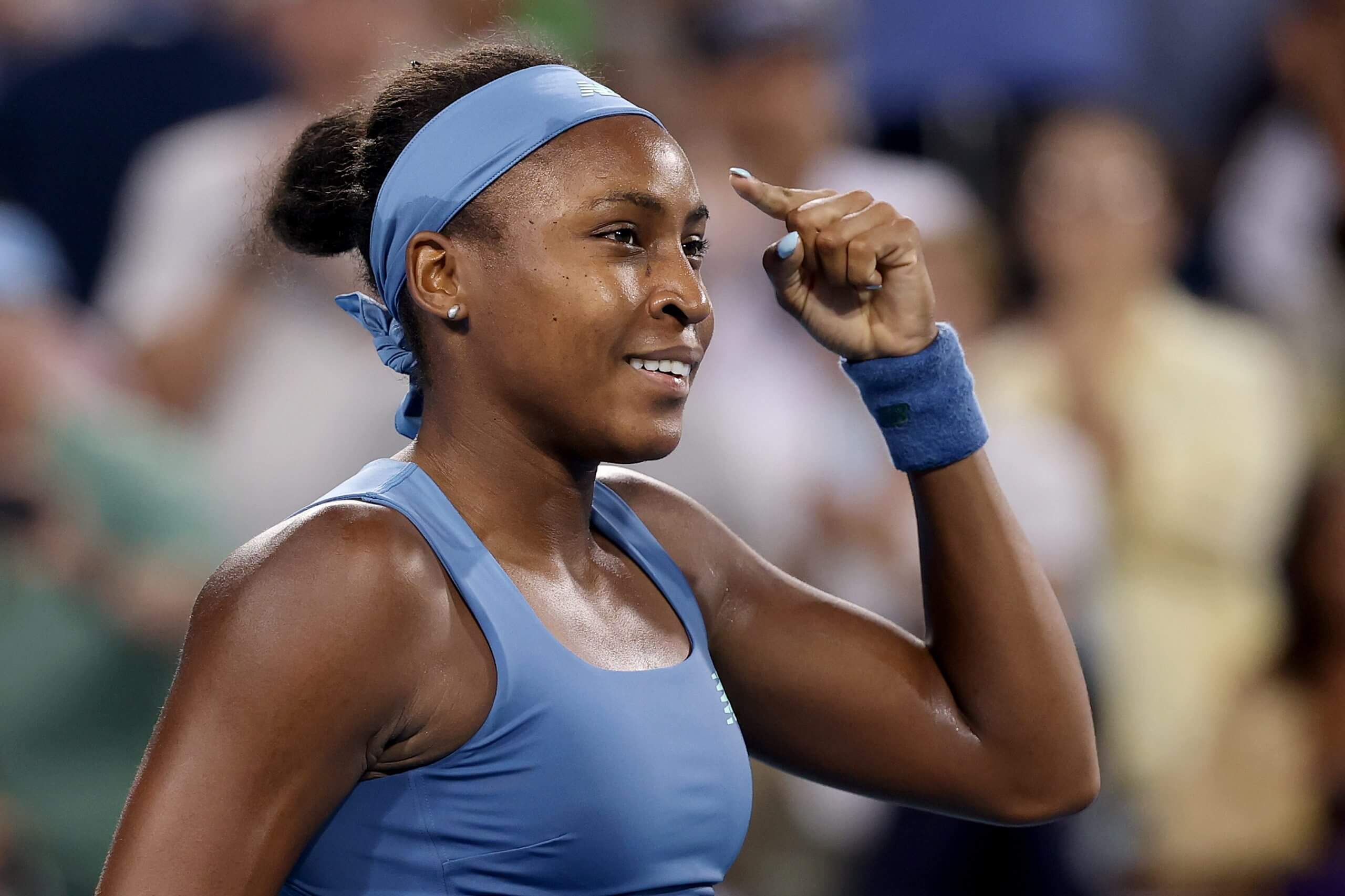
Coco Gauff is one of the biggest stars in tennis. (Matthew Stockman / Getty Images)
Their contemporaries, like world No. 6 Jessica Pegula, Shelton’s former top-10 compatriots Taylor Fritz and Tommy Paul, and Emma Navarro, who knocked Gauff out of Wimbledon and the U.S. Open in 2024, may sometimes go deeper in tournaments. But they don’t usually draw eyeballs or attention or fill stadiums, both in the U.S. and abroad, the way the others do.
Black players are also a major presence in the development pipeline, especially among the women, including Clervie Ngounoue, 20, who won the Wimbledon girls’ title in 2023, and Akasha Urhobo, who is 19 and rising fast.
Blackman said roughly one-third of the top 1,500 to 2,000 youth players who cycle through the USTA’s regional camps each year are players of color. That is a significant jump from 25 years ago, and far different from so many other multicultural countries where tennis is popular.
This growth isn’t limited to the top of the sport. According to studies from the Physical Activity Council and the Tennis Industry Association, participation among Black players rose more than 60 percent from 2019 to 2023. Black people, who make up roughly 13 percent of the U.S. population, account for about 11 percent of the nearly 27 million players now in the U.S., a figure that is getting close to the USTA’s goal of aligning its participation rates with the country’s demographics — but means tennis remains, per Gauff, a predominantly White sport.
Marisa Grimes, the USTA’s chief of diversity and inclusion, said the organization has worked hard to be more intentional about making tennis a part of people’s lives in the Black community. Diversity in the sport is about far more than supporting tennis clinics in less advantaged urban areas, though that is important, too.
In recent years, the USTA has started running junior tennis programs with Jack and Jill of America, a leadership organization popular in the Black community, as well as organizing tennis clinics at SpringComing, the popular gatherings of alumni of Historically Black Colleges and Universities (HBCUs). It has held events in Oak Bluffs on Martha’s Vineyard, a popular summer destination for the Black community for years. New initiatives, like Black Girls Tennis Club, co-founded by Kimberly Selden and Virginia Thornton in 2021, put on low-cost clinics to encourage young people, and their families, into the sport.
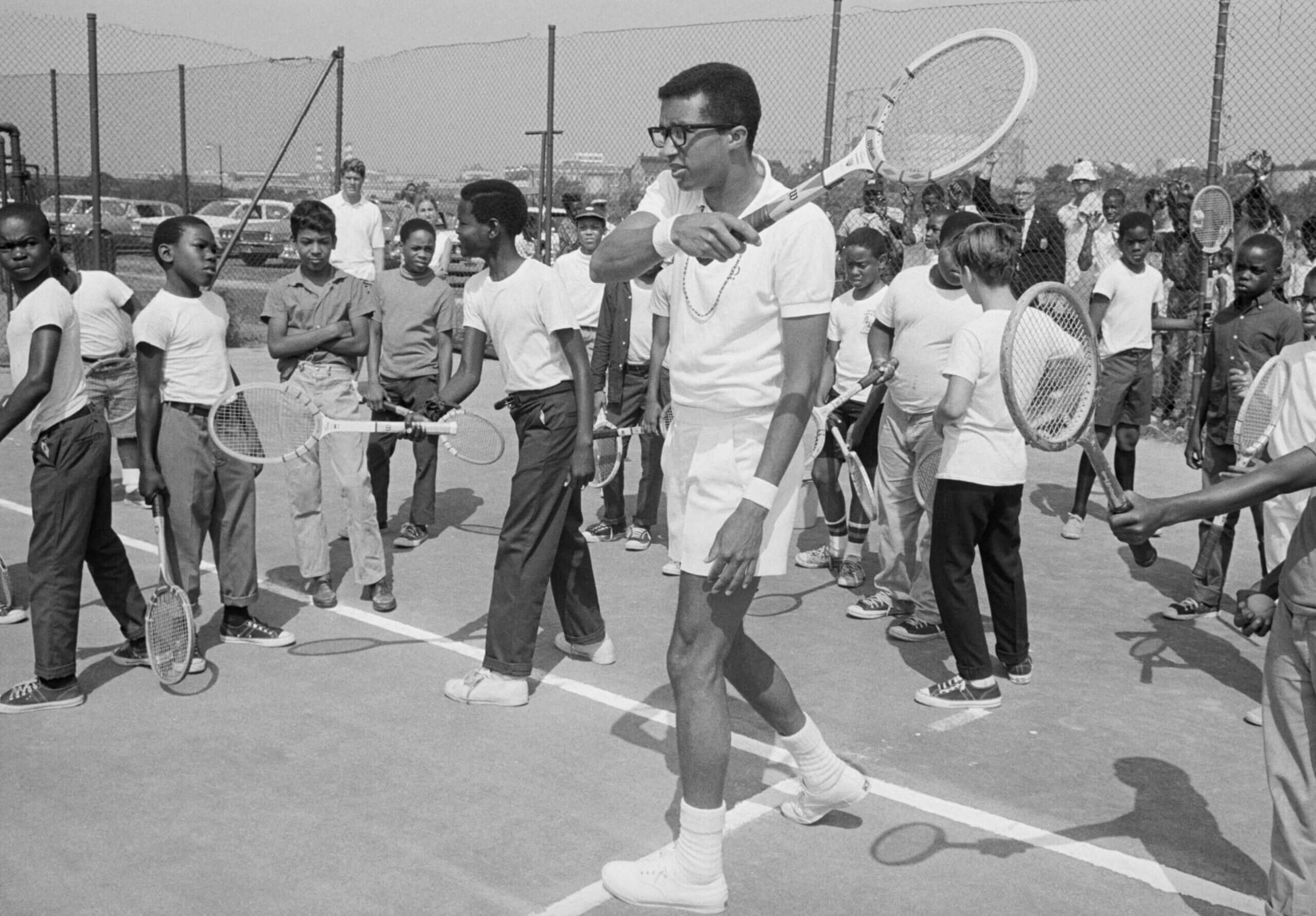
Arthur Ashe leads a clinic in Washington D.C. in 1968. (Bettmann / Getty Images)
Grimes said these efforts coalesce around meeting all facets of the Black community where people are. “Not expecting them to always find us and come to us, but finding ways to connect tennis from a culturally relevant standpoint,” she said.
Those efforts are in addition to the more than $10 million that the USTA Foundation invests in some 250 National Junior Tennis and Learning centers throughout the country each year. Those centers use tennis as a vehicle to teach life skills and provide academic support to 150,000 children of all ages and tennis abilities. Nearly 80 percent are children of color, including 42 percent Black, 22 percent Hispanic/Latino, 8 percent Asian, 1 percent Native-American, and 4 percent mixed race. More than 70 percent of the children qualify for free or reduced-cost lunch at school.
“When they walk into a park and they see a tennis court, it’s going to have a fence and a door,” said Ginny Ehrlich, the chief executive of the foundation.
“We want them to see the door. That open opportunity to play.”
The USTA may be the door today, but for a long time, it played the part of the fence. The sport has been a part of the Black middle class and aristocracy since 1890, when the leaders of Tuskegee University in Alabama, an HBCU co-founded in 1881 by Dr. Booker T. Washington, built a tennis court on its grounds. The USTA did not allow Black participation in its events until 1950, so the Black community founded the American Tennis Association as a counterforce in 1916.
Black doctors, dentists, lawyers and business leaders who were unable to gain entry into country clubs built tennis courts in their backyards and came together to create their own, with tennis at the center of social life. Gibson, who won Wimbledon in 1957 and the U.S. Open in 1958 as one of the first Black athletes to cross the color line, honed her game at the home of Dr. Hubert Eaton, a surgeon in Wilmington, N.C.

Althea Gibson was a life member of the American Tennis Association, established as an alternative to the USTA in 1916. (Heritage Art / Heritage Images via Getty Images)
Ashe, who grew up in Richmond, Va., often trained on the backyard court of Dr. Robert Johnson in Lynchburg in the same state.
Art Carrington, who would become a practice partner of Ashe’s and a top coach in the U.S., grew up in northern New Jersey hanging around the Shady Rest Country Club, one of the first Black country clubs in the U.S. He got used to bumping into celebrities like Count Basie, Sarah Vaughan, Duke Ellington, Sugar Ray Robinson and Joe Louis.
American tennis then experienced an influx of Black players during the 1980s, a group largely inspired by Ashe and Gibson, Blackman said.
These were players like Chip Hooper, Bryan Shelton — now known as Ben’s father and coach — Leslie Allen, Katrina Adams, Zina Garrison and Malivai Washington. Garrison and Washington both made the finals of Wimbledon in the early 1990s. Many of those players, especially the men, were products of college tennis, which increased its recruitment of Black players in the 1970s and 1980s and became the leading development pathway to the pro tours in the U.S.
But tennis changed through the 1990s. Player development and coaching became more professionalized and more expensive at every level. Rising to the top began to require intense training from an early age; players needed to build a team of supporting staff in early adulthood, rather than banking on a few formative years in the NCAA. The USTA wasn’t yet providing much support to create the next generation of stars, and the ascendancy of Michael Jordan and the NBA claimed first the attention and then the representation of so many of the best athletes in America.
According to Roxanne Aaron, the president of the ATA, there was another big problem. It wasn’t clear back then, she said, that Black kids could express themselves in tennis, that they could play the sport and also be the people they wanted to be.
Then, two sisters from Compton arrived.
“They came out there with the braids, wearing bright colors and all kinds of stuff,” Aaron said of Serena and Venus Williams. “They acted like they were revolutionizing tennis, like they were revolutionaries. Kids saw that and they said, ‘Oh, OK, right, I can do both.’”
Aaron said that this was so much different from how Ashe had behaved, for reasons at the time beyond his control. She said the only way for him to open the door and keep it open had been to conform to the expectations of the tennis establishment. And because Ashe did that, 30 years later, the Williams sisters were able to write their own rules.
“They always came out on the court like they’re the baddest thing around,” Aaron said.
Blake, who is the same age as Venus Williams and played in braids and cornrows and dreadlocks in college at Harvard, said the Williams sisters changed everything. They freed tennis from its reputation as an uncool pursuit among Black youth.
“Serena and Venus said, ‘I can be myself,’” Blake said.
“If you feel you can be yourself, it can make a huge difference.”
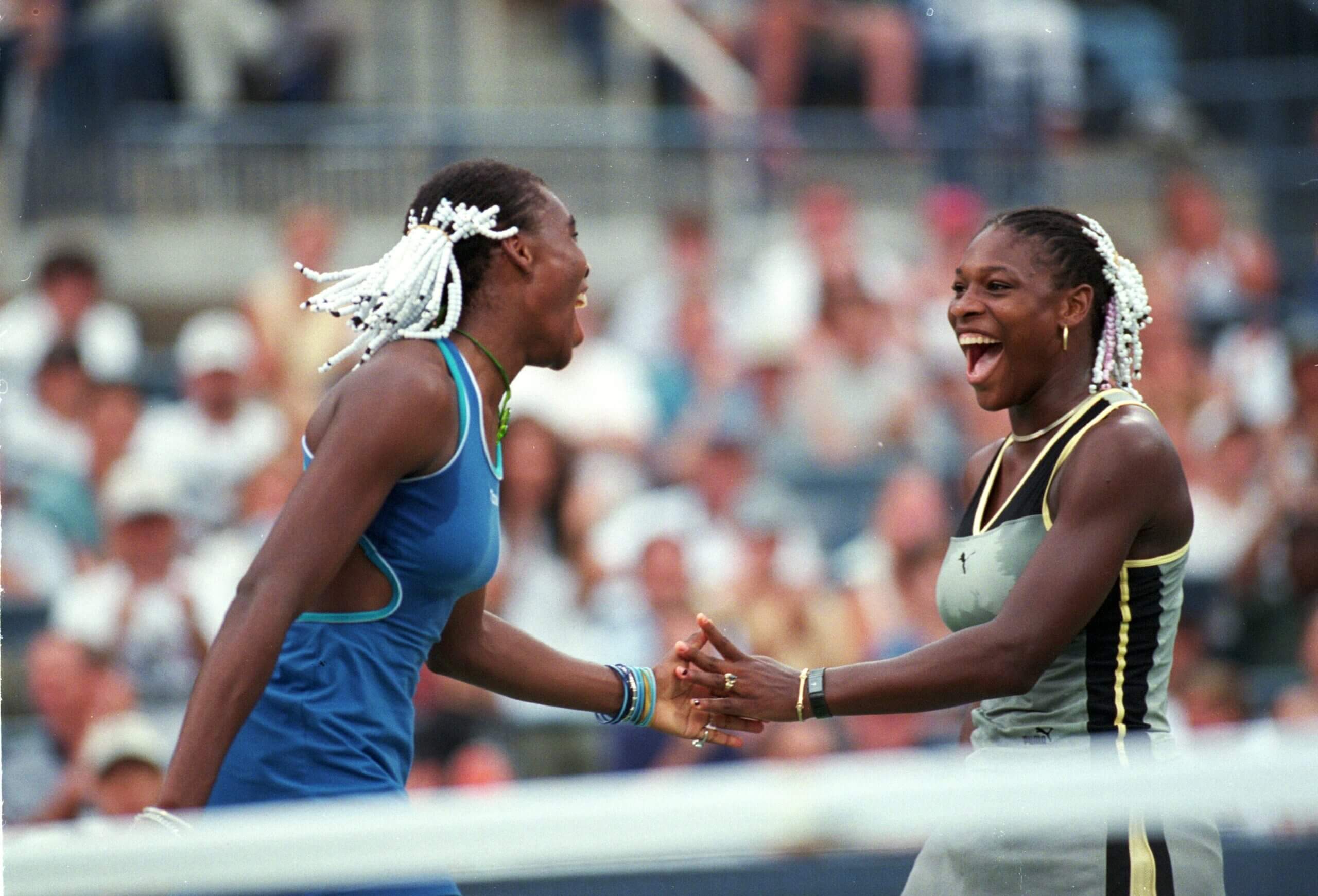
Venus and Serena Williams’ tennis legacy is peerless in the U.S. as they return. (Jamie Squire / Allsport via Getty Images)
Still, regardless of race and background, nearly every American player who makes it these days in tennis has some combination of two things. At least one supportive parent and, if money is an issue, and it almost always is, an opportunity that can eventually lead to some level of support from the USTA, especially during the late teenage years when players try to cut their teeth on the pro tours.
“You had a parent who was an athlete who introduced the game to their child,” Carrington said of Ashe and Gibson’s era. “That’s mostly what you still see going on now.”
For Blake, that opportunity was weekly participation in the National Junior Tennis and Learning program in Harlem, even after he moved to Connecticut. Through his teenage years, he volunteered there as a tutor. Asia Muhammad, who grew up in Las Vegas, got to play in a program Andre Agassi started for less advantaged young people in his hometown. Keys and Stephens gained entry and received support to train at the Evert Academy in Florida. Shelton had the right father, the head tennis coach at the University of Florida.
Taylor Townsend’s mother became friends with the mother of Donald Young, who became the world’s top-ranked junior. Young’s parents ran a tennis program in Atlanta where Townsend trained. Eubanks’ father introduced him to the game and eventually trained with the Youngs as well.
Montgomery, Ngounoue and Hailey Baptiste began at NJTL centers. Montgomery and Baptiste won spots at the Junior Tennis Champions Center in College Park, Md., the same tennis facility where Tiafoe’s father worked as a maintenance man. That allowed his son to be discovered, banging balls against the wall with his brother when he was six years old.
Gauff’s father drilled her on a local court at Pompey Park in Delray Beach, Fla., seeing early on that she was a prodigy. She played in ATA junior tournaments, and then when she was 10, Patrick Mouratoglou, Serena Williams’ coach, offered her a scholarship to train at his academy in France.
Then one day, after years of work, she was the U.S. Open champion. On another day in the summer of 2024, she was the literal standard bearer for her sport and for all the American Olympians, the first tennis player to have that honor.
She knows it’s a long story, that it took a village, and that being a Black American tennis star has a larger meaning than simply compiling tennis titles and a growing fortune.
“It means a lot to me,” Gauff said that day in Paris. “Especially in a sport like tennis where it is a predominantly White sport.”
And then the conversation goes back to where all these conversations always go.
“Having Serena and Venus, kind of, lead that path for me and pave that path for me,” she said. “It means a lot.”