
Editor’s Note: This article is part of our Bragging Rights series, exploring rivalries that form the backbone of college football throughout the 2026 season.
LAWRENCE, Kan. — The eyes of the college football universe last weekend fixated on what network executives call “helmet games,” which are instantly recognizable to most casual observers. On Saturday afternoon, it was Oklahoma at Michigan. In the evening, Ohio State faced Texas. Both were competitive, and huge television ratings will surely follow.
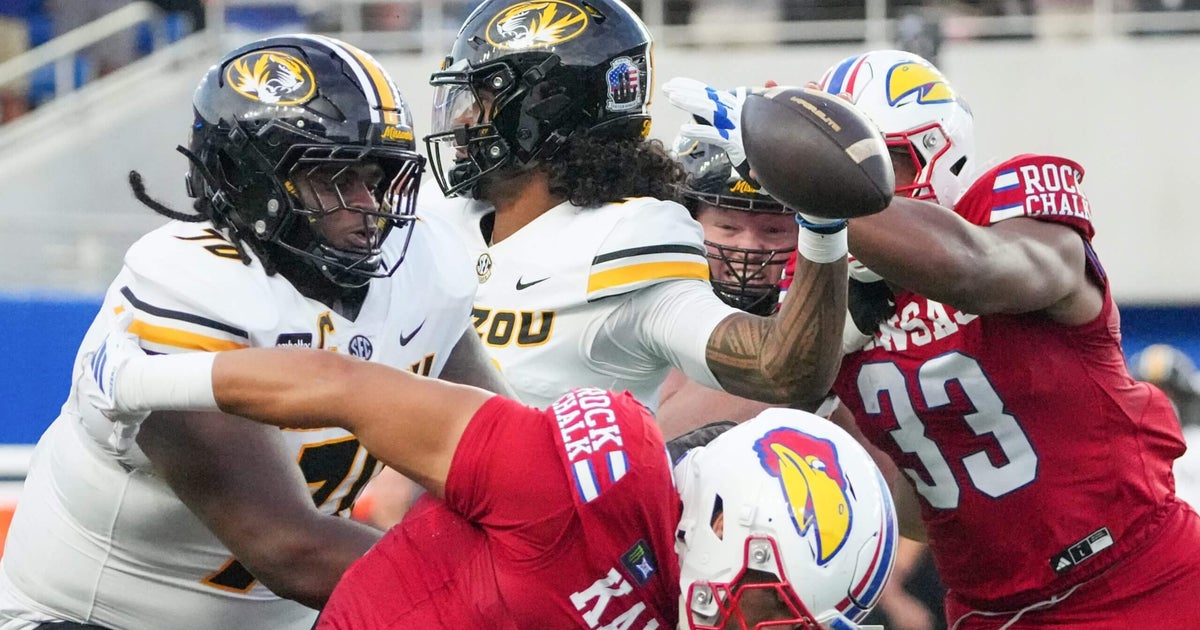
In the Midwest, there were two rivalry games that carried more importance than the result and College Football Playoff positioning. On Friday, for the first time in 21 years, Missouri crossed the river that bears its name to play archrival Kansas. A night later, Iowa played host to Iowa State for the Cy-Hawk Trophy. Both games earned prime-time slots, but in comparison to the week’s LED national matchups, these two had a Halogen quality.
Yet to fans of these four programs, Missouri-Kansas and Iowa State-Iowa mattered just as much, if not more.
Why college football must save its rivalries
Scott Dochterman
For neighborhood brawls, there’s almost a codependence. Rivalry outcomes define seasons and legacies for these programs as much as they do for high-profile battles like Michigan-Ohio State. Fans live and work alongside one another with bragging rights at stake. Without the big-picture implications, regional rivalries are more personal and emit a different type of energy — both positive and negative.
“Outside of this, everyone loves each other,” said Lily Schneider, a sophomore at Iowa State who traveled to Iowa City. “We’ll go to Iowa City, and Iowa students will go to Ames. But when it’s this specific game, we all hate each other.”
On Friday, Missouri cheerleaders sprinted to their sideline and waved sarcastically to the Kansas student section. Moments later, KU’s cheerleaders ran to the edge of a rope separating them from the Tigers football team, where talking commenced. At Kinnick Stadium, deafening boos greeted the Cyclones on their sideline in warmups, before kickoff and after halftime.
At game’s end, Missouri players attempted to plant the state flag on the Jayhawk logo at midfield and nearly ignited a brawl. Then, they joined their mascot, Truman, in pounding the Kansas side of the War Drum traveling trophy. For the first time in three years, Iowa claimed the Cy-Hawk Trophy, and when carrying it off the field, a pair of offensive linemen dropped it on the turf, nearly breaking it.
It’s unlikely any of those four teams will win a national title. Yet, Iowa and Missouri fans will hold the results over their Iowa State and Kansas counterparts for a full year or — in the Tigers’ case — even longer. In a college football universe that demands increasing buy-in from donors to remain competitive, these are the series that ultimately matter to consumers.
“I’m glad we took a break for a little bit, but ultimately the rivalry is good for college football,” Kansas fan Mike Volkmann said. “Obviously, we hate the Missouri Tigers but respect the rivalry.”
Tainted love
The Missouri-Kansas series features the most disturbing backstory of any rivalry in American history. Their shared animosity predates the Civil War, when Missouri border ruffians invaded the Kansas territory in 1854 with designs on making it a slave state. Then, in 1863, a collection of Missouri Confederate Bushwhackers led by William Quantrill rode into Lawrence and butchered 150 men and boys. Kansas’ Union soldiers, who were known as Jayhawkers, responded by cleansing three Missouri counties along the border and stacking a similar number of dead bodies in retaliation.
Bitterness lingered for generations and eventually channeled into their all-sports rivalry. Kansas adopted Jayhawks as its official moniker, while Missouri became the Tigers after the unit that protected Columbia. Kansas fans have taunted their rivals with their sordid history, and it remains part of the discussion 163 years later.
One block north from Booth Memorial Stadium at the intersection of Illinois and Tenth Street, Garrett Miller has staged a tailgate for the last 25 years. On this Friday afternoon, the backyard party featured live music, food and drinks galore, and a couple hundred fans, including those sporting gold and black. The ribbing was good-natured overall, but when describing the rivalry, the friendliness dissipated.
“It’s so much deeper than the rivalry,” Miller said. “It’s not just about the game. It’s about life in the Civil War. Not that Missourians are racist; it’s the fact that they burned down Lawrence. That’s a grudge that you kind of want to hold in a rivalry.
“I have plenty of Missouri friends that would never do such a thing, but the fact that you can find something like that and pull that thread and hold on to it — that’s what makes college football, college football.”
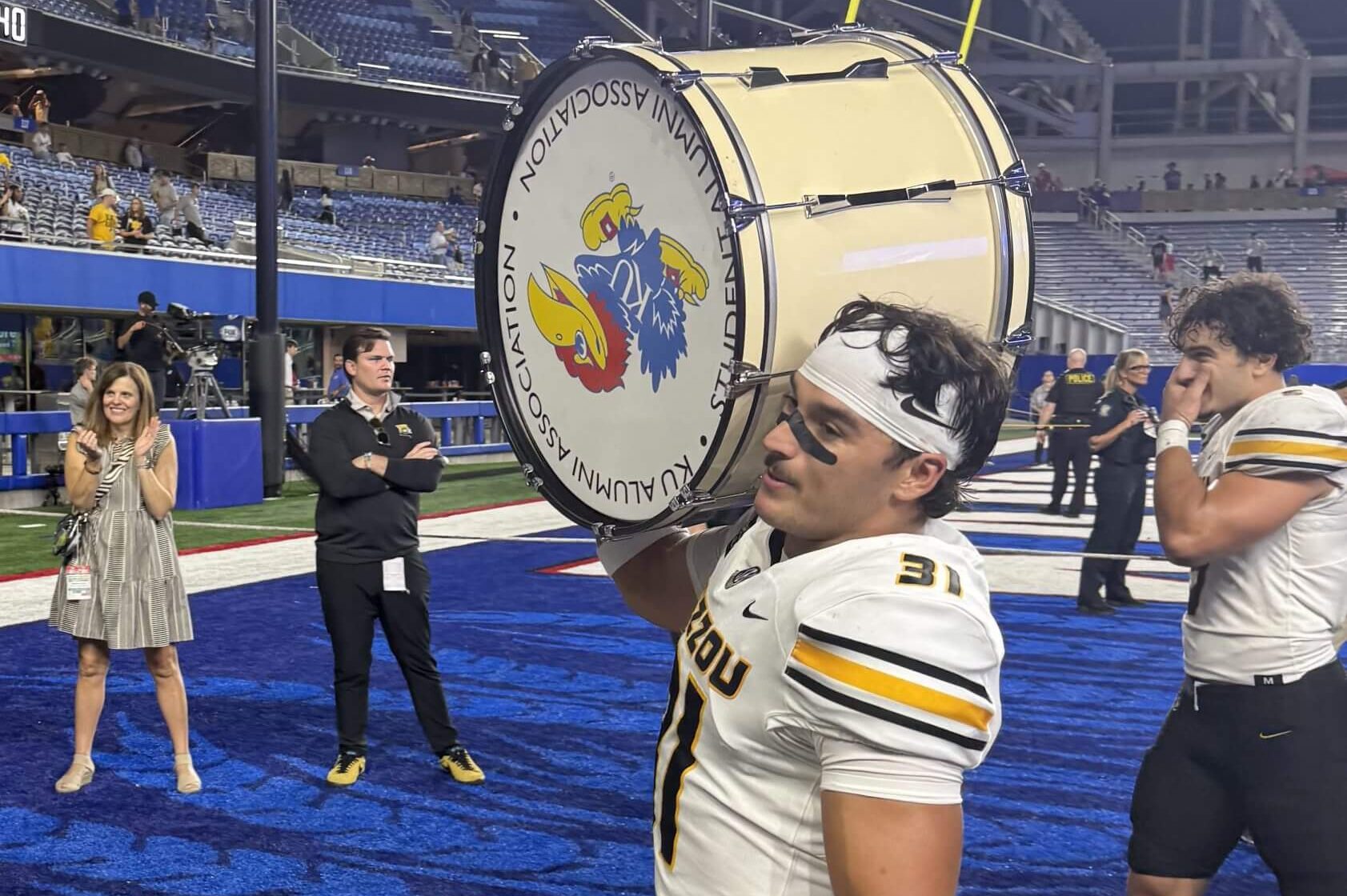
Anthony Favrow carries the Border War drum, next at stake in 2031. (Scott Dochterman / The Athletic)
For this rivalry, it’s appropriate that fans walking south toward the stadium must cross Fambrough Drive. Don Fambrough coached the Jayhawks in two stints and famously said: “Kansas State is our rival; Missouri is our enemy.” He set up college trust funds for his grandchildren, but he’d pull the offer if they chose the school 164 miles east along I-70. Two hours before kickoff, Missouri team buses parked on Fambrough Drive as they filed into the stadium. Loud jeers and expletives from Kansas fans rained upon the Tigers, most of whom were unfazed.
Amid the sea of street carts, tents and volumes of blue “Muck Fizzou” T-shirts, four friends strolled past the stadium shortly before kickoff. Tom Morris and Kyle Schrick wore Mizzou black; Jon Ross and Emily Ross sported Kansas red. They all attended the same high school, and the men played football together at Benedictine, while Emily played basketball at Baker.
When they were in college two decades ago, Jon Ross described the Missouri-Kansas rivalry as “hateful.” Today, he said it’s more like “love-hate.”
“K-State’s like your little brother,” he said. “Missouri’s the rival you hate. Legitimately, they burned our town down. It’s totally different. Like, there’s history.”
Schrick then quipped, “Well, we did win that one.”
They all remarked about the signs around Lawrence, which are witty rather than mean-spirited.
“That was more fun,” Morris said of the old hate. “Now they try to be funny.”
Kinnick carnival
Iowa City and Ames turn into carnival-like atmospheres for the Cy-Hawk. It takes place every year in early September, with an estimated 30,000 extra people tailgating and not among the 70,000 in attendance this year. Gubernatorial and senatorial candidates attended the game and greeted fans at tailgates and official functions.
There’s animosity between the programs that dates back to Iowa declining to schedule Iowa State from 1935 until 1977, and every few years something pops up that gets under one another’s skin. In comparison with Missouri-Kansas, the Cy-Hawk is friendlier, although the pregame banter may not qualify as “Iowa Nice.”
Along Melrose Avenue, one bearded Iowa fan obnoxiously shouted “Go Hawks” at every passerby, no matter the colors. He offered fist bumps to Iowa fans and then leaned in and whispered to Iowa State fans, who ignored him or squirmed away.
“We get a lot of ‘F— State’ as we’re walking,” said Kenley Gilhaus, a sophomore Iowa State student. “Or they’re like, ‘Wrong colors.’”
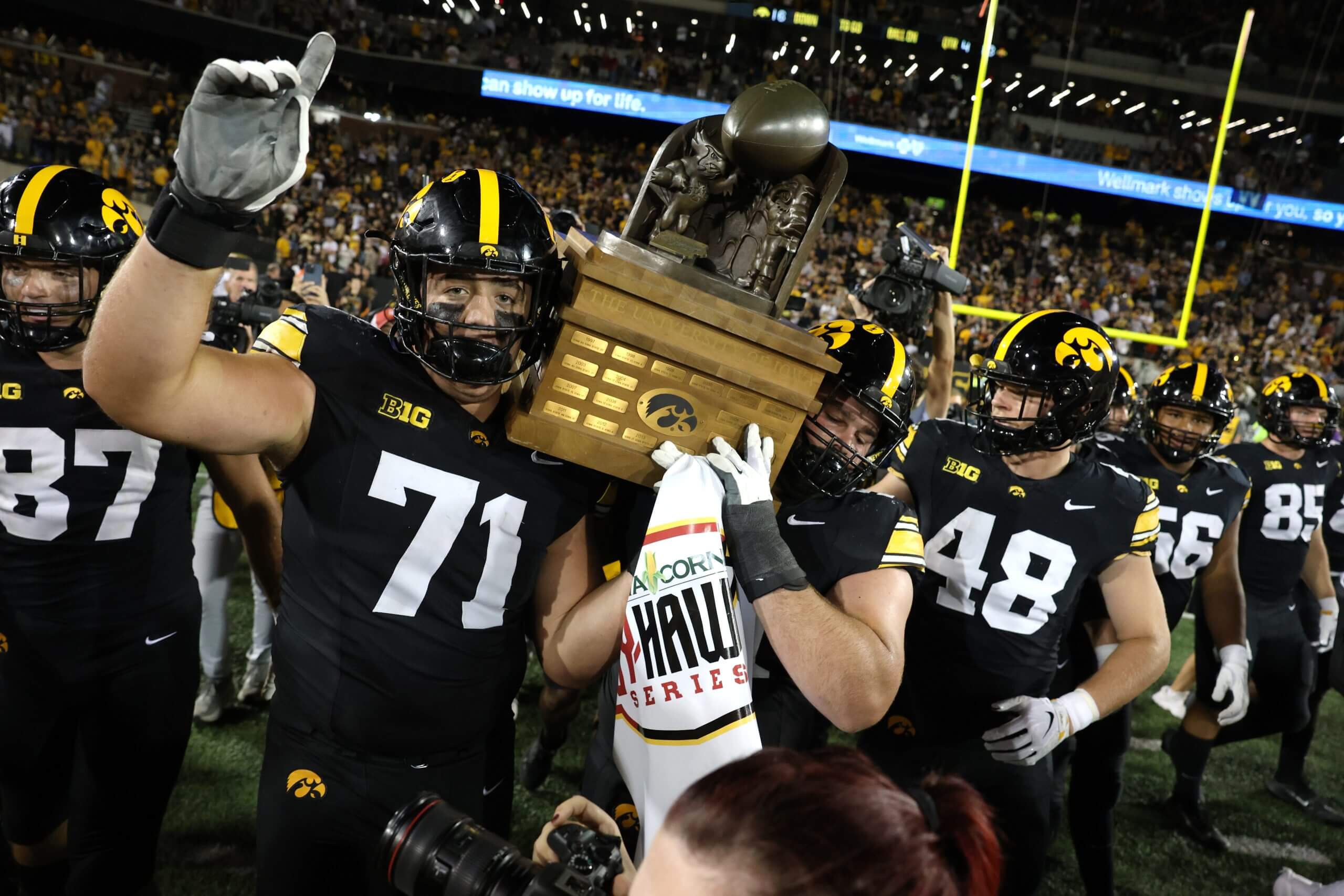
Iowa and Iowa State have split six Cy-Hawk meetings since a pandemic break. (Reese Strickland / Imagn Images)
But most interactions are mild because of the state’s shared heritage. In the Des Moines metro area, which contains roughly 750,000 people, the fandom is split almost evenly. “House Divided” flags fly throughout the state on Cy-Hawk week. Iowa’s Brevin Doll and Iowa State’s Aidan Flora and Vince Benetti were football teammates at ADM High School in Adel — the birthplace of Hawkeye legend Nile Kinnick. A total of 64 players on both teams hail from Iowa.
Gilhaus, Schneider and Cambree Sussex embody the friendly banter and interwoven relationships of Cy-Hawk week. All three are Iowa State students, but Sussex wore an Iowa sweatshirt because her boyfriend, Eli Robbins, is a first-year defensive back for the Hawkeyes.
“I don’t have a choice,” Sussex said.
Without a major professional sports team inside their borders, Iowans often refer to this game as the state’s Super Bowl. From the turnout to the vibes, it certainly felt that way. There’s “Hate Week” banter from both sides, but they also come together, unlike most rivals. During Iowa’s season opener, third-year Hawkeye Marching Band member Derek Phillips suffered cardiac arrest in sweltering heat and died three days later. That night, Iowa State held a moment of silence before the volleyball match with the Hawkeyes, and the Cyclone Marching Band will wear black-and-gold pins this season in Phillips’ memory.
Can they continue?
Despite the intensity and interest surrounding these series, it’s far from automatic that they remain in place. Since 1977, Iowa and Iowa State have played every year, but in 2020, they agreed to a new deal through 2031. Should the Big Ten or Big 12 increase its number of mandated games, there’s an out. Iowa coach Kirk Ferentz has long advocated for the series and will continue to do so, but he’s 71 and won’t coach forever.
The last five Cy-Hawk matchups have been decided by seven points or less, four of which were by a late field goal. Every Cy-Hawk game since 2007 has been sold out. Over the last 10 seasons, Iowa State has won the most Big 12 games (48), while Iowa ranks fourth with 52 Big Ten victories. Even this year, in which Iowa State replaced its head coach and added 83 new players, the Hawkeyes pulled out the win on a 42-yard field goal with 15 seconds left.
“It’s probably underappreciated a little bit on a national front just the football that gets played here for a state of our size, our population,” Ferentz said. “You have two Power 4 programs that have been really good this past decade.”
Missouri-Kansas’ future remains more complicated. It was the second-most played rivalry among FBS programs before the Tigers left for the SEC in 2012. Although Missouri wanted to extend the series, Kansas administrators vowed never to play again in football or men’s basketball. Gradually, they relented, first in 2017 with a charity basketball exhibition in Kansas City. The sides agreed to a two-year football contract for 2025 and 2026 with two more years in 2031 and 2032.
Both sides continue to infuriate the other, as the Jayhawks did last week. One day before kickoff, Kansas’ social media team released a video that described the historical origins of their contempt as “heroes and villains,” featuring images of historical figures such as Quantrill and John Brown. Following the Tigers’ 38-21 win, Missouri coach Eli Drinkwitz said he was disappointed with Kansas’ hype video and added, “I don’t really care if it continues or not.” He also attempted to score a late touchdown to make a point.
Kansas athletic director Travis Goff said before the game that “right or wrong, we lean into the history. At Kansas, we’re an athletic program that’s part of an institution of higher education. So, should we talk about the starting point of the Missouri-Kansas territory conflict? I think in education and in college sports, you should talk about that. Not everybody likes that, right? But we’re going to do it.”
Perhaps the stubbornness on both sides is why this rivalry thrives despite its nonconference status. The Tigers have traveling trophies with Arkansas and South Carolina in the SEC plus a burgeoning series with old Big 12 foe Oklahoma, but nothing riles up the Mizzou faithful like the Jayhawks. For Kansas, the series with Kansas State matters but doesn’t juice up the locals like Missouri.
This raises the question: Is it healthier now as an infrequent matchup?
“Yes and no,” Miller said. “Yes, because we don’t play each other as much, so it’s like not on top of our mind. No, because we don’t play each other. Mizzou still hates KU and thinks about KU all the time. Every game they chant (M-I-Z-F-K-U). I love that, but we also get our butts kicked a lot nowadays. So, I wish that we had more chances, but I also wish that we were in the same league together, playing each other every single year.”
“I think we should do it every year,” said Missouri fan Mark Keith, who brought his college-aged son Mark Jr. to Lawrence to experience it. “That rivalry goes way back as far as I can remember. So, I think these games make college football better, just like Auburn-Alabama.”
Every so often, these games approach upper-level status, like No. 4 Missouri beating No. 2 Kansas in 2007 or No. 10 Iowa topping No. 9 Iowa State in 2021. In most years, the rankings are an afterthought. But not playing one another sometimes feels worse than losing.
“I have so many friends across the border in the KC metro area that love Mizzou,” Miller said. “I miss the days where every single year, multiple times a year, one football game, two basketball games, maybe three, where it’s the week that we hate each other but we love each other. The last two years, I’m getting text messages or voicemails or ‘Hey, can I come to your tailgate just so I can talk some crap?’
“I miss that camaraderie.”
The Bragging Rights series is part of a partnership with Modelo.The Athletic maintains full editorial independence. Partners have no control over or input into the reporting or editing process and do not review stories before publication.