
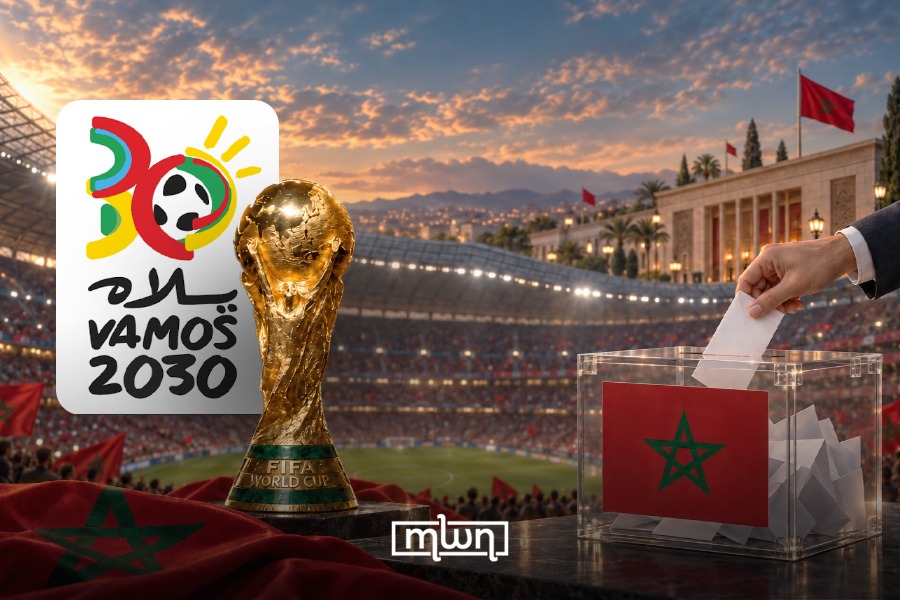
Rabat – Morocco’s political parties are entering the campaign for the September 23 legislative elections with programs built primarily around purchasing power, employment and public services.
Sport rarely occupies the same space in that conversation, even though it touches directly on public health, education and youth policy, and carries economic potential that few other sectors can claim at this particular moment. The election campaigns mark Morocco’s preparations to co-host the 2030 FIFA World Cup with Spain and Portugal, a tournament that has turned sport into one of the more concrete tests of what the next government intends to build.
The 2030 World Cup as a development lever
For several parties, the World Cup is treated less as a sporting fixture than as a national development project.
The Authenticity and Modernity Party (PAM) frames the tournament as a chance to convert the momentum it generates into lasting infrastructure, singling out stadium construction and renovation alongside transport, urban development, housing, and digitalization.
The party’s broader electoral program, unveiled in early September and cost at roughly MAD 350 billion over five years, sets a target of creating 40,000 jobs in sport specifically, within a wider plan of 360,000 positions tied to the World Cup and its surrounding activity.
The National Rally of Independents (RNI) draws a similar line between World Cup preparations and employment, with particular emphasis on opportunities for young people.
Its program also gives weight to integrating the informal economy, positioning the tournament as a moment that should widen the circle of people who benefit from the investment it brings rather than concentrate those gains among a few sectors or regions.
School sport and access for the Istiqlal Party
The Istiqlal Party takes a different starting point, placing less emphasis on the economic windfall of hosting a global tournament and more on school sport as the foundation for wider participation in physical activity.
The Istiqlal party’s program proposes an integrated national system built around strengthening sports facilities and equipment in schools, expanding pupils’ access to sporting activity, and identifying and developing talent from within the education system.
The approach treats school sport as part of the educational process itself, a way of instilling discipline, teamwork, better health outcomes and social cohesion, and of building a generation with a habit of physical activity rather than one that produces occasional talent for clubs and national teams.
A MAD 15-billion sports budget for the PPS
The Party of Progress and Socialism (PPS) has given sport one of its more prominent positions among this year’s campaigns.
Under the slogan “Osons ensemble” (‘Let’s dare together’), part of a broader program valued at MAD 575 billion in additional spending over five years, the party has earmarked close to MAD 15 billion for sport, with a commitment to create 100,000 direct and indirect jobs in the sector by 2031. Related reporting on the program has also referenced a target of bringing one million people into Morocco’s sports federations.
The PPS frames sport as a right that should not depend on a person’s income or where they live. Its program sets three objectives: widening access so that men and women across social and economic backgrounds can take up physical activity, with membership across sports federations targeted to reach one million by 2031; guaranteeing four weekly hours of physical education for all pupils and nearly doubling the number of sports instructors, from around 10,000 today to 20,000; and moving national sporting performance away from a reliance on isolated individual talent and a single dominant sport toward an integrated system of training, talent identification, and development across disciplines.
Governance reform from the PJD
The Justice and Development Party (PJD) has focused its sports proposals on governance rather than budget figures, pointing to overlapping responsibilities within Morocco’s sporting institutions as a structural weakness.
The party proposes separating political and partisan roles from the management of sports bodies, distinguishing clearly between the public, political and electoral functions on one side and the administrative running of leagues and federations on the other. Under this proposal, professional leagues would take charge of organizing competitions and developing the professional market, while national federations would be responsible for training, regulation, and oversight of national teams and international relations.
A dedicated ministry for the Popular Movement
The Popular Movement (MP) has called for the creation of an independent ministry for sport and a new national policy for the sector, arguing that Morocco’s preparations to host major tournaments, led by the 2030 World Cup, justify a dedicated institutional structure.
The party’s program describes sport as a social right that goes beyond entertainment or competition, framing it as a tool for education, integration and disease prevention, a source of role models for younger generations, and an economic activity capable of generating jobs and attracting investment.
A contest already staked on one front
The question of who will actually run World Cup preparations has already been decided outside the ballot box. A royal decree issued in August 2025 established the Morocco 2030 Foundation, chaired by Budget Minister and Royal Moroccan Football Federation president Fouzi Lekjaa, to oversee all FIFA and CAF events hosted in the country.
The foundation operates with considerable financial and executive autonomy, regardless of which coalition emerges from the September vote. This means the tournament’s organization sits above the usual electoral cycle even as it remains one of that cycle’s central talking points.
Lekjaa’s move to join PAM in July 2026, seven weeks before the vote, was widely read as an attempt to convert his football administration profile into electoral capital, and it has fed talk in Moroccan media of a future ‘World Cup 2030 government’ whose performance would be measured against a fixed, internationally visible deadline.
In an interview with Jeune Afrique published this week, Lekjaa addressed speculation about his political future and his recent move into party politics. Asked about the possibility of becoming head of government after the September 23 legislative elections, he said that the position had never been part of his plans.
“Head of the government? I have never thought about it,” he said.
Lekjaa added that his immediate focus was the electoral process, saying, “I have a mission that ends on September 23.”
A sector still waiting for a comprehensive vision
Taken together, the parties’ programs suggest that sport enters this campaign mainly through the door opened by major international events and the economic opportunities attached to them, rather than through a comprehensive vision for how sporting practice should develop across society.
With a new government set to take shape after September 23, and with four years standing between the next legislature and kickoff in 2030, the argument among observers is that Morocco needs to move past treating sport as a showcase for big tournaments or a tool for international image-building, and start treating it as a sector that requires a clear, long-term strategy of its own, one that starts with school sport and grassroots participation, continues through talent identification and training, and extends to professional competition and the broader sports industry.