
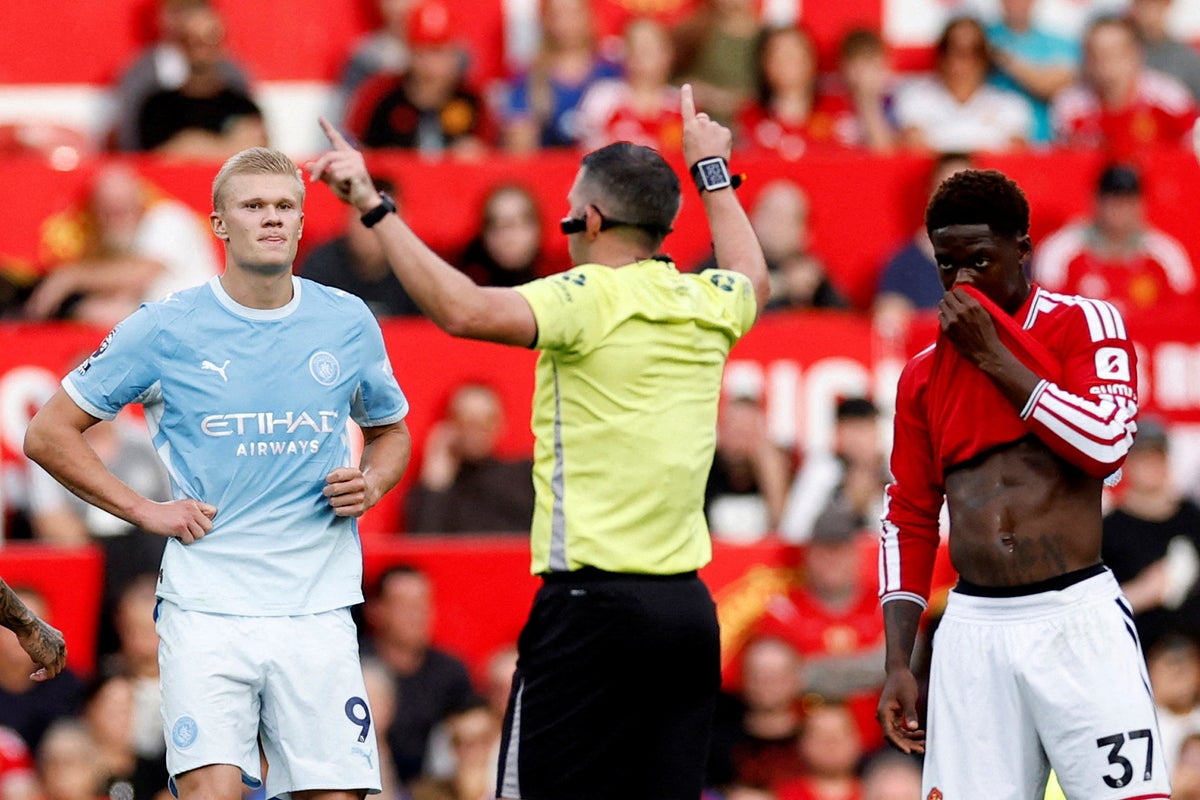
Amid yet another refereeing storm, some in the game couldn’t help but think of a much quieter moment. It is one they feel helps explain so much of the chaos – and why there will always be more to come, but not down to competence.
In the summer of 2025, representatives from what was then PGMO were having their customary meetings with clubs as part of the reformed approach. There is an admirable need to ensure “alignment” across the English game, and the big concern at that point was over set-pieces – except many wanted a greater permissiveness.
Then the rest of the world hated the effects of this, and there has since been an immediate swing back. One source within the authorities says that Sunderland’s penalty against Arsenal was a direct response to this; “a classic of ‘we’ve got to do better here, crack down on this holding’.” There was just something of an irony, or maybe an inevitability, that it was Arsenal involved after all of last season’s discourse.
The context for the Haaland goal was much the same, except in a much quicker timeframe. The previous week, amid the more forgiving spotlight of a 3pm Saturday game, Sunderland scored a goal against Brentford where Kevin Danso was clearly offside. The key question was whether he was in the goalkeeper’s line of vision; it took around four minutes to decide. Since the match finished in a draw where everyone was relatively satisfied, that was largely forgotten – but football sources feel it directly influenced what happened at Old Trafford.
The referees generally have a weekly call about the major VAR incidents, and if there has been a slow check, the sense will very much be “we’ve got to get it done more quickly”. To add to that, many officials are naturally mindful of the idea of “possibly ruining it for everyone”.
And so there’s the Haaland goal. Multiple people in football have pointed to how the VAR, Matt Donohue, used the word “quick” eight times – and that was in a situation where there were multiple layers of the goal to check… but not, apparently, the one that mattered most: whether Enzo Fernandez, like Danso, was interfering with play.
And so, from referee chief Howard Webb’s description of a VAR displaying “tunnel vision”, we have another of those weeks that brings scrutiny on every element of refereeing, as well as a state-of-the-nation debate; a real back-and-forth; one more week when England has become either Spain or Italy in terms of disproportionate focus on referees.
That didn’t come as a shock to refereeing circles this week, of course. There, according to multiple insiders, the view is that one notable error in a match-round is generally seen as statistically likely, one VAR error is a bad weekend, and two VAR errors is viewed as a crisis weekend – especially if an incorrect VAR decision is inserted, as happened during the Manchester derby. The anticipation has been that this week’s meetings will now involve calls to “take your time”. Officials have often been left wondering what is really wanted from them, on top of having to navigate so many elements to many modern decisions.
Football’s very relationships with their referees swing in the same way. For all the perceptions, there are multiple stories of positive meetings – like in the summer of 2025 – where club executives were actually thanking the referee chiefs for their honesty and openness. Players and coaches are quite empathetic as regards how tough the job is, especially when many have the same experience of extreme criticism out of pressured situations.
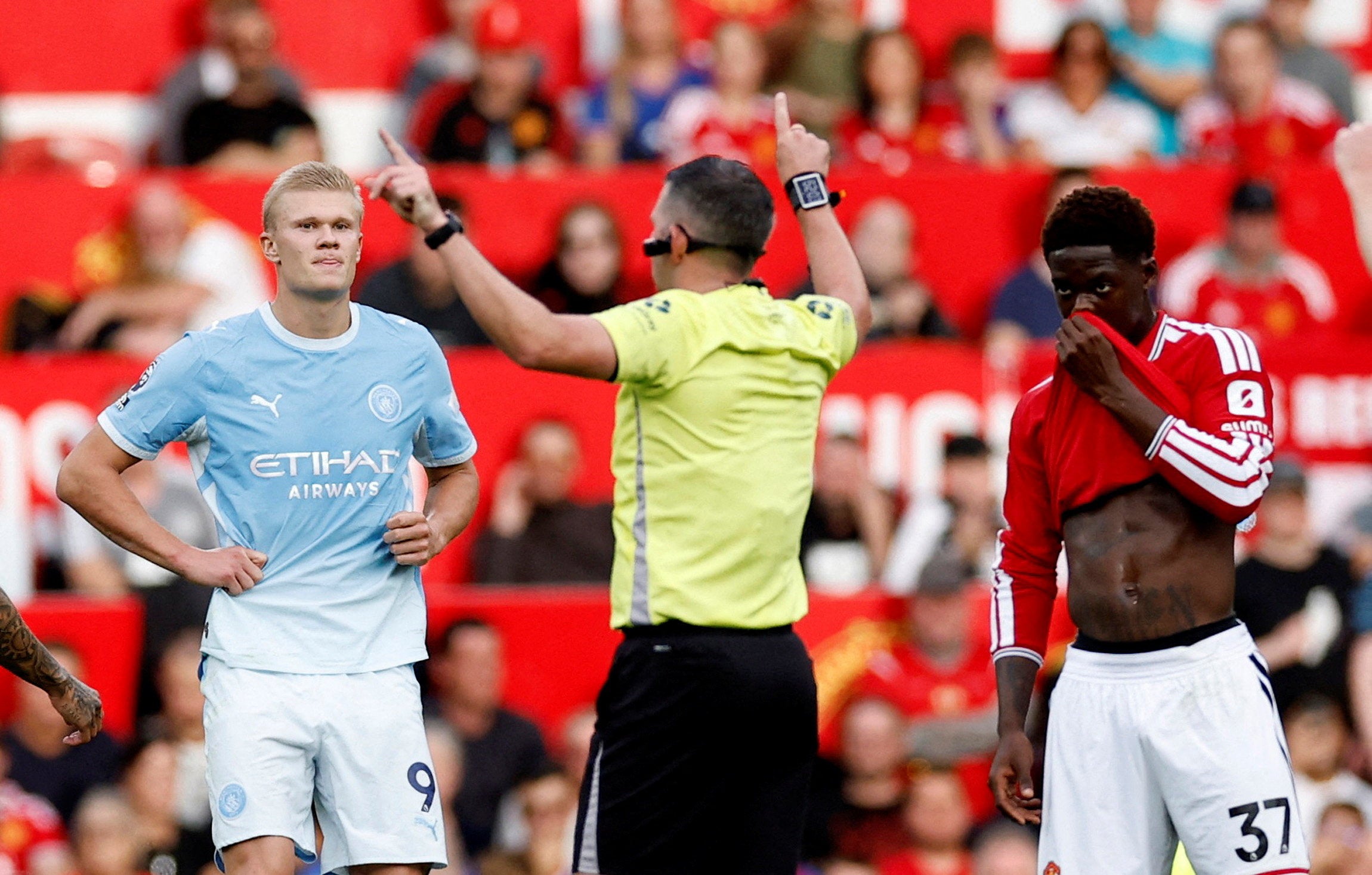 Manchester City’s Erling Haaland reacts as referee Michael Oliver awards a goal following a VAR review (Reuters)
And then you speak to some of the same people in weeks like this, and it’s as if years of frustration just spill out. “PGMO should be 100 per cent thrown away,” is a common line, pointing to how the rebrand to ProRef hasn’t necessarily gone that deep yet. “Standards are worse than ever,” goes another refrain, “because PGMO only care about the Premier League. Hence the EFL, which referees obviously have to graduate through, isn’t at the level.”
One of the biggest complaints is of course about “accountability” and a culture of protecting each other, “like the cops”, which football figures find all the more frustrating when the margins within games are tighter than ever and the margins for key league positions can be a mere two to four points. There were even references to how there “literally used to be a freemasonry” at the old Lancaster Gate, and executives complain of an “arrogance” among referees, where it’s like their complaints aren’t being heard.
Only reflecting the complexities of this, those in refereeing circles would say clubs often have contradictory complaints that you can’t possibly consistently satisfy. And, sometimes, they contradict themselves.
Far from not listening to them, Webb is almost viewed as being too open. He takes calls from clubs a lot, which is a complete contrast to predecessor Mike Riley, when there was barely any engagement four years ago. It is the directors of football who often make the calls during these regular dialogues – and the three much-lauded Bs, Brentford, Brighton and Bournemouth, are surprisingly said to be among the most active, trumping even some of the “big clubs”.
If so, it would actually be entirely consistent with their approach to everything; to play the odds. As one official says, “there’s no downside in complaining all the time, only potential upsides that are worth a punt.” Some have even called Webb about penalties that everyone in the world has considered a stonewall penalty, demanding to know “the thinking”. Mikel Arteta’s very public criticism of the Sunderland penalty on Saturday felt consistent with that – it was setting an Alex Ferguson-style marker.
Other coaches display a far greater paranoia, and that isn’t due to the potential of fines. They genuinely believe that if they say anything in public, they’ll get decisions going against them.
At least one southern club has meanwhile referenced the much-discussed “northern bias”: the over-representation of officials from the north, and especially “greater Manchester”, in refereeing. Many sources would insist that this is just an ongoing consequence of long-term structures, right up to accessibility, that Webb’s organisation is seeking to work against. They’d point to greater investment down the whole pyramid, how they are building modern pathways that encourage a healthy competitiveness among referees that are gradually improving standards. When it comes to standards, referees from the Premier League and Championship have been grouped together, so as to recognise high performance.
The sense is that it will just take time for all this to come through. ProRef would nevertheless point to how VAR errors are going down, as well as time used for the system. For the former, it was 35 in 2022-23 and 25 last season, due to 22 missed interventions; Haaland’s goal is interpreted as the only error so far this season. For delays, it has gone down from 64 seconds in 2023-24 to 36 last season. As one source says, “imagine the meltdown in the Premier League if we had an equivalent to Germany’s goal against Paraguay in the World Cup being ruled out”.
And yet others say that time is precisely the problem, that incremental changes are considered revolutionary, which is why Webb’s progress is good but “glacial”. There is also an insistence from some that the northern over-representation is a genuine issue. They describe how all of the key decision makers for 25 years have been from there, and “word of mouth” still goes a long way.
One of the subjects that provokes the most emotion, however, is that of “accountability”. ProRef would strenuously point to how Webb is directly accountable to the clubs – as illustrated by those calls – how every single match is judged by an independent panel, how officials are moved off games, like this weekend, and how officials’ pay is actually dependent on accuracy. That is how their bonuses are decided. There is also a “professional pride” in getting things right.
Football staff would counter that this is an incentivising approach, rather than true accountability. One Premier League coach is meanwhile said to be so obsessed by all of this that he actually has a detailed plan for how refereeing should work, right up to how there should be three entirely separate pillars: the on-the-ground officials; the VARs, who never work with the officials or do any on-the-ground work; and then a group that audits them. ProRef would point to how they are now developing specially trained VARs. There are said to be politics there, too, “depending on hierarchies and personalities”. It isn’t seen as helpful that some officials talk of “babysitting” new recruits.
While this newsletter is not intended to be another debate on the very existence of VAR, it of course adds a whole other layer; one where chaos, rather than order, is arguably inevitable.
 Howard Webb wants more transparency in refereeing (Getty)
As educationalist Daisy Christodoulou posited in her insightful book, I Can’t Stop Thinking About VAR, there will always be a fundamental problem with the idea. Football’s laws were written for on-the-spot human interpretation, not for video replay. Now, however, every single detail has to be retrofitted to the latter. Or, as the astute former referee Graham Scott has put it, “laws upon caveats upon sub-clauses”, and “the irresistible force of speed versus the immovable object of accuracy”. That is how you get the “tunnel vision” that Donohue endured on Sunday.
Referees meanwhile privately admit they can feel the tension from all of this in the moment, especially as the crowd chants about VAR. It builds. Some players and managers doubt whether referees are sufficiently prepared for that kind of pressure; it is very different to an on-the-spot decision. Others insist it’s more stark. For all the talk of pilot-style training, “the runway doesn’t move”.
You can’t recreate a given situation in training. Everything is always unique and in real time, communicated verbally – all of this, of course, as the very same cameras ensure more scrutiny, greater demands and all amid ever-increasing stakes.
As one figure wondered this week, would you really have a modern equivalent of Liverpool’s Robbie Fowler insisting his fall against Arsenal wasn’t a penalty, as happened in 1997? It seems highly unlikely. Everything around the decision-making has changed so much.
Get Inside Football direct to your inbox
 Miguel Delaney’s Inside Football newsletter lands in your inbox every Monday and Friday (The Independent)
The article above is the lead column from the award-winning Miguel Delaney: Inside Football newsletter.
Inside Football members and Independent Premium subscribers can get the full column – plus additional reporting from inside the Premier League, Champions League and more – delivered to their inbox every Friday at midday. This week’s members-only newsletter also includes:
More interest in JJ GabrielRivals stunned by “alarming” Manchester United collapse against Brighton
New Inside Football members can enjoy their first month FREE. After that, membership costs just £3 per month or £30 per year. Join HERE.