
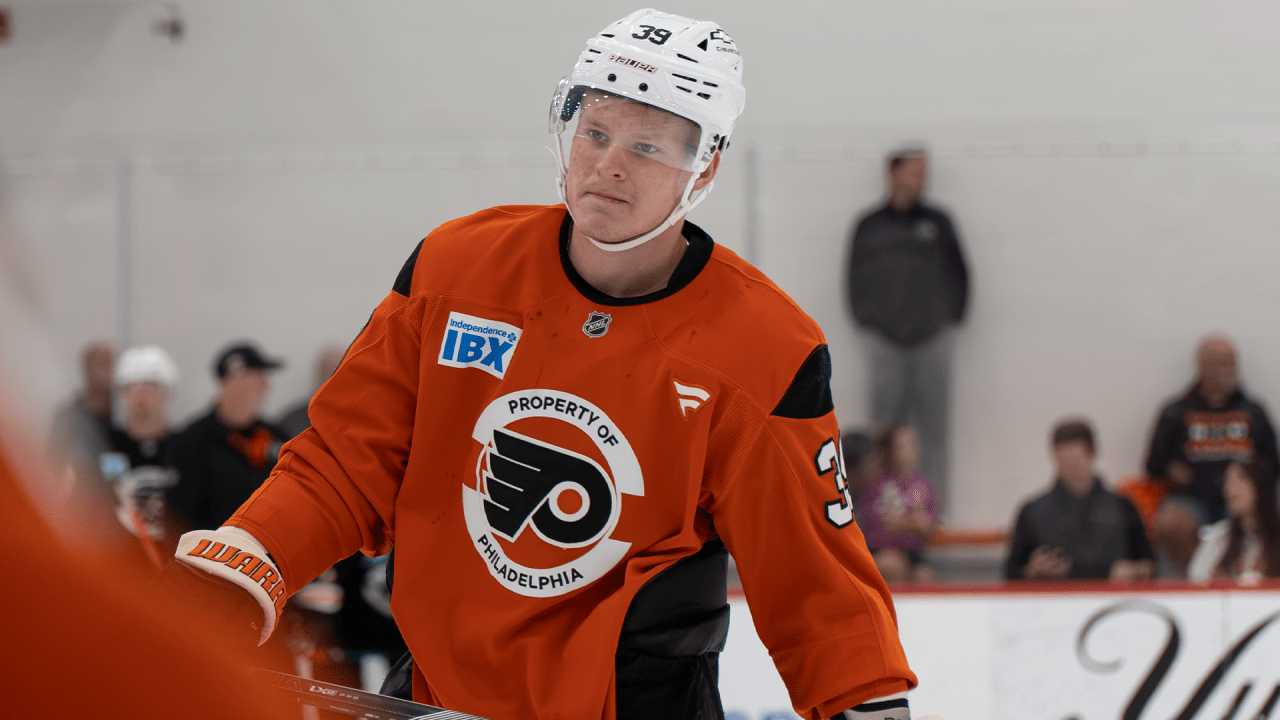
With the full complement of players on the ice across three practice group sessions, the Philadelphia Flyers opened their 2026 training camp by getting right down to business on Thursday.
The NHL shortened the preseason from six to four exhibition games apiece and lengthened the regular season from 82 to 84 games apiece. As such, every day and each drill at camp takes on greater importance.
On Thursday, the Flyers wasted no time incorporating systems work into the first day of camp. There are always a few tweaks the coaching staff implements before camp begins — the Flyers aim to improve puck possession and need less frequent defensive containment to the perimeter compared to last year– but their system “staples” from Rick Tocchet’s first year as head coach carry over to 2026-27.
Day one practice sessions were divided into two main groups (Group A and Group B) with a smaller third group having its own session. The grouping broke down as follows.
Group A
Carl Grundstrom – Trevor Zegras – Owen Tippett
Alex Bump – Sean Couturier – Cole Knuble
Zach Aston-Reese – Denver Barkey – Matvei Michkov
Noah Powell – Jack Studnicka – Mattew Gard
Travis Sanheim – Olver Bonk
Maksim Sokolovskii – Rasmus Ristolainen
Simon Benoit – Helge Grans
Ty Murchison – Brek Liske
Dan Vladar
Aleksei Kolosov
Group B
Travis Konecny – Jett Luchanko – Porter Martone
Noel Acciari – Noah Cates – Tyson Foerster
Danila Klimovich – Christian Dvorak – Nolan Foote
Riley Thompson – Jacob Gaucher – Garrett Wilson
Cam York – David Jiricek
Hunter McDonald – Jamie Drysdale
Nick Seeler – Spencer Gill
Riley Steen – Andrew Perrott
Joseph Woll
Carson Bjarnason
Meanwhile, although second-year winger Nikita Grebenkin is day-to-day with a physical issue at the start of camp, he skated while the Group C session took place. Group C notables included defenseman Luke Vlooswyk, Alex Ciernik, Nathan Quinn and goalie Martin Psohlavec and Marek Sklenicka.
Michkov shines on Day One
Entering his third season in North America, Matvei Michkov could hardly have hoped to make a better impression than he did on Day One of 2026 training camp. In far superior physical condition than last September, Michkov sailed through the drills with good pace and a sense of confidence.
Over the summer, apart from working on his physical conditioning, Michkov put in a lot of work on one-timers. He did a lot of skating, too. The aim was to add a little more separation from defenders and elusiveness. The one-timer, which he used to snipe a couple goals on Day One, adds an improved weapon to his arsenal. Opponents can’t always expect Michkov to hold the puck and look for a play to make if he fires off quick shots more often, too.
However, the biggest news from Day One: Michkov conducted his first-ever English press conference. Translator Slava Kuznetsov was on hand to make sure Michkov fully understood questions, but Michkov gave all answers entirely in English.
The young player admitted he was nervous about clearing the English interview hurdle, but he did very well in expressing himself. Afterwards, the young Russian had a broad smile on his face, especially when the attending media clapped for him. The day meant a lot to him.
“I started in Philly with zero level English. Second year (was) a little bit better, now a little bit better more. Now this is my first interview in English. This is hard for me. Guys, sorry. But I think now much better. I think Philly is my second home. I feel the same about my first home and my second home. I feel the same, so good. Thank you everybody for your support. And the atmosphere,” Michkov said.
In terms of conditioning and on-ice work, Michkov noticed an immediate positive difference. So did Tocchet and veteran teammates such as captain Sean Couturier and perennial team leading scorer Travis Konecny.
“I think this is so good for me. I feel lighter on the ice. More speed. Every skill (has) more speed; better speed. I eat right now, Just good food. No fast food,” Michkov said.
The player still has work to do in some of his risk vs. reward decision making on the ice — particularly from the top one of the offensive and defensive zones through the neutral zone. These ongoing adjustments will be part of his continued growth as an NHL player. However, these are all attainable goals, especially as improved quickness translates into more attack opportunities with higher percentage chances to make a creative play successfully.
Said Couturier, “You can definitely tell he’s put in the work, he’s put in the sacrifices, He looks in good shape. He’s skating well out there, making plays. So it’s exciting to see. He’s always been a big part of our team. We expect that out of him and he seems to want more.”
For his part, Toccet reiterated on-ice messages he spent considerable time last year trying to instill in Michkov: he wants to provide leeway to make plays but the player has to recognize when it’s a good decision to make a play and when it’s smarter to wait for the next battle.
“He looks quick out there, him and Barks were buzzing around,” Tocchet said.
“We were doing the concepts that we talked about. He did look very quick out there. He really wanted to work on his shot this summer, he spent a lot of time working on his shot. And he was pushing the pace on the laps, I love that.”
Better conditioning plus more mature decisions with and without the puck equals greater trust from the coaches. Greater trust from the coach means more high-leverage ice time. That’s a truism at every level of hockey, and with any coach.
Michkov aced the first day of camp in every conceivable way. Now he has to build off that foundation, day by day. If he can do that consistently, the sky’s the limit in his third NHL campaign.
Clean bills of health
Noah Cates (playoffs), Owen Tippett (late stretch drive and playoffs), and Grebenkin (mid-season) all suffered season-ending injuries last year. Tippett and Cates both started camp on time with clean bills of health.
“I’m feeling 100 percent.” said Tippett, who dealt with both a core muscle surgery and unrelated internal bleeding.
“I took some extra time off the ice. But when I got back out there, I felt 100 percent. Basically had a full, normal summer. No complaints, no restrictions and it feels 100 percent now….It is what it is, but there’s one thing you learn, there are some things that you can’t really control and there’s also life after hockey that you’ve got to look after. It was unfortunate with the timing and everything, but I’m glad I took the time that I needed.”
Rookie Jett Luchanko played through a core muscle issue for roughly 18 months — which adversely affected his 2025-26 season — but is now fully healthy after undergoing an offseason procedure. He noticeably attacked through the middle, made plays and shot the puck more readily both at Rookie Camp and Day One of NHL camp.
Grebenkin, meanwhile, was at least able to do so skating on Day One along with Group C. He is in a roster battle with Alex Bump, Carl Grundstrom and any surprise standouts that emerge in the abbreviated camp.
Competing youngsters get looks with NHL vets
In terms of the defensemen in camp, Day One saw fellow right-shot blueline hopefuls Oliver Bonk and David Jiricek play on the respective “top pairs” in their respective groupings.
The coaches separated the incumbent top defensive veteran pairing of Sanheim and Rasmus Ristolainen on Day One. This was done in order to give 2023 first-round pick Bonk a look alongside Sanheim at Thursday’s session.
Meanwhile, in Group B, the regular veteran duo of Cam York and Jamie Drysdale was separated for the first day of camp. York played the left side of a pairing with Jiricek. Hunter McDonald got the opportunity to play alongside Drysdale.
It’s up to the youngsters to make the most of these high-profile opportunities. The regular veteran pairings will reunite as camp moves along until one of the kids break down the door.
Rewarding Rookie Camp Standouts
There are some players in camp — recent draftees mostly — who got promoted from Group C into either the A or B sessions for Day One of camp. These players will head back before long to their respective junior clubs.
However, the assignments to A or B on Thursday were rewards for strong performances at Rookie Camp. Most notably, 2026 first round pick Maksim Sokolovskii had the opportunity to pair alongside Ristolainen on Day One.
Meanwhile, 2026 second-round puck Brek Liske played alongside NHL/AHL roster candidate Ty Murchison on Day One. Murchison’s physical presence offered Liske a chance to skate with and outlet the puck; two of his main strengths.
For the youngsters assigned to Group C for Thursday’s session, it was an incentive to earn a practice or two with the “NHL groups” while they are in camp. As with the NHL roster hopefuls, the clear message is “earn your chances, one day at a time.”