
Editor’s Note (Updated Sept. 24): This article was written by a summer editorial intern as part of our commitment to developing early-career journalists. It has been updated to clarify post-game transit logistics at MetLife Stadium and to include secondary source links regarding spectator delays.
“The Viking Row.” “Cielito Lindo.” “I Believe That We Will Win!” These chants echoed through stadiums across North America during the 2026 FIFA World Cup. The tournament drew over 6 million fans across 16 host stadiums, generated $15 billion in revenue for FIFA and host cities, expanded to 48 competing nations, and pulled in global broadcast viewership in the billions. Yet beneath the spectacle lies a darker reality for the world’s most popular sport.
Ticket affordability proved a major barrier for average fans. FIFA’s implementation of dynamic pricing, which adjusts ticket costs instantly based on real-time demand, drove prices to unprecedented levels compared to Qatar in 2022. Tickets for the final between Spain and Argentina peaked at $11,000. This pricing strategy backfired visually during early group-stage matches, leaving noticeable pockets of empty seats. During the Netherlands versus Japan match, FIFA even resorted to filling empty seats with tournament volunteers to avoid bad optics on international broadcasts.
For local players like Alex Boury of Boulder United FC in Major League Indoor Soccer, these steep economics priced out the very community that sustains the sport. “You’ve got to get a hotel, you’ve got to get tickets for the game, so you’re talking thousands and thousands of dollars just to be a part of the World Cup,” Boury said.
Compounding ticket costs were severe transit bottlenecks. The heavily car-dependent infrastructure of the United States routinely struggled to move crowds.
Following the group-stage match between Brazil and Morocco at MetLife Stadium in East Rutherford, New Jersey, thousands of spectators faced delays of up to three hours. The congestion was driven by a combination of high ticket pricing, rideshare coordination issues, and post-game transit bottlenecks, prompting some fans to consider walking along Interstate 95 toward New York City.”
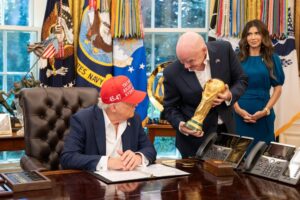
President Donald Trump, flanked by Vice President JD Vance and FIFA President Gianni Infantino, announces that the FIFA World Cup draw will take place on December 5 at the Kennedy Center, Friday, August 22, 2025 – USA (Official White House Photo by Joyce N. Boghosian)
Environmental groups also targeted the tournament’s expanded format. By spreading 48 teams across three host nations, air travel between cities spiked. Scientists for Global Responsibility estimated the tournament’s total carbon footprint as equivalent to driving 6.5 million average gas-powered cars for an entire year. According to the BBC, this made 2026 the most polluting World Cup on record.
Beyond physical logistics, institutional politics shadowed the games. FIFA leadership faced scrutiny over its relationship with host-country politics, including FIFA President Gianni Infantino creating and awarding a bespoke FIFA Peace Prize to U.S. President Donald Trump. For fans like Boury, the political maneuvering dulled the excitement of having the global stage nearby. “It takes away from it when there’s something potentially ugly behind the scenes,” Boury noted.
The fallout extended well past the final whistle. Post-tournament, Infantino proposed the FIFA Forward Enterprise plan, an effort to sell a 20 percent stake in the 96-year-old World Cup to a private investor group led by Joshua Kushner. The proposal triggered immediate pushback from UEFA, European soccer’s governing body, whose 55 member nations threatened a total boycott of future FIFA events. Infantino rescinded the proposal on July 31, but high-profile resignations followed, including senior advisor Carlos Cordeiro in July and FIFA COO Kevin Lamour in August.
Rather than serving as a unifying global moment, the 2026 World Cup leaves FIFA leadership facing an uncertain future, alienated fan bases, and a fractured international soccer community.
In today’s corporate world, finding true, honest journalism is getting harder, and that includes local news, too. From corporate takeovers to the nonprofit industry, finding reporters willing to ask the hard questions seems like a thing of the past.
Which is why Yellow Scene remains fiercely independent and never, ever accepts quid pro quo. We are only beholden to our readers, not funders.
The truth is, we really cannot do this without you. If you value our journalism, become a sustaining supporter for $8 a month. Your support keeps honest reporting alive and gets the hard copy delivered to your home.