

This story appears in the September 2026 issue of Utah Business. Subscribe.
UTAH EMBRACES THE WORLD’S GAME
Utah’s soccer story started more than two decades ago, but 2026 changed where the game could go next. The FIFA World Cup put soccer at the center of Utah’s sports conversation. Lionel Messi and Inter Miami CF’s first appearance at America First Field became one of the hottest tickets in town, while the Utah Royals FC climbed to the top of the NWSL and Real Salt Lake’s young players gave fans new reasons to watch.
The momentum reaches beyond the field. World Cup watch parties introduced new fans to the joy and community of the game, youth-sports initiatives are working to make participation more accessible and America First Field is becoming the anchor of a future sports and entertainment district in Sandy. Together, these stories show how a sporting moment can become a lasting part of a place’s identity.
World Cup Momentum
The 2026 World Cup was a global phenomenon: its 104 matches averaged a record 7.7 million viewers, up 116 percent from 2022; 128.4 million people in the U.S. watched at least part of the tournament. In Utah, America First Field became a gathering place for watch parties, celebrations and Bosnia and Herzegovina’s national-team training. World Cup watch parties here in Utah drew more than 90,000 fans.
Those gatherings made soccer personal for people who may not have followed it before. Miller Sports + Entertainment focused on creating an affordable, welcoming experience for fans of many cultures and nationalities—and the response demonstrated how quickly Utah’s audience is growing.
“The momentum created by the World Cup in America will only continue to grow,” said John Kimball, President of Business Operations for RSL and the Utah Royals FC. “Millions of fans are discovering the joy and power of soccer for the first time, and we’re excited to see that energy carry over to America First Field.”
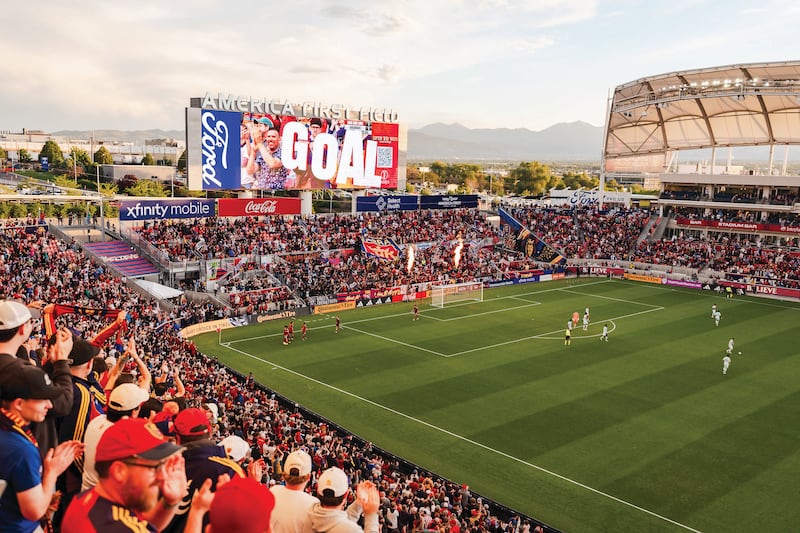 Photo courtesy of Larry H. Miller Company Hosting the G.O.A.T.
When Inter Miami and Lionel Messi arrived at America First Field in April, the match became more than a regular-season game. Over 21,500 fans filled the stadium for a bucket-list night. RSL Head Coach Pablo Mastroeni described the broader impact: “Being in the presence of a player like Messi will turn a layman fan into a true soccer fan.”
Messi’s visit expanded the audience and gave casual fans a reason to imagine themselves in Utah’s soccer future.
Homegrown Talent
RSL’s young core reflects the value of sustained investment in the club’s Academy. Utah native and RSL Academy homegrown Zavier Gozo emerged as one of the 2026 season’s breakout stories, leading the team in goals through the first half of the season, ranking among its top assist leaders and earning a place in the MLS All-Star First XI. At 19, he became the first Utah native to receive that honor and the youngest RSL All-Star representative.
His rise in Major League Soccer and now his move to the English Premier League send a clear message to young athletes across the state: elite development happens in Utah.
ELEVATING WOMEN IN SPORTS
Women’s sports are a critical part of Utah’s sports future. Founded in 2017, Utah Royals FC was one of the state’s first professional women’s teams and helped pave the way for the Utah Talons AUSL softball team and League One Volleyball Salt Lake.
Across the country, investment is turning long-standing passion into unprecedented visibility. The National Women’s Soccer League’s Denver Summit drew 63,004 fans to its inaugural home match, setting a U.S. record for a professional women’s sporting event. That growth creates a high-opportunity moment—one Miller Sports + Entertainment is using to pursue success today while building generations of future fans.
Building a Winning Culture
After a difficult expansion launch in 2024 and a tough 2025 season, the Utah Royals FC carried a 10-game unbeaten run into the World Cup break and climbed as high as first in the league. Head Coach Jimmy Coenraets was named NWSL Coach of the Month for May; Mandy McGlynn, Kate Del Fava and Mina Tanaka earned Best XI honors, with Tanaka also named Utah Sports Commission Female Athlete of the Year. In August, Miyabi Moriya, Narumi Miura and Mina Tanaka each scored in a 3-2 win over Bay FC—the first time three Japanese players found the net in the same NWSL match.
 Photo courtesy of Larry H. Miller Company
Royals FC midfielder and Utah native Courtney Brown credits the team’s chemistry. “Our superpower is that we like each other,” she said. “We have a great connection with each other, we’re super supportive and we always root for each other.”
The team’s “Better Together” campaign carries that identity beyond the field. As defender Kameron Simmonds put it, “Doing it together means having a common goal and working together at it.” That cohesion is turning matchday curiosity into lasting support for women’s sports.
An International Roster, a Local Connection
The Royals’ roster represents the United States, Japan, Mexico, Haiti, Canada and Jamaica. Ten players were called into the June international window, and multiple have previously played in a World Cup—evidence of the club’s trajectory as the 2027 FIFA Women’s World Cup approaches.
The team’s growing platform also creates opportunities to serve Utah. During Asian American, Native Hawaiian and Pacific Islander Heritage Month, Royals players surprised Asian-owned businesses with free game tickets. Japanese-born midfielder Aria Nagai, a nominee for the 2026 Lauren Holiday Impact Award, works with the Asian Association of Utah and uses her platform to inspire young athletes. Players walk out with youth teams, stay after matches to connect with fans and host free clinics with Real Salt Lake.
“What makes the Royals so special is that the matchday experience is accessible, the players are visible and there is a real connection between the team and the community,” said Michelle Smith, president of Miller Sports + Entertainment. “We’re building something people want to be part of—not just a club, but a team, a culture and a community.”
INVESTING IN THE NEXT GENERATION
Youth sports teach children to pursue goals, contribute to a team and respond to both success and disappointment. They can also provide confidence, belonging and a consistent place to grow.
But access is becoming harder to afford. An Aspen Institute study found that the average U.S. family spent $1,016 on a child’s primary sport in 2024—a 46 percent increase from 2019. With about 27.3 million children participating in organized sports, youth athletics has become a $40 billion annual industry. The question is whether rising costs will push the children who benefit most farther from the game.
Rep. Burgess Owens addressed that concern during a June 2026 House hearing on youth sports commercialization, saying, “Investment is important, but it’s when the mission is our kids, not investors,” and warning, “We’re going to lose the soul of our nation if we don’t get this right.”
 Utah Youth Sports Giving Day Press Conference
June 5, 2026
From left: Leo (RSL), Swiggy, Michelle Smith (Larry H. Miller Company), Steve Miller (Larry H. Miller Company, Larry H. & Gail Miller Family Foundation), First Laddy Abby Cox, Governor Spencer Cox, Kaysha Love (Olympian), Luke Ragland (Daniels Fund). | Photo courtesy of Larry H. Miller Company
Utah’s participation goal is 63 percent by 2030; the state currently sits near 60 percent. Utah Youth Sports Giving Day is designed to close that gap. Led by Miller Sports + Entertainment, the Larry H. & Gail Miller Family Foundation, Utah 2034 and the Daniels Fund, the statewide campaign supports organizations working to make sports more accessible. Together with other partners, the campaign has raised $1.5 million toward a $3 million match pool. The two-week giving campaign began September 12.
At its core, the effort protects the chance to play—helping families cover fees, equipment, travel and registration so more children can find the confidence and connection youth sports provide.
BUILDING MODERN SPORTS AND ENTERTAINMENT ECOSYSTEMS
Sports and entertainment can do more than fill a schedule. The places built around them shape how people gather, connect and belong. National examples such as The Battery Atlanta and the district around Audi Field in Washington, D.C., show how venues can anchor dining, hospitality, retail, public space and year-round activity.
Utah is developing its own version of that model: America First Field in Sandy, The Ballpark at America First Square in Downtown Daybreak and the vision for the Power District on Salt Lake City’s west side.
America First Field is moving toward an expanded sports and entertainment destination. The FIFA World Cup Trophy stopped at the stadium, Bosnia and Herzegovina trained there and Noah Kahan performed in Sandy for more than 25,000 fans. During the World Cup, watch parties and activations at America First Field, Megaplex at Jordan Commons and Downtown Daybreak drew more than 90,000 people and showed how Utah venues can create shared statewide experiences. Planned renovations will add updated seating, fan technology and premium experiences to support year-round use.
Downtown Daybreak shows how the model can work today. The Ballpark at America First Square has become more than a baseball venue, hosting youth clinics, Béisbol en Salt Lake, exhibition games, Home Run Derby X, Cosmic Baseball, Banana Ball and community theme nights. Movies, bowling, concerts, restaurants and events at America First Square keep people returning beyond game days. During the World Cup, the neighborhood gathered around the big screen to watch matches together. Starting November 20, Downtown Daybreak’s Winter Village brings the season to life with ice skating, dazzling holiday lights, festive activities and merry memories for the whole family.
 The Power District | Photo courtesy of Larry H. Miller Company
The Power District represents a larger, riverfront expression of the same idea. Planned as a walkable, mixed-use neighborhood on more than 100 acres, it will bring together office, multifamily, retail, hotels, green space and a potential Major League Baseball ballpark. The $3.5+ billion private investment is intended to create a place for uniting and gathering people while connecting the Jordan River, Utah State Fairpark and Rocky Mountain Power’s emerging campus.
The river is central to that vision. Plans led by Field Operations will restore habitat, improve water quality, expand public access and create family-friendly gathering spaces—treating the Jordan River as a beautiful recreational amenity rather than its edge.
Larry H. Miller Real Estate and Miller Sports + Entertainment are not simply building venues, they are building places that strengthen everyday community life through connection, unity, stewardship and a stronger sense of place. As the state prepares for the 2034 Olympic Winter Games and considers the possibility of Major League Baseball expansion, the greatest legacy may be the communities that continue to thrive after the games end.