
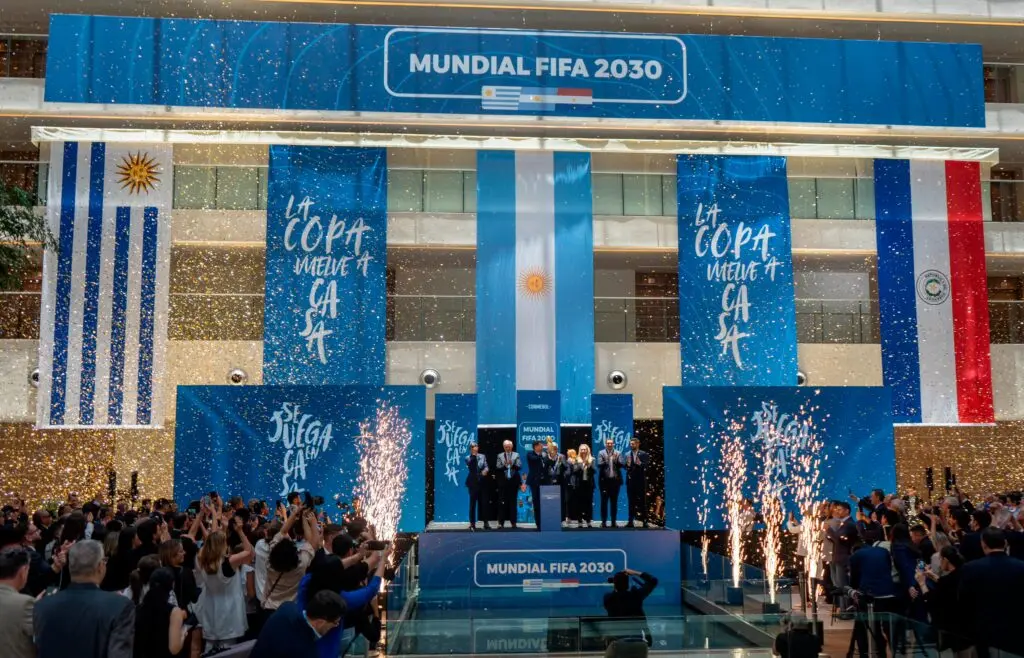

The confirmation of Argentina, Uruguay and Paraguay as inaugural venues forces Conmebol to modify their qualifying format for the World Cup Centennial, which will reduce the probability of qualification for the remaining teams to 50%. Photo: CONMEBOL.
September 30, 2026 Hour: 11:08 pm
🔗 Comparte este artículo
The FIFA World Cup 2030, set to celebrate its centennial anniversary, will see a significant reduction in CONMEBOL qualification spots, as Argentina, Uruguay, and Paraguay secure automatic qualification as hosts.
South America’s qualifying format for the 2030 World Cup will undergo a historic overhaul after Argentina, Uruguay and Paraguay secured automatic berths as hosts of the tournament’s opening matches, forcing CONMEBOL to redesign its qualification system for the rest of the continent’s national teams.
With the three South American countries confirmed as hosts, the number of available spots for the remaining South American nations has been halved.
RELATED: CONMEBOL Confirms FIFA World Cup 2030 Centenary Matches in South America
While FIFA will keep South America’s allocation of six and a half World Cup slots intact, the guaranteed presence of the three host nations fundamentally changes the competition’s dynamics for everyone else. With the hosts already through, only three direct qualifying spots and one intercontinental playoff berth will remain up for grabs, cutting qualification odds roughly in half for the teams still competing for a place.
The automatic qualification of Argentina, Uruguay, and Paraguay as hosts means that the CONMEBOL region will have three direct spots and one intercontinental playoff spot, reducing the chances of qualification for the remaining seven teams by 50%.
🚨El PLAN de ELIMINATORIAS SUDAMERICANAS:
▶️JUGARÁN las 10 SELECCIONES de CONMEBOL:
⚠️Argentina, Paraguay y Uruguay jugarán las clasificatorias a pesar de estar CLASIFICADOS.
▶️Se asignarán 3 PLAZAS Y MEDIA para el Mundial 2030.
ℹ️ @estebanedul pic.twitter.com/VDAkZHS7UY
— Deportes 24 – Argentina (@deportes24ar) September 30, 2026
Text reads: “South American eliminations’ plan: will play the 10 teams of CONMEBOL: Argentina, Paraguay and Uruguay will play the qualifiers despite being classified. 3 places and a half will be allocated for the 2030 World Cup.”
Fewer Spots, Fiercely Contested
Seven nations -Brazil, Colombia, Ecuador, Chile, Peru, Venezuela and Bolivia- will be left fighting over those remaining spots in what is expected to be one of the tightest qualifying races in the region’s history. The hosts’ exclusion from the points chase will also reshape tournament logistics, since each remaining team will see its home matches reduced from nine to six, leaving far less room for error on their own turf as they try to secure a spot. .
The reduced number of spots means that every match will be crucial, and the slightest mistake could cost a team its chance to qualify. The stakes for the seven non-host nations are considerable: missing out on direct qualification would mean relying on a single intercontinental playoff slot shared through a broader global process, a far narrower path than South American teams have faced in recent qualifying cycles.
Despite having their participation already locked in, football authorities are considering having Argentina, Uruguay and Paraguay continue playing matches during the qualifying calendar in order to preserve competitive rhythm heading into the tournament, under the condition that their results would not count toward the standings of the seven nations still competing for qualification. Officials have not yet detailed exactly how those “exhibition” fixtures would be structured within the broader calendar.
According to current projections, the revamped and more demanding qualifying process toward the Centennial World Cup is expected to kick off in the first quarter of 2027.
A Cup Across 3 Continents
The decision to reduce the number of CONMEBOL spots has sparked debate within the football community. Critics argue that increasing the number of qualified teams to 64 would devalue the qualification process and reduce the overall quality of competition. FIFA has yet to confirm the 64-team expansion proposed by CONMEBOL, leaving the final format uncertain.
The format change marks one of the most significant structural shifts South American qualifying has seen in decades, reflecting the unusual circumstances of a World Cup that will be staged across three countries for its ceremonial opening while the bulk of matches take place elsewhere, as part of FIFA’s broader hosting arrangement for the 2030 centennial edition. CONMEBOL has not yet released the full fixture list or detailed calendar for the new format, though the confederation is expected to formalize the qualifying structure in the coming months as it works out logistics with FIFA.
The 2030 World Cup, honoring the 100th anniversary of the first tournament in 1930, will be jointly hosted by Morocco, Portugal, and Spain. This marks the first time the World Cup will be held across multiple confederations and the first edition in North Africa. Special matches and celebrations are planned at Centenario Stadium in Montevideo, Uruguay, Monumental Stadium in Buenos Aires, Argentina, and Osvaldo Domínguez Dibb Stadium in Asunción, Paraguay.
The next World Cup promises to be a landmark event, not only for its centenary celebration but also for the changes it brings to the qualification process. The reduced number of CONMEBOL spots adds an extra layer of intensity and unpredictability to the tournament, making it one of the most anticipated football events in history.
Author: Laura V. Mor
Source: FIFA / Conmebol