
When the Red Sox lost to the Yankees in three games during last fall’s American League Wild Card Series, it felt as if the club took a necessary step forward. The Red Sox returned to the postseason after missing out three straight years, and it seemed that with a couple of improvements the club could be poised for championship contention.
One year later, the Red Sox enter the offseason again with little progress to show.
The 2026 season will go down as one of the wildest years in franchise history, but in the end, the Yankees exploited weaknesses that were apparent from the beginning and were never adequately addressed. When the season began the concern was that the lineup wasn’t good enough, and outside of the two-month surge where the Red Sox boasted the highest-scoring offense in the sport, it otherwise consistently ranked as MLB’s worst.
Fixing that should once again be a top priority for the Red Sox, but between the organization’s own problems and the larger issues looming over the sport, this winter will bring a lot more uncertainty than usual.
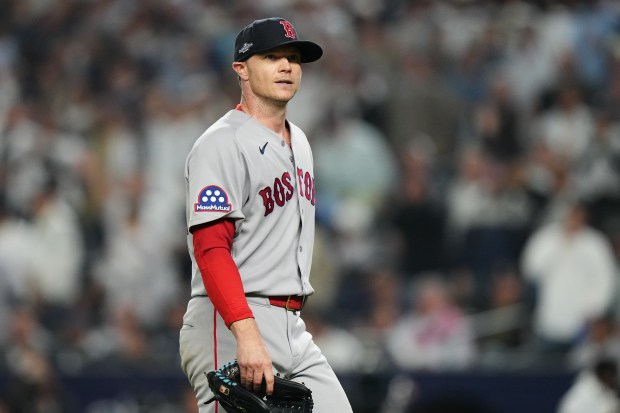 Between his expected free agency and the possibility he could retire, Sonny Gray faces an uncertain future. (AP Photo/Frank Franklin II)
Will Sonny Gray return?
The biggest unanswered question facing the Red Sox this offseason is what the future holds for Sonny Gray. The 36-year-old veteran is expected to become a free agent — he has a mutual option, which are almost never picked up — and Gray has acknowledged that he is considering retirement.
If Gray decides to walk away, it will be to spend more time with his family and not because he doesn’t have any baseball left in him. The right-hander was clear on both points following the club’s Game 2 loss on Wednesday, but even if he does decide to pitch in 2027, he was noncommittal about whether he’d consider returning to Boston.
In addition to Gray’s mutual option, the Red Sox also have a $8.3 million club option for Garrett Whitlock. A decision on all options are due five days after the World Series ends.
Who else is set to hit market?
Besides Gray, the Red Sox have two players set to become unrestricted free agents next month.
Patrick Sandoval will hit the market after a two-year stint with the Red Sox marked mainly by his recovery from Tommy John surgery. The left-hander signed a two-year, $18.25 million deal with Boston after he’d already undergone elbow surgery in June 2024 as a member of the Angels, and he did not return to action until July 9 after being sidelined for more than two years.
He appeared in 15 games with the Red Sox, going 1-7 with a 5.12 ERA over 70 1/3 innings. He was not included on the club’s playoff roster.
Isiah Kiner-Falefa will also hit the market after completing his one-year, $6 million deal. The 31-year-old appeared in 66 games for Boston, batting .242 with two home runs, 16 RBI and a .633 OPS, and he posted 1.6 Wins Above Replacement driven largely by his contributions on defense.
Neither Sandoval nor Kiner-Falefa is a candidate to receive a qualifying offer, which is a one-year deal worth the average of MLB’s 125 highest salaries. Last offseason that amounted to $22.05 million, and if a player declined a qualifying offer and went on to sign with a new team in free agency, their original team would receive draft pick compensation.
Theoretically Gray would be a candidate, but he is not eligible to receive a qualifying offer because he was previously extended one during the 2023-24 offseason.
Roster crunch coming
With relatively few spots set to open, the Red Sox have some decisions to make to clear space for all of the players who will soon need to be added to the 40-man roster.
The Red Sox have seven players on the 60-day IL who must be added back to the 40-man roster within five days of the end of the World Series.
Those players are right-handers Justin Slaten, Kutter Crawford, Johan Oviedo and Zack Kelly, left-hander Eduardo Rivera, first baseman Triston Casas and outfielder Eli White.
The club also has to make room for any prospects eligible for the Rule 5 Draft who they’d like to protect from being poached by another organization. Starting pitchers Blake Wehunt and Hayden Mullins would be two of the top candidates to be added to the 40-man, as would speedy outfielder Braiden Ward, who was among the last cuts for a spot on the wild card roster as a pinch running specialist.
Between the two pending free agents and Gray, the Red Sox should have at least three spots opening up, so they’ll have to trim at least another four players to get back to the 40-man limit. The simplest way to do that is by designating some players for assignment, with left-hander Raymond Burgos and infielder Tsung-Che Cheng among the possible candidates.
The club may also have to make a decision on some of the injured players, most notably Crawford, who was once among the club’s most reliable starting pitchers but who has now missed two full seasons due to injury.
If necessary the club can also decline to tender some of its arbitration-eligible players a contract. Crawford could be one such candidate. Jarren Duran, who MLB Trade Rumors projects will earn approximately $11.1 million in arbitration, might be another if the Red Sox decide that salary could be better invested elsewhere.
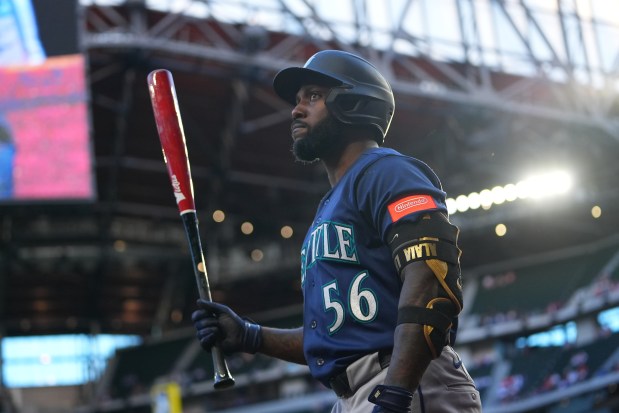 Seattle Mariners outfielder Randy Arozarena is expected to be the top free agent bat available on the market this winter. (AP Photo/Julio Cortez)
How can Sox improve?
This past week’s lopsided wild card sweep at the hands of the Yankees drove home just how far this Red Sox team has to go before it can be considered a true championship contender. The lineup in particular needs a lot of work, and outside of the club’s two-month surge, the Red Sox ranked as MLB’s worst offense for extended portions of the season.
The tricky part is that everyone who started in Game 1 of the AL Wild Card Series is under team control for next season, so it won’t be as simple a fix as letting an underperforming player walk and replacing them with someone better.
Roman Anthony, Ceddanne Rafaela and Wilyer Abreu should all be entrenched as starting outfielders, Willson Contreras will be back at first base and catcher Adley Rutschman has one more year before hitting free agency after the 2027 season. There’s no reason to expect Caleb Durbin won’t retain the third base job, and the Red Sox also have Curtis Mead and top prospect Franklin Arias in house as possible upgrades up the middle.
That leaves one obvious opening for an external upgrade at the designated hitter spot.
In terms of top free agent bats, the two obvious headliners are outfielders Randy Arozarena and Seiya Suzuki. Arozarena is coming off a career-year in which he recorded his sixth consecutive season with 20 homers and 20 stolen bases while posting an .865 OPS. The three-time All-Star is also a proven postseason performer and the kind of big personality who can provide an immediate spark on the field and in the clubhouse.
Suzuki similarly has been reliably excellent ever since coming over from Japan ahead of the 2022 season. The 32-year-old has posted four straight seasons with an OPS+ of 125 or better — that’s 25% better than league average offensive production — and this past season he batted .270 with 26 home runs, 86 RBI and an .841 OPS.
A case could be made that outside of not re-signing Kyle Schwarber, the biggest mistake the Red Sox made in the 2021-22 offseason was missing out on Suzuki.
Of the remaining free agents, second baseman Brandon Lowe has the highest power ceiling and is a better fit than infielders Jazz Chisholm Jr. and Luis Arraez. The Red Sox could also work the trade market, something Craig Breslow has utilized time and again since taking over as chief baseball officer.
As far as the pitching staff goes, the Red Sox could always use more bullpen help but should be in good shape as far as the rotation goes. Even if Gray doesn’t return, the rotation currently projects to include Garrett Crochet, Ranger Suarez, Payton Tolle and some combination of Jake Bennett, Brayan Bello, Tanner Houck, Oviedo and Crawford.
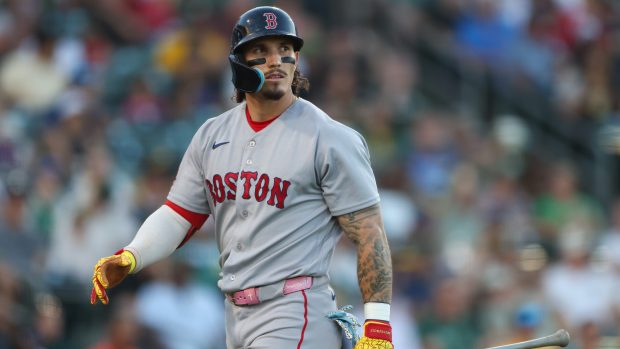 If the Red Sox add a big bat, what could that mean for Jarren Duran’s future with the organization? (AP Photo/Scott Marshall)
What’s next for Duran, Yoshida?
If the Red Sox bring in a big bat like Arozarena or Suzuki to serve as the primary designated hitter and change-of-pace outfielder, it would likely signal the end of Jarren Duran and Masataka Yoshida’s time with the organization.
The Red Sox already had an outfield logjam the past two years, with more starting-caliber players under team control than the team had spots in the lineup. While injuries have largely prevented that from being an issue, there were long stretches this season where Yoshida was effectively relegated to bench duty as he brought limited value defensively or on the base paths.
Duran also saw his role diminish as the year went along, moving into a platoon role as his struggles against lefties deepened.
At this stage, Duran doesn’t have nearly the trade value that he might have last offseason, but even amid his struggles, he still managed to hit 20 homers with 20 stolen bases while playing good defense and retaining top scale speed. He also has two years of team control remaining at what shouldn’t be a prohibitive price for most mid-to-large market teams. So if the Red Sox tender him a contract but decide to move on anyway later in the offseason, he could still help land a quality piece.
That won’t be the case for Yoshida, who is due to make $18 million in the final year of his five-year, $90 million deal. Any deal involving him would be a pure salary dump, with the Red Sox likely having to attach a prospect similar to the deal that sent out Jordan Hicks and David Sandlin last offseason.
Sandlin, one of Boston’s higher ranked pitching prospects at the time, had a rocky rookie year for Chicago but threw 1 1/3 scoreless innings of relief to help the White Sox win Game 1 of their wild card series.
At first glance Trevor Story would seem to fit into the same bucket as Duran and Yoshida, especially given that he’s entering the last year of his six-year, $140 million contract. But while this was mostly another lost season for the veteran, Story did finish the year strong once healthy, so there’s a good bet the Red Sox will keep him as the starting shortstop with an eye toward eventually handing the baton over to Arias.
Lockout looming
The uncomfortable truth hanging over this offseason is we have no idea when the Red Sox will play their next game. The current collective bargaining agreement between MLB’s owners and players is due to expire on Dec. 1 at 11:59 p.m., at which point the widespread expectation is the owners will lock out the players.
Once the lockout begins there can be no free agent signings, no trades and no games until the two sides work out a new agreement. No one knows how long that could take, and if the owners insist on their demand for a salary cap, it’s possible the fight could stretch well into next spring, raising the possibility that regular season games could be lost.
So what can fans expect?
In the short term, expect a lot of activity in November. All of the typical offseason business that happens the week after the World Series ends will proceed as normal, as will all of the end-of-season awards announcements. Prior to the last lockout in 2021-22, we saw much more player movement in November than usual as well, with Dec. 1 serving as a de facto trade and signing deadline.
But when the clock strikes midnight and the lockout begins, everything will crash to a halt, and baseball fans will have a long and quiet winter to endure before brighter days hopefully come.