
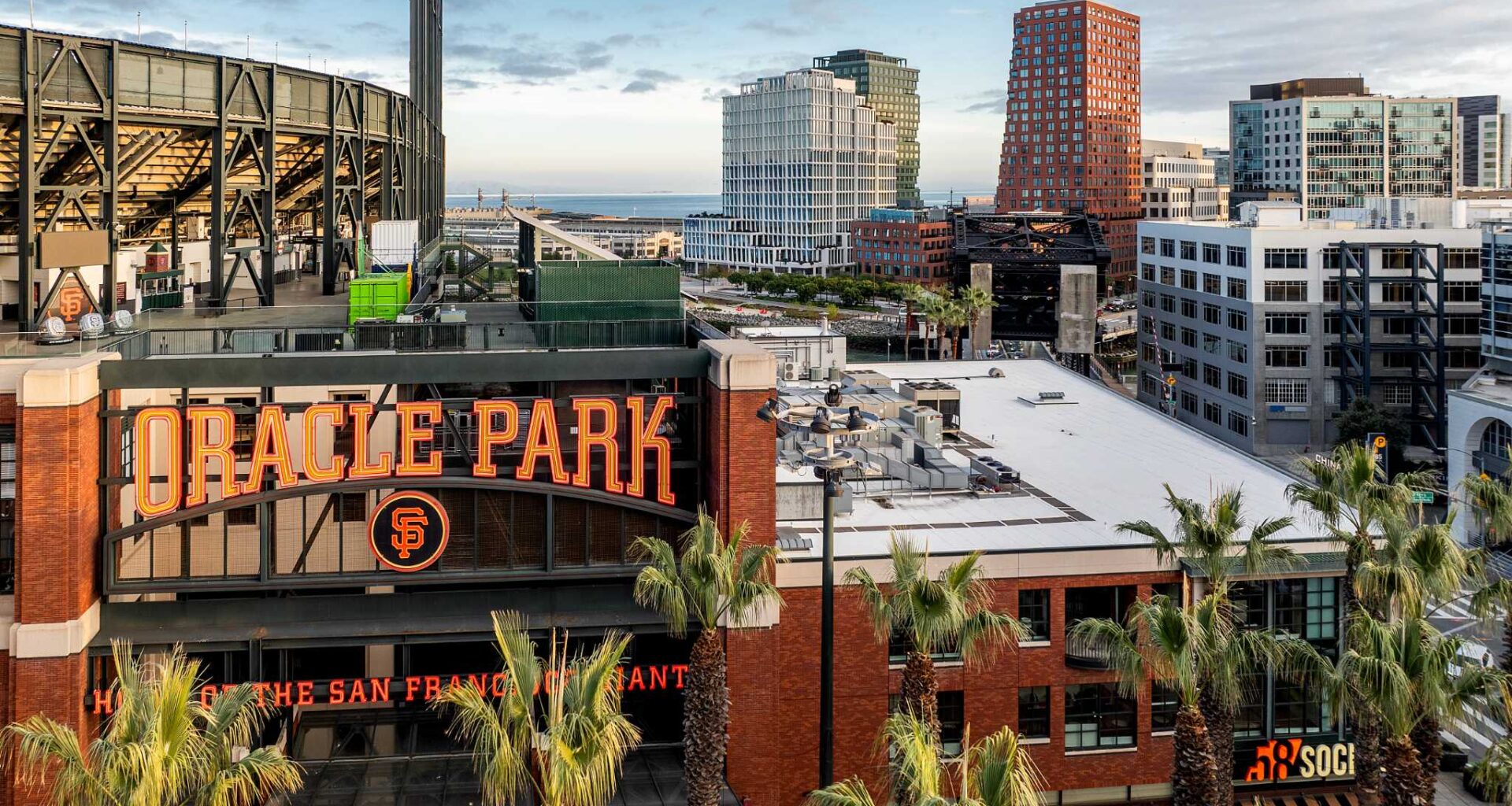
Real estate projects in the Mission Rock neighborhood, seen behind Giants-owned Oracle Park, give the team the income and financial means to compete for free agents.
Noah Berger/For the S.F. Chronicle
Shohei Ohtani signed a 10-year deal with the Los Angeles Dodgers before the 2024 season, a $700 million deal with $68 million deferred annually, that the Giants had been willing to match.
Mark J. Terrill/Associated Press
For all the questions fans and media might have about the San Francisco Giants in 2027, one biggie is out of the team’s control.
The season itself is under threat, with the collective bargaining agreement expiring Dec. 1, likely followed by an owners-imposed lockout. There is nothing but uncertainty from there, especially if the owners continue to insist on a salary cap, a feature of the other three prominent U.S. men’s pro sports leagues and a hot topic thanks to the Los Angeles Dodgers’ hefty payroll and postseason dominance.
The last time the owners put a salary cap on the table, in 1994, the result was the longest labor stoppage in major-league history, from Aug. 12 on, plus no postseason and no World Series.
Article continues below this ad
The MLB Players Association has never wavered in its opposition to a salary cap. The upshot, if the owners don’t back off their stance, could be a significant labor stoppage.
“We won’t play. I’m going to be frank with you,” former Giants starter Carlos Rodón, now with the Yankees, told the Associated Press last week. “I’m not worried about it. They should be worried about it. There’s a lot of money on us playing baseball. That’s why they pay us a lot.”
The union amassed a large war chest, with enough funds to withstand even a full season cancellation, and the owners are believed to be willing to sacrifice games, too. Posturing? Perhaps, especially with record profits, attendance and franchise valuations — see the recent Angels ($4 billion) and Padres ($3.9 billion) sales. The owners instituted a lockout before the last CBA, which lasted 99 days and did not wind up reducing the length of the 2022 season. Spring training opened three weeks late, with more than a week’s worth of spring games eliminated, and Opening Day was pushed back a week but the full 162-game schedule went forward.
Last time, there was no salary cap proposal, however. And this time around, the Dodgers’ spending is the owners’ big talking point, and they’re finding some sympathy among fans who believe their clubs cannot compete with the big blue behemoth. The union would argue that given the astronomical rise in franchise valuations, all teams could spend much more and that one fix might be for more increased revenue sharing, particularly when it comes to local TV revenue.
Article continues below this ad
L.A.’s $8 billion local broadcast deal provides the team $350 million per year and bankruptcy provisions at the beginning of the contract, which runs through 2038, ensure that the Dodgers are paying an estimated $66 million less into revenue sharing than they might otherwise. Currently, 48% of local TV and media rights income go into revenue sharing; increasing that would ensure that the much smaller TV markets inch toward at least somewhat more similar financial footing.
This is something that MLB itself has proposed — but only in concert with a salary cap. And there are no guarantees that with increased revenue sharing, clubs will spend more, one reason the union would like a salary floor or provisions tying revenue sharing to increased spending. Some clubs, the union contends, are happy to accept what in essence is a corporate subsidy and pocket it for profit rather than attempting to contend.
Salary floor, you say? The league is all for it — but only combined with a salary cap. And so we go, in a circular fashion, until one side blinks, which could cost fans spring training, a month or two of the regular season, a whole season — which would damage the sport’s image and income alike. After the 1994 labor stoppage, attendance dropped more than 20% and the sport didn’t recover fully until the Sammy Sosa/Mark McGwire home run record chase in 1998. It would be impossible to replicate something like that, and in a time of significant inflation, there is little consumer sympathy toward billionaires arguing with millionaires about slicing up their extravagant pie.
This will be Commissioner Rob Manfred’s final labor agreement, and he’d love nothing more than to secure a salary cap before he departs in 2029. The union believes strongly that a cap would cost its members billions and can point to flaws in other pro sports’ caps, including “soft” caps, and the ways clubs bend rules or worse to get around spending limitations. The best current example is the English Premier League soccer club Manchester City, found guilty of more than 100 breaches of Premier League financial restrictions; the team is alleged to have falsified its income by more than a billion dollars in order to get around spending rules.
Again, we come to the Dodgers, who also did some fancy footwork, especially when it came to Shohei Ohtani’s record deal, deferring $68 million of $70 million (interest free!) for each of the 10 years he’s under contract. Eliminating deferred contracts, especially to this extreme, seems like a no-brainer for both sides.
Article continues below this ad
When the Dodgers are held up as the “why the game is broken” model, it’s also instructive to look at the New York Mets. Thanks to that Ohtani deferral, the Mets actually have the largest cash payout this year when it comes to payroll, $345.5 million vs. Los Angeles’ $285.4 million, which is the fifth highest in baseball per Sportrac. The Mets, Yankees, Phillies and Blue Jays all shelled out more, though the Dodgers blow everyone away in tax payroll, at $430.7 million, with the Mets second at $359.4 million.
While Los Angeles won each of the past two titles and got a first-round bye this month, the Mets have kept near pace spending-wise but finished last in the NL East this year after missing the postseason last year.
The best record in baseball this year belongs to small-market Milwaukee, with 103 wins. The best team in the American League is even smaller-market, ballpark-challenged Tampa Bay, with 98 wins. Ability to compete does not always correlate with market size or spending, disrupting various arguments on both sides.
There are any number of smaller elements to talks, too, of course: the arbitration system, service time, qualifying offers, conditions for big leaguers to play in the Olympics, MLB’s long-stated desire for an international draft and the like. All of these things are important, but they pale in comparison to the salary-cap conversation, and it’s possible that throwing the big no-go into the talks is a tactic for the owners to get more concessions elsewhere. That would be a best-case scenario, however — because if the owners keep that on the table, there is no doubt that regular-season games will be sacrificed.
How does all of this impact the Giants? As NL West residents, they certainly look at the Dodgers’ spending and sigh — but now that San Francisco is the only team in the Bay Area, one of the largest unshared markets in the sport, there isn’t much excuse not to increase spending. The Giants have plenty of assets — their own ballpark, the real-estate empire expanding around it, the addition of venture-capital firms to the ownership group and one of the more affluent fan bases and potential sponsorship pools, given the proximity to tech firms and AI — Sam Altman’s right next door. San Francisco was 13th in the majors in taxed payroll, per Sportrac, at $225.9 million. (It should be noted that the Giants were willing to match the deal that L.A. gave Ohtani.)
Article continues below this ad
The team is ranked fifth when it comes to Forbes’ franchise valuations, at $4.05 billion, up nearly a billion from 2021, and CNBC reported after the Angels’ and Padres’ sales that those numbers have increased substantially, as much as 37%, with each team worth as much as $1 billion more than it was in March.
On a more micro level, the Giants will have to deal with the practical fallout from the looming lockout. Does the team strike early, before the stoppage, to wrap up some free-agent talent or snag some trade targets, or will it wait for the post-lockout signing frenzy? General manager Zack Minasian said Tuesday that top baseball exec Buster Posey has demonstrated a willingness to “act decisively and act early,” but added that at the very least the Giants will be prepared to make good decisions whenever it is that opportunities arise.
Before the last lockout, when Farhan Zaidi was running the club, the Giants added starters Alex Cobb, Alex Wood and Anthony DeSclafani and they signed Rodón after the CBA agreement; this winter, the team needs rotation help and to rebuild the bullpen, so a similar strategy might be on the table — get some pieces in place, at least, and put some finishing touches on the roster whenever baseball is back in business.
When will that be? All bets are off, despite the number of gambling entities sponsoring teams and broadcasts and partnering with the league. In a novel twist, perhaps the “prediction market” types can exert a positive influence on these proceedings — there aren’t odds without a game.
Article continues below this ad
The people most hurt aren’t the gambling entities, the uber-rich owners, the media corporations or veteran players. Younger players who’ve yet to reach their earning potential will feel the sting, particularly those members of 40-man rosters with minimal or no big-league team. So, too, will the support staff, coaches and trainers, nutritionists, media-relations people.
No one wins during a long lockout. Teams will shed entire departments of employees making middle-class wages, with many scouts already ousted and lists drawn up of other areas to cut staff. Those who work games, concessions, parking, ushers will all be out of luck. And with the airwaves empty, so too restaurants near ballparks. All while the game’s reputation risks taking a kick in the teeth for years to come.