
The U.S. Senate recently passed the Protect College Sports Act. Authored by Sens. Ted Cruz (R-Texas) and Maria Cantwell (D-Wash.), the legislation would regulate college sports and is an attempt to end the “chaos” in college sports that has seen skyrocketing payments to athletes.
In the wake of a 2025 court settlement that allowed colleges to directly pay players for their name, image and likeness, college sports have been reshaped. It has led to college football roster payrolls that can exceed $40 million.
The legislation the Senate passed still requires approval by the House of Representatives. That passage is reportedly very doubtful. However, if passed, the legislation would stabilize what is referred to as the NCAA transfer portal that has led to players constantly changing teams. It would restrict player transfers to one move over five years and restrict player eligibility to five years.
But here’s the irony of the situation. Although Cruz and Cantwell accomplished something very rare in Washington these days — crafting bipartisan legislation that passed overwhelmingly by a vote of 77-22 — we have another problem that needs to be addressed. And that problem is the behavior of college athletes on the field. There doesn’t appear to be a rush to fix it.
On the weekend before the Protect College Sports Act was passed, there were several incidents that occurred in different football games that are concerning. Characterized as “celebrations” after a play, the antics were simply inappropriate and reflect poor leadership by coaches and administrators and poor sportsmanship by the players. Parents of the players should also share for some of the blame.
Here’s a sample of what we saw.
In a game between Texas and Tennessee, one of the Texas linemen sacked the Tennessee quarterback. The Texas lineman celebrated by simulating unzipping his pants and urinating on the field. His coach took him out of the game for one or two plays before inserting him back in. The player is reported to be the best lineman in college football and the captain of his team — likely destined for the NFL.
In the same game, a Texas running back scored a touchdown. His celebration included wiping his hand across his crotch and smelling his testicles before getting dizzy and then fainting. Texas is the player’s third school, and he, too, is a projected high NFL draft choice.
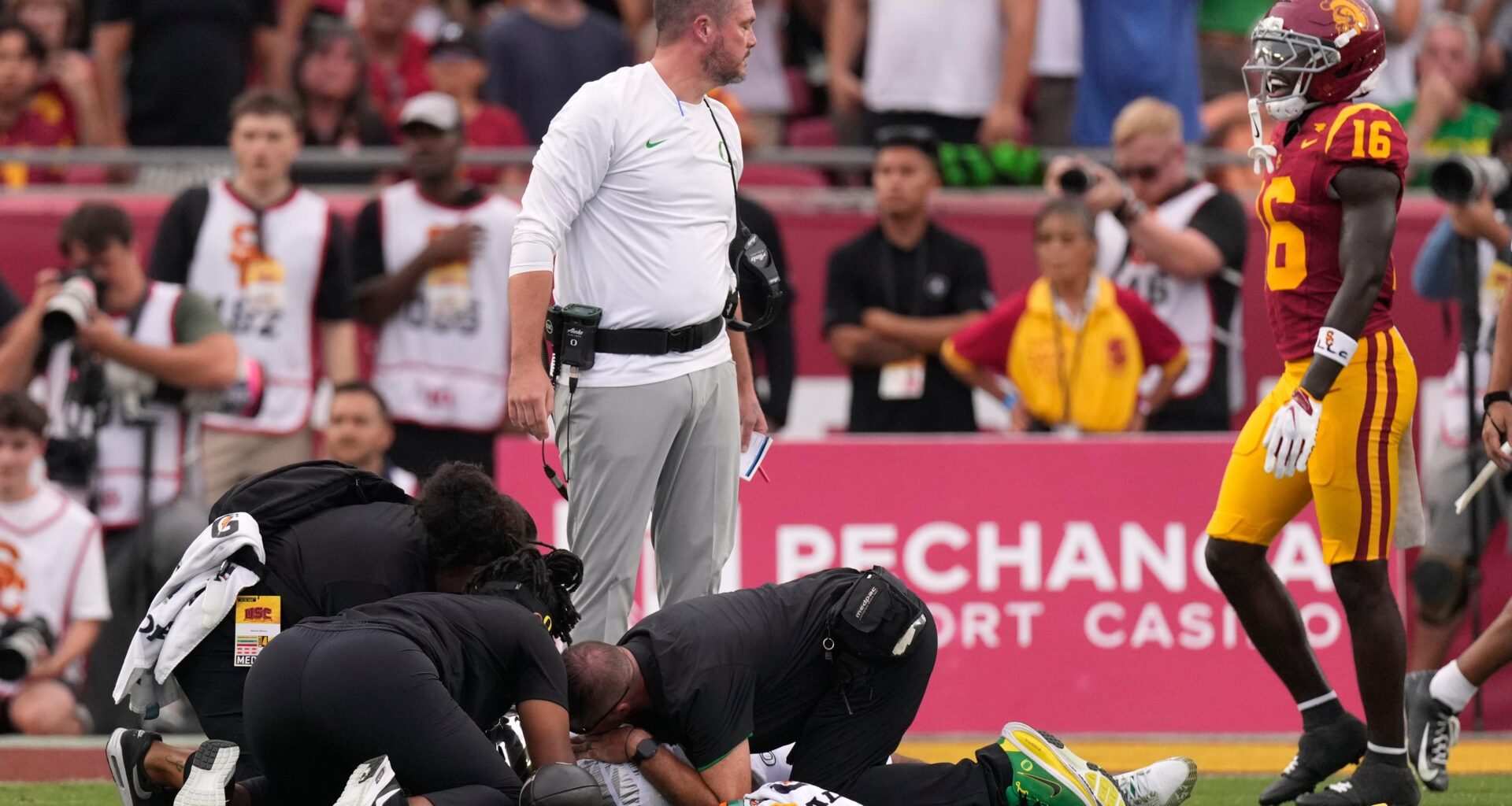
In the game between USC and Oregon, a USC linebacker made a vicious hit to the head of the Oregon quarterback. The injured player, motionless on the field, was placed on a stretcher and taken to the hospital. Meanwhile, the USC linebacker was seen smiling and “high-fiving” his teammates. The linebacker was ejected from the game and given a one-game suspension.
Providence Journal sports columnist Ken Schrieber argues that a dangerous and dirty play such as the USC linebacker’s crossed the line. A six-game suspension would be more appropriate and send a strong signal, effectively eliminating the intent to injure another player. Instead, the USC coach simply apologized for his player.
It’s not unusual to see NFL players “celebrate” their plays with various antics. In fact, the NFL routinely fines its players for unprofessional celebrations as it tries to tamp down the taunting and tasteless actions.
The Houston Chronicle reported that in NFL Week 2, there were 22 fines for unsportsmanlike conduct violations that amounted to more than $300,000. Thirteen of those were for “illegal” celebrations and vulgar acts.
Sadly, all these cases (and others) reflect poor leadership. Taking a player out of the game for one or two plays is not nearly sufficient for one who has gone “over the top” with a celebration. Many of these celebrations have become a trademark for some players. They are often crude and vulgar and not what you’d expect from someone earning millions of dollars playing college football.
But young players see it, think it’s funny and begin to replicate the behavior. They soon think the disgusting behavior is acceptable.
This behavior starts with parents who dote on the athletic successes of their kids, overlooking potential teaching moments for that hopeful college scholarship. Coaches of youth teams also have a responsibility.
Then there is the NCAA. What is it doing to curtail this type of behavior? In fact, what are school and league administrators doing to curtail it? Obviously nothing — probably because of potential revenue loss.
I cannot help but laugh at my experience involving the NCAA. Our daughter played lacrosse at Penn State. In 2005, Penn State was playing in the NCAA playoffs. I took pride in my cheering with a cowbell until an NCAA rep approached me and said I must leave the stadium and discard the cowbell. Using a cowbell to cheer was inappropriate. However, I could return to the stadium and watch our daughter if I ditched the bell.
The NCAA’s priorities have clearly changed. It would appear that good sportsmanship, sound leadership and maintaining ethical and appropriate behavior are not a priority in its playbook.
Tom Jurkowsky is a retired rear admiral in the U.S. Navy who served on active duty for 31 years. He is the author of the book “The Secret Sauce for Organizational Success: Communications and Leadership on the Same Page.” He served on the Anne Arundel Community College faculty as an adjunct instructor, where he lectured on current affairs.