
Nearly 4½ months ago, MLB introduced a salary cap proposal, with Commissioner Rob Manfred saying that the payroll disparity from top to bottom is “not a fair fight.” The league’s proposal would introduce a mandatory floor ($171.2M) and hard cap ($245.3M) system.
And yet, heading into the two League Championship Series, three of the four remaining teams will have payrolls below the league average, with two of those ranking in the bottom five.
The two-time defending World Series champion Dodgers remain the league’s highest paying team, with Spotrac projecting their payroll at $433M and their competitive balance tax bill at $183M.
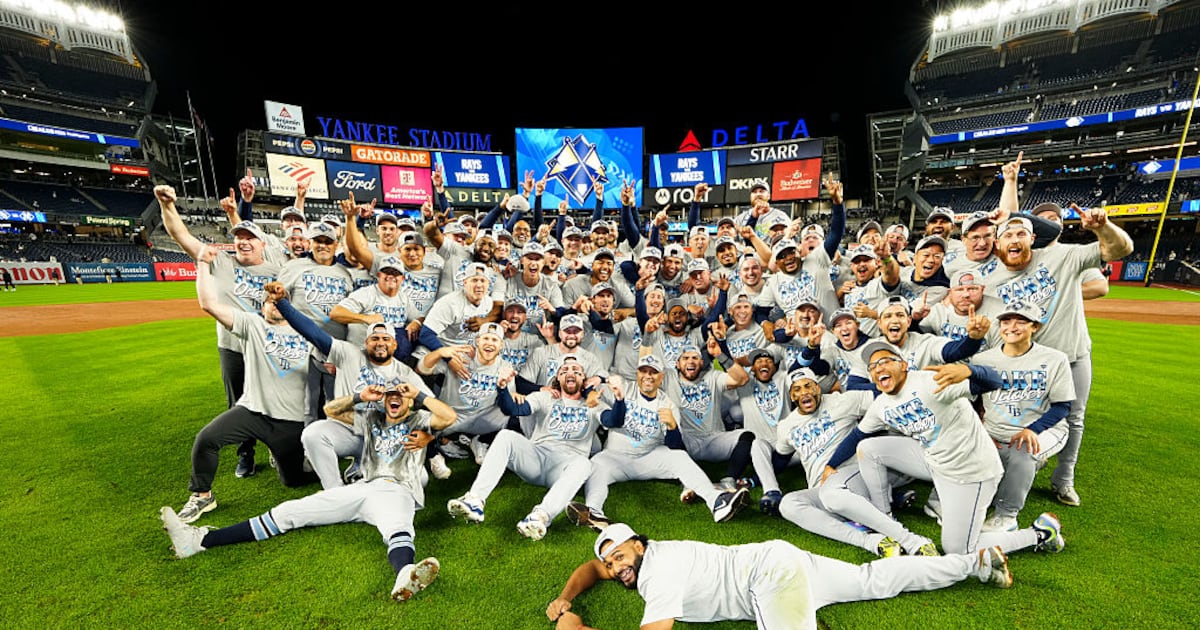
However, the 19th-ranked Brewers ($155M) and the 27th-ranked Rays ($113M) are also still standing, having posted the best records in the NL and AL, respectively. The 26th-ranked White Sox ($118M) and the 29th-ranked Guardians ($93M) are still battling it out for the final spot, with a decisive Game 5 set for Saturday night.
Due to a mix of scouting, player development and savvy signings and trades, Milwaukee, Tampa Bay and Cleveland have regularly punched above their weight, pushing any competitive balance concerns to the side.
The Brewers have won the NL Central the past four years, while the Guardians have finished atop the AL Central in three consecutive seasons. And the Rays have the third-most wins in the majors since 2008.
Still, those teams all face economic uncertainty. Tampa ranks in the bottom-three in both attendance and revenue. The Rays, though, are procedural steps away from building a $2.36B ballpark, accompanied by an $8B-$10B adjacent mixed-use development, for 2029, which ownership believes will be able to drive top-15 revenue in support of a top-15 payroll.
Milwaukee (2026), Tampa (2026) and Cleveland (2025) all exited RSNs in favor of MLB Media. Brewers owner Mark Attanasio said his team was slated to lose $20M due to the switch. The Guardians also went through a two-year, $202M renovation of Progressive Field as part of a lease extension that will keep them in Cleveland through at least 2036. David Blitzer has an option to take over majority ownership of the team after the 2027 season.
The White Sox are attempting to secure their own ballpark future, with minority partner Justin Ishbia announcing plans for a stadium in the South Loop. Ishbia has a deal with Chicago chairman Jerry Reinsdorf to potentially take over the team between 2029-34.
MLB’s argument surrounds lower revenue teams not being able to win the World Series. The last bottom-10 payroll club to do so was the 2003 Marlins, who ranked 25th. Meanwhile, this season, eight of the 10 highest paying teams made the playoffs.
“The biggest issue we need to solve next to continue to grow the game off the field is fixing the payroll disparity unseen in any other major U.S. sport,” MLB spokesperson Glen Caplin said. “Ultimately the game is about hope and competition and too many fans in too many markets have too little hope their team has a fair chance to win.”
The union believes MLB’s competitive balance argument is about something else entirely.
“They want a cap system because it’ll increase their profits and they think it’ll increase their franchise values,” MLBPA Interim Executive Director Bruce Meyer said during a September appearance on Foul Territory. “That’s it. That’s why they want it. They don’t want it because they think it’s good for the fans.
“From our standpoint, the issue is and has always been not teams that are spending too much or trying too hard to compete. It’s the teams that can afford to and are not spending as much as they can to try and compete.”
David Samson, president of the Marlins when the modern luxury tax was introduced, said competitive balance arguments are insignificant at the actual bargaining table, calling them a red herring.
“The real issue for me is that neither the owners nor the union are actually speaking to each other (on core economic proposals), and that’s what should concern fans at the moment — not who’s in the World Series this year or who’s in the Championship Series,” Samson said. “It’s the fact they’re not speaking the same negotiating language.”
Samson continued: “The owners make proposals. And the players don’t respond to the proposals until they’re ready. The players and the owners try to get the public to side with them, thinking that will be of some assistance as the winter of the lockout becomes the spring of the lockout. And what we’re all just waiting for is both sides to actually respond to each other’s proposals in a way that moves the ball forward toward a conclusion.
“Because there will be a conclusion. It’s just a matter of when, not if, and all fans want is for that to be as soon as possible.”
There’s a debate to be had over whether MLB’s diagnosis of competitive imbalance is more spin or substance, especially as compared to the NFL and NBA.
A look at postseason results over the past decade shows there isn’t much separating the three leagues, despite their different economic systems. MLB has had seven different World Series champions, compared to six Super Bowl winners in the NFL and eight NBA champions. And 28 of baseball’s 30 teams have made the playoffs at least once, compared to 31 of 32 in the NFL and 29 of 30 in the NBA.
There are differences in how many teams get a shot. MLB had 114 playoff berths available over those 10 seasons, compared to 132 in the NFL and 160 in the NBA. And making the playoffs isn’t the only measure of competitive balance. But the numbers raise questions about just how much less competitive baseball really is than leagues with salary caps.
“If you look at competitive balance, there is basically nothing separating baseball, football and hockey,” said Michael Leeds, a Temple University economics professor who has studied competitive balance across leagues for nearly 30 years. “Basketball is actually a little bit worse. If you want to talk about no competitive balance, look at the European soccer leagues.
“With baseball, it’s kind of a solution in search of a problem.”