
The federal case over President Donald Trump’s efforts to transform Washington, D.C.’s historic East Potomac Golf Course has, perhaps inevitably, itself transformed quickly into a case that illustrates how far the Justice Department will go to advance Trump’s aims — and how difficult it can be for judges to push back.
At a daylong preliminary injunction hearing on Monday, U.S. District Judge Ana Reyes asked Justice Department lawyers, as well as Interior Department and National Park Service officials, about Trump’s plan to renovate the course, an NPS report from 2019 addressing improvements to be made at all three D.C. public golf courses, and the October 10 cutting down of hundreds of trees at the East Potomac Golf Course.
Although all three federal entities — DOJ, DOI, and NPS — have claimed the October 10 tree-cutting project was solely based on the NPS 2019 Cultural Landscape Report, Reyes, a Biden appointee, was blunt early on: “There is no universe in which all of this happened as a coincidence.“
Midmorning, in perhaps the most shocking admission of the day, Interior Department Deputy Chief of Staff Gregory Wischer acknowledged that he had received “renderings” of the renovation plan “sent … to [his] personal phone“ from the Trump allies outside of government working on the renovation plan.
Although Reyes did not rule from the bench, she certainly signaled that she was inclined to issue a preliminary injunction that would bar any more tree-cutting and require substantial advance notice from the Trump administration before it could take any significant action relating to the course.
The breadth of the arguments being made were never far from front of mind — despite the specificity involved in addressing the claims made about the future of one historic golf course in D.C.
At one point in the Justice Department’s rebuttal, when Deputy Assistant Attorney General Robert Stander argued to Reyes that separation of powers concerns should weigh in favor of denying the plaintiffs a preliminary injunction, Reyes stopped him.
“I really wish you hadn’t done that,“ she said, pausing for a long moment before continuing on, raising Alexander Hamilton and James Madison and asking Stander a series of questions eliciting the fact that courts have power and an obligation to act in fulfilling their role as one of “three coordinate branches.”
At the end of the hearing, noting texts she had received during a break about news coverage referencing death threats Reyes had reportedly received, Reyes acknowledged the death threats in a case “over a golf course.”
She then added, “I don’t think that’s what our founders intended.”
The case, initially filed in February by the D.C. Preservation League and two golfers who use the course regularly, had been moving along slowly until the Justice Department informed the court on October 9 that it would begin a tree-cutting operation at the course the next day.
The past 10 days have been a series of at-times escalating developments and at-times conflicting filings — including, as the plaintiffs’ lawyers wrote first thing Monday morning, “ANOTHER SOCIAL MEDIA POST BY THE PRESIDENT OF THE UNITED STATES.“
Trump had been working with the Fazios — a family involved in designing several of Trump’s private golf courses — on the project, and Tom Fazio and his son, Gavin, toured the course with the president on June 28.
Nonetheless, because Reyes was told that no immediate plans were in place and that environmental and other reviews would need to precede any such large-scale renovation, she held off on granting any preliminary relief to the plaintiffs beyond require notice of any actions.
On October 9, the Friday afternoon heading into a holiday weekend, DOJ provided such notice, informing the court that what is now referred to as the tree-management plan would be going into effect starting the next morning — purportedly as part of the 2019 Cultural Landscape Report.
Hundreds of trees were felled the next day, sending the plaintiffs to court on Sunday asking for a temporary restraining order and leading Reyes to block any further tree-felling until she could hold a hearing on the request.
On October 12, Reyes held a tense holiday hearing, challenging the government’s prior statements in the case and making clear that she was concerned about whether anyone had lied to the court. She granted the TRO on October 13.
As briefing continued in preparation for the preliminary injunction hearing, the next Friday — October 16 — presented a new surprise move from DOJ as it moved for Reyes to recuse herself from the case because, as Associate Attorney General Stanley Woodward alleged after entering an appearance in the case for the first time, Reyes had shown “bias” that included “histrionics“ in hearings involving the Trump administration.
On Sunday night, October 18, Reyes rejected the recusal request, which she called “baseless.”
That would have been enough to make Monday’s hearing contentious, but it’s 2026 and Trump is president.
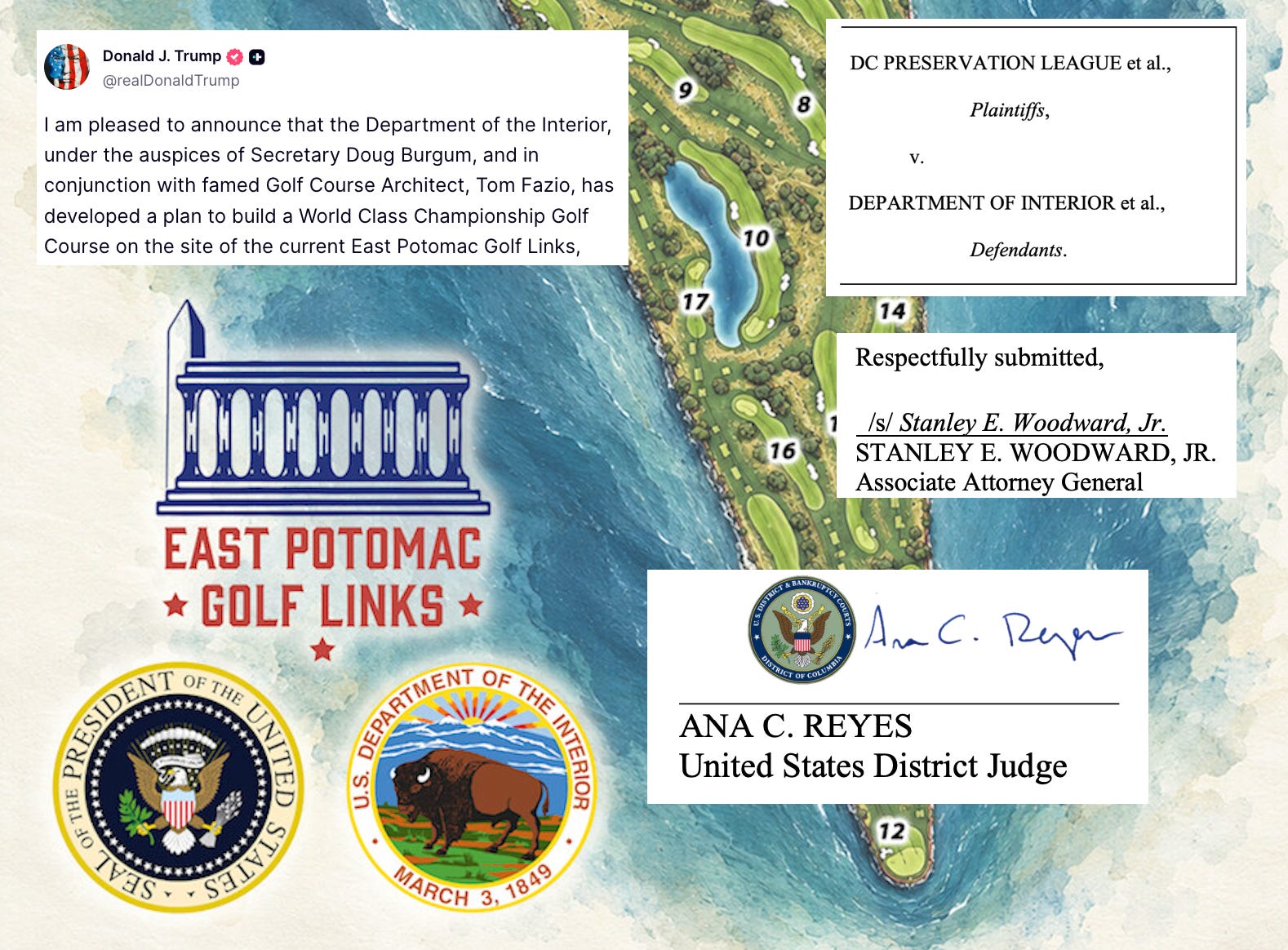
Earlier October 18, in a pair of posts on Truth social, Trump announced “that the Department of the Interior, under the auspices of Secretary Doug Burgum, and in conjunction with famed Golf Course Architect, Tom Fazio, has developed a plan to build a World Class Championship Golf Course on the site of the current East Potomac Golf Links, located in Washington, D.C.“ Claiming that the current course had “falling, dangerous, and disease infested trees,“ he went on to state: “Restoration work will begin on the Fazio Design on November 15th, when the old Course will be closed to play.”
DOJ, meanwhile, argued — in another filing only signed by Woodward — that even with Trump’s Truth social posts “there is no final agency action“ of the type required in an Administrative Procedure Act claim like the one brought by the plaintiffs here.
On Monday morning, Trump gave it one last go before the hearing, posting at 6:08 a.m. that Interior has “an absolute right” to make Trump’s sought “First Class renovation” of the historic East Potomac Golf Course and that “a crazed lunatic” judge is standing in the way of Interior, who, he continued, “do not need an approval.“
Trump then announced, “Work is scheduled to begin IMMEDIATELY!“
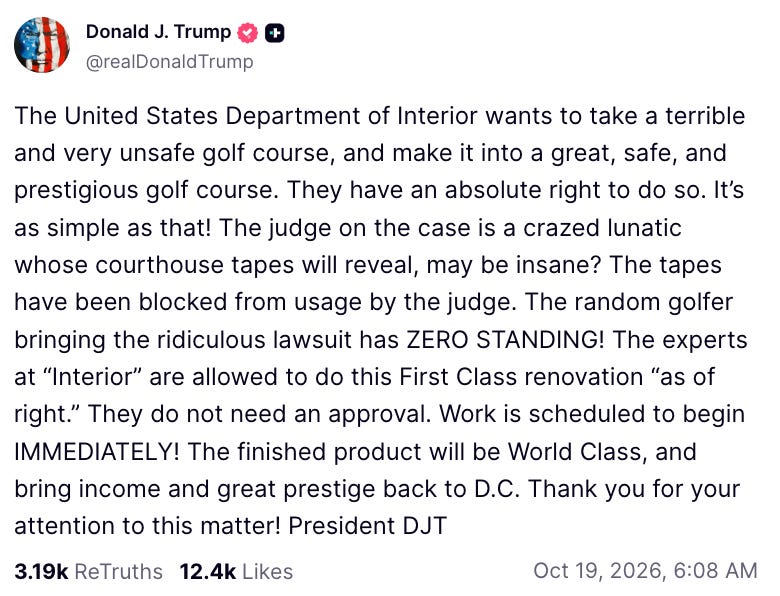
That, DOJ’s Stander kept insisting about 10 hours later, doesn’t mean “immediately” or, really, anything that a normal person would think it meant.
“The way I would look at it is like an executive order,“ Stander said to Reyes in one form or another several times, attempting to equate the “IMMEDIATELY” post with the election “integrity” executive order at issue in the August shadow docket decision from the U.S. Supreme Court where the Supreme Court majority ruled that the commands in the executive order were not justiciable.
Although Reyes kept trying to get Stander to move beyond that, he pretty much held firm. The same thing, Stander said, applied to the November 15 closure date that Trump announced over the weekend. It should be seen, he explained, as akin to an executive order directing agency action.
Notably, however, Woodward later did get up and clarify that just because there is no specific action in place yet doesn’t mean that there weren’t people looking at how to implement Trump’s Truth social directives.
The entire day involved such shifts from counsel for the Trump administration — with similar frustration from Reyes.
In one of the first notable moments of the day, as Roger Parloff reported, Reyes initially sought to require DOJ to refile the Sunday night filing only signed by Woodward with signatures from any DOJ lawyers on the case willing to sign it — explaining that this was so because she questioned how it related to earlier government arguments in the case.
In the afternoon, she withdrew that refiling requirement. And though it is likely that she did so to try and take the temperature down to the extent she could, it also appeared that Stander’s arguments — as much as Reyes pushed back — showed what DOJ is claiming here.
Stander initially attempted to argue that even a wholesale renovation of the course — Trump’s aim — would not constitute final agency action under the APA, but Reyes pushed back aggressively, noting that prior declarations submitted by the government in the case stated that such redesign would be “major federal action.” Going further, she explained that the government made those arguments because they didn’t want her to grant the plaintiffs’ request for a TRO.
Stander tried insisting this was just an “alternative argument,” but Reyes shot back that it was not. “You all made those arguments for months.“
Shifting yet again, Stander then claimed that DOJ could take a different legal position from the conclusion reached by DOI about this project.
Noting that DOJ was representing DOI, submitted the declaration, and used it in their arguments, Reyes continued, “This wasn’t just DOI on a bender was it?“
Despite all of that, when it came to hearing out DOJ’s argument that a wholesale redesign of the historic course would not be a final agency action, Reyes asked where there was precedent supporting their narrow understanding of the APA and — after being pressed — Stander acknowledged nothing directly on point but highlighted two cases from the U.S. Court of Appeals for the D.C. Circuit supporting their position.
After Stander initially couldn’t tell Reyes what those two cases were, he got the relevant brief and told her. Then, because he was seeking to apply two not-directly-on-point cases to their narrow construction, she asked what the facts were of those cases.
The first case?
“I don’t have the fact pattern.“
“You don’t have the fact pattern?“
The second case, Stander stated, had to do with “guidance documents.”
Guidance documents, of course, are a far cry from the hundreds of trees that have been felled — with plans for more than a hundred more to be felled — let alone the wholesale redesign that Trump stated over the weekend has already been “developed” in part by the secretary of the Interior Department.
DOJ’s brief noted that the author of that case’s opinion with then-D.C. Circuit Judge Brett Kavanaugh.
As for the first case, it is — at the least — convenient that Stander did not “have” that fact pattern.
There, an Environmental Protection Agency letter was at issue that the court held represented discussion of a position that was “hardly new” and a letter that “reflects no change in the position announced” previously. As such, the court later explained, the letter is not final agency action in part because it “merely restated in an abstract setting — for the umteenth time — EPA’s longstanding interpretation.”
In short, the facts of the first case were pretty much the opposite of the case before Reyes.
For those interested, the author of that opinion — not noted in DOJ’s brief — was then-D.C. Circuit Judge John Roberts.