

Nearly two decades after his passing, Lamar Hunt’s influence continues to drive soccer forward in America
By: Ethan TriebschOctober 20, 2026
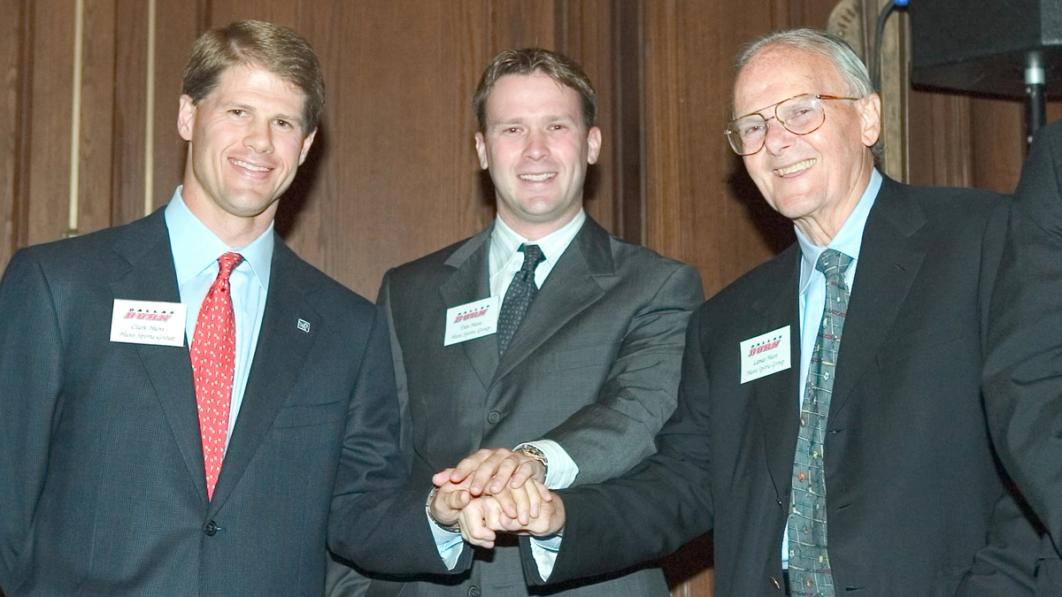
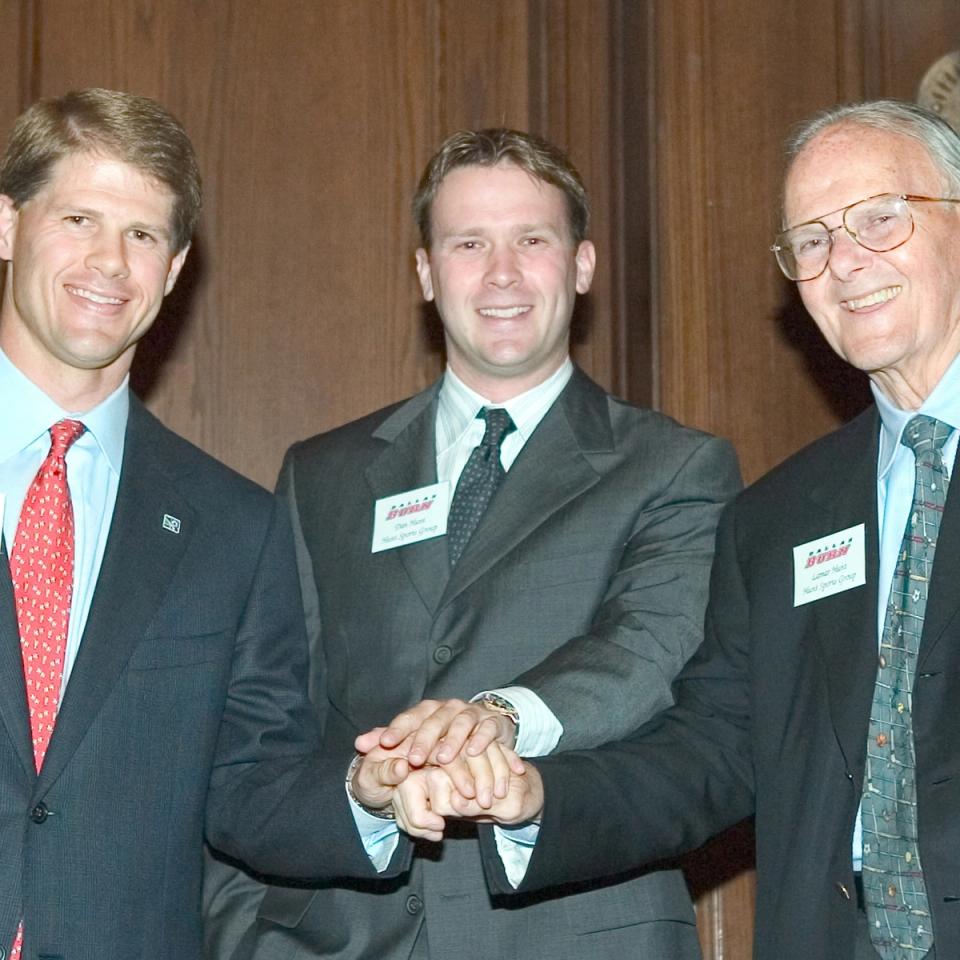
Lamar Hunt always had a fascination with the spectacle of sport. The pioneering Texas sports executive revolutionized several sports in the mid-20th century, transforming American football as a co-founder of the American Football League (AFL) and ushering in a modern era of professional soccer with the North American Soccer League (NASL) and later Major League Soccer (MLS).
Of all the sports, leagues and teams that Lamar helped shape, soccer arguably offered one of the clearest opportunities for lasting transformation. By the time Lamar became enamored with the sport in the early 1960s, soccer was in a period of decline as the once powerful regional leagues were fragmenting and becoming overshadowed by the national dominance of Major League Baseball (MLB) and the National Football League (NFL) in addition to the rising challengers of the National Basketball Association (NBA) and the National Hockey League (NHL).
Through a lifetime of service to soccer, Lamar overcame these obstacles. He helped launch the star-studded NASL that introduced the sport to millions of Americans, paved the way for MLS to become a globally respected league and kicked off the soccer-specific stadium boom still felt to this day. The soccer pioneer has been rightfully honored in more ways than one; Lamar was inducted into the National Soccer Hall of Fame in 1982 and the U.S. Open Cup—U.S. Soccer’s national club championship—was renamed in his honor in 1999.
Though it’s been nearly two decades since Lamar’s passing, his impact on American soccer has only grown over the years. His sons—Clark and Dan, who are involved in the family’s ownership and operation of the NFL’s Kansas City Chiefs and MLS’s FC Dallas—recount their father’s foray into soccer and his lasting legacy.
“There’s no doubt in my mind that the sport would not be where it is today without Lamar Hunt,” Clark said.
An Epiphany in Ireland
Lamar, born in El Dorado, Ark., in 1932 and raised in Dallas, was the son of oil tycoon H.L. Hunt. He was a lifelong sports enthusiast and played both football and baseball during his collegiate days at Southern Methodist University. Lamar drew upon his budding business acumen and passion for football to launch the upstart AFL in 1959—just three years after his graduation from SMU—to rival the NFL. In the early 1960s—a highly consequential decade for Lamar on the gridiron, court and pitch—a chance encounter in Dublin, Ireland, changed the trajectory of American soccer forever.
Between the inaugural AFL season in 1960 and Lamar’s momentous decision to move his Dallas Texans to Missouri and establish the Kansas City Chiefs, the rising sports executive took a trip to Ireland to visit his future wife, Norma, who was studying abroad on a Rotary scholarship at University College Dublin. It was on that trip in 1962 that Lamar attended his first professional soccer contest—a Shamrock Rovers match—in turn sparking a lifelong attraction to soccer.


Lamar and Norma | Photo courtesy Hunt family/Kansas City Chiefs
“The first thing he came away with was that he loved the passion of the fans,” Dan said. “He just thought it was extraordinary and very unique; that supporters’ culture. Secondly, unlike American football, baseball and other American sports, he felt like a mom, a dad, a brother, a sister could all play soccer together and kick a ball. He just loved it and thought it was such a great family game. Those were the two things he just fell in love with.”
After his experience in Ireland, Lamar watched the 1966 FIFA World Cup on television thanks to the tournament’s groundbreaking global broadcast reach, subsequently becoming enamored with the idea of establishing a fully professional, coast-to-coast soccer league in the United States. The latter portion of the decade was a busy one for Lamar; the now well-known sports executive helped execute the groundbreaking merger between the AFL and the NFL while simultaneously continuing to diversify his portfolio by becoming a founding investor of the Chicago Bulls and helping establish World Championship Tennis (WCT).
Still, he never forgot about soccer, and helped usher in a new frontier for the sport in the country with the launch of the Dallas Tornado in 1967. Its league, the United Soccer Association, merged with the National Professional Soccer League that December to form the NASL, which began play in 1968.
The NASL got off to a rocky start. After a debut 1968 campaign featuring 17 teams—which included Lamar’s Dallas Tornado—the next two seasons tested the league’s fortitude. During the 1969 and 1970 seasons, the NASL fielded no more than six teams and saw average attendance plummet to roughly 3,000.
In 1970, Lamar penned an article in the annual U.S. Soccer Federation Yearbook, reaffirming his belief in the sport’s long-term prospects despite the nation’s seemingly waning interest.


An illustration of Lamar in the 1970 U.S. Soccer Federation Yearbook | Image courtesy Society for American Soccer History
“Professional soccer, though barely in the incubator stage in America, will, in my opinion, eventually be a large-scale major sport in North America,” he wrote. “At present it suffers from lack of exposure on a school level from such traditional American sports as football, baseball and basketball. This status is changing and will be a major factor in the successful growth.”
Recalling his experience in Ireland eight years prior, Lamar reiterated his source of continual belief in the sport, adding: “I found the crowd enthusiasm and participation far exceeded any which I have ever seen at American pro football, baseball World Series or college football games… [Soccer] is played by millions all over the world, and it is this universality of appeal and the international flavor of competition that, in my opinion, will make it of appeal to Americans…That it can and will be realized, I feel sure, and I look forward to seeing American boys compete with the rest of the world.”
With the league on the brink of extinction as the 1970s rolled along, the NASL persevered. After struggling to manage more than 5,000 fans per match in the first few seasons of its existence, the NASL exploded in popularity thanks to the arrival of international stars like Pelé, Franz Beckenbauer and Johan Cruyff, as well as increased national media coverage. Rivaling attendance figures of other major leagues in the United States, the NASL averaged over 10,000 fans per match in every season between 1976 and 1984, peaking in the late 1970s, and enjoyed dozens of matches with attendances well over 50,000 during that period.


Lamar (top left) with his Dallas Tornado in 1976 | Photo courtesy Hunt family/Kansas City Chiefs
That meteoric rise to mainstream recognition, however, was short-lived.
“As a family, we like to joke that our dad’s vision about the sport of soccer was right on the money,” Clark said. “It was just 40 years too early.”
Lighting the Way Through a Dark Period
By 1985, the seemingly invincible NASL had folded. Overexpansion, unsustainable spending on star players, dwindling attendance and decreased media coverage contributed to the league’s untimely demise. Dan, who was born in 1976 and began to develop an appreciation of the sport in the 1980s, described the decade between the NASL’s collapse and the launch of MLS as a ‘dark period.’
“I know my dad was incredibly disappointed that the NASL had failed and folded in the 1980s,” Clark added. “If he was anything, he was persistent and had a never-say-die mentality, but for the Tornado and the league as a whole to go under was very disappointing for him. I don’t think he stopped believing in the sport, though. As a family, we kept attending World Cups every four years during that era.”
Though bitterly disappointed in the NASL’s demise, Lamar remained focused on the Chiefs, tennis and the theme park industry—opening up Worlds of Fun and Oceans of Fun in Kansas City—even though his passion for soccer persisted.
After Lamar’s experience at the 1970 FIFA World Cup in Mexico, he made an effort to take his family with him to every subsequent World Cup. Some of Clark and Dan’s fondest soccer memories come from those days on the road, taking in the world’s game. For Clark, it was spending the summer of 1974 as a 9-year-old watching the games in West Germany. For Dan, it was the whole family piling into a minivan and driving around Mexico and Italy during the 1986 and 1990 FIFA World Cups, respectively.
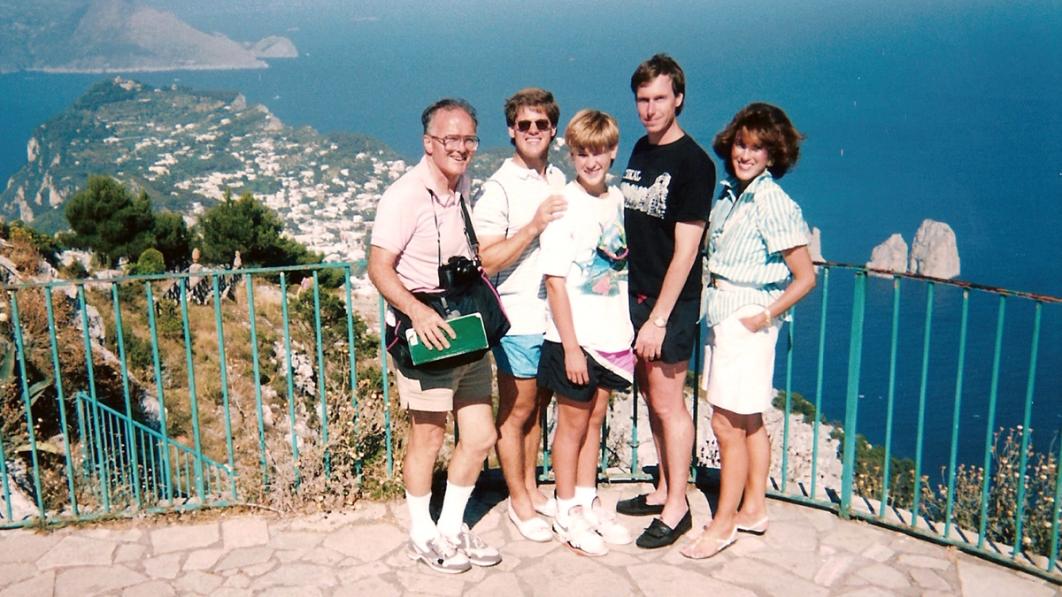
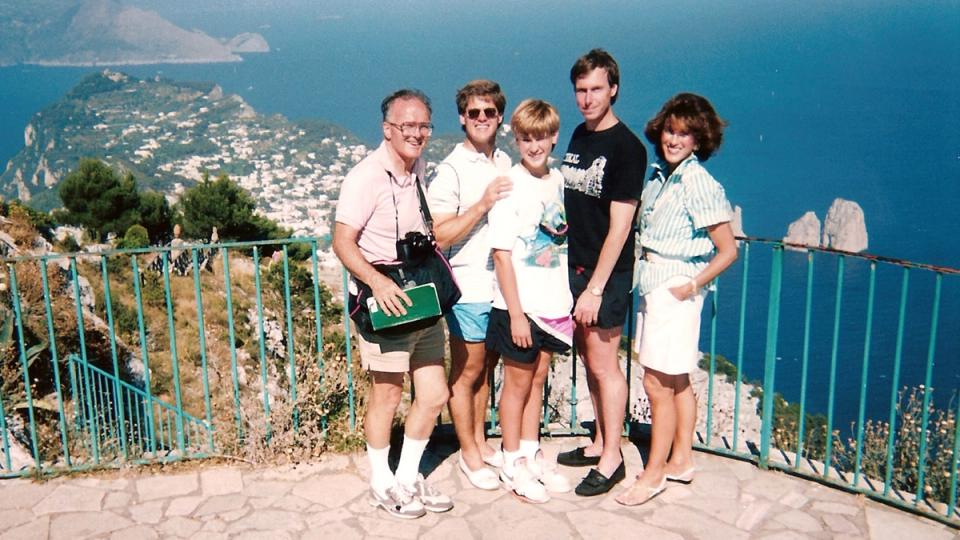
The Hunt family and Bob McNutt in Italy for the 1990 FIFA World Cup | Image courtesy Hunt family/Kansas City Chiefs
Even without the connection to an active professional soccer league or team in the late 1980s and early 1990s, Lamar’s involvement with the sport ramped up once again ahead of the 1994 FIFA World Cup—the first to be hosted in the United States.
“We end up in 1994 with the World Cup finally in the United States,” Clark said. “Our dad played a big role in that as co-chairman of the Dallas Host Committee. The tournament was very successful across the country, specifically in Dallas, and as a result, MLS is launched two years later in 1996. Of course, the very first person to raise his hand and say ‘I’m in’ was our dad because he truly loved the sport. He believed in its future in the U.S., and he knew that one day there would be thousands of fans packing stadiums to cheer on the domestic league.”
As part of the United States’ successful bid to host the 1994 World Cup, organizers committed to establishing a top-flight professional league shortly after the tournament. Naturally, Lamar emerged as MLS’s principal founding investor ahead of its inaugural 1996 campaign, simultaneously assuming ownership of two of the 10 founding clubs: the Columbus Crew and Kansas City Wizards.
The budding league coasted on the residual soccer enthusiasm of the 1994 World Cup, but less than five years after its launch, the novelty of MLS was wearing off, and Lamar feared the league might suffer a similar fate to the NASL. At that time, Clark was actively involved in his family’s sporting operations, while Dan was just joining the business.
“On my very first day [in November 2001], we sat in the Chiefs offices—it was myself, Clark, John Wagner, and our dad—and the league nearly went out of business on my very first day,” Dan described. “My dad got Philip Anschutz and Robert Kraft to stick together and keep 10 teams alive, because he knew that the foundation had been set.
“His health was in serious decline at that point, and he knew that he wanted to leave his mark. So, if [MLS] had died in that moment, we would have been set back 10 or 15 years probably. Instead, I think one of his parting gifts, if you will, was to you know ensure that the league stay alive.”
Nursing the league back to health, the now seasoned sports executive was fully committed to saving the sport he believed in. During MLS’s tumultuous period at the turn of the century, Lamar spearheaded a series of changes to keep the floundering league afloat: he financed the construction of the revolutionary Columbus Crew Stadium in 1999—heralded as one of the first soccer-specific stadium in the country—helped implement the league’s single-entity structure and expanded his ownership umbrella by taking on the Dallas Burn’s operations in 2003.
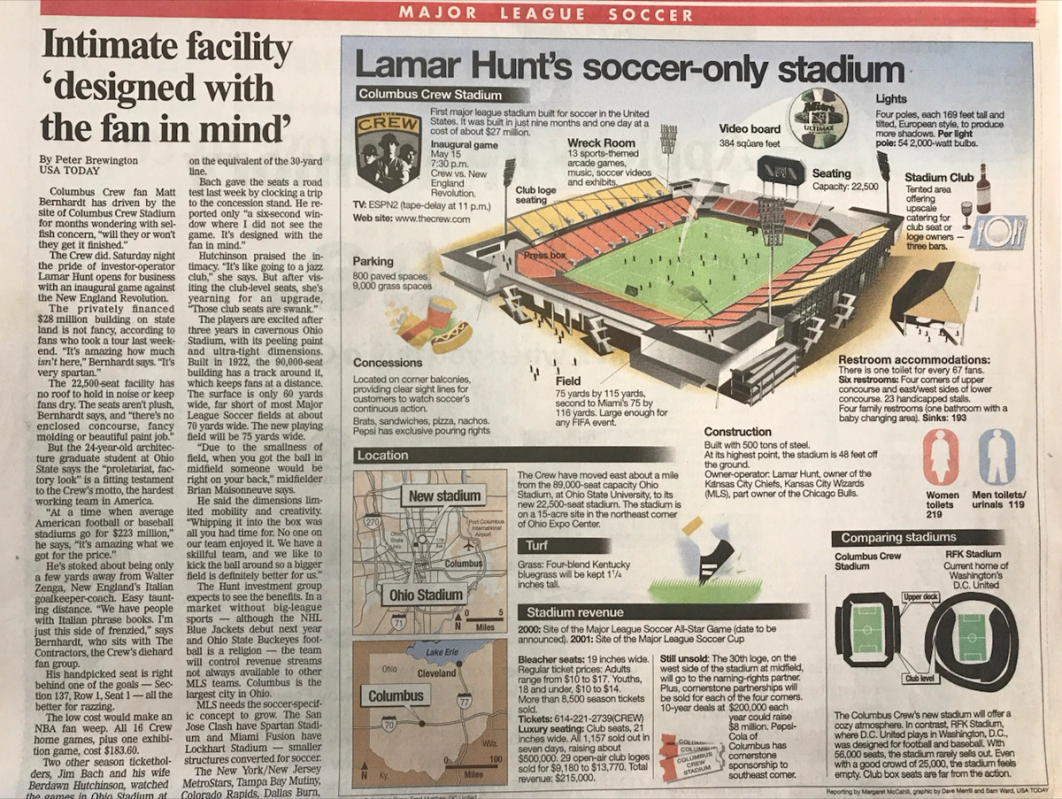

A snippet from USA Today detailing Columbus Crew Stadium | Image courtesy Columbus Crew
“He decided to build the first soccer-specific stadium,” Dan said. “That is one of the most important moments in all of the history of soccer in our country, because it showed that there was a viable path forward. He took that leap. It was almost shocking, but it showed that if you give the fans their own home, a culture becomes built around that.”
Those fundamental transformations and Lamar’s unwavering support for the fledgling league proved successful, and the ripple effects of those decisions can still be felt to this day, as MLS has developed into a sustainable league fielding 30 clubs and attracting global recognition in the process.
The Lamar Hunt U.S. Open Cup and Beyond

The old U.S. Open Cup trophy perched beneath a statue of Lamar Hunt at Historic Crew Stadium | Image courtesy Columbus Crew
By the late 1990s, the U.S. Open Cup was nearing a century of uninterrupted, annual play. With the emergence of MLS in 1996, the tournament was beginning to evolve, as the top-flight league began to dominate the historic competition. Still, the tournament stayed true to its name, remaining open to any eligible leagues and teams.
At the grand opening of Columbus Crew Stadium on May 15, 1999, the U.S. Soccer Board unanimously voted to rename the then-85-year-old U.S. Open Cup the Lamar Hunt U.S. Open Cup in recognition of Lamar’s lifetime of dedication to the sport.
“He was incredibly honored,” Dan recalled. “He said, ‘This is the FA Cup of America,’ and he knew it was such a substantial honor. I was a young child when the AFC championship trophy was named after him in 1984, so I didn’t understand the significance at the time. But I feel like he held the two honors in the same regard.”
“It’s very fitting that he be associated with [one of] the longest-running competitions in the history of soccer in the United States,” Clark said. “I remember hearing about it and thinking how incredibly appropriate it was and also knowing for a fact that my dad would hate it because he never wanted the attention to be on him. He never wanted it to be about him. He wanted it to be about the sport, the players, the coaches.”
Fittingly, the first time the Open Cup bore Lamar’s name also marked the last time a non-MLS side—the USL A-League’s Rochester Rhinos—won the whole thing, taking down MLS’s Colorado Rapids at Columbus Crew Stadium in 1999.
“Our dad was always a big fan of the underdogs,” Dan explained. “He always was. He thought soccer was an underdog for a long time. His AFL was an underdog for years, and he just loved that [the Open Cup] actually gave a stage for everyone to compete on. I think that’s why it resonated even more with him, because anybody had a chance to win. My dad loved competing; he loved fairness. Those are the extra values that really resonated with him: it was truly an open tournament that you could work your way through, and an underdog could actually win it.”
Not long after the tournament was renamed in Lamar’s honor, the three MLS sides in the Hunt family portfolio found success on the pitch, reflecting the league’s upward trajectory in the early 2000s. After the Kansas City Wizards won MLS Cup in 2000, the Columbus Crew won the Open Cup in 2002, before the Wizards added an Open Cup of their own in 2004. For the Hunt family, those years brought both unforgettable triumphs and profound sadness.
“It really is unique, and each one has such special memories,” Dan said, pausing with emotion. “The images of my dad celebrating in Columbus are really special. There’s just something about seeing his smile. Columbus was a little bit of an underdog, and it was at the first soccer-specific stadium; it helped tie it all together for me.
“In Kansas City, he didn’t go to the Final because he was so sick, so I got to call him and tell him and it was awesome. We actually got him dinner because he’d been in treatment all day, and just to hear the joy that brought was really amazing. You think back to that memory because he passed away two years after that, and just how much pain he was in… I think back to the Kansas City win and being able to call him and just how uplifting that was.”
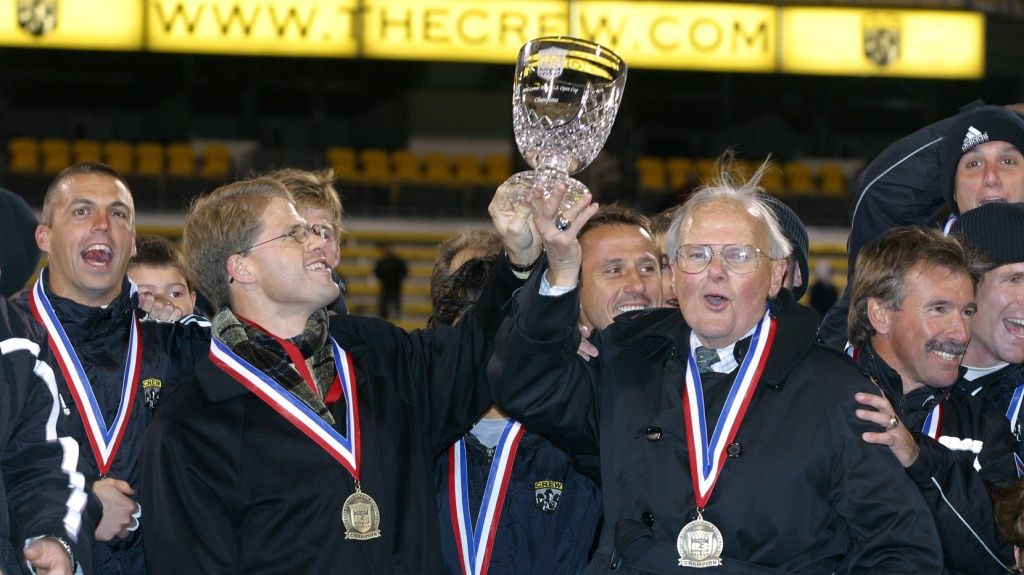
Clark (left), Lamar (right) celebrating the Columbus Crew’s 2002 U.S. Open Cup Final victory | Photo courtesy Hunt family
“I’m so glad that my dad got to be part of [the Columbus victory],” Clark said. “The thing I remember most about that game is being on the platform after the game, with the team and the coaches and my dad holding the trophy, and everybody’s jumping up and down and the confetti’s going everywhere. He’s there in the middle of it, and I just think it was probably a nice reward for somebody who had worked so hard to make the sport what it had become. I think it was a special moment for him.”
Lamar died of cancer in 2006, a decade before FC Dallas won the competition carrying his name in 2016. The family sold its interest in the Kansas City Wizards in August 2006, before Lamar’s death that December, and the Columbus Crew in 2013, while retaining FC Dallas. Clark and Dan remain involved in the club and have fond memories of Dallas’ 2016 Open Cup triumph.
“All of them are so special from that standpoint,” Dan said of his family’s three Open Cup victories. “They’re different moments in time.”
Dan also reflected on seeing footage of his father at the National Soccer Hall of Fame, located at FC Dallas’ Toyota Stadium, adding, “What’s cool is when you go into the Hall of Fame and one of the video screens brings up footage of my dad from one of the Open Cups. It’s really cool to see that inside the Hall of Fame.”
“Then this is the funny part of 2016: we win the trophy, and Clark and I have it, and we’re like, ‘Wow, this feels so great. Could you imagine what it would be like to win an AFC Championship trophy with Dad’s name on it?’ And we’ve won a few of those lately.”

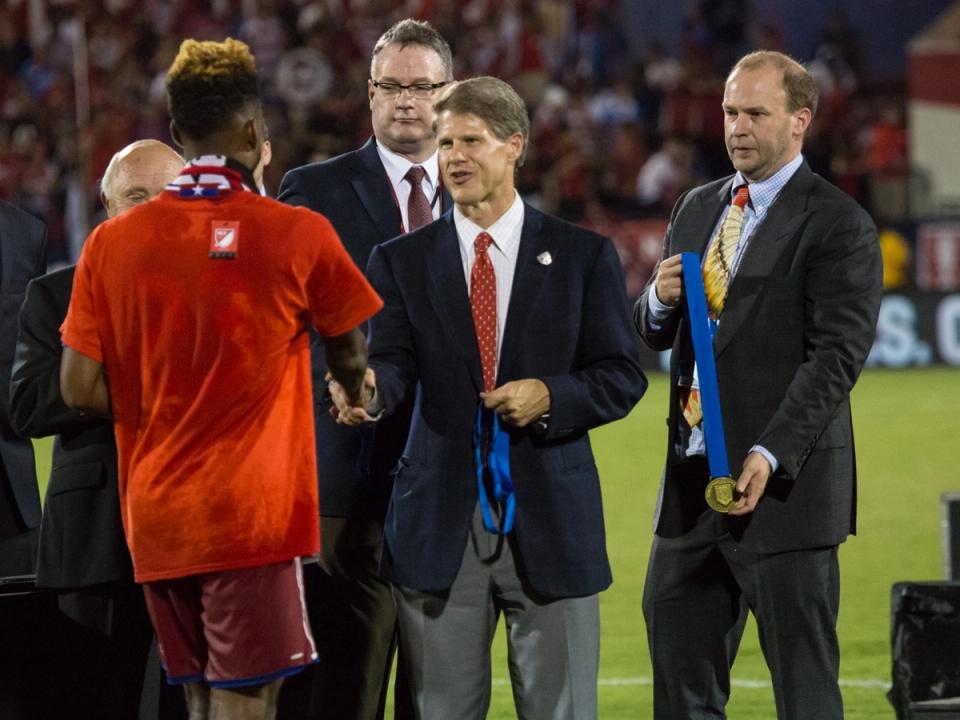
Clark (center), Dan (right) handing out medals following FC Dallas’ 2016 U.S. Open Cup Final victory | Photo courtesy Hunt family
In addition to Clark and Dan’s success in orchestrating the Kansas City Chiefs’ ongoing dynasty in the NFL, the pair of brothers have continued to honor their father’s soccer legacy through action. The Hunt family continues to own and operate FC Dallas, which is in the midst of a massive stadium renovation and on track to record its best season since winning the Open Cup and Supporters’ Shield in 2016. The duo also followed in their father’s footsteps when the FIFA World Cup returned to North America over the summer, as Clark brought the game’s biggest stage to Kansas City and Arrowhead Stadium for the first time, and Dan helped World Cup soccer return to Dallas.
“I think he would absolutely be thrilled with where soccer is in the United States,” Clark said of his father. “He lived long enough to see it taking off, and it’s come a long way in the 20 years since he passed. But I think he would be absolutely thrilled with MLS at 30 teams, with full stadiums, with star players playing throughout the league, with the respect that MLS has garnered around the world, and all of that was highlighted through the World Cup this summer, which he would have also been so happy to see the World Cup come back to the United States.
“He enjoyed it so much in 1994 and was such a big part of making that happen. I think he would have been very glad that Dan and I were both involved with the World Cup as co-chairs in Kansas City and Dallas, I think he would have really enjoyed that. And you know his two favorite cities, Dallas and Kansas City, both did an incredible job hosting the tournament in every way, and he would have absolutely loved that.”

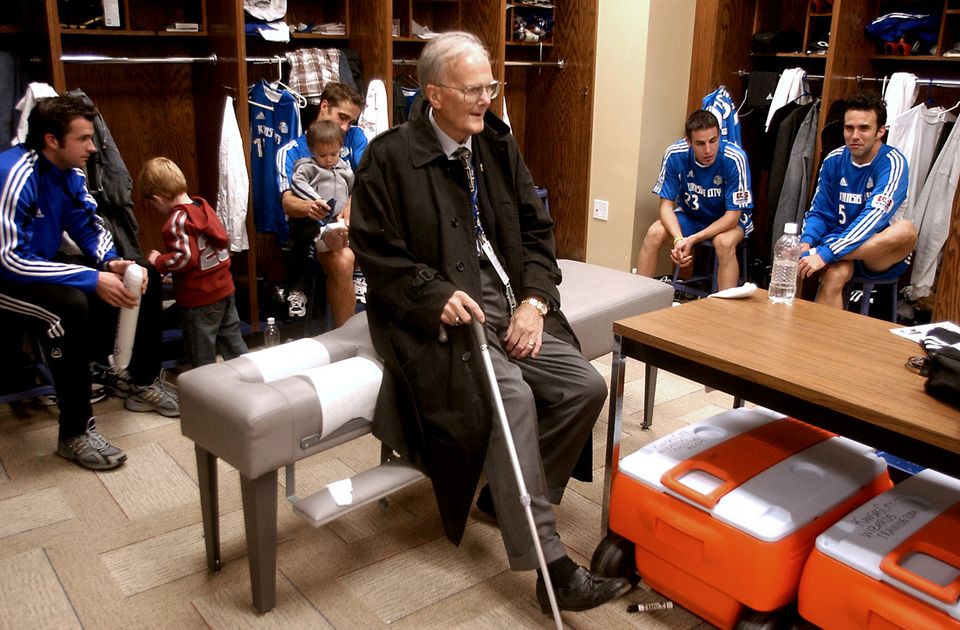
Lamar with his Kansas City Wizards in the early 2000s | Photo courtesy Hunt family/Kansas City Chiefs
The Lamar Hunt U.S. Open Cup Final is set for a return to Columbus for the first time since Lamar, Clark and Dan lifted the trophy with the Crew in 2002. This time at the glistening ScottsMiracle-Gro Field five miles down the road from Historic Crew Stadium, the surging Columbus Crew will look to derail a St. Louis CITY SC side that just set an MLS record with 21 consecutive matches unbeaten.
Although FC Dallas did not participate in the Open Cup this year, the Hunt’s club and its remaining 26 U.S.-based counterparts will be back in the venerable tournament next year.
“I’m so excited for the Open Cup, and I’m hoping that it will continue to evolve, and it looks like it is,” Dan said. “I just think the energy behind it is so great, and it’s so fun. One of the reasons my dad was most honored—besides equating it to the FA Cup—is that he always loved the underdog, and he believed that this gave everybody a chance to compete. He was a man who, at his core, valued fairness and giving chance and opportunity, that’s why [the Open Cup] meant so much to him.”