
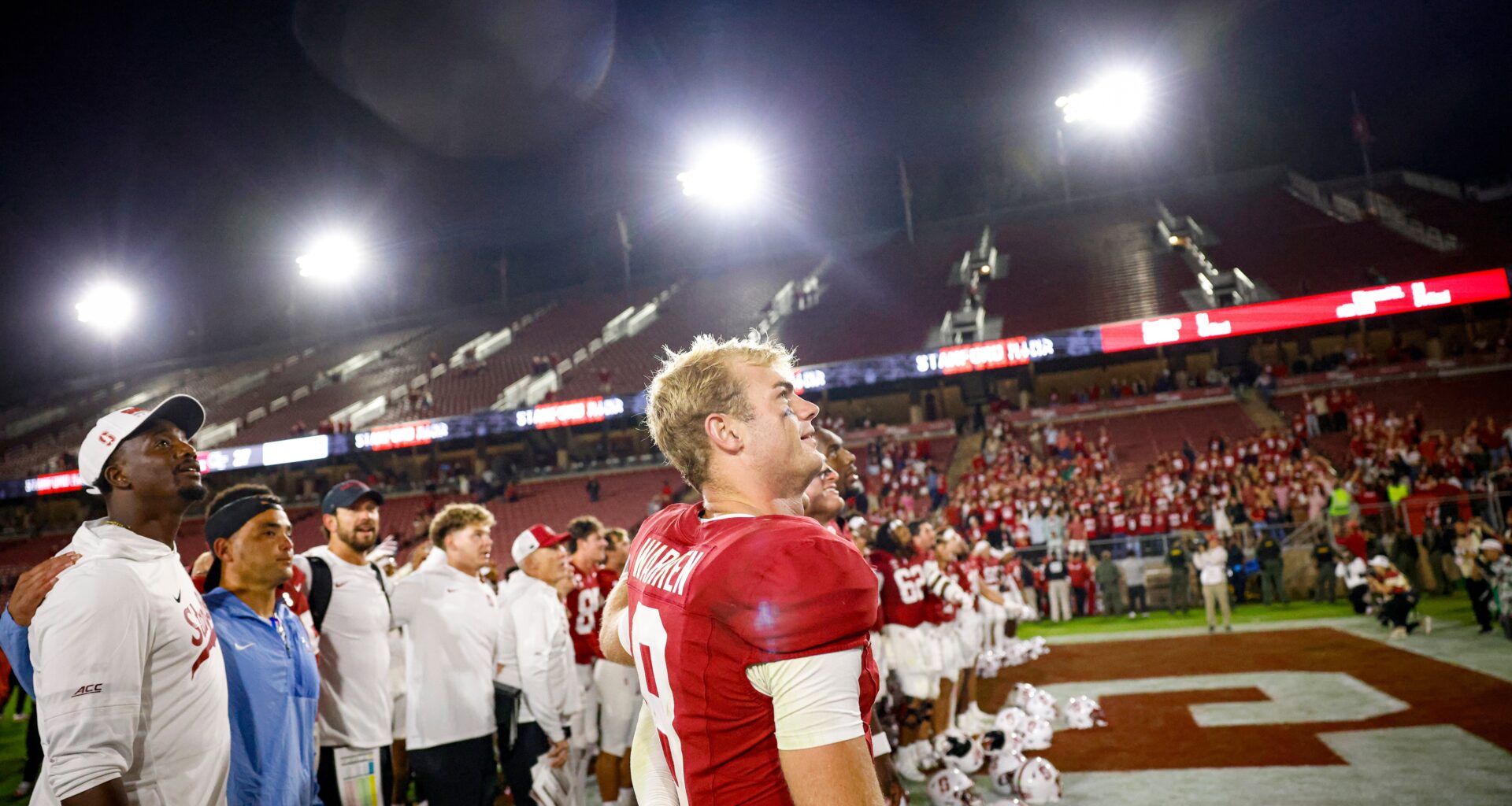
STANFORD – Quarterback is a position defined by pressure.
Davis Warren knows something about pressure.
On Friday night, when Stanford (3-4, 1-3 ACC) hosts N.C. State (3-3, 1-2), the sixth-year senior will have another opportunity to do what he once feared he might never do again: play football.
Warren has started every game for the Cardinal this season and is one of nine FBS quarterbacks with at least 200 passing attempts and two or fewer interceptions. He is also trying to help Stanford reach its first bowl game in eight years.
But the challenges of trying to turn around the program pale in comparison to the one Warren faced as a teenager, when a seemingly ordinary morning workout changed the course of his life.
In March 2019, Warren arrived at a football workout in Southern California expecting another routine day. Instead, he found himself unable to lift even a warmup weight.
Warren, then a high school junior, initially assumed he was dealing with a seasonal illness. He rarely got sick growing up, and he figured his symptoms would eventually pass.
A search online raised a possibility he struggled to accept: cancer. He dismissed the thought, reasoning that something more common, such as mononucleosis, was the likelier explanation.
But blood tests at an urgent care clinic revealed enough cause for concern that Warren was sent to Children’s Hospital Los Angeles, about an hour away.
There, he received a diagnosis of acute myeloid leukemia (AML).
Warren knew little about the disease. He had little family history with cancer, and his understanding of what the diagnosis could mean was frighteningly simple.
“The only thing I associated with cancer was death,” Warren said.
The physical demands of treatment were considerable, but Warren said the mental toll was even harder. In those early days, his questions extended far beyond football. Would he survive? Would he ever return to the activities he loved? Would he still be the same person?
He underwent four rounds of chemotherapy, and his body responded well enough that he did not need a bone marrow transplant.
Football eventually offered a path forward, though not a conventional one.
After completing treatment, Warren joined the Michigan football program as a walk-on under former Stanford coach Jim Harbaugh. Following Michigan’s 2023 national championship, Warren earned the starting job and appeared in nine games, throwing for 1,199 yards and seven touchdowns.
Then came another setback. Warren tore his ACL in Michigan’s victory over Alabama in the 2024 ReliaQuest Bowl, forcing him to miss the 2025 season. He transferred to Stanford that winter, beginning another chapter in a football career marked by unexpected turns.
 Michigan quarterback Davis Warren (16) fires a pass in front of Alabama linebacker Jihaad Campbell (11) during the first half of the ReliaQuest Bowl NCAA college football game Tuesday, Dec. 31, 2024, in Tampa, Fla. (AP Photo/Chris O’Meara)
For a long time, Warren wanted to keep his cancer experience separate from his identity.
“I wanted to be anything but a kid with cancer,” he said. “I just wanted to be Davis.”
As he found success on the field, however, his perspective began to change. Warren recognized that sharing his story could offer encouragement to children confronting the same frightening uncertainty he once faced. Speaking openly about his experience also became a way to process it himself.
His journey through leukemia, the competition to earn a starting role at Michigan and the setbacks that come with playing quarterback taught him more about his own resilience than he had previously understood.
That perspective now shapes how he approaches the position. A quarterback must respond to mistakes, adjust under pressure and move on quickly, regardless of what happened on the previous play.
Warren had learned a similar lesson long before taking the field at Stanford: He could not control every circumstance, but he could control how he responded.
The same outlook that helped him navigate months of treatment continues to guide him through the uncertainty of football. And it has given him a reason to look beyond his own comeback.
Through hospital visits, including time spent with young patients at Lucile Packard Children’s Hospital Stanford, Warren has sought to offer encouragement to children facing their own battles.
“It just inspires me to keep pushing and never to give up,” Warren said.
 Stanford Cardinal’s Davis Warren (8) throws the ball against Georgia Tech in the first quarter at Stanford Stadium in Stanford, Calif., on Saturday, Sept. 26, 2026. (Shae Hammond/Bay Area News Group)