

The FIFA U-17 World Cup 2026 is just around the corner, and judging by the tournament alumni, we could be about to witness the next legendary talents.
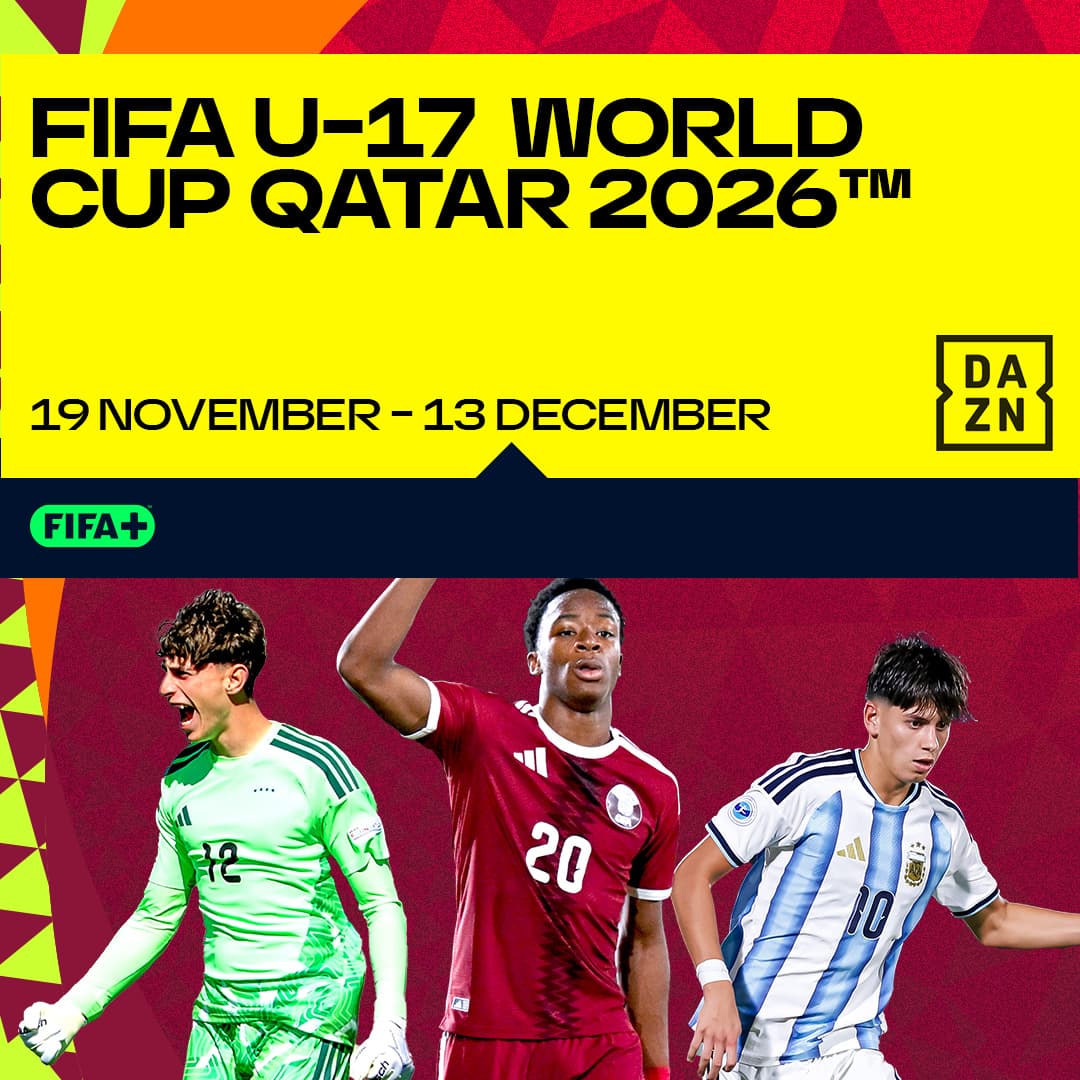
Forty-eight teams are set to compete in the three-and-a-half-week competition in Qatar, which commences with the group stage on November 19.
The inaugural tournament was in fact called the FIFA U-16 World Championship and was held in China in 1985, with just 16 sides battling out for glory as Nigeria defeated West Germany 2-0 in the final.
Since then, the under-17 version of the competition has hosted Ballon d’Or winners, World Cup legends and some current stars of the game.
Ronaldinho
Let’s start with Twinkie Toes himself, the man who played the beautiful game like no other.
In 1997, Brazil entered the FIFA U-17 World Cup, having never won the tournament, but it was the year that opened the door to one of the most revered talents in history.
Wearing the number 10 shirt, a shorter-haired Ronaldinho dazzled in the famous yellow and green, showcasing his unique ability with the ball at his feet.
The boy from Porto Alegre bagged both goals in the final, his only goals in the competition, against Ghana to guide his team to their first-ever title at this level.
Two years later, Ronaldinho lifted the Copa América trophy before landing the senior World Cup in 2002 and also tasted great success at club level with Barcelona and Milan.
 Getty Images
Neymar
Another boy from the land of samba made his mark 12 years later and went on to become one of the icons of the game.
Neymar arrived at the 2009 FIFA U-17 World Cup with considerable hype, having already made his senior debut for Santos just months earlier, aged 17.
It didn’t take the teenager long to make his mark, bagging in Brazil’s opening group game thriller with Japan, but Seleção Sub-17 lost their next two and were eliminated in the group stage.
Indeed, it never quite happened at international level in terms of trophies, with no World Cups or Copa Américas to his name, although he did win Olympic gold at Rio 2016 and is Brazil’s all-time leading scorer with 80 goals in 130 appearances.
At club level, however, Neymar excelled, lifting the Champions League and two La Liga titles with Barca alongside Lionel Messi and Luis Suarez before completing a record €222 million transfer to PSG in 2017.
 Getty Images
Gigi Buffon
When you’re good enough, you’re old enough and that saying couldn’t be more pertinent for Gigi Buffon in 1993.
The Italian shot-stopper was just 15 when he represented his country in Japan, but the tournament unravelled rather quickly, with the goalkeeper shipping six goals as the European side were eliminated in the group stage without a win.
Just two years later, Buffon made his senior debut for Parma at 19, keeping a clean sheet against Milan in a goalless draw, including some impressive saves to keep Roberto Baggio and George Weah at bay.
Buffon made his senior debut for Italy in 1997 and was selected for France 98, but his crowning achievement came in 2006 against the French.
The 2006 World Cup is remembered for the chaos of the final, with Zinedine Zidane’s headbutt on Marco Materazzi forever etched in history.
Amid the carnage, Buffon produced a string of world-class performances, conceding just two goals all tournament – a penalty and an own goal.
 Getty Images
Xavi
The list of legendary Spanish players to have graced the FIFA U-17 World Cup is quite simply ridiculous, but Xavi was the one to kickstart a generation of domination.
Alongside a young Iker Casillas, a 17-year-old Xavi arrived at the tournament in Egypt as a product of Barcelona’s famous La Masia academy, having joined at 11.
Spain were particularly impressive at the competition, smashing New Zealand 13-0 in their opening group game before reaching the semi-finals, where they were knocked out by Ghana before defeating Germany in the bronze medal match
The tournament provided an early indication of the midfielder’s intelligence and technical ability that would build the foundations for the upcoming Spanish dynasty.
Xavi made his senior debut for his country in 2000 and went on to win back-to-back European Championships, with the 2010 World Cup sandwiched in the middle.
At club level, the Terrassa-born midfielder was part of a devastating Barca side that won eight La Ligas, four Champions Leagues and two FIFA Club World Cups.
 Getty Images
Toni Kroos
Team: Germany
Year: 2007
Toni Kroos set the tone for a glistening career by delivering a series of match-winning performances as Germany finished third in 2007.
Indeed, the midfielder was the standout talent of the tournament, earning the Golden Ball as well as the Bronze Boot for bagging five goals.
Eighteen days after Germany’s third-place finish at the U-17 World Cup, Kroos made his senior debut for Bayern Munich, providing two assists against Energie Cottbus in the Bundesliga.
The general went on to win three Bundesligas and the Champions League before joining Real Madrid in 2014, where he won five more Champions Leagues alongside Luka Modric and Casemiro.
Having made his senior debut for Germany in 2010, the midfielder then played a key role in his country’s 2014 World Cup triumph, including that infamous 7-1 annihilation of Brazil in their own backyard.
Kroos’ most endearing quality is that he just went about his business while allowing his teammates to bask in the spotlight.
 Getty Images
List of legends
Here is the full list of notable names to have featured in a FIFA U-17 World Cup before achieving significant success at senior level.
Year Player Team 1989Luis FigoPortugal1991Alessandro Del PieroItaly1993Gigi BuffonItaly1993Francesco TottiItaly1997RonaldinhoBrazil1997XaviSpain2001Andres IniestaSpain2001Fernando TorresSpain2001Carlos TevezArgentina2003Cesc FabregasSpain2003David SilvaSpain2005MarceloBrazil2007Toni KroosGermany2007Eden HazardBelgium2007James RodriguezColombia2009NeymarBrazil2009Philippe CoutinhoBrazil2009CasemiroBrazil2009AlissonBrazil2009Mario GotzeGermany2011Raheem SterlingEngland2015Victor OsimhenNigeria2017Phil FodenEngland2017Ferran TorresSpain
Where to watch the FIFA U-17 World Cup
You can watch every game from the FIFA U-17 World Cup live and exclusive on DAZN and all for free.
You just need an email address to set up a free account to start watching
The tournament will be available on DAZN via FIFA+ with every game being shown live in the UK, Republic of Ireland, Croatia, Serbia, Denmark, Romania and many more (check your local schedule for availability in other regions).
DAZN subscribers have full access to FIFA+ on DAZN, providing unprecedented access to football content from around the world.
How to watch DAZN
Watching the FIFA U-17 World Cup on DAZN gives fans the ability to enjoy the action live anywhere and everywhere via the DAZN app.
Available on smart TV’s, smartphones, tablets, streaming devices (EG: Fire Sticks); game consoles, and laptops / MAC’s / PC’s, you can stream your favourite content live from your home or while out on the move (mobile network data signal required).
Here’s a comprehensive list of devices on which DAZN is available.
Device type
Supported devices
How to download the DAZN App and set up an account
It is simple to watch via the DAZN App, available on smart TVs, smartphones, tablets, game consoles, streaming devices such as Fire Sticks, and PC’s, laptops and Macs.
On your smart TV, phone, tablet, or streaming device, go to the app store, search for ‘DAZN’ and download
Once downloaded, open the App and select ‘Get started’ or ‘log in’
Manually enter your email address and choose a password. Or sign up via the Apple, Google or Facebook options
You now have access to all of DAZN’s free content, including FIFA+ to watch every game
On a laptop/PC, visit www.DAZN.com/home and then follow the above instructions.
Watch World Cup archive, highlights and documentaries for FREE on DAZN
DAZN is the home of FIFA+ , a vast library of football on-demand content including World Cup archive, iconic documentaries, player profiles, live matches and both full match replays and highlights.
Watch it all for FREE on DAZN on smart TVs, phones, tablets, streaming devices, games consoles and web browsers.