

The city of Los Angeles recently blocked new housing on a Woodland Hills golf course, saying the land provides critical habitat for endangered mountain lions.
But last month, California housing regulators said the city’s denial goes against state law. And on Monday, supporters of the project filed a lawsuit aiming to force the city to allow its construction.
“If the city does not correct its violation and approve the project, it will face severe punishment,” said Ryan Patterson, a lawyer representing one of the plaintiffs, YIMBY Law, which advocates for building more housing.
Patterson said if the city loses, taxpayers could be on the hook for up to $20 million in damages plus attorney’s fees.
But many Woodland Hills neighbors are determined to fight. In addition to the concern over mountain lions, they describe the project as a risk to the community’s character — as well as resident safety during wildfires.
Developer hoped state law would be a hole-in-one
The fight centers on a 20-acre portion of the century-old Woodland Hills Country Club. The 93-acre site currently features an 18-hole golf course and a clubhouse that hosts private events.
Arrimus Capital bought the property in 2020. Last year, the firm submitted plans to the city for 398 units of new housing, including 223 apartments and 175 single-family homes. About 15% of those units would be reserved for low-income families.
The developer sought to fast-track the project through a state law that took effect in 2023, Assembly Bill 2011. Like other recent Sacramento streamlining bills, the law lets mixed-income housing projects bypass lengthy environmental reviews and city approval processes, in this case as long as the project is located along a street wide enough to qualify as a “commercial corridor.”
Woodland Hills homeowners have been organizing to fight the project. They say putting nearly 400 new homes on the golf course would remove valuable green space and add to dangerous road congestion during emergencies.
“We’re in a high-fire zone,” said John Walker, president of the Woodland Hills Homeowners Organization. “If anything happens up here that blocks any of these roads, all of us can’t get out. We’ll die up here.”
Most of the Woodland Hills Country Club falls within a state-designated Very High Fire Hazard Severity Zone. The state law says if projects in such zones are located on “vacant,” undeveloped land, they cannot be streamlined. But housing supporters say that exemption doesn’t apply to the golf course, because it is not a vacant site.
“There are city processes, permitting processes, and even state law requirements that a project like this be built in a fire-safe manner,” said Patterson, the YIMBY Law attorney.
“I would certainly never tell anyone they shouldn’t be concerned about fire in California, but new construction is held to a very high standard, including projects like this,” he said.
City handicaps plans for nearly 400 homes
The city’s denial of fast-tracking had nothing to do with the project’s perceived fire risk, though.
Councilmember Bob Blumenfield, who represents the district, said in an August letter to his constituents that he shared their concerns and had tried “many different ways” to block the project’s fast-tracking. He said the L.A. Department of City Planning had found what he saw as a legally viable reason to reject the application: mountain lions.
The department determined in August that the golf course qualifies as “wildlife habitat” for an endangered species, one of the few exemptions in the state law.
“The city is only following the rules,” said Blumenfield, who is soon to be termed out.
“The scientific evidence is indisputable,” he said in an email to LAist. “Biological and ecological experts, including the Mountains [Recreation] and Conservation Authority, have definitively concluded that this site is habitat for mountain lions.”

A flag sticks out of a hole on a putting green at the Woodland Hills Country Club.
Advocates for the developer said the city has not provided evidence of mountain lion sightings on the golf course. They say the animals thrive in untouched chaparral, not in environments manicured for human activity, such as golf courses.
Mountain lions have been spotted near the golf course
The Santa Monica Mountains Conservancy released a home security video Monday it said showed a mountain lion walking on a street next to the golf course’s seventh hole late Friday night.
Joseph Edmiston, the conservancy’s executive director, said in a news release that the footage “shows both the value of Woodland Hills habitat areas and that these magnificent animals are pressed for space.”

The Santa Monica Mountains Conservancy released home security camera footage showing a mountain lion walking along a street next to the Woodland Hills Country Club.
(
Courtesy Santa Monica Mountains Conservancy
)
But officials with the state’s Department of Housing and Community Development have weighed in on the side of the developer. They sent L.A. a letter last month saying the city’s denial of fast-tracking for the project “appears to be in violation of state housing law.”
The letter took issue with a city report on the golf course’s importance as mountain lion habitat, saying, “The city must demonstrate that the site actually serves as a habitat, for which the report offers no such evidence.”
L.A. Planning officials declined to answer LAist’s questions for this story, saying they “cannot comment on pending litigation.”
Could fresh L.A. leadership change the city’s course?
The legal wrangling comes at a pivotal moment for the city’s political future. Voters recently chose a new mayor, Nithya Raman, who ran on making it easier to get new homes built at a time when L.A. is far behind on meeting its state housing goals.
Next month, L.A. will also have a new city attorney, Marissa Roy, and Woodland Hills will have a new City Council member, Barri Worth Girvan. Zachary Pitts, the L.A. director for YIMBY Law, said it’s unclear how the changing of the guard could impact the lawsuit.
“I think any politician — knowing that they are going to lose — would prefer to settle and to just approve it,” Pitts said. “That’s our hope.”
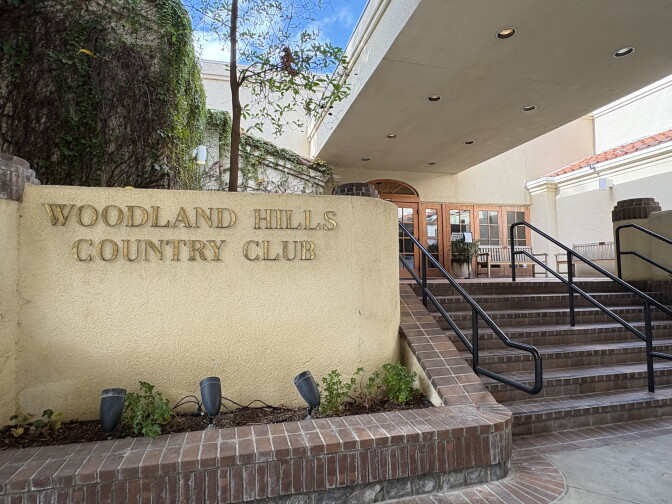
Stairs lead to the entrance of the clubhouse for the Woodland Hills Country Club.
Nearby residents said they think the city has a strong case, and they hope the project will fail.
“There’s this ridiculous false need for there to be more housing,” said Walker with the local homeowners organization. “We don’t need more housing. We need responsible housing.”
This is not the first time the issue of what qualifies as mountain lion habitat for the purposes of housing development has been litigated in California.
In 2022, state Attorney General Rob Bonta warned the San Mateo County town of Woodside that its plans to exempt the entire town from a state housing law due to mountain lion conservation were illegal.