
Wherever one falls on the case for Draymond Green to be a Hall of Famer, there’s absolutely no question that he’s one of the most unique players in NBA history. He’s a defensive savant who averaged 6.8 rebounds a game despite being 6’5, guarded centers with regularity and distributed the ball perfectly amidst a dynasty. There’s a very good chance we never see another player with his exact skillset.
Atlanta Hawks guard Dyson Daniels isn’t a carbon copy of Green. However, Daniels’ contributions towards winning in almost every way – except the points column – deserve some special attention. He’s becoming the most important player on Atlanta’s roster and one of the most fascinating talents in the NBA.
In fact, I would say he occupies a role on the team that is unique across the entire league. Here’s why.
Offense Isn’t Just Points
Nov 22, 2026; Atlanta, Georgia, USA; Detroit Pistons forward John Collins (20) and Atlanta Hawks guard Dyson Daniels (5) fight for the ball during the first half at State Farm Arena. Mandatory Credit: Dale Zanine-Imagn Images | IMAGN IMAGES via Reuters Connect
Largely speaking, the best offensive players in the NBA are given that designation because they can score 25+ points with respectable efficiency while the entire defense is set against them. Their offense lies in their scoring touch and their passing. Dyson Daniels contributes to great offense in an entirely different way.
First, it’s important to establish how much better the Hawks’ offense is when he’s on the floor. Their offensive rating improves by 1.4 points when he’s on the floor, and their TS% goes down by 4%. However, the Hawks’ turnover rate is cut by 2.5%, and their offensive rebounding percentage goes up by 4.4%. Simply put, Dyson keeps the Hawks from wasting offensive possessions and always fights to get the ball back for them to run another offensive set.
Individually, he averages 3.4 offensive rebounds a game. That’s in the 100th percentile at the guard position, and it’s more than a lot of centers, including names like Nikola Jokic, Joel Embiid and Karl-Anthony Towns. His offensive rebounding numbers are a huge reason why the Hawks are 4th in second-chance points despite not having a center over seven feet and dealing with several injuries to their center rotation.
As a passer, he’s not just putting up empty assist totals. Out of the 100 assists he’s dished out thus far, the Hawks are 8-2 when he has five assists or more. He’s created 23.9 points per game, which is in the 79th percentile relative to his position, on a bad pass turnover percentage of 5.9%. That tiny turnover percentage is in the 96th percentile among all point guards. Unlike other lead or secondary passers, Daniels doesn’t artificially inflate his assist totals by monopolizing touches. Actually, his usage percentage is the lowest it’s been since his sophomore season in the NBA (13.8%).
Defensive Dominance
Oct 28, 2026; Atlanta, Georgia, USA; Miami Heat guard Davion Mitchell (2) dribbles defended by Atlanta Hawks guard Dyson Daniels (5) during the first half at State Farm Arena. Mandatory Credit: Dale Zanine-Imagn Images | IMAGN IMAGES via Reuters Connect
However, the defense is where the full force of Daniels’ impact is felt. He’s forcing three steals a game while having a stellar STOP% of 5.1%. To force a change of possession at that rate is elite for a perimeter defender, and he’s also averaging 6.1 deflections a game. There is practically no one in the NBA who punishes a loose handle more than Daniels, and he’s only fouling on 6.2% of his shot contest attempts (92nd percentile).
Atlanta’s also dramatically better on defense when he plays. Their defensive rating is a whopping 16.7 points per 100 possessions better in his 537 minutes, which is already a pretty significant sample size. Per CraftedNBA, he’s also taking the most difficult matchups in the entire NBA on a nightly basis. Putting up this kind of production while guarding the best player on the other team every game is a testament to how impactful he is on winning.
Furthermore, Daniels is doing this without the benefit of a great rim protector behind him or a seven-foot frame. Admittedly, teams are shooting about 6.4% worse at the rim when Onyeka Okongwu contests their shot, which is in the 78th percentile among all centers. However, the Hawks haven’t been great as a whole at protecting the rim. In the restricted area, Atlanta’s conceded the sixth-most points. Teams are shooting a whopping 67.5% around the basket when they play the Hawks. That severely reduces Daniels’ margin for error.
Draymond Comparison
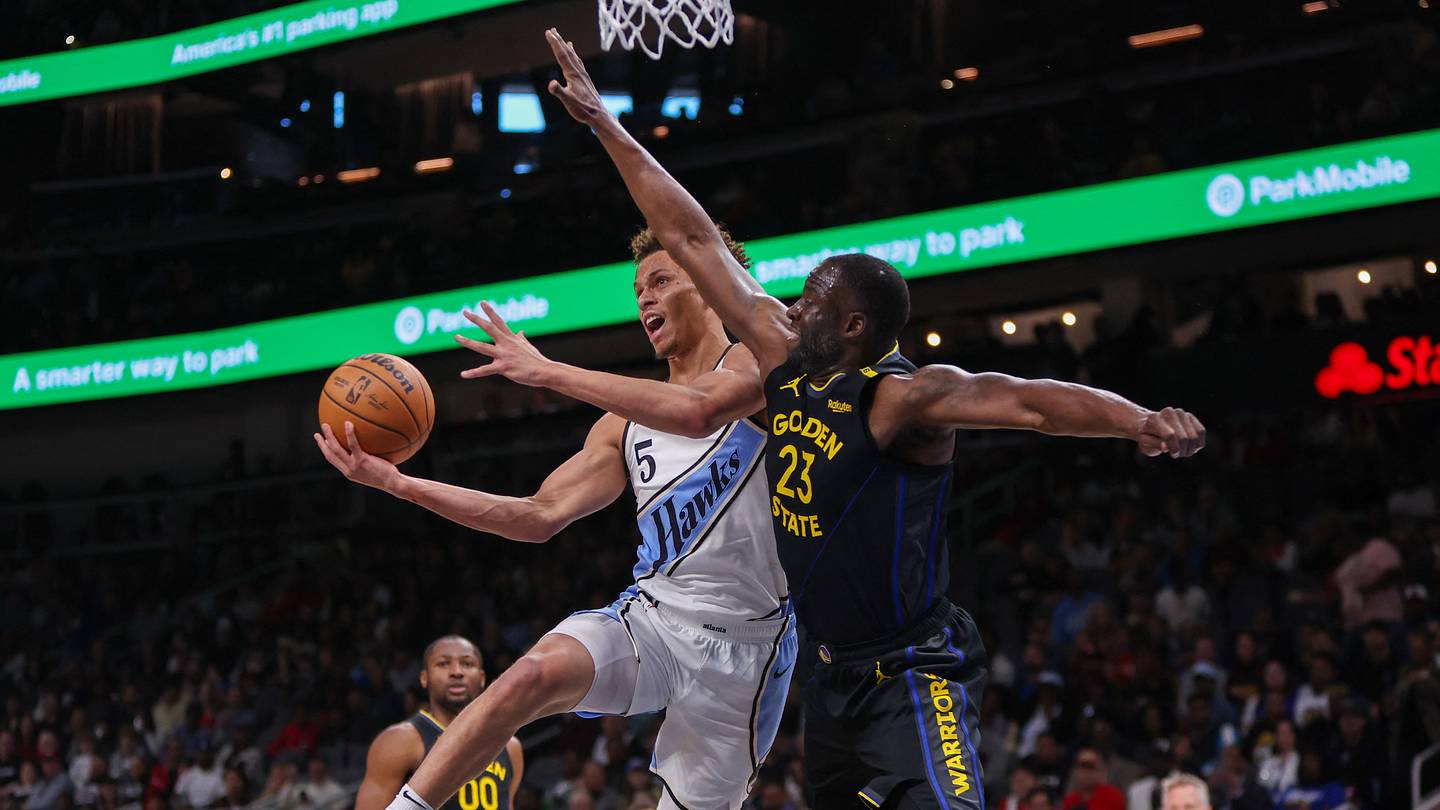
Mar 21, 2026; Atlanta, Georgia, USA; Atlanta Hawks guard Dyson Daniels (5) shoots past Golden State Warriors forward Draymond Green (23) in the first quarter at State Farm Arena. Mandatory Credit: Brett Davis-Imagn Images | IMAGN IMAGES via Reuters Connect
Obviously, Draymond Green has a clear Hall of Fame case, and Dyson Daniels still has a lot of work to do to catch up to his body of work. However, the comparisons aren’t as outlandish as one might think.
To be fair to Daniels, he came into the NBA at 19 years old, and Green came into the league at 22 years of age. Adjusting for the development curve, there’s a realistic comparison to be made between Dyson’s age-22/age-23 seasons and Draymond’s age-23/age-24 seasons. The 2014-15 Golden State Warriors won the NBA Championship, so there also has to be some consideration of the context the player was in.
In that season, Draymond was 23 years old and had an on-off swing of -0.1. The Warriors were 4.9 points better with him on the floor, but it was a far cry from the ridiculous on-off swings he’d have later in his career. He averaged 6.2 points, 5 rebounds, and 1.9 assists on 40.7% from the field and 33.3% from deep while taking about two threes a game.
Given that Draymond played in 82 games and got 21.9 minutes per game, it’s easy to statistically compare that to Daniels’ last season in New Orleans, where he was 20 years old. He averaged 5.8 points, 3.9 rebounds and 2.7 assists per game on 44.7% from the field. Even adjusting for the era, he was a full three years younger than Draymond and had a comparable effect on his team when he was on the court – the Pelicans were 4.3 points per 100 possessions better in his minutes.
The leap Dyson made during his first season in Atlanta is as impressive as Draymond’s third-year leap. Daniels had an on-off swing of 1.4 points while averaging 14.1 points, 5.9 rebounds, 4.4 assists, and 3.0 steals per game. He finished 2nd in DPOY voting, won Most Improved Player and earned a nod on the All-Defensive First Team. Draymond averaged 11.7 points, 8.2 rebounds, and 3.7 assists per game while finishing 2nd in DPOY voting and earning an All-Defensive First Team nod.
Of course, Draymond separated himself in his age-25 season by being a central reason why the Warriors won the 2014-15 championship. It doesn’t seem like the Hawks have that type of ceiling just yet. However, Dyson had an on-off swing of 11.2 points per 100 possessions last season despite arguably taking a step back overall. This year, it’s at 17.2 points per 100 possessions.
In 2014-15, Green had an on-off swing of 14.5 points per 100 possessions for the eventual NBA Champions.
That type of impact is extremely hard to find. Dyson’s likely got some more limitations in the postseason due to how clunky his offense can be at times. However, Draymond also got to play with two of the five greatest shooters of all time, which undoubtedly helped some of his numbers. At the very least, I believe it’s arguable that Dyson’s been as important to the 2026-27 Atlanta Hawks as Draymond Green was to the 2014-15 Golden State Warriors. Their respective abilities to set teammates up, generate extra possessions and contribute towards winning, coupled with the relative diffi
 Add us as a preferred source on GoogleFollow