
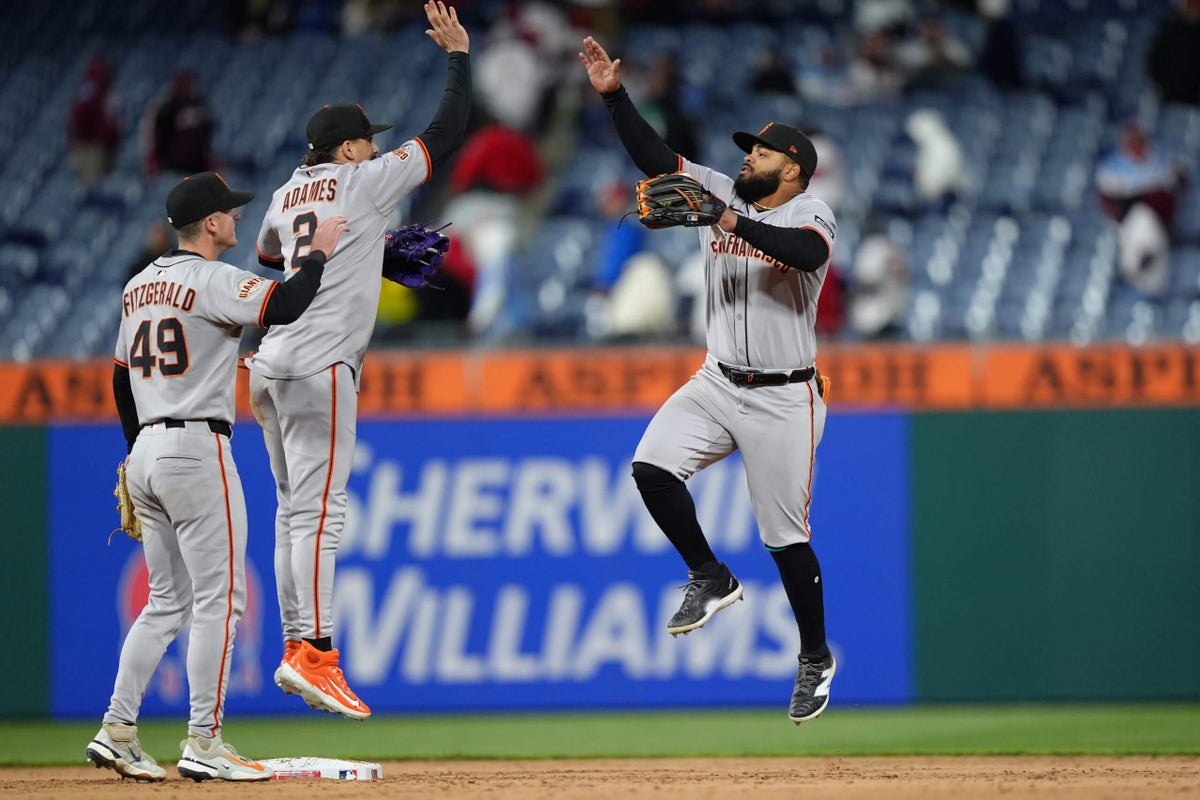
After an 11-4 win against the Phillies on Wednesday night, the 2025 Giants are at exactly 100 runs scored on the season. They’re averaging 5.55 runs per game, which is the third-most in baseball, behind only the Cubs and Yankees. Enough of their hitters are still struggling to justify an article centered around those struggles.
It’s a complicated team. Also, by most indications, a pretty good one.
The Giants are 13-5, and if you want to find another team in franchise history that started the season with the same record, you’ll have to go back to … 2022. Which wasn’t the best team of your lifetime. Still, it’s impressive that this year’s team is banking a lot of these wins away from Oracle Park, with their road record moving to 9-3. The last time a Giants team started this hot on the road was … 2022.
My goal isn’t to bring you down after another Giants win, especially a thumping like that one. The goal is to remind everyone — myself included — that we still don’t know what the eventual story of the 2025 season will be. It’s not enough to blurt out a team’s record through 18 games and claim it proves anything. If you’re going to be bullish about the 2025 Giants, you’ll need more details than just the wins and losses.
So if you’re in the market for unfettered optimism, you’ll have to dig for tidbits, nuggets and factoids. Maybe a morsel or two. The good news is that the best reason to be bullish is also the simplest one to cite and comprehend, and it goes something like this: The Giants have now scored a lot more runs than their opponents this season.
4️⃣ runs in the first 😎
[image or embed]
— SFGiants (@sfgiants.com) April 16, 2025 at 4:24 PM
It seems obvious because it is obvious, but that doesn’t mean it’s unimportant. The Giants have scored 100 runs and allowed 64. That’s good for a Pythagorean record of 13-5, which just happens to be their actual record. You might think that a team’s Pythagorean record is something that only nerds care about. Well, allow me to disabuse you of that notion and … wait, no, that’s entirely correct. It’s definitely just for nerds.
But allow me to explain why we care about it. Back when it started becoming a popular tool, I was a skeptic. Any team can be on the wrong end of a miserable blowout. Pick any of the 100-plus-win teams in baseball history and dig through their schedule. The ugly games are in there. So, what the sabermetricians were telling us is that a couple of extra ugly games, combined with an absence of wins in which the blowout roles were reversed, made that much of a difference?
Pretty much. A Pythagorean record can point you in a lot of different directions about the strengths and weaknesses of any given team, but its best utility is as a proxy for overall team strength. To have several uncompetitive losses, a team needs to roster pitchers who are capable of creating and contributing to that kind of avalanche. To have a lack of uncompetitive wins, a team needs to have a lineup that’s unlikely to sustain an offensive attack for very long, except for an explosion every month or three.
So it’s not enough to say, “The team’s Pythag record is lopsided because Reliever X is the one giving up all the runs in garbage time.” The best teams don’t have one of those relievers. Sometimes, a team will need its 13th man on the staff to pitch in a high-leverage situation. In Wednesday’s win, Lou Trivino came into a tie game in the fourth inning. He had to protect a two-run lead in his second inning of work, and he had to get four outs to finish that inning, with the Phillies getting a runner on via the worst rule in professional sports.
Trivino did it with aplomb. He was a big part of the Giants’ win, and a byproduct of his outing is that he helped the team’s run differential. I’m not going to do an ordinal ranking of the Giants’ high-leverage options out of the bullpen, but Trivino is closer to the bottom of the list than the top. Yet he still gave the Giants two quality innings when the outcome of the game was very much in doubt. It seems like a minute detail, but it makes a substantial difference over 162 games. It even makes a substantial difference over 18 games. The best teams don’t make you wince when the bullpen door opens. The best teams don’t have a reliever who makes you wince at all.
It’s early enough to where a couple of dreadful games could deal a huge blow to a team’s run differential, so don’t get cocky. But if you’re looking for reasons to believe in the fast start, a good one is that there doesn’t appear to be a lot of smoke and mirrors with how the Giants are winning games. They’re scoring a lot more runs than their opponents. That’s how. This game was the third time the Giants have scored 10 or more runs this season, yet it’s only their 18th game. Is that some sort of franchise record?
It is not. Here’s a table that isn’t exactly meaningful, but it sure is fun.
Number of games until third 10+ run game
Season
Game no.
2005
9
1964
9
1970
13
1958
14
2000
16
1993
16
2002
17
1962
17
2025
18
1960
21
2006
22
2016
23
1995
24
1996
25
1966
25
2023
26
2022
27
1987
27
1969
28
2021
29
2013
30
1979
30
1973
30
1965
30
1994
32
1998
33
2001
34
1986
36
2020
37
2019
37
2014
41
1972
41
1963
41
2018
42
2015
42
1991
43
1976
43
1967
43
1999
45
1984
46
1975
46
2024
47
1959
49
1989
50
2003
52
1990
52
2004
54
1961
56
2008
61
2010
63
1997
66
1988
71
2017
75
2009
75
1977
75
2011
79
2007
80
1992
82
1983
82
1968
86
1974
90
1981
94
1980
95
1971
96
2012
106
1978
131
1982
152
1985
N/A (They had two)
Sometimes bad teams score a lot of runs early in the season, and sometimes championship teams don’t score them much at all. Sometimes a team has Willie Mays or Barry Bonds. The list is also a way to ride the ups and downs of year-by-year league scoring contexts. A special shoutout goes to the 1985 team, which scored more than 10 runs only twice. They didn’t do it at all at home that season, which partially explains why they’re still the franchise leader in walk-off wins. They also scored 20 total runs in a doubleheader at the Astrodome, somehow. I love that team of weirdos so much.
Anyway, if you’re looking for a way to be even more impressed with this year’s team, note that the Giants have had the toughest schedule in baseball so far, at least according to Baseball-Reference’s SOS (strength of schedule) metric, which is based on how many runs their opponents score. Except the Giants have been one of the best teams in baseball when it comes to runs allowed, which suggests that their opponents are scoring most of those runs against other teams. That’s a tricky combination to pull off.
One more tidbit? You greedy … OK, zoom in on how the Giants scored their 11 runs on Wednesday. They did it without a home run. The last time they did that was in 2017, and what I love about the list of teams to do it is that it’s mostly populated by two types of teams: The ones that were incapable of hitting homers, and the ones with legitimately potent lineups. This year’s team might not have a 30-homer hitter, but you can’t say that they’re incapable of hitting a homer.
It’s early. We still don’t know the story of the 2025 Giants, and you can let the 13-5 start from the 2022 Giants serve as a reminder, if needed. If you’re looking for positive signs, though, you’ll take a team scoring a lot more runs than their opponents, even though they’ve had a remarkably difficult schedule so far. Nobody has to believe just yet, but it’s sure easier to believe than it is to poke holes in the fast start.
(Photo: Kyle Ross / Imagn Images)