
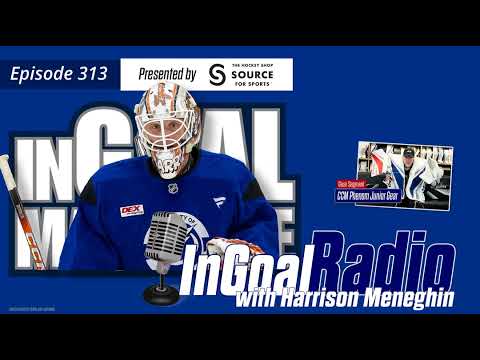
Episode 313 with Tampa Bay Lightning Prospect Harrison Meneghin
Getting through the summer, we have to get an update on Kevin Woodley’s summer on ice performance as we get you into InGole Radio, the podcast presented by the hockey shop, source for sports Langley, the hockeyshop.com. Darren Lard along with David Hutcherson and the affforementioned Woody. How is it going out there, pal? Still a civ, bud. Are you touching up you? Yeah, usually not on purpose, but the odd one hits me. position. I usually say positioning stops pucks. That’s what’s that’s my mantra. If you touch it and it flips in, that shouldn’t count. That’s only half a goal. Yeah. Half a goal, right? Yeah. Yeah. Good point. Got to give him a little credit or at least help the save percentage a bit. The almost percentage. Woody, when are we going to get a GoPro out there and just give us a sample of the Woody like performance? Uh, we have some ice rented this Tuesday. Woody’s coming over with a vehicle jammed full of gear and we will be on the ice. He doesn’t necessarily have to be the only goalie out there, but he might choose to dress up. We might get some real footage of him. What are you guys doing on the ice? Just going to do a little bit of review work with a bunch of different gear that’s sitting in the ingole office. So, we thought we would uh spend some time together and get the shots while we can. Over the years, we’ve tried, you know, you run out there with a camera for the 5 minutes before a Woody’s Beer League game and try and grab a little bit of video or something. And now we’re uh now we’ve taken a couple hours to purposely shoot some stuff that uh we know we want to get for some of the reviews that are coming up and to really be able to tease out what’s going on with some of this new gear. I don’t know if we want to mention exactly what some of it is, Woody, or we’re going to leave for people to find out. Followed our social medias, you’d know. Yeah, follow our social, you’ll figure it out. some exciting new partnerships. Darren, here’s the tease. And maybe see a little bit of Woodman in action. You down for this? He’s kind of hoping not. No, I’m I’m kind of like not really down for this. I’ll let you notice notice that we’re hopping in in a car and I’m going to the island to do this. Ice is literally onethird the price over there per hour that it is over here. What’s an hour of ice time in the lower mainland? 350 bucks an hour in the summer. So 250 US. It doesn’t I thought it’d be higher, but I’m so glad that it’s affordable on the island. Honestly, considering we have to rent a bunch of ice over here a couple of weeks from now, and when I asked what was available, there was multiple sheets for multiple days available. I’m a little surprised that it’s that expensive. Like it’s isn’t there like there’s some type supply and demand, right? Yeah, there’s there’s there’s more ice than there is people on it in a lot of these rinks and yet 350 an hour. I guess there’s a certain cost. I wonder what the cost is to not have it used. Does it go up in the winter or does it come down? That is a very good question. I think it probably stays the same. Okay. I I thought you mentioned summer so I was wasn’t sure whether there was It’s definitely cheaper over here in the summer. They have different seasons, different rates. Makes sense. I guess real economics applies on Vancouver Island, just not in the lower mainland. Our economist, David Hutcherson, joining us live on Inold Radio, the podcast. I may have studied a little economics in university and hated every minute of it. We’ll get into the show here in just a second, but uh just to promote and touch on our feature interview brought to you by Sense Arena. Uh it’s a fabulous interview this week. Uh what a wonderful conversation, Woody. Yeah, we got Harrison Medigan on the podcast. So, heads up and we get into it a little bit. It’s a friend of the family. I’ve known Harrison since he was in kindergarten. Won the Western Hockey League Championship, WHL playoff MVP, draft pick of the Tampa Bay Lightning. Went through some difficult times uh that we get into a little bit. Lost his dad right at the last game of the regular season. uh suddenly tragically and was able to come back with some help from his team and the support mechanisms around him, his family who who my family knows very well. Um get back and get back into the playoffs and lead a run all the way to the final of the Memorial Cup. So, we talk a little bit about that, about the adversity he’s faced, but mostly we just talk about goalending, talk about some of the guys that have impacted his life, his experiences going to development camp with the Tampa Bay Lightning, going to main camp with the Tampa Bay Lightning, what’s it like to to look around and see Andre Vasileki out on the ice and be a part of the same organization. uh getting past not being drafted, passed over in his first year of the Banttom draft before having success in the WHL, passed over in his first year of the NHL draft before getting picked second time around and signing with the Lightning after the playoff run. So, there’s a lot going on in this young man’s life. Uh he’s very open, insightful, honest, talks about everything he’s been through personally, but but also gives a ton of great advice for young goalenders on, you know, what the journey can look like for different people and when it doesn’t look the way you maybe planned it out in your head in advance, how to bounce back from that, how to move forward and make sure that you’re still a part of the equation. You’re not not sort of settling once you’ve been passed over. Looking forward to that conversation in just a little bit on Ingold Radio, the podcast presented by the hockey shop, source for sports langly the hockeyshop.com. Uh let’s just uh revisit a discussion that we had organically a week ago. Which pad is in front when you’re in your stance, if there’s an overlap and you guys, I give you credit after we’re done recording went down a rabbit hole on this. So we’re talking about you’re in your stance. uh uh and uh maybe the the feet are a little farther apart, but there’s always one pad that seems to overlap forward. And I was wondering, put it to you guys, am I normal or is it a little bit different? And because my right pad uh is frontal, what did you discover, Hutch? I did a very very unscientific analysis of a ton of photos that I have on my computer for from going to goalie camps and I worked out roughly 2/3 of goalenders maybe a little bit more were right pad in front of left. Uh I personally would be left in front of right. So I’m calling that goofy padded in line with the goofyfooted snowboarders out there. Hey, don’t skateboarders and surfers. Easy. Snowboarders. You count too. Yeah. The only one I’ve actually tried. Well, no. I’ve tried surfing, just not very successfully. I think that’s about it, Darren. But it definitely seemed to be quite consistent because I saw multiple photos of the same kid and it was always in that one particular configuration. Might be genetic. Uh 100% of the father-son combinations I looked at were both left in front of right. So, uh I think we can take that one to the bank. Woody, did you discover what you were? because you were really kind of No, but I discovered that I totally misinterpreted the conversation last week and was talking about how my pads cross when I was in the butterfly as opposed to standing up. It just means your pads are too big. Oh, 100%. Not cheating, not trying. Um, so yeah. No, I didn’t. I had cuz I haven’t actually I’ve been on the ice since we talked last week. Can’t wait till somebody’s on on a breakaway and you’re going to be thinking, “Oh, I’m I’m left pad front.” Yeah. So like tying knots left over right and under or something like that. Yeah, exactly. Left over right and the puck goes under. Well, there we are. I remember the first time I noticed that happening though years and years ago after taking a break from playing and of course the old Brown Coopers that are behind me on the shelf here, they did not cross. No, no, cuz they barely came above the tops of my knees. And I was uh curious because I I had these uh new pads, the the uh access to and AF. Uh no, I get that mixed up all the time. Right. Yeah. You just like you everything else you do in life is AF. These are actually XF. Yeah, XF. I I always get that mixed and I tried to get them to rename them. It just didn’t work. And and I remember when it first came out that being uh such a great line going AF. We all kind of know. Uh and that would have been a great take on it. So I’m I’m going to stick to that. Um with the XF and uh and with them, I’m like I couldn’t remember on my other ones what what what it was normal. This one just seemed to jump out at me. So thank you. I appreciate it. Uh uh solving that mystery. Let’s get into our gear segment presented by the hockey shop source for sports langly the hockeyshop.com uh dealing with some some of the younger groups. Yeah, and it’s perfect timing cuz if your young goalender has hit that age where they need their own equipment or if you’re just in an association where maybe they don’t have it uh as they move out of the youth line and into the junior sizes, we’ve got a great new option from CCM. It’s called the Phenom. We’re going to get into that this week, but a reminder that over at the hockey shop and the hockeyshop.com, they’ve got every line, all types of youth options and junior. So, if you’re in that youth range, and we can clarify that cuz it’s a little confusing, but the little little guys, they’ve got multiple options for you at the hockey shop. If you’re moving into that junior, you start to get into that 24, 26, 28, 30 in that range, inch pads to the knees, something that looks a little more like a scaled down version of adult pads, they’ve got those at the hockey shop. But best of all, at the hockey shop source for sports or if you reach out to them by email at the hockeyshop.com, they have experts that play the position, understand goalending, and have fit young goalenders for years. They have the experience, the knowledge of the position, the passion for the position to make sure that your young goalie gets something that’s going to be right for him. I’ve been in the store with Cam. I’ve watched him have conversations with parents about, hey, I understand you want room to grow, but if you go any bigger, he’s not going to be able to skate and he’s not going to have fun. Cam is all over those dynamics, as is everyone else in his staff. So, if you’ve got a young goalie, we suggest you check out the CCM Fenom online that we’re about to unveil here in our latest gear segment. But there are other options at the Hockey Shop Source for Sports. Make sure you reach out to them to find out which one, which size, which price point is the best for your young goalie. Let’s get into it on the gear segment presented by The Hockey Shop. Source for sports. Langley, the hockeyshop.com. I’m a phenomena. What soundtrack is that from? Eminem. Yeah, you’re just going to regail us with your movie knowledge there. Southpaw. Jay Gilly Hall. Boxing movie. Great track. Entire track. Little little gets a little dicey there for the parents. Maybe don’t listen to it with your kids on some of those songs. But squirrel, we are phenomenons. That’s better. We cut CCM Phenomenon. We’re back at the hockey shop source for sports with tons of great there is a reason they called this the phenom line. There is some phenomenal features for the new CCM youth line. Cam here at the hockey shop source for sports goalie utopia is going to explain them all to us. Where do we start? I know that was such a phenomenal intro. I I I don’t know where to go from here. Dad jokes galore, Cam, I already beat you to it. Let’s go. All right, ladies and gentlemen, CCM’s new what we’ll call junior lineup kind of replacing all-encompassing junior along their their basically that lower end price point for example that entry- level gear that’s going to get us out there. That said, they’ve really updated and made a heck of a lot better by commigling both lines together. Okay, so rather than saying what ages it’s for when you say junior gear, let’s go into sizing. Like what are we talking here? 24 through to 30. Okay. So, roughly what age? And I I just said I wouldn’t do ages. What? Like what type of age is this for usually? I guess it depends. Hey, listen. We know. We know some adult goalies that could fit in this. Yes. But I digress. Yes. So, I mean, we’re going to be talking about, you know, your U9s, U10s, all the way through, maybe even U12. It depends again how big the size of your goalie, how far they are in their development stage, the odd 50 plus goalie who’s shrinking, the size of your legs, things like that. That’s all going to kind of come into fact. So, specifically, let’s talk about the pads first, okay? Cuz we got them both sitting in our head. So, completely new design. You can’t say redesign cuz it’s a new design. All new. All new. However, featuring some hallmarks that we’ve seen from the CCM lines kind of, you know, throughout some of this new development and whatnot. So, starting off, no speed. No speed. All Gen Pro construction. No CGT. It’s Gen Pro. That’s correct. We still get their version of their integrated knee. So, you’re getting that stability and a really solid looking knee stack as well. That’s a big big call out here. So, one of the things that’s been lacking in a little bit of that junior price point has been that extra stability in the knee. So, so you can be on in the butterfly nice and stable and not having those pads completely roll out on you as well as we’re trying to build those fundamentals. So, great addition by CCM. Great call out, great feature moving its way down. Okay. On the knee stack, we we we saw a change in terms of the materials at the Elex 7 line. Here we’ve got the Hexa Plus. Is it Hexa Hexa Plus? Hexa Plus. Explly that nice soft material we found in the gloves and the blockers of the E-Lex 7 are we’re going to see it again here in a little bit. So nice soft sort of landing area. Nice and cushiony but very stable. Yes. Okay. Into the leg channel. Into the leg channel. So although similar they call their upper calf straps the adapty fit. The adaption point is that it’s extremely adjustable. So you can really get that proper wraparound. So, in years past, we’ve had a little bit of kind of trying to figure out what length the CCM was going for. It was either too long or too short. Now, you have the ability to adjust it yourself. So, dial in your fit, find it perfect. Great additional feature to help lock in that leg in terms of for that fit of the pad, but not affect pad rotation. Just like the high-end pads, just like the pro pads, the adult pads, the knee stack can be slid down to the calf or you can wrap it around to the removable knee flap on the outside. And as we’ve seen in the E-lex 7, that air knit style leg channel all the way kind of throughout. So nice, breathable, lightweight would be probably the big key here too as well. And soft and segmented. So if you do go for a tighter fit, you’re going to be able to sort of establish that connected feeling in the bottom of the pad. Correct. So close it all off with a Velcro craft strap. Moving on to the boot. We have a boot strap. We have a boot strap. Why, folks, would we have a boot strap in the lower and make it optional as opposed to included? And hey, you can remove it quite easily. Exactly. It’s just held in by a pocket on both sides. The bootstrap is really good at sort of pulling a pad down if you’re looking to maybe you got growing kids might not they’ll grow so fast they might not even get a season in the right size. If you want it a little bit tall and you need to pull the pad down on their leg at the beginning, you can use the boot strap to accomplish that. Caution, if you go too tight, you’re going to affect rotation and the leg dropping out of the pad. So, within reason. Within reason. Within reason. I’m a reasonable man. Cam. Reason for regular skate lace plus elastic. We like that system. Same as in the Elex 7 stock. Yes. So you can still create your knots kind of in the front. You get that ease of adjustment in terms of being able to pop it in for Velcro. Or if you do want to switch it to this skate lace or for example something else. Easy peasy. They just untie, pull them out, install your new toe tie. Okay. flex is nice and soft above the knee down at the base, but they have some rigidity still at the upper portion of the thigh. Like it’s not going to be completely floppy, which I think is a good call out to as well cuz that’s something again that we can find in junior pads when they get too soft. For example, a little bit of extra the extra wear material on the top corners of the thigh. Correct. Just to help prevent some of that rubbing, which will naturally happen for sure. Blocker. It’s a blocker based off of Elex 7 Axis. Bit of a combo of both. for example, you still get that hexopom um that we’ve seen in those higherend uh pro versions. For example, the label to make sure I was calling it the right thing. Yes, Hex is right. Hex is right. There you go. It’s good. Uh junior fit blocker. Nothing too too fancy here to call out other than just proportional size in terms of her hand size as well. So again, made for those smaller hands for sure, but solid overall feel. Segmentation on the thumb. So again, smaller hands, not as much strength. protectional move with their thumb. This is something that CCM’s gotten right the past little bit here for sure is definitely the the blockers. Great overall fit. Good punch in terms of a rebound. Glove feels like about a 590ish brake. Ooh, he’s got the phenom glove. So, yes, we have a 590 brake for the glove. Nice easy easy closure out of the box. The index finger stall, pinky finger stall. That center in between for those two fingers is open. But most kids when they would put their hand in the glove anyway would combine those two fingers as a stall cross form strap. Exactly. Still same as the feature that we have on the prolevel glove giving great wrist mobility. I like this. Is this is this you doing this sports? This is stock little skate lace pocket. Skate lace pocket. Nice easy retention. So you are going to see some exclusive colors from us. White based with depending on the accents. Stock colors will be solid based darker. So, source exclusive will be the white base. Yes. Oh, a lot of people like that. And the white glove. Oh, all white’s just All white. Everybody gets all white. Oh, okay. You’re not special. Me? Oh, you know I’m special cuz ladies and gentlemen, you can figure out how special this gear is by giving me a call at 6045898299 or 1800 567790. We’re going to cap this phenomenal video off by saying thank you for watching. I am phenomenal. As far as the name of a line goes like that, that’s a brilliant marketing push for that age group, isn’t it, Hutch? I think we all like to think that our sons and daughters are phenoms. So, absolutely. Absolutely. Very cool. Good-looking set of gear. One of the things I like about it is they didn’t just take, say, the E-lex 7 and scale it down in size. They thought what’s best for a goalender of that age, of that strength. Uh, you know, physiologically, what’s going to be or biomechanically what’s going to be best for them? Uh, I think they’ve done really good work with this line and and I know if my son were still that size, I’d be out trying it for sure. You know what the other thing that, you know, we talk about, you’re right, not just scaling down and shrinking the pro gear, but they figured out the glove at the E-Lex 7 level, like the glove, we’ve talked about how much better the closure is. and this thing too, like young goalies are going to be able to close this glove fairly easily and that’s such a key part of learning how to catch a puck. So, uh yeah, hat tip to CCM for doing a good job with the Phenom line, not just because it allows me to, you know, channel back my uh Eminem lyrics to phenomenal, great tune. We talked we we we name check the the movie it’s from in the in the segment there, but I I was digging that. I may or may not have added that to my workout playlist after after that day. Woody, I’m seriously concerned actually about uh posting this video on YouTube because you are so good. I think we might get a copyright strike. Darren, before you listen to the segment? No, I heard it. I heard it. Okay. So, you you already you already knew. Do you know the movie? Uh 8 Mile. No, Southpaw. Oh, Jake Gyllenhaal. The boxing one. And Eminem did the soundtrack. It’s a good one. It’s a good soundtrack. It’s a good workout soundtrack. pump up music. I was angry at you because I had the Muppet song in my head for a while. As one does when they see Yes, that that’s what that’s what I had in my head. Two old guys in the balcony, right? Statler and Maldorf. Yeah. Yeah. That was in my head. So, there you go everybody. You’re you’re gonna you’re gonna live uh with me and my journey. Do you you enjoy that thing rattling around in your head? You know that that glove at the youth age, the the uh junior age, you’re starting to get some players who can raise the puck a little bit and it’s going to hurt your hand. So, it’s important to have some protection there. When you’re really young, you’re not catching pucks, but you get a little bit older bordering knocking on your teens. uh that’s going to happen a little bit and some confidence and that sort of leads us into the stop a goalending you uh the app parent segment what’s happening over at stop at goalending Woody well interestingly enough we talk a lot about this over at goal magazine with our weekly pro reads but they have five daily primers at on the stop at goalending app this year this week on reading the play so a reminder when you get the stop at goalending app every day during the week Monday to Friday you get a weekly or sorry, a daily quick hit video, something small, something easy, something digestible that you can quickly deposit in the brain and will help make you a better goalender. And this week’s are on reading the play. They also got a full goalie playbook video breakdown on on Carl Vamela of the Utah Hockey Club. Well, I guess now they’re the Utah Mammoth. And a drill of the week on quick backdoor transitions. So, it’s a great sample of a drill that you can take out onto the ice with your goalie coach if it’s something that fits what you’re working on. uh there’s a drill you can take and and try out yourself. So these are the types of things you get every week at the stop at goalending you the app. And of course, as we say and remind you every week, not only do you get all their great content based on 25 years in the game led by Brian Dord, former NHL goalie coach, former NHL goalie scout, former NHL goalie director, but you also get a free subscription to InGole magazine included with your sub to the Stop goendingu app. Make sure you check it out on the Apple Store or wherever you download apps for Android. Hutch Darren, this week, I had a thoughtful back and forth with a parent who uh who was concerned about her young goalie flinching as we say during practices with teammates. Uh her son is under 10, but uh really this is very common at that age. So, I thought it was something that we could address. I certainly remember being the flincher myself, especially at young ages. These are ages where goalies, as you alluded to earlier, Darren, aren’t used to as many high shots, and they definitely aren’t prepared for some of these kids who’ve figured out how to consistently shoot at the top of the net. And at that age, there’s a wide range in development. You’ve got some kids that might be 50 lb soaking wet, and you’ve got some that are years ahead in development and honestly can look like they can shoot like young men. So fear of the puck at that age totally normal. You know, you’re at this unfortunate intersection I like to think of it as is where you’ve got every player out there wanting to shoot at the top of the net while your young goalie is of the perfect age that puts their head right at the crossbar or even a little bit lower. Apparently, this young man that we’re talking about was showing no real fear when he was training with his goalie coach and showing some real ability as a goalender. But most importantly, he just loves being a goalie. Yet, when he’s out there facing players, mom described it to me as him throwing every part of his body towards the puck to try and make a save. And uh even while he’s pulling his head in the complete opposite direction for safety. So, I had a few thoughts that I wanted to share with her and with everybody else. And the first is that point I’ve already made. This is very common. Fear of the puck as a young goalie does not mean that you need to hang up the pads and go find a different sport. It’s really hard to watch and uh your young goalie with that conflict, you know, of loving what they’re doing even while they’re fearing what’s happening out there in practice. But just know that you’re not alone. Second, as much as we want to scream at the team and tell them to keep the puck down and stop shooting at his head, really, what are the players supposed to do? They have to learn how to shoot for the top of the net. You can’t develop a team that’s only allowed to shoot the puck low. And if your goaliey’s head happens to be at the exact height to be in danger, it’s a it’s a tough tough situation. So, if you’re Darren Mard facing NHL shooters, you probably feel safe. Those players can place it precisely in the corners. And uh as Woody said before, what doesn’t hit you doesn’t hurt. But uh at age 8, nine or 10, whenever the players are getting stronger and raising that puck consistently, um many of those players have no better an idea where the puck is going than your goalie does. And that is a recipe for fear. So that’s uh you know, for a similar reason, I think that’s why they feel safe with their goalie coach simply because they can trust where that goalie coach is going to place the puck and so they they can feel like they’re in a safe zone with their coach. So, uh, six tips here for what you can do as a parent if you’re in this situation. Number one, listen and be understanding. Uh, if you’re frustrated, you can be sure that your goalie is just torn apart inside and they need a chance to be able to share that with somebody without judgment. The second thing, please don’t feed the fear by expressing anger about all the players shooting high. That is not going to change. and helping your goalie learn to be angry about it is just going to give them one more thing to be upset about. Number three, find them some ways to enjoy the game away from practice and away from that fear. Now, that probably mean, you know, they need some sort of pressure relief that will separate uh their fear from their love of the sport, I believe. And that’s probably providing some great sessions with that goalie coach that they feel comfortable with. It might be some fun at stick and puck where things are a little bit uh safer out there. I I’d like to think, at least what I’ve seen in some public skates around here, you you just need to be creative so your kid can have some fun playing the game and not be worried. Number four, engage the goalie coach in a discussion. They probably see what’s happening, but they might not know how much this is affecting your goalie and how much it’s affecting their their enjoyment of the game. And goalie coaches have a large bag of tricks for helping with that puck fear. Not going to get into those here. We might be able to, but this is more for the parents than the coaches. So, just trust your goalie coach. they can help. Um, ask your goalie coach their opinion about your child’s gear. Does it fit? Is it still of the right quality for this new level of play that they moved up to this season? It won’t always be an easy solution like this, but I’ll recount one quick story. Our young son was flinching on shots quite frequently after he’d been drilled in the head as a young goalie. And uh thankfully for us, he was big enough and strong enough at that age that he could uh manage it. When we definitely overbought and got him a pro mask, the fear went away immediately. I actually read this segment to Matthew and asked him what he thought about the whole piece and he said, I was thinking exactly the same thing. Don’t go out there and spend $400 on a stick for your young goalie. Spend some money on a helmet. He said they those kids can’t shoot the puck, but they can sure get a concussion. My point being, it might not be as simple, but it might be as simple as the fact that your kids getting hurt on a regular basis on one place of their body because of some equipment and maybe you can fix that. And then uh perhaps they need to chat with somebody else who’s got experience helping them work through those fears. They’re real. Nobody wants to see them go through this. And I believe that working with a sports psychologist at a young age is a great thing if you’re able to make it happen. Won’t go through a list of them. You’ve heard us talk about lots of people on this show. If any individuals would like some advice, please contact me. Parents ating goalmag.com and I’ll be happy to share. Puck fear fear everybody. It is real. It will take time to get over it. But if your goalie loves the position, don’t give up. There’s lots of goalies in the NHL today who were diving for safety back when they could barely tie up their own skates. I went through it when I was younger, like 13 to 15 age group. Uh, thank you Bob Lawrence and Braden Pilling for instilling that and uh forcing me through that stage. Two guys that came in and took clappers from 20 ft away. I had a technique when I was younger that was easier to pull off back in the days when Kelly Rudy used to face shots from the top of the hash marks all the time. My strategy was just get out of the net as far as I possibly could so I’d take it in the shins before it got high enough to catch me in the head. Little harder to do that in the game today. And the kids at that age are really discovering the use of the slapshot. And that’s when they’re engaging in in that area. And it’s it’s a perfect storm for what we’re what we’re listening to here. Yeah. And I don’t think you can ask those kids not to do that. Uh they want to be out there at practice having fun. They want to learn how to shoot the puck. You can ask the coach to make sure there aren’t three of them shooting at the same time like they do in Woody’s Beer League warm-ups, control it to that extent, but uh the kids have to be allowed to play the game, I think. And and for me, the big one is not getting your kid into that anger cycle. Like, we all joke about it semi-seriously about going after guys who shot at our heads in practice, but uh I don’t think that’s the train of thought we want to be giving our young kid when they’re worried. You talk about the the National Oculate guys, you you never get hit with with the pro guys. Like they’re just they’re so good that they can control it. It’s uh it’s more at the lower levels that you end up getting them buzzing around your ear or whacking off the the top of your head. Unless you’re Woody and you’re diving over. Un unless you’re that guy in the RVH and you got some skilled NHL forward with the goal line banking it off your ear and in. Even then, they’re so good. It’s It’s just going in. I wouldn’t mind it if it whacked off the bucket because the bucket is uh such a a highly uh perfect uh performance part of my gear that uh that I don’t mind that every now and then. Woody, when was the last time you got hit in the head and and rang hard? You’re on a good run of that, I feel. Uh, I feel like that’s almost a pretty much game by game daily. Every time I skate basis, I take one, but it just means I’m centered in position on the puck. It’s not my fault. They can’t shoot, Darren. And I may spend a little too much time on my knees. What can I say? Patience is not something I possess. Holding your edges is something we only talk about at ingoldmag.com. Not something that I, as one of the writers of those stories, am able to exercise. Thank you very much. Visual Edge brings us pro reads every week. Uh Visual Edge, one of the great partners of ingmag.com. Well, and this week’s Visual Edge features Cam Talbot. We’ve told you about guys right up to the NHL, 50 goalies in the professional leagues, American Hockey League and NHL that have used Visual Edge to help sharpen their visual skills as well as their cognitive tools. We’ve talked about Jordan Bennington using it every day on a game day basis to get ready to play, both warming up his eyes and his brain. Cam Talbot is one of those guys. He’s talked to us in the past on the podcast, in his pro reads about the fact that he uses visual edge and that his use of visual edge he believes has played a big role in his ability late in his career to sort of become an all-star to take big steps in the National Hockey League long after he entered it. So this week’s pro reads with Cam, it makes them the perfect sponsor because goalies like Cam in our weekly pro reads show you how they read and anticipate the game. And Visual Edge, of course, is helping Cam see the game better. This week, he breaks down a scoring chance from the top of the circle off a low high pass where his defenseman is rushing out to it. And the first part of the breakdown deals with what side of that defensive screen he positions himself on. So Darren, I will ask you on the spot, buddy. This is my revenge for saying I got to get on the ice with a GoPro. Which side of that screen are you staying on? And what factors dictate that? Top of the circle, defenseman rushing out to him. I usually go lean towards the hand that the shooter’s taking the shot from. And that’s an old John Garrett tip. and I still subscribe to that and try and cheat there or I will look at which side that the if I have to do it really and sometimes I don’t have time for this but uh which side the defenseman if if it’s a my own guy is is covering I will lean over and take the other side and just improve my odds a little bit if if they put it beside my defenseman that’s a good shot and uh and I feel like at least They put some some thought into it. I like it. Ding, ding, ding. Darren really hit all the notes. Not only in terms of and in this case for Cam, it was short side, but the short side was dictated. His defenseman was flexing out kind of right in the middle lane. So, he had to pick one of the two. And it’s the handedness of the shooter. The fact it’s a left shot that influenced his ability to go or his decision to go to the short side or on the side of the hand of the shooter. Now, that’s not where this pro reads in. There’s a pass that comes. Camp talks about the decision how he comes across whether to slide or skate and how he skates across shuffle not te push which ends up resulting in a a a difficult a high quality chance in the slot being made to look like a routine save. So we’ve got that video up at ing inolmag.com. We’re not giving away all the secrets that Cam does. Got to be a subscriber to get it. Make sure you check it out. Cam spends about three minutes walking through the keys to this save, managing the screen, that decision on how to move across, and of course a reminder. Visual Edge as a sponsor of the ProRad segment also gives readers a discount. Everybody gets a standard discount using the codeging. But if you’re a member, go to ingolmag.com, click at any recent pro readads, and you will see a discount code that doubles how much you get off of Visual Edge. Can’t give it away obviously on the air, but if you’re a member, make sure you check it out. Um, save some money on Visual Edge. Check out Pro Reads. Get better at reading the game like Darren has cuz he watches all our pro reads. That’s why he nailed that. All atmag.com on a weekly basis. New every week. What are we up to, Hutch? Like almost 300 of these things. It’s got to be like 290 now. 290. I’d say about 290 is a good guess. 290 videos of NHL goalies watching footage and explaining their decision-making process. There is no better deal in the game to learn how to read the game than a subscription to InGole magazine. Shameless plug by me because it is that freaking good. Can’t believe I nailed that. That’s awesome. It was I was today years old before I discovered that teams have systems set up where the defenseman will take a certain side and the goalies will sort of cover off the other side and you spread your your coverage out and the goalie isn’t just standing in the middle peering around everybody. And I think that’s an unbelievable edge. even if you don’t have the system there, uh the defenseman is usually one way or the other slightly and you can lean in on that. I always told guys I played with cuz I didn’t play on a team very often that had a good system. I would especially beer league, I just told the defenseman, if you’re going to be rushing out at a guy, shift yourself just a little bit towards his inside shoulder cuz I would much rather take that shot from an angle where I’ve got a better chance to deal with it. Uh, and I’d much rather take it than forcing him into the middle where there’s more chance of a screen and rebound issues and so on. So, just shy a little bit to try and get him and and that was also a point on giving me some vision because of course if your defenseman is playing goal, they’d better stop the puck because you’re not going to see any of it. And that kind of matches Darren mentioned the systems. I would say every team has that baked into their system in terms of, hey, this is where a defenseman, this is the lane we want you in. flexing forward, whether it’s on a PK or even a five on five, we need you to flex out in this lane. And it’s almost always the short side. Your players are trying to box out or flex out on a shot in the inside lane so that the goalie handles the short side because most pucks into the inside, there’s more traffic. We’ve gone through it before, different things it can hit. Puck has the fastest path to the net on which side? The short side. So, it makes sense for the goalie to make that a priority. And if you’re on the same page as your defenseman and your forwards in terms of what lanes they’re in, everybody’s job gets easier as opposed to the helter skelter crap that I deal with at beer league. I was just trying to make it really easy for the beer league folks out there. Go at his inside shoulder. So you’re playing go at the inside shoulder. That’s where you take the angle. That’s what I would tell the defenseman to do. Just shade to the side. That’s the inside a little bit. Please just keep it real simple. Also keep in mind uh in pro hockey the defenseman’s or defender is going to do everything they can to block that shot if in our leagues Woody they’re doing everything they can to get out of the way. So you can’t totally rely on it. It’s interesting you say that though because I saw an incredible breakdown by Steve Valicette and we love his work here and he was going through the percentages of the chances of a defenseman scoring on a clear-sighted shot versus the risk to one of your skilled players coming out trying to block that shot. He’s just like and he he did it right by numbers of course is what he probably will now. But we can stop those shots. Yeah. All you’re doing is getting in the way and creating more chaos a lot of the time. Now, you can’t let guys that said can’t let him walk in. You can’t let him walk in. And also a forward flexing out to defenseman at the point. You’re right. If there’s nothing else between the goalender and that shooter, but chances are at the National Hockey League level, there’s also a screen and a defenseman on the inside in the slot area. No, if you allow that defenseman to have a clear lane, clear sight, and pick either corner with a layered screen of a defender and another forward in front of you, that becomes a 40% scoring chance. So, telling the the guys on the outside not to block it, well, I understand, only works if there’s not other layers of traffic that you have to deal with as a goalender. Now, I’m a little more confused. Uh but we’ve got Sensorina uh bringing us our feature interview this week, NHL Sensorina, and it’s a wonderful conversation coming up. But first, a note from our friends. Oh, Darren, I was just going to say that you caught on. You threw it to me, but uh you just threw it out there in the middle because you weren’t sure where to go, didn’t you? Yeah. Not Not bad. I have been talking about Sense Arena every week. And now, well, I’m going to be talking a little bit about Woody, even if I don’t completely throw it to him, but I have a feeling Woody will jump in with his own two cents at some point. Uh, this week, we posted a fun little video on socials of Woody after a sense training session, and yes, it was real. It was not staged, and it was a great It was a great video. Yeah, Woody absolutely drenched in sweat. I don’t know about drenched, but yeah, I was pretty much pretty much. Yeah, pretty. And look, Woody’s giving, right? Instead of just sitting around moaning, he’s like, “How can I help in goal? How can I help our readers? I’ll just throw myself up there on video.” Look, not taking a shot at Woody’s fitness level. It’s actually a perfect endorsement, though, of how real NHL sense training really is, isn’t it, Woody? And it was all part of him going deep this week into his review of part two of the new goalie advancement program which is all about mastering your angles. And uh and Woody writes, let’s just say that he writes the way that he talks at length. We’re talking about over 2500 words and 12 videos just on this one part of the program. So, if you would like to uh learn more about NHL Sense Arena, learn more about the goalie advancement program, check it out now over at Ingole Woody’s review of part two, and uh see how NHL sensorina can be a massive part of your goalie summer development. And don’t forget, use the code IGM50 to save even more. Hey, listen. It’s 2500 words cuz that’s how indepth that program is. six levels, three training levels within each level, six to eight drills within each training drill. Like, do the math. It adds up in a hurry. And of course, by the time I went through the whole thing one last time, I was a little gassed, I will admit. And by the time you get to the end, you’re doing five on three drills with the defenders out there. So, we just talked about screens and managing screens. So, as much as it this was all about square and being able to be on angle and learn how to be on angle and square, you had to work to find that puck as well. And yes, I was sucking a little wind by the end of those sessions. But it was it was great. I can’t wait to take it on the ice. I also can’t wait to dig into the third part, which is all entirely dedicated to managing traffic as we build off our first two lessons. The first one was on reading the releases. The second one we just did talking about staying on angle. Now it’s all about that traffic we were talking about Darren. So I can’t wait to dig into that this week and we’ll have that review coming in the next couple. Now to our conversation. Just set the groundwork for us here. Oh, it’s a bit of a tough one. Um because we know Harrison. I do. because we know the family and we’ve seen what they’ve been through and because of everything he’s been through, everything they’ve been through. I didn’t know where to start this one cuz it is a part of the conversation and him and I talked about that after. It’s been a part of a lot of the conversations and interview he’s done. But his story is not just about overcoming the loss of his dad during these playoffs. His story is about a passion for the position, how it developed, how it was nurtured, the coaches involved, the experiences he went through in Banttom, not getting drafted, moving up to the WHL, getting drafted a second time around by the Tampa Bay Lightning, going to development camps, first as an invite without being drafted at the Minnesota Wild camp, and then the two years afterwards with the Lightning, signing with the Tampa Bay Lightning. So, we get into all of it. It’s a story of a young man who is on the path to professional hockey as a goalender. First year will be this year who had to overcome a pretty big bump in the road this season. So, uh there’s a little emotion here, but there’s a lot of great insights about the game, about his game, and about how he’s navigated that path, both the personal side in this playoff run, but also from a development perspective. It is loaded with great advice from a young man who, to be honest, caught me a little offguard with just how open and insightful he was. uh about that path as we get into it on this week’s feature interview. Really excited to welcome to the Engle radio podcast. First time guest, but I’ve known this young man for a long time. Uh he was a lot shorter when I first met him. Was like kindergarten. Harrison Menigan, WHL champion with the Medicine Hat Tigers, Tampa Bay Lightning draft pick, freshed off his second trip to development camp with the Lightning. There’s so much I want to catch up with you about, but first off, so our audience knows, like full disclosure, you went to school with my older daughter, so I’ve known you and your family since probably kindergarten, eh? Yeah. Yeah, it’s been a while. Um, but it’s been good, you know. It’s pretty pretty cool that we’re still in touch. So, yeah. Well, it’s funny that our our paths cross here. I remember how into hockey you were as a young man and here we are now. National Hockey League draft pick, off development camps. Let’s just let’s start with right now. What’s what’s a dev camp like? You’ve been through three now. Two as a drafted goalie and one before with the Minnesota Wild off off of your first draft year. For those goalies that don’t know what it’s like, share with me. Yeah, I mean um there’s definitely a lot of different experiences that you know you might go through. My first dev camp was a lot of fun. Um, you know, we did a lot of team bonding in Minnesota, but then there was also times where you kind of realize that the next level is a lot harder than the level you were just at. So, you got to kind of sit back and kind of realize some things that you need to work on, whether it’s on the ice or off the ice. And yeah, but you kind of need to take in also what you’ve accomplished and kind of be a little proud of yourself, but also know that there’s a lot of work left. Do you I mean after you get drafted and you go to your first development camp with Tampa Bay, you’re right. You’re like it’s a big moment, but then the next step is always a big step. What are some of the things when you talk about give me an example of something you were like, man, I didn’t realize this was going to be this hard or hey, I need to change this at this level. Yeah, I think the the biggest thing for me was the fitness. um you know the there’s a lot more staff that you work with and then you kind of have to um I guess please um they got a lot you know higher bar for you. They they expect to see improvement. So if you’re not doing the right things they pick on they pick up on that right away. And yeah I think it’s just growing as a person as well. Like you can’t be that same goofy kid you once were and now it’s you’re becoming a professional. You’re you’re a business piece now. Not so much a um just another goalie. you’re you’re you’re more of a asset than maybe you were in BAM or even junior hockey. Okay. So, it gets a little more serious, but do you still get to be hairy? Like, do you you have to make sure you don’t lose yourself in that process because that’s probably a part of what allows you to succeed is there’s a looseness. And I’ve had coaches talk about how you’re able to sort of bounce back from stuff and not not that you don’t take it too seriously, but that you don’t end up sort of I’m looking for the right word. You don’t end up like if you’re struggling, you don’t you’re able to sort of process it and not internalize it. Does that make sense? Yeah. I think that’s kind of one of my stronger suits. I think that as I’ve, you know, grown in my hockey career, you kind of realize that you play way too many hockey games to sit back and and just, you know, think about one or maybe even a few bad games in a row. It’s uh it’s important, especially in a playoff run, to kind of just move on to the next game. And I think for me, my personality is also, you know, one of those things that helps me a lot, whether it’s um being a good guy in the locker room um and just, you know, brightening the mood up. I think that’s one of the things I I kind of take pride in, I guess. Uh, you know, it’s it’s it’s the, you know, it’s the person I am. I I I don’t want to change that. And I think I’m learning that, you know, as you get older, um, you can kind of keep those same attributes, but also tweak a few things to kind of, I guess, mature yourself. Okay. So, balance a little bit, right? you you don’t want to lose who you are because your like you said your ability to sort of like uh move on from things and water off a duck’s back was how somebody you know what I mean like have a bad game don’t dwell on it um but it does get a little more serious is it a matter of getting comfortable too like your first time into a development camp your first time into a team you have to find where that fits within a room what’s that process like yeah I think I mean a perfect example would be when I got traded to medicine hat you know some people know who you are one of my good buddies Matthew Ward was there so he knew knew kind of what I was like. We grew up together. But when I first got traded there, I wasn’t, you know, the same person I usually was. I was definitely, I’m not going to say putting on an act, but I wasn’t being the same kind of social person I was. I was just focused on hockey and kind of learning what all my new teammates were like. And I think the more games you play and the more comfortable you get, you kind of you learn a lot more about your teammates and you’re able to become, you know, more of yourself. And I think that’s kind of what brought me more success. I I didn’t start the season off too hot, but um as I got more comfortable, I was able to kind of, you know, be myself and that helped me on the ice, too. And definitely off the ice, you know, building new relationships. Okay. So, what’s that like? I mean, for a lot of young kids, the dream is to get to junior hockey or college hockey. You’re establish yourself in the WHL and now you get traded. Walk us through that experience. It’s It’s definitely a a weird experience. I I don’t think I’ll ever forget the day I was traded. Um it was definitely a weird one. How did you find out? Well, it’s kind of like a crazy story. We won on Friday night, so the team went out and you just with the guys and then get back a little bit later and then you get you get traded the next morning at like 9:00. Were you on the road or at home? We were at home. Okay. So, we were pretty tired and I kind of found out that I got traded at night. Um it got kind of got leaked through whatever. So, I found out and I I didn’t really I wasn’t really sure if it was true or not. So, then I got called in the coach’s office the next morning and you know, as soon as I got called in, I knew I was getting traded and all my teammates knew when I was in there what was kind of happening. So, came out, said my goodbyes and I went and played that night. Game didn’t go the way we wanted, but uh it was it was kind of a neat day just to kind of you’re you’re in one locker room in the morning and now you’re playing a game for a different team. That’s arguably one of the biggest rivalries in junior hockey. The bridge to medicine. So, um yeah, it was definitely a surreal moment, but I’m I’m super grateful that it happened cuz, you know, a lot of great things came from that. So, I should probably know this, but like did you travel or were they actually playing against each other? I traveled. So, I d I drove up to Medicine Hat and then we played Moo Shaw that night and we lost like like 53 or something. Not my best game, but um Well, you probably had a lot on your mind and I’m guessing if you knew going to bed and didn’t actually find out till the morning that wasn’t a great sleep. Yeah, it was not a great sleep. Not a lot of hours, but it was a great experience. Like those guys in medicine hat were unbelievable. Like they’re going to be my family for the rest of my life. So, yeah. Okay. So, um that experience of getting traded, new team. Obviously, the headliner is Gavin McKenna, who’s made headlines again as he goes to the NCAA. I want to ask you a little bit about what it’s like facing that shot and and how you approach that as a goalender in practice because I’ i’ve seen that release. And maybe it’s just the old man in me, but all these all these kids shoot way too hard and way too deceptively for me, but he might be at the peak of that list. Um, but what about like I’ve known Willie Dejardan for a while uh because of his time with the Vancouver Canucks. What can a coach what’s what’s that like in terms of the coach bringing you into a new environment? How much of a role does he even play or is it mostly the goalie coach? What was that like sort of first starting with a new team and getting comfortable? Yeah, I think um Willie uh did an unbelievable job. Like he’s a huge reason why we won that championship. You know, bringing me in, he did he he he obviously has a lot of experience. Um you know, bringing in older players. He was ready right away. Like he knew that we were making all these traits. We had a brand new team. You know, the team from this year to the previous team, I think there was like maybe four or five returning guys. So it was brand new locker room. So he did a really good job. Um just and you were going in early. It was early in the season that you were Yeah, I went in in October, but even then it was a really new group. So, um I remember getting there and there was a lot of I don’t want to say friction, but people just no one really knew each other yet. So, it was definitely interesting. Usually, I feel like when you get traded, you’re the odd man out, but in this sense, I feel like there was a lot of people just trying to get to meet each other. So, Willie was really good. he was a he bought a team meetings, leadership group, um stuff like that just to kind of integrate everyone together and he just kept it super loose and he knew he knew when to be serious. So that was super helpful. I mean he did a great job. Like when you have a bunch of guys that are, you know, high draft picks are super talented. You know, guys are going to go first overall probably. You’d expect a lot of egos, but he was able to bring those egos down cuz we weren’t going to win if we just all cared about ourselves. So, um, he was able to kind of tame us all in and at the end of the day, like we had a really great year. So, yeah, it’s still a team sport, right? What’s McKenna shot like? I got to ask cuz I mean there was one in the in the I think it was in the Memorial Cup where I think I don’t know how many guys would have been able to shoot it, where he shot it, and how quickly he got it off his stick. I can’t remember which game it was, but like just seeing that release and having watched the Bards and the CBrinis of the world uh locally here at some of the summer skates, man, the amount of deception on releases these days, it was it was easier back in the old days where guys just put their head down and leaned into a slap shot. It was easier to know where that was going. Yeah. Um I think the biggest thing now is just the deception. Like he he has a hard shot, but there’s definitely guys with harder shots. He just knows where to place it. He’ll shoot it when you don’t expect it. crazy angles to make you look kind of goofy. Like I’m happy I didn’t really have to play against him this year. I had his number before that. So if he is ever listening, he knows that. But uh yeah, I think he just he knows where to shoot the puck and know and knows when to. And he’s also a great playmaker. So maybe as a goalie you don’t think he’s going to shoot and then he does. It’s just you don’t really know what to expect and he just always finds a way to just be in the right position. So, it’s stuff like that that just you don’t know really what’s going to happen when he has the puck. Mindset when you’re on a team like that. You mentioned it like not just him, but you know, a lot of great players on that team in medicine hat towards practice. Like as a goalie, we know practice is sometimes not for us. It’s sometimes not very friendly for the goalenders. A lot of open looks from open spots that you might not see during a regular season. How do you approach that so that you are always working on your game even in moments where maybe the drills weren’t that friendly for a goalender? How have you learned to handle that? Yeah, I think sometimes in practice you have your time for yourself and you have your time just to be a competitor. I think well at least in Medicine Hat before practice we’d have goalie skates. Then I knew that’s when I needed to be dialed in and just work on the stuff that would help my game. But then after that it was just all about stopping the puck and finding a way. So, in practice, if you got a threeon-one drill or like a a a drill where maybe the defense isn’t trying as hard because it’s just they’re doing a lot of reps, it’s all about just being competitive. If you get scored on, you know, maybe that play’s probably not going to happen in the game, but it’s just you against your teammates and your friends. So, you want to kind of, I guess, have a little battle with them. Kind of make it fun. Don’t worry too much about how many goals are getting scored on you. I think when you practice a 100 times a year, you don’t really nitpick all the little things like that unless you’re doing your own goalie skates. I think it’s just about having fun and and kind of chirping your teammates and and making sure that you’re stopping more than they’re scoring, but also just bringing that competitive nature out of yourself. Do you think when it benefits for yourself too, but also teammates hit like when a goalie, you’ve probably seen it, maybe even went through a period of your time yourself where where we’re like when they when the drills get unrealistic, guys will shut down. Do you think teammates notice a difference when a guy is battling? Like do do you think being that guy that battles as much as it helps you with the competitive side, do you think it can help maybe your teammates go to war for you once the puck drops for real because they know you’re willing to battle through some of those drills where a lot of goalies might be like to heck with this? Exactly. I think that’s I think that’s actually really true. Like I talk with a lot of my teammates and you know maybe there’s a goalie there that’s not trying and then they don’t have that kind of builtup respect that they would have for you or maybe a different goalie that is battling in net during practice because players don’t get they’re not going to be happy if if you’re in net and you’re not trying cuz no one’s getting better from that. And I think the higher up level you get you kind of earn that respect from your teammates that you kind of owe it to each other to you know want each other to improve. I mean that’s also a huge part of why we won. like we were a team that really wanted each other to get better and want, you know, the best for each other. So that’s super important that in practice, you know, guys are pushing each other to get better and we had lots of leaders on our team that would do that whether it was on the ice or off the ice. So um that’s something I really learned this year. Um I don’t think I’ve ever been a part of a group that’s like that. So I think that’s important even for me just getting ready for pro that it almost felt like we were in a pro environment in junior hockey. And again, the fact that you battle like that makes it easier to become a part of that team, like to really become a part of that team. It’s a great lesson on because I think even we’ve been guilty I’ve been guilty in the best of writing about how practice can be bad for goalies sometimes. And we know it’s not always goalie friendly, but how you treat those moments matters and and in this case, like you said, not only are you getting something out of it, but it builds that bond within that team. It’s it’s an important lesson, I think, for a lot of young goalies. Yeah. I think growing up for me, I was always like, “Ah, it’s practice. I would just dread it.” And then as I got older and you kind of realize how hard it is to be an elite goalie, you you realize all the things you need to be consistent at. And you’re not going to get consistency from, you know, in practice, you’re not you don’t necessarily need to go 100%, but you need to make sure you’re thinking about what you’re doing and also um pushing yourself because when the times get, you know, uncomfortable, you need to be ready for that. the more comfortable practice times, goalie coach times. Uh Matt Wong was your goalie coach. Yeah, I just wanted to make sure I had that right. That’s what I was looking up on the computer there. I should have known that offh hand. Um how much time did you get with him? Uh I know it’s different from team to team. How much support there is, whether it’s full-time, part-time, in for a week, in for a couple weeks, and what was that process like? Like how has Harrison Menigan’s game evolved in the past year? Yeah, I think when you’re a 20-year-old goalie in junior hockey, your game is pretty much where your coach would want it to be. I think that what Matt what Wonger did a really good job with was um making sure that every day I was focusing on the right things. I think something that I struggled with was I maybe focus on too many different things and I wasn’t able to kind of clean up the important things and that’s what kind of hurt me at the beginning of the year. But as I got, you know, as we got closer in our relationship, he was able to kind of figure me out really good. And he was able to kind of just sit me down and talk me through what what we needed to do today and also just like maybe what I needed to focus on off the ice as well. Um, we had a really good off ice relationship as well. So yeah, he did a great job kind of just dialing me in and yeah, he got me ready for playoffs all season. Like that’s what we were preparing for. We knew we had a good team. So we got ready for like we got ready for the harder times rather than just regular season all year. We were preparing for the most uncomfortable positions we could be in. Okay. So off ice when you say that are we talking like training physically or also sort of between the years how you’re managing moments and the ups and downs of a season? Yeah, it was it was for sure between the years. Me and Wonger were not lifting weights together. So, okay. Yeah, we were he was you know it would almost sometimes I was like a it’s too much for me when I first got there and then as I got more into you know the system and the organization I was like you know what this is this is exactly what I needed and that’s exactly what I’m talking about being uncomfortable then becoming comfortable in a situation like that. I remember um my first game there, I was struggling and he came in and he called me into the o the the office right away like I guess it was the food room, but but yeah, he sat me he sat me down and he just told me to relax. Um and I was never used to that. I I never had a goalie coach come talk to me in the middle of a game before. So, um, it was a little bit different for me and I was a little overwhelmed, but as time went on, I got used to it and it just became routine at that point and it was easy to kind of just keep moving forward maybe when a game’s not going too great. Was that something that continued like like conversations between periods? Yeah. Yeah. And is he full and is he full-time there? So, is he around all the time? Yeah, he’s around all the time. He’s nice. That’s not always the case. That’s that’s a feather in the cap to Willie and his staff that they’ve got a full-time goalie coach. Exactly. And that’s kind of um something that I knew right away not to take for granted. Um and that kind of just goes to the type of organization that um Medicine Hat is. It’s honestly like being there was unbelievable. Like I I was not expecting it to be that good throughout, you know, the whole organization. I was just like I was just I was like honored to play there. That’s kind of what what it felt like. So I was super happy with everything that was going on. Okay. So, what were some of the things that you guys talked about like getting you like you you talked about like this this might be too much at the beginning. What were some of the things that you and Matt worked through that helped you continue to get better as a goalender with and I mean if there’s stuff you don’t want to talk about that’s totally fine but what give me is there an example or a couple takeaways that you think it might help another young goalender out there? Yeah, I think sometimes it’s important to realize why you got scored on. Um I think sometimes there’s some goalies that are like why am I getting scored on? like why does this keep happening? And uh I think we would talk about each goal that happened and it’d be really quick. No, that’s not in between period. That would some sometimes if I like asked him I was like like what happened? Like I don’t have no idea what happened on that second goal cuz you don’t have replays. Yeah. I don’t I don’t watch the game right away. And he’d be like you know what it was so small this happened and you’re you’re never going to do that again. Like that’s not what in your style. Like that was a that was a one-off. And we’d move forward and we just play the rest of the game like we were in practice. like just go do the things you practice all the time. Um all the habits you’ve kind of built up and that’s why practice is so important because you can always fall back on, you know, what you work on and give yourself that confidence. Um in terms of on the ice, you talked about too many things versus the important things. And certainly at goal, we’re always we always talk about tools in the toolbox. Like when we publish articles or whatever from all kinds of goalies and goalie coaches, the idea is to show people different things they can try, but not to be, hey, you should try this. That difference between the two. Were you trying too many different things or were you trying to fix too many? Like when you say too many versus the important things, is that just trying new things, trying different things and not recognizing what your foundation is? Yeah, I think sometimes you try and be some someone that you’re not when you’re in net. I think you Can you give me an example? Yeah. Like I think sometimes maybe not like a certain goalie, but you’re trying a new play style that doesn’t fit you. Like whether it’s trying to narrow your stance too much, but that’s not how I would want to play. So, it’s stuff like that or keeping your hands too far out front cuz you feel like you can’t track the track the puck properly. So, um just little things like that. And then, you know, Wonger would come back and be like, “Listen, like the reason why you’re not doing it is cuz you’re not you’re not getting square fast enough. You’re not moving quick enough.” like stuff like that. Like so you’re you’re you think it’s now you’re like, okay, maybe it’s just I’m not working to position fast enough and that’s why he was able to pass the puck before I got square and you know I spread out or something like that. So it all falls back to smaller details and you can’t really worry about five different little things like that. I mean wor about five different little things sounds like me on the first tea of any golfer, right? Like all these things swimming around and then it looks like a folded lawn chair when I take that first hack. Um, did you come up with some staples? Like did were you able to and we’ve had different guys at different levels, including well into their NHL careers, sort of almost come up with mantras. We’ve seen guys write it on their gear or like, hey, this this is my staple. This is my anchor. This is my focal point. Were you able over the course of year to come up with things where, hey, this this is this is my foundation? Yeah, I think there was I wouldn’t say there was like three things, but I think we would just always say to each other, work to position head first and just track the puck. And if you can do those three things, everything else kind of falls into position. You know, some guys are like control rebounds. I don’t know, skate quick. I don’t know, something crazy. But if you’re in position, if you’re in position, if you work to position fast, you’re probably controlling a rebound. Exactly. So, it’s it’s all those things. It’s like a it’s like a puzzle. Everything just kind of falls into place. The more pieces you have in, the easier it is to finish the puzzle. So, yeah. I like that. I like that. That’s good. Um, where did the puzzle start for you? Let’s give some some love to some people that we both know around here. Angel Mio, I know you trained with him when you were younger. Uh, and Magic Goalending. Let’s let’s let’s rewind here a little bit. Where did you fall in love with go who was your first guy? Like, who was the guy? My first guy was Angelo Nagio. I started training there when I was I think 8 years old. Um but who was your first who made you love the position? Who who did you want to be like a role model? Yeah. Or who who did you watch in the NHL? Like I What made you want to be a goalie Harrison? Ah I mean I think the real reason why is cuz when I put on player skates I couldn’t skate that well and then I was put honestly and no one could raise the puck. So I just felt super confident and then obviously you start watching hockey. Um, and when I started playing hockey was when the Conucks were on that 2011 run. And, um, that was the first time I ever cried watching a hockey game. So, that’s kind of where I guess the love the love started for the sport when I when I felt really sad when the Canucks played brutal in game seven. So, Zoongo was your sort of first one. Yeah, he was he was kind of my first guy and I think um you watch just goalies like Carrie Price um and then Vaselki when you get a little older and then now I kind of watch him play on the ice so it’s a surreal moment but yeah I think that’s kind of where it started. I I’m a huge Canucks fan so that’s that’s definitely where the passion started and I mean it’s a frustrating team to support but I’m loyal. I like it. I like it. Now, and back to Angelo, you mentioned him. So, you fall in love with the sport, with the position, you want to be a goalie. Um, some of your earliest influences, obviously, I remember talking to your parents about, hey, where should I go? And Angelo and Magic Goending, man, like you look at the a lot of the guys that came out of this area and made it and a lot of them started there, right? Like Tristan Jarry, Lur Bruis, now yourself. Like, what do you remember about the coaching style that you think resonated so much? Yeah, I think um they always keep you super confident. Um and then when I was younger, Angelo would be super hard on me when he when he needed to be. He always kept me kind of loose, but also dialed in in a sense. I think I learned a lot of lessons with him in terms of just maybe not goofing around as much as I would like to. Um but it was I don’t know like we have such a close relationship. Um especially with his son Greg. that’s who I train with. Um, that’s who I train with now and he’s done an unbelievable job. So, I think it’s it’s pretty cool kind of the relationship that we’ve built over the years. I was going to say too, the one thing I remembered like a lot of compete drills for young goalies, a lot of skating and I think that I mean to me that’s not a coincidence. You talked about Vaselki. I think when we see from the Russian goalender, a lot of skating at a young age. I remember watching a lot of skating at Angelo’s camps with other goalies. Yeah, he’s Angelo’s uh like the skating has been really good for me. I think when I was younger, I didn’t realize how important it was. I think there was a few times where I shed a few tears, but now that I’m kind of happy, um I think it’s pretty funny now. I’m sure that maybe he’d have a good laugh hearing that. But, uh yeah, I think the skating is is it’s more important than a lot of young goalies think. I think at least I I’ve coached a few goalies, too. Um, I’m not the greatest coach, but I I definitely see them not enjoying skating. They like to just go in net and stop pucks, but they don’t realize that that’s the whole foundation of the position. Every goalie when you get older can stop a puck that’s shot when they’re square. But it’s it’s how do you get square and how do you do it fast? And uh how do you keep up that conditioned kind of feeling that so you’re not building all these bad habits? And when I look at a lot of young goalies nowadays, I see they can stop the shot, but they can’t really skate that well. So that’s kind of where they get, you know, hiccups in their career and maybe they don’t make that junior team they want to cuz they can’t skate as well. So Andel, there’s the skating, right? And we used to car mentioned Carrie Price is one of the early sort of role models, guys that you looked up to and he used to talk to us all the time about like crease movement. If you can’t move, you can’t play, right? You don’t need pucks to work on it either. But it’s not as fun as when there’s a puck out there. So, kids don’t love it. It’s not It’s not the funnest, but as you get older, um, you do it a lot more than you did as a kid. And it’s probably been the biggest difference in my game. I remember in BANM, I wasn’t the greatest skater and I wasn’t the greatest goalie by any means. I didn’t get drafted to the Western Hockey League, but I started working on my skating and that’s when I kind of saw my saw my career, I guess, advance, you could say. Yeah. Okay. So, walk me through that because again, young goalies, I mean, you’ve been through it now at two levels. You said didn’t get drafted into the WHL, didn’t get drafted your first time in the NHL. Your second time through the draft, you do get picked by Tampa Bay. Now, you’re signed with the Tampa Bay Lightning. Do we get too caught up in the first opportunity? Like, what was that like for you? I know you played academy, so there’s probably a ton of pressure, your, you know, peers getting drafted. What was that like to go through and how did you move past it? Yeah, I I mean I can still remember the day um that the Bantam draft was on. We were all sitting on the um the bikes in the gym and no one was really pedaling. We were just sitting there watching and I remember seeing all my buddies get drafted. We had a really good BAM team. I think there was like three or four guys that didn’t get drafted and I was one of them. And uh I was just sitting there and guys were getting listed after the draft by teams that you know didn’t want to use their draft pick, see who was available. And I was just like, I’m so like I wasn’t confused, but I just felt like defeated. And then looking back now, I’m like, well, that’s stupid. You were 14 years old. But it’s definitely tough hearing everyone talk about all the teams that they’re going to. And then you kind of sit back and you’re like, well, am I as good as I think I am? And then I remember thinking that, but I was like, I feel like there’s so much more that I can do. And I’m kind of surprised I thought those things, but I’m happy I did because it kind of kept me able to push forward. But I always knew I was better than maybe what people thought I was. So that was that was good for me to think that. And yeah, I think just I got opportunity to play 16U. I was supposed to play in the 15 league, but um I got pretty lucky. I’m not sure how that happened. And uh yeah, I had a really good season and Yogi Vakovski was my coach and um he’s got a lot of connections. So he was able to I I don’t know what happened. Maybe some Lethbridge guy saw me and I played good that day. Then they listed me and you know I got my opportunity and I just tried my best to season and I I guess I did and yeah I think it’s just important to kind of realize that maybe the first time won’t work but if you believe in yourself then you know good things will happen. You gave yourself you’re honest there about the emotions of that day and and feeling disappointed by it. So can’t ignore that. give yourself that and then find a way to push through like like drive you a little harder after that initial disappointment. Is that fair? Yeah, that’s fair. Like um I mean I remember going like you can’t pretend that you’re not affected by it, right? But then just you have a choice. You either let it defeat you or you dig in. Yeah. Like you can’t sit there and pretend like it doesn’t hurt because it obviously does like it’s a big it’s a big day. I would argue we make it a bigger day especially in the academy envir. I’ve heard you and I’ve heard the stories not from yourself but from other kids like when you’re in that environment they’re all watching the draft and every and there’s a ton of pressure that comes Yeah, there is. And I think especially for younger goalies, I could like name like a handful of goalies that are drafted to the NHL and signed that didn’t get drafted in the Bantum draft. Like the ban draft means I I’ll be like brutally honest, it means nothing. Like it it actually does. Like unless you’re a first round draft pick as a player, like there’s there’s nothing going to be given to any players or um it doesn’t count you out. Like there’s so many goalies that are the best goalies in that league right now that are not drafted. So, okay, so fast forward now, you’re in the dub. You’ve established yourself with Lethridge, but you get passed over in the first draft in the Did you have expectations your first time through the NHL draft or or were you How did you go into that? How did you come out of it? Mindset wise, I thought I deserved to be drafted, but I also understood that there was not a lot of pedigree um yet. I um you know, I was thinking like I I had a good season. I proved I could play in that league, but teams want to see consistency, so I I understood that maybe I wouldn’t get picked, but at the same time, I felt a lot of pressure on myself to have a even better season next year. And uh so going to that next season, you know, I knew I had an opportunity to be a starting goalie in the league. So I think it was just important to realize that I had to take care of myself for that season and just get ready to be, you know, essentially promoted to a full-time starter. So um that’s kind of where my mindset was and I did a good job of that. I had a good year. Didn’t have the best playoffs, but yeah, I mean proved myself I could be a starter and I think that’s when I really thought I could get drafted. Yeah. So in between the two years you put it sounds like you put pressure on yourself. Yeah. How how did you manage that, right? Like how do you how do you raise the bar and raise your expectations without falling victim to because expectations can be a tough thing. But how like did you do you goal set? Do you identify specific things you need to work on and just knock one off after the other? Like how did you Hey, I It’s one thing to say Harrison to me, hey, I want to be better next year cuz I think I can get drafted if I take another step. How did you do that? Add that pressure to yourself without feeling that pressure, I guess, is what I’m trying to ask. Yeah, I think for me that’s where my like loose, goofy kind of personality um helps me out. I did put a lot of pressure on myself, but at the end of the day, I was like, you know what, it’s just hockey. Like, go out there and play. But there is things that you do need to like like work on and hold yourself accountable for and you know you you take back some time and you just look at some things that you truly need to work on in your game and you work on those things and um you know you you got to understand that it’s not going to be quick. But what were some of the things can do you remember some of the specifics you were trying to drill down on? I think it’s just a lot of it’s like just being harder in front of your own net when there’s you know bigger players in front of you. Um, I think for me it was just getting a little bit stronger. That’s still something I need to work on, but I remember I was just super super like fragile and weak and I’ve gone a lot stronger and just so battling for your ice a little bit. Yeah, battling for your rice. And I think a lot of it is just understanding how to be a consistent goalie. You you got to understand that you can play seven of your best games your life and then you could have two games right after those seven games where you played really good that you just play awful and you can’t question your whole career after that. Like you got to just understand that goal is a position where you do get scored on. Like that’s the whole idea of the position is to stop the pucks but you at the end of the day like you’re going to get scored on. You got to just understand that you got to you just got to accept that fact and you got to move on. And that’s something that I never understood. I would beat myself up, you know, too much about that. And is that does that tie into like Matt Wong and too many things? Like would you if you had a couple bad games, would you start trying to change things like change for the sake of change? Yeah, I think so. And that’s what I was really worried about going to a team that is a contender. I was like, you know, I got to find a way that I can um kind of push myself in playoffs when maybe we go down in a series or, you know, I play a bad game, but we play the very next day and it’s essentially the biggest game of the season. Like every game is the biggest game of the season in playoffs. So, you just it was it was hard for me to kind of wrap my head around that, but once I did, um I felt really good and really confident cuz um you knew that I knew that if I played bad, I was going to feel the exact same as I did if I played good the night before going into the next game. So, that’s something that I think a lot of goalies need to understand. I feel like some goalies feel like they’re playing guilty in a sense, like they’re they’re trying to redeem themsel for the last game, but um that’s just not how it works. Like, it’s just game by game. You can’t try harder in this position, can you? Yeah. No, you can’t. It doesn’t usually work. It’s like golf. Yeah. Yeah. Exactly. Um, so you rip off a 919 say percentage as a starter in Lethbridge in 2324 and you get drafted. What What do you remember about the draft? Well, I remember being in Italy the week before and coming like everyone else was still in Italy and I came home by myself and I was at home with my um grandma, my mom’s mom, and she doesn’t really know a lot about hockey. So, I remember seeing the draft by myself at home, not at the actual draft. And uh I keep watching just like these names go by and we’re by like the fifth round now and I’m like, “Okay, this is probably where I should get drafted, fifth to seventh round and they’re just I remember just seeing goalies names that I didn’t know necessarily and which is what we have especially from overseas and stuff. There’s a lot of that time of the draft.” Yeah. lot of like Russian goalies um that obviously are good but I don’t know who they are so that’s hard so it’s hard to see that so you really start questioning if you’re going to get drafted and um but I knew in the back of my mind that I did a lot of talking with Tampa and I think they had like three seventh round picks so I’m like you know what I’m fine if I go in the seventh round I do not care what round I get drafted in and uh I remember about to start walking downstairs cuz I was like I’m not getting drafted and as I was walking downstairs as as cliche as it sounds I heard my name on the TV like really like faint cuz in the seventh round they don’t really announce the picks anymore. They kind of just say it and then they move on to the next one. Yeah, it’s pretty quick. But I but I heard Lebridge and then I heard my name and I look and I saw my name just kind of like pop up on the TV and I was like I kind of just sat there for a bit and my grandma was like, “Oh, look. It’s your name.” And I was like actually I don’t even know if she was there. I think she was like watering plants or something. And uh I like started celebrating and then I go ask my grandma or I go tell my grandma like, “Yeah, I just got drafted to the NHL.” And she’s like, “So like do you like have to travel and stuff?” And I’m like, “Well, yeah, like a little bit.” And then I kind of just call my whole family’s watching in Italy, so I FaceTime them, but then my phone starts blowing up. Like all my friends and all my like other like family members that were in Italy were trying to get a hold of me. And then then Tampa, all their staff start calling me. So, um it was pretty busy and then but it was pretty cool seeing my notifications on my phone kind of just blow up. So, um that was nice. Okay. And then first dev camp and then do you go to training you went to training camp too last year? Yeah, like I went to I think all Yeah. All drafted guys at least in Tampa go to main camp. So, it was it was like a three three weeks long. Like it was super long process, but it was super fun. Like I remember coming back to my team and saying like that was like some of the most fun I’ve had playing hockey because you’re in Tampa. It’s nice. You feel like you’re on vacation but you’re also you’re also like trying super hard at hockey. So it’s a little bit weird but I got used to it and I’m like you know I could be comfortable here but yeah it was it was super fun. Okay. So you mentioned Vassie and seeing him on the ice. You get a chance to be on the ice with him? Not yet. I’m hoping this year a little bit. But um I don’t know. When you get to watch him, so you’re probably just in your I can’t but you’re in different groups, I’m guessing. Yeah, because usually there’s a lot, you know. What do you see like when you watch a guy like that? Yeah. I think when you watch someone on TV, you kind of just think that they’re like, this is going to sound super weird, but you think that they’re just like a robot. Like you think that they just show up to games and they’re just perfect at everything they do. But you watch in practice and you just see like him how he’s always doing the same thing. There’s so many habits and layers onto, you know, an NHL goalie’s game that makes them successful. So you you do bring that back to your own game and you understand that, you know what, he didn’t just get lucky. Like he he he worked on this his whole life. So you you take that and you bring it back to for me it was junior hockey and uh you work on those things and it’s a little weird at first cuz you’re always so nitpicky about what you’re doing but you get used to it and it’s uh I think it’s pretty cool to kind of see that firsthand. Okay, so the nitpicky the stuff that you talked about too many things versus the important things no matter what it is even as you narrow that focus how do you go from worrying about all those things to just playing a game? What’s your advice to goalies that maybe sometimes get a little too consumed with all the too many swing thoughts if if I was on the golf course and just watch the ball hit the ball? What advice would you have for that? It take all the things you work on in practice and just go out and play. Yeah, I think for me my game is it’s I don’t think when I play at all. Like I literally I don’t talk to anybody on the ice. I won’t talk to the refs. I won’t I mean I barely talk to my teammates when I’m playing. So, it’s just I think you just got to be so dialed in on just playing that you you’re so dialed in you can’t even think about things like going down in your RVH too early or if you’re on angle to the puck. Like I feel like when you’re playing straight off adrenaline, it’s it’s when you play your best. Do you have a way of getting to that point? Like are is there a preparation game day right before a game? Like when you say adrenaline, I think of elevated heart rate. I think of making sure you’re up for it. Are there different ways you do to make sure you get that dialed? I think it’s um a lot of your warm-up. Um I’m someone that’s super loose before games. Like I play sewer ball um and I’m talking a lot with my teammates, but it’s it’s for me it’s just getting my heart rate up. Like that’s just the best way. So you’re super talkative and relaxed and hairy before the game, but once it starts your Hen once I once I start putting on my gear, I don’t say a word like unless it’s like to the trainer saying I need something like So that’s that’s how you dial Everybody’s different. That’s how you dial in your foot. Yeah. It’s like it’s a little cliche, but it’s almost like a light switch. Like that light like I need to flip that switch before I play. And but if you flip it too early, like if you’re not loose and playing Super Bowl, I would imagine it would be draining to be in that mode for 2 hours before the game as opposed to right when you put your gear on be tiring. Yeah, that’s that’s kind of why I do it. like like I I probably played maybe 70 games this year and I I don’t know if I’d be able to play 70 games where I’m just dialed in for 6 hours straight almost like like it’s I’m loose before games I’m you know and then at the hotel if we’re at the hotel I’ll I’ll be talkative with my roommate like it’s not it’s not like I need to be dialed in but once game time comes though it’s it’s like a light switch like I’ll be I won’t say anything to anybody and it’s just yeah like you just got to you got to focus on not so much um the results of the game. I feel like some people are like, “Oh, I hope I don’t let in five goals today.” Like even if you get scored on first shot, you’re just focusing on, you know, the I guess the um process. You’re focused on the process to winning rather than the results of winning. And that’s something I really picked up on this year. Is that something where where Wonger would in between periods be like, “Hey, like like that doesn’t like did he help you get to that point?” Yeah. Like if I let in, let’s say I let in two goals in the first period, I’m not I’m not thinking to myself, oh, I’m on pace to learn six goals tonight. Like some guys do. Yeah. Yeah. Like I used to that’s what all roads lead to beer league guys like me think about. That’s exactly what I used to think about. So um that’s something that really helped me. Um just focusing on the process cuz that way in a game you’re almost focused on just getting better almost too. like you’re just focused on doing the right things and then when you’re actually when the puck’s in your own end, you’re just playing at that point. Yeah. Love it. Um playoffs, different beast. You It’s funny you said, you know, playoffs even at the year you were drafted, playoffs didn’t go as well as your regular season did. What did you learn about playoffs this year that allowed you to have the success? You guys win a WHL championship. I’m watching you on TSN in the WHL Championship Series. Like there’s a bright light. there’s a bigger spotlight. What did you learn about that process that allowed you to have more success in the playoffs this year? And obviously team and everything plays into it, but it sounded like you personally didn’t love your playoffs two seasons ago. Yeah. What did you learn? I think it’s just I was in a different atmosphere like a lot more people the whole season in Lethbridge it was we need to make playoffs. We need to make playoffs. So when you make playoffs, you’re thinking, you know what, we made playoffs. Like we’re happy we’re here, you know, let’s see how far we can go, but at the end of the day, we’re happy. And maybe the coaches are saying you let your like a okay, we’re done. Yeah. Like almost. Yeah. Almost. And then um you know, when the coaches are still they’re saying like let’s win, but the it’s a different it’s a different mindset in the locker room. But in this case in um medicine hat, the whole year it’s when we get to playoffs, when we get to playoffs, we got to be ready. Like stuff like that. And you you said Wonger had you dialed in on that, too. Yeah. So we’re focused on Yeah. The whole year we’re we’re getting ready for the hardest games of the year, which is as like the farther you go in playoffs. And obviously there’s going to be games where you’re not as comfortable and you’re not feeling your greatest, but it doesn’t matter cuz it’s it’s game three of the playoffs and you’re up two in the series and you don’t want to have to come back to Swift current in round one, right? So it’s it’s it’s all those little things that um you know you you work on all year that get you ready for you know the bigger spotlights. Yeah. the Can you give me an example like because you you’ve said this a couple times and I’m just trying to think of like you know what as a goalender you said everything was about getting ready for playoffs. Can you give me an example of what that like how you would approach something or how you would look at something in a regular season in a way that helps you come postseason. I think playoffs is it’s still hockey but there’s some things that are a little bit different. Teams will try and get to you a lot more. It’s a lot more personal. you play the same team at least four times. You mean personal in terms of like chirping and the chirping but more just like guys will try and be in your face a lot more like like screams and more wax and there’s definitely chirps but I don’t really hear the chirps necessarily but you notice when guys after a whistle slap your glove or something like it’s like more physical but also in a sense like when you have that mindset that the these are the games that truly matter the most it’s it it gets you more like more like hungry to win and you’re you feel more just like confident in that situation. It’s not like you’re doing anything different in practice. It’s more just reiterating that like okay playoffs are here but we’ve been ready for this the whole time so there’s nothing else you need to think like you you’re prepared for this kind of so like if you somebody’s whacking you in the regular season there’s that like hey like don’t let this bother you because it can’t bother me when the playoffs come and everybody’s whacking you after a whistle that type of thing. Yeah, a little bit. I think the biggest thing though is the reassurance of that you are ready for playoffs. I think a lot of people when they get to like the bigger games, they don’t feel ready and they kind of crack. I think what we worked on all year was um everything we did this year was this for this purpose right here was for playoffs. It’s mindset. Yeah, it’s mindset pretty much. Like if you can dominate in regular season, you can dominate playoffs. I think we see a lot of time, especially in the NHL, you see Connor Halabuk, he plays he plays a game where he is always square to the puck, but when it comes playoff time, it’s it’s more of a messy game. Like it’s a different he you look, it’s chaos. And you look at a guy like Thatcher Demco, like he he was good in playoffs, but he’s always hurt. But he he has really quick foot speed, right? And how’s different he doesn’t have different style of go different style. So, it’s a completely different style in playoffs in a sense that it it’s messier and it’s, you know, some games are more structured cuz teams are playing better defense, but like there’s going to be more stuff going on in front of the net. So, um yeah, like it’s that’s why you see some it’s not as clean a game. Even if you’re on a good defensive team, it’s really hard to maintain that clean game. I got that. Okay. Um before playoffs, you went through something that nobody should have to go through, especially at your age. Yeah. Um, I haven’t even had a chance to say condolences and I’ve seen you since then. Walk me through your dad who we knew, Derek. Um, yeah. What? Right. You head into playoffs and you lose your dad. Mhm. How do you How do you move on from that? I mean, you don’t, I guess. Yeah. It’s hard to happened at the game and last game of the season. Last game of the season. And um you know it was it was like it felt like that plane ride home was you know 12 hours rather than one. And uh I remember getting home and kind of it was just quiet like no one was really saying anything. Um I couldn’t really sleep at all. shock. I was in shock like I didn’t understand really even I didn’t believe it still but you know I had so much support from my teammates But like my team was so supportive. Like like when I came back I was it literally felt like it was my family. Like I had so many like people that just cared about me like constantly reaching out. So I felt like comfortable being there and yeah like it just and then for my dad’s funeral they came too. So it they actually did feel like family and that’s like it made hockey so much easier mind off of it. Like it was like it almost felt like it was the only thing that mattered. So um it was kind of in a sense it was nice to keep my mind busy cuz you had to focus. Yeah. Because I had to focus on hockey. Um that switch you throw. Yeah. you know, from from sewer ball and fun to game. Was it harder to throw that switch? Did was the mind still wandering? Were there mechanisms that allowed you to get back to it? Yeah, like my mind was still wandering, but um I remember that first game back and I don’t think I’ll ever forget it. Shut out and it was super special after the game kind of just seeing all the fans. They were all chanting Harry and I just thought it was surreal. Like I didn’t really like I thought that I’d never have you know however many people 12,000 I have no idea how not 12,000 like 7,000 people in there were just chanting my name and it was insane. Then you know my captain says go for a lap. So I go for a lap and just the crowd got louder. So I was like you know what like I really want to win this for for the city. So, the emotions must have caught up to you at different points where I would imagine it would be still overwhelming. How did you were you able to keep them at bay at all times during games or were there times during that run to the WHL championship WHL ch MVP for you? Were there times where it where it it it came in where it crept in? locker room. Everyone was super negative on the bench. Like guys were arguing, whatever. And we sat down in a locker room. It was silent for like 30 seconds and then you know the older guys on the team were like guys we’re winning this game like we’re finding a way and uh that’s exactly what we did. Like we went out there it was like a brand new game and we just felt like we were scoring like every shift and they but they scored right away. Like they scored like the first two minutes of the game and I was like I’m sitting in my or of the period and I’m sitting in my net. I’m like oh my god like this is crazy. Like I was in shock when they scored on me right away, but then we literally came back and tied the game then won it 2 minutes into overtime and you know it was insane. Like it was crazy. And now we’re up three nothing in the series and um I’m sure Lethbridge didn’t feel too great after that game. So what did the Mem Cup what was that like? I mean, again, you know, I watched you on TSN, you know, like which is kind like maybe that’s no big deal to you, but like to watch it like for me even and I’ve covered the NHL for 25 years, but it’s different when it’s somebody you know and I know what you’ve gone through emotionally having been at the service. Mhm. To being on TV. Yeah. And now all of a sudden the Memorial Cup’s an even brighter spotlight. Sports Net’s there and it’s it’s every game is on TV and it’s in a national championship. Was that like for you again? How did you how do you manage both the moment and the highlight and the spotlight of the event itself, but also the emotions of what you’d been through to that point because there’s a gap there. You have a little break. Yeah. So, I mean, after we won the league, had our fun, we we relaxed for a few days and then it was right back to, you know what, we got to get the water hot again. Um, we got to get ready for once again the biggest games of our lives. And, uh, having a leader like Willie probably helps with that, too, Oh, he we we wanted so badly to win it for him because we knew that um he’s never won one before and you know in all our leadership meetings was like we got to do it for Willie. We have to. So it’s really sucks that we came, you know, just shy of it. But um I remember sitting on the plane going to Ramuski and I was like this is going to be insane. Like this is the biggest covered junior hockey thing ever. And it’s in a small town that year. So it’s like like there’s probably the only it’s it’s the event in town. like there was nothing going on in Remusi except for this and um I was sitting there on the plane. I was like I knew how much media coverage was going to be around me and also having Gav on our team. So I was like I don’t know like really what to expect. So I was really nervous for that. But then when we actually got there I was like this is just hockey again. I’m with the same group of guys I just won a championship championship with. It’s my family. my mom’s gonna be there. Like it just felt like a hockey tournament in BANAM or or Pee-Wee when you’re, you know, it’s like Sunday championship. Like, like it’s crazy that it’s like that again. But that must make it easier to just go out and play. Yeah. Exactly. So, I’m like, you know, we’re just going to go out there, take it game by game, whatever happens happens, but I’m just going to, you know, stick to the things that make me good. And that’s why building all these good habits is it gets you ready for when you’re uncomfortable. So, I learned that you need need to be so like so close with your teammates. Um because at the end of the day when things aren’t going well, that’s who you fall back on. Yeah. Being uncomfortable. Um I mean you went through the ultimate test of of comfort, but it sounds like that was something you worked on throughout the year. Obviously not not knowing what’s coming, but on the ice too cuz I just want to touch on that a little bit because it sound like you talked about being uncomfortable. whatever position you is that something you and Matt purposely worked on. I think not so much like when the play is like scrambly, but maybe when the game’s not going well and you’re stuck on the ice. You can’t you can’t go hide as a goalie. So when you’re on you don’t get to hit a timeout. Exactly. So you got to go just out there and when you’re uncomfortable, it’s all about facing the next shot. That kind of became a theme for us. And even like Joe Fraser, my coach, would say it when I’m going in the second period, it’s like 2-1 for the other team. He’s like, “Just focus on the next shot.” I’m like, “Okay.” It’s the easiest thing to say, but it would be tough to do. It’s tough to do. And it’s it’s it’s super cliche, but like it’s all you can do. You can’t go back in time and try and, you know, save a deflection that hit off four bodies. Like, you can’t save that. You don’t know what’s going to happen. It’s just you got to be comfortable in the most uncomfortable positions. Yeah. Not to put you in another uncomfortable position, but with your dad Mhm. Tell us a little bit about him and his role in your career cuz I know he was like your biggest fan cuz we used to talk about you when you were only came up to my waist as opposed to being 3 4 in taller than me and about playing hockey. How much you know, not the goofiness. Your dad was so cool. I always thought your dad was the coolest guy. like a little too cool, like almost like I felt like not worthy cuz he was just sort of but he was super casual about everything, right? Do you get a little bit of that that ability to bounce back and not not get caught up in in negative stuff? Does that come from him a little bit? I think when I was younger Not easy as a goalie parent. Exactly. ready for kind of whatever the future holds. I guess as cliche as that sounds, but it’s true. No. Okay, that might be a cliche, but when you say prepared us for life, like that’s not a cliche. That’s not But but as a parent, this won’t resonate with you because you’re too young. But as a parent, I think that’s all you ever hope to do for your kids. So feeling like he’s done that might be that’s the ultimate compliment, Harrison. So, you say he’s always with you. Where do you take him next? What does what does summer look like as you head into your first year of professional hockey? Where where do you know where you go after camp? Do you have an idea where you’re going to end up or do you just go to camp and what will be will be? I think the whole goal is to just go to camp and whatever happens happens. You just kind of got to do what you’re good at in a sense. Like you can’t try and be someone you’re not. So, right back to not chasing change for the sake of change. I realiz that I’m naturally good at these things, so I might as well just stick to what I’m doing. So, it’s okay to watch Vasileski, to admire what he does, to maybe try a few things, but to understand you don’t need to be Andre Vasilleski. Yeah. There’s some things that are things that you do at the NHL level that are you need to do. Yeah. That’s that’s that comes from experience and learning. It’s not something you force upon yourself. Yeah. If that makes sense. No, I I like that. A lot of guys start now pro. It used to be like AHL or bust, but the reality is ECL right now is where a lot of like top prospects start because they get a chance to play. Is that something that again you haven’t mapped out, you don’t know where you’re going to be, but like is it all about playing at this point, getting adapted to the pro game and getting those opportunities? I think so. Um I think sometimes you got to look at maybe the pipeline you’re in. Tampa Bay doesn’t have a lot of goalies. So for me, I do want to play in the AHL. Um, I think I’m good enough to But at the end of the day, you just fall back on what makes you good. Yeah. I got to say, 20 year olds on this show, usually guys are a little older, a little more experienced. Yeah. And the interviews are usually a little shorter, but it’s younger guys like yourself. Yeah. But we’re over an hour, buddy. This has been really good. Yeah. Great job. Incredible insights. Thank you. I really appreciate your time. Yeah. Thank you. Appreciate it. Okay. So, until next time. And the next time we’ll be we’ll be talking to you be after you’ve gone through the pro experience. I look forward to it. Yeah. Yeah. Thank you. Pretty mature young man. Definitely. Definitely. And some great answers there. And like when I said coming in, caught me off guard. It’s just I’d seen some of the postgame stuff. fight, you know, and the guys go into their hockey speak and they’re on TV and they’re on camera. But you get them talking goalending and we were he was relaxed. Uh he was insightful, he was open, he had some there’s some great stuff in there for young goalies, for goalie families that are feeling that pressure if this is your banttom year. Uh as he said, like at the end of the day, yeah, it’s real and the disappointment was real. Um but it doesn’t have to mean anything. I love it the way goalies open up on this platform. think they feel safe talking to Woody. They know it’s goalies talking to goalies. And Woody always I mean, not everybody can hear the the preamble to these conversations like I do when I’m editing them editing them. But Woody always just sets them up in such a professional and yet comfortable way so that these guys know they’re safe to speak and we’re not going to throw them under the bus. I recently got a very kind note from someone who sent one of our interviews to an executive and I I don’t I didn’t ask for permission to share this so I’m not going to share names but just it was just it was a really nice reinforcement to me about that about getting guys to open up and they sent it to an executive who was having trouble doing interviews and getting people to open up in interviews and I think we’ve done a nice job of creating a a pretty comfortable safe environment for the goalies where they feel like they can share and be open and not worry about who’s listening. Do you have a do you have a strategy in the conversations? Because I have a couple of things that I try to hit on during a podcast interview or uh something that’s a little bit more long form. Do do you have a like a a foundation? I have a list of topics and as you guys have heard, we’re 313 in on this. Quite often I start with a you know the origin story. Yeah. the origin story for you because at the end of the day, most of these conversations come down to the shared passions that bind us as goalenders from pee-wee right to pro, whether it’s gear, technique, like what is it that makes you love this position? So, quite often we get into that as one of my early ones. But the truth is, Darren, despite all the work with Sense Arena, despite all the pro reads, my interviews are usually much like my goalending. There isn’t a deep thought or plan involved. I have a couple things I think. Uh I try to make a person laugh at some point. I try to make sure that I learn something or I hope to learn something along the way. Uh so following up on things and I always have to remind myself and this is a tough one that I don’t have to get to everything on my list. If the conversation goes in a certain direction, let it go. And if that if the person’s passionate about taking it there, then your interview is going to be so much better than if you try to rein it back into uh what you want to talk about. Where was that advice like 150 episodes ago, Darren? The amount of times that I had a list in front of me and now I make a note like, “Oh, he he talked about this. Make sure we go back to that.” Pull on that thread as as Hutch likes to say. Uh, and as I often now say in the interviews, I stole that one from Hutch. There’s a thread there I want to pull on. Um, but in the early going, I was I very much had my list and then I would listen back after and I’d be like, man, why didn’t I pursue that one more? Because that sounded like it was going to be really good. But I was too eager to sort of check off the boxes. That’s great advice, Darren. And it only took me what were 313 in? I would say probably only took me 250 episodes to figure it out. So, thanks for sharing. Now, and then the other thing we do is whether it’s Woody warning me having done the interview or I pick something up while we’re editing it is every now and then you hear something from a guy that we know what he meant but we could imagine that it might be interpreted differently and so we just pull it out. Like there was a guy not that long ago that mentioned why he didn’t go see his goalie coach from when he was younger and just the way he said it just I could just see people not getting what he was really trying to hit at. So we just we don’t need that. It’s not needed. Let’s just keep these guys in a in a completely positive space. I don’t I don’t think we’ve ever had a case where it’s like, “Oh my gosh, I can’t believe he would say something controversial like that. Cut it.” It’s more just what we think people might interpret it to because we’re we’re uh maybe overly sensitive to what uh people say on social media these days. So yeah, and I guess that maybe maybe that’s part of it. We’ve created that safe space where goalies are comfortable that rather than having something they say immediately peek our eyebrows and go, “That’s going to be gold on social media. Let’s run with it.” If we’re worried about it may be interpreted the wrong way or put them in a bad spot, we’ll actually go the other way and say, “Hey, I think I know what you meant here, but I’m not sure putting other people may interpret it this way. What do you think? Should we just pull this part?” And sometimes they say no, and sometimes they say yes, but that’s how we approach it. We are not looking to be sensational, make headlines, maybe we maybe we’d have more listeners if that was what it was all about. Well, we’re just content having great conversations about the position that we all love. And I think they feel that. Want to thank you guys for being patient. Uh uh we were supposed to record this a few hours ago, but we had a little bit of a power outage in my area of Shelton PEI and everything’s back on and running. So uh thank you for just just standing by holding firm before we did this. I see the wets suit in the background, Darren. I see the the old and the old graph skates. So, what I’m wondering is if you were out there in the wet suit with skates on each hand cutting power lines to get a day away from us. You know what I did yesterday? We went out in a boat, a a tour boat uh through Charlotte Town Harbor and then into the Northland Straight and we saw seals. Uh that was a cool experience. And then we pulled up a a lobster trap. They have a educational license so they can fish all year round. They they don’t harvest the lobster. They trap them and then they let them go. I saw the biggest lobster I’ve ever laid eyes on yesterday. It was Was that how did you weigh it and how like No, the guy he was just holding it and then he said, “Does anybody want to give us the fish story? Show us the hands.” The thing was crazy. And then he said, “Does anybody he put bands on them? This one he couldn’t put bands on because it was too big. But he’s he let everybody hold the lobster. Uh the three or four that he put bands on. Not a chance I’m putting that thing on me. No way. And my kids did. Everybody else did. No way. I fully admit that I’m soft there. Darren’s Everybody else is holding it. Darren’s got a large pot in the background. He’s letting He’s letting a Bunson burner stove. He’s got a little hot butter going. Although they say when they get too big, cuz everybody likes I got a 2-lb lobster. When they get too big, they get a little less tasty. Is that right? We were debating that. This thing was 40 years old. Yeah, you get sad 40 years old. Got a lot of You get a little si senuey when you get old, right? A little tough to eat. Imagine cutting us open, throwing us in a pot. Oh, that would the sarcasm that would drip off us. Wouldn’t be the only thing dripping. What do they What do they say that about a nice cut of beef? Oh, it’s well marbled. I’d be well marbled. Marbled. That That says us uh sums us up well. Uh thanks, guys. Appreciate it. Uh we’ll talk to you next week everybody on the wonderful journey of goalending on InGal Radio the podcast. [Music]
Episode 313 of the InGoal Radio Podcast, presented by The Hockey Shop Source for Sports (https://www.thehockeyshop.com/) , features a great chat with Tampa Bay Lightning prospect and 2025 Western Hockey League Playoff MVP Harrison Meneghin.
In the feature interview presented by NHL Sense Arena (https://hockey.sensearena.com/store) , Meneghin takes us behind the scenes of his run to the Memorial Cup Final with the Medicine Hat Tigers, including what its like to face Gavin McKenna in practice, and how his team helped him get through the sudden passing of his father, Derek, less than a week before the playoffs started. The insightful 20-year-old also shares valuable lessons on being passed over in both his Bantam Draft into the WHL, and his first NHL Draft, and how he bounced back from both disappointments to get picked by Tampa his second time through. He also takes us into life as a goalie at a development camp and at the Lightning’s main NHL camp with Andrei Vasilevskiy, how his game has continued to evolved, and what’s next as he turns pro.
In the Parent Segment, presented by Stop It Goaltending U the App (https://www.stopitgoaltending.com/app-download/) , we share some ideas about how to help a young goalie who is scared of the puck.
We also review this week’s Pro Reads, presented by Vizual Edge, which features Cam Talbot of the Detroit Red Wings breaking down a defensive screen, how to pick the proper side to look around, and whether or not to slide on a pass from behind it.
And in our weekly gear segment, we go to The Hockey Shop Source for Sports for a closer look at the all new CCM Phenom youth line.