
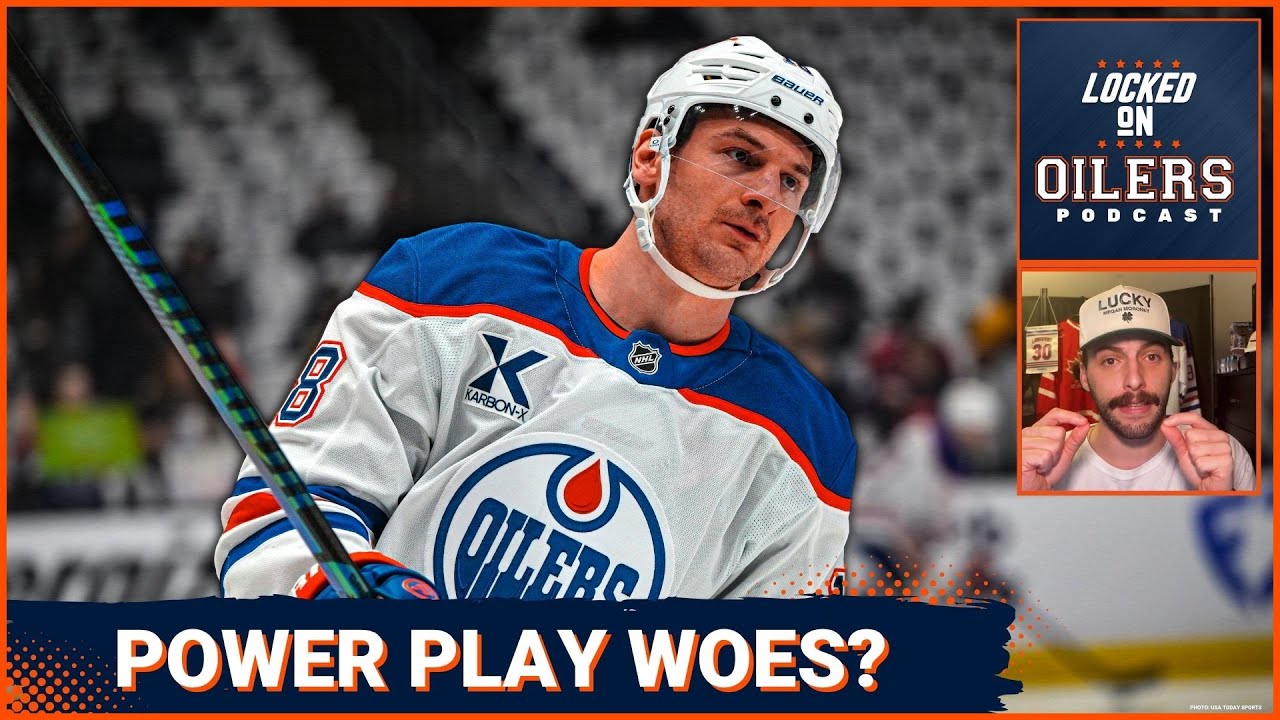
Edmonton Oilers Special Teams Struggles: Why the Power Play Dropped & How to Fix It
The Edmonton Oilers have the perception of being an elite power play. While featuring amazing players like Conor McDavid and Leon Dryidle, the Oilers power play took a step back year-over-year. On today’s edition of Locked on Oilers, we explore what went wrong and what the Oilers can do going forward to improve their special teams unit. [Music] You are Locked On Oilers, your daily podcast on the Edmonton Oilers, part of the Locked On podcast network, your team every day. Hello everyone and welcome to this Friday edition of Locked On Oilers. I am your host, Nick Saris. This upcoming NHL season will be my fourth as a host on the Locked On podcast network and I want to thank everyone that is making Locked on Oilers their first listen of the day. Locked on Oilers is a part of the Locked On podcast network where we’ve got your Edmonton Oilers covered every day. And on today’s show, we are going to walk through all things power play. We’ll talk philosophy. We’ll talk about structure. We’ll talk about the underlying numbers, what they say year-over-year about the Oiler special teams unit, my theory as to why it regressed year-over-year. And then in our final segment, we will pivot to talking about some strategic improvements and some methodology improvements. So, to start things out, and I do want to make sure I’m clear about this, I am definitely guilty of this, and I know most hockey prognosticators, content people, columnists, journalists, podcasters, we can be guilty of this at times, of saying, “Well, that team’s just a power play. Well, that team’s too reliant on their power play.” Yes. In the grand scheme of things, in the big picture, when a team has a particularly dominant power play, they can use it as a crutch. They can use it as means of filling in a gap. And while I think that framing is perhaps a little bit of a negative lens that well, they’re too reliant on their power play, so their five on five isn’t good enough. I do think that is the case most of the time. But in some cases, there are teams where their best players are so good that their power play being as effective, efficient, dominant as it is is an integral part of how that team wants to play. You know, that is a bakedin component to that team success. And I know the Oilers, and we’ve talked about this a lot, have the perception of being an elite power play. and they have two of the three four scariest players in the entire world on their same special teams unit. They have a guy who had 140 points. They have a guy who led the league in goals. They have they are one of the handful of teams that has multiple heart trophy winners on the same team. And look, yes, there were some guys who have hung on like Cory Perry cuz technically the Oilers had three former heart trophy winners on the team last year with Perry, McDavid, and Dry Cidle. But of course, you get what I’m saying here. When you have two guys who are still in the primes of their careers and you have a fringe Norris candidate in Evan Bousard, you have a former first overall pick in Ryan Nan Hopkins and you have a 50 goal guy. Of course, that’s a one-time thing, but Zack Heyman does get to be called a 50 goal scorer in the National Hockey League for the rest of his life. you know, that’ll be the first word. That’ll be the first descriptor word after the comma, after his name, unless he wins a Stanley Cup or wins an individual award or, you know, eventually becomes a coach or a general manager. For the most part, Zack Heyman’s going to be called Zack Heyman 50 goalcorer. And power plays are a fluid game state. They are an eb and flow within the game. And the Oilers as a team that doesn’t take a lot of penalties, at least in the regular season, they did take a lot of them in that King series and again in the Panther series. When you don’t take a lot of penalties, referees are very inclined to let things go. There is a real balls and strikes methodology of how referees choose to adjudicate what is and isn’t a penalty. I know everybody who was very kind to let me know in the comments of the episode after game three where the Panthers let the the Oilers let the game get away from them. They got a little too frustrated. They got a little too angry. They took a ton of penalties down the backstretch. And look, the Panthers get away with a lot. They very clearly know where the line is and know what they can get away with. They know that if the Oilers don’t take a lot of penalties, the referees are going to be inclined to say, “Well, we can’t call four straight penalties on the Panthers, even if they’ve taken four straight or committed four straight penalties, because we got to keep the game even. We got to keep the game balanced.” And that’s the first real point to understand here. There is a real inclination because referees call the games with a keep it even mindset that opportunities are not as present. So, starting there, I’m going to click over to my notes here and go up to the section just on the raw numbers. So, last year, the Oilers in the regular season, 350 minutes of power play time, 23rd in the NHL. The year before, 2324, where they have the fifth best power play in the NHL in the regular season. 360 minutes of power play time, that was 31st in the NHL two years ago. Again, think about it just in terms of the raw opportunities, the minutes in the game, and over the course of a full season. We’re talking about 4 1/2 minutes per game on average of power play time. That doesn’t sound like a whole lot because it isn’t. When you’re only And of course, that evens out because you’re talking about the minutes you’re on the penalty kill as well. So, the other team has that four to five minutes. So, overall, you’re talking about, you know, 8 to 12 minutes of special teams time within a given game, not just these four minutes cuz penalty kill is a part of this as well. But power play is a volatile game state. We we all know this. We all understand that the whole point is one team is at a structural disadvantage. It is your responsibility. It is your job as the team with five players or four if it’s four on three to manipulate the defense and to use the space available to you. Then when you go a level below that, 215 power plays this past season, 23rd most, 206 power plays against, ninth fewest. So that puts you right around that 22 23 mark. That tells you the game is not as available to them. And then I I I wanted to hit on this as well before we take our first break. There’s a perception that because the Oilers have stars that they get protected. And are there cases where player safety or the league at large might be a little more lenient? You know, McDavid getting the two games for the Conor Garland cross check where he probably could have gotten more. Have has Didle done some stuff that’s maybe been worthy of suspension in the past? Yeah, of course. But this is a star-driven league. And one of the products, one of the benefits of being a great player, of being in a really special player is that you’re entitled to the benefit of the doubt because you are, you know, the boat that raises all tides. And that’s the trick here. You are towing a very fine line where you don’t want to turn into those early 2010s Penguins where everybody hates your guts. They think you’re a bunch of flopping whiners, where you you’re Sydney Crosby thinks he can get every single call he wants. And the Oilers don’t do that. By and large, the Oilers don’t Is there a perception of the Oilers as being whiny, as being a little bit um I won’t say disingenuous, but is there a perception of the Oilers as being a little sour grapes? I think so. After the Stanley Cup final, in particular, the way game three went where the game ended with that final 10 minutes with all of those penalties of Ander Kane getting tossed. I do think some people look at the Oilers and see, well, they have a bunch of stars. They’re a bunch of whiny babies. They’re not that good. I think you’re missing the boat there when you take that view. And look, I understand the reductionist perception. We exist in a resultsbased business. If the Oilers won playing that way, nobody would be judging them. But again, when we exist, when you exist in a resultsbased business, you do have to win. And the Oilers to great effect two years ago ran a top five power play, ran a great power play in the postseason. And that was a driving force that was able to make up for some of the five on five shortcomings. And that’s the way you got to think about special teams because they’re not enough of the game that you can win on them alone, but they’re great for plugging in holes. They’re great for, you know, if you’re a boat that’s taking on water, your power play and your special teams, those are your buckets you’re throwing water off the boat in so you can buy yourself more time before your boat sinks. That’s the way you got to look at special teams when you are not a dominant five on five team. And look, the Oilers in the aggregate have really good five on five numbers, but when you look at the actual goals and the actual results, that tells you a slightly different story. And there’s a whole lot more to get to as far as efficiency and the raw numbers. And we are going to get there coming up next on today’s edition of Locked on Oilers. So, be sure to stick around. We’ve all been there, logging on early and waiting forever for concert tickets to go on sale, only to lose your spot or not come away with tickets at all. Live music should be about the fans and making memories, not dealing with the stress of getting tickets. And that’s where our friends at Game Time come in clutch. Game time makes getting concert tickets faster and easier than ever. Prices actually drop the closer it gets to Showtime, and you can save up to 60% off with their killer lastminute deals. If you’re tired of trying to find the best bang for your buck, Game Time Zone Deals pick the best seats in your section for you. If you’re wondering what your view is going to look like before you buy, this is my favorite part. They have a panoramic seat view feature that shows you exactly what you’re going to get from your seat. And if you’re worried about what happens if your plans change, the Game Time Guarantee has your back with cancellation protection and more. Take the guesswork out of buying concert and show tickets with Game Time. Download the Game Time app, create an account, and use code locked on NHL for $20 off your first purchase. Terms apply. Again, create an account and redeem code L O C K E D O NHL for $20 off. Download the Game Time app today. Last minute tickets, lowest price guaranteed. Thank you to everyone who is hanging out on this Friday edition of Locked on Oilers. And I have stuck to it. I have been very adamant about doing more than three episodes per week. We’ve been doing four for most of July since the turnover from three to f five to three. But I as little as there is to talk about you. You’ve seen it this week. We have manufactured conversation topics and are really trying to open the way you think. That’s my goal here. I can do endless research. I could spend the rest of my life just alternating between natural static, evolving wild, hockey viz, puck IQ, um, all three zones. I could spend the rest of my naturalb born life alternating between the various databases and Patreon subscriptions to try and look for more answers. I can do this for every single player and every single team in the National Hockey League because I can think of a question I have about them. And coming out of yesterday’s show and the day before where we were talking about, well, where’s the Oilers offense going to come from? Are they going to score enough goals? How do we get there? Naturally, when you have at a regression the way the Oilers did, and look, the percentages aren’t that different. We’re talking about four or 5%. That’s the difference between fifth in the NHL and 11th in the NHL in terms of power play success rate. As long as you’re over that 23% mark, you have at least a passable power play. Generally speaking, the benchmark, the key stat is you want to be 10th in both special teams or better. Tenth or better in both gives you a real chance. You supplement two top 10 special teams units, power play, penalty kill, with reasonable five on five results. you meet at least the statistical criteria to be a Stanley Cup contender. Of course, we can look at the Carolina Hurricanes. We can point and laugh. Cory Canes, whatever. Against most teams, the Hurricanes are pretty good against Florida. Is anyone good against Florida? I mean, I I hate to use that copout, but I I do have empathy for the Carolina Hurricanes. the way they’ve tried to build their roster, the way they tried to play, and they had the special teams this year to supplement the really good five on five play. And ultimately, Florida’s best players are just more talented than Carolina’s best players. And that’s the drawback there. And as we recycle this conversation to the Oilers, the real key here is the degree in which there was regression. So, of the statistics we’re going to talk about, we have scoring chances, shots on goal, goals for expected goals, and high danger chances. Scoring chances is anytime a puck is shot at the net. It doesn’t matter if it gets blocked, if it misses the net, it hits a post. All of that counts the same. Of course, that accounts for pucks that don’t get to the net. So, we use shots as our first point of demarcation. So, it has to hit the goalie. It has to be on net. it can’t get blocked. It can’t miss the net. So, that’s the first aspect of understanding the quality conversation. On both counts, year-over-year in the regular season and in the playoffs, the Oilers were far worse on the power play. So, in the regular season, 17 fewer scoring chances per 60 minutes, eight fewer shots. So, right there alone, 17 fewer scoring chances per 60 minutes. And of course, because we’re talking about, you know, 5 minutes per gameish, that’s not a huge sample. So, you’re talking about that on a per game basis. So, for example, if we were to do the math, just really rough back of the envelope math here. So, we’re going to say 116 for 60 minutes. So, if we’re only going to play five, and we’re going to do five so it’s easier, you would do 116 / 12, which comes out to something in the ballpark of like I want to say like 9 something. 116 / 12 9.67. Yes, we broke out the locked on Oilers calculator here for the math there, but we’re talking about nine scoring chances per 60 minutes at five on five. Nine, excuse me, nine scoring chances per game on on the power play. That’s what we’re talking about there. So, if you’re only getting nine scoring chances per 60 minutes, well, that’s not a very high rate, especing chances per game on the power play. That’s not a whole lot. It It’s really not a whole lot, especially considering there are some power plays where you don’t register a shot on goal. And those are the particularly frustrating ones where it feels like the Oilers are just infinitely passing the puck. There’s no skater movement. the penalty killers and the goalie are relatively square. They’re keeping everything in front of them. So year-over-year to have a regression to that degree where you know 98 scoring chances per 60. So if you were to do 98 divided by 12, you would end up with eight eight scoring chances per 60 minutes. That really doesn’t feel like a lot. Eight scoring chance. And look, that’s one per game, but one scoring chance per game in the aggregate of 82 games, that adds up. So the next layer of this, not only did the Oilers generate fewer scoring chances, fewer shots on goal, they conceded more scoring chances against, they conceded more shots on goal against. So when you get to the actual goals, a year-over-year decrease of 1.62 does not sound like a lot, especially when you divide that out on a per game basis. You know, again, because you’re only getting 5ish minutes per game of power play time on average, you are going to divide that number by 12 because 5 * 12 is 60. 60 minutes in a game. And again, there are games where it’s more penalty minutes, less penalty minutes, and that’s not accounting for the penalty minutes you’re on the penalty kill. But again, you get what I’m saying here. When you talk about this type of wholesale regression where you are scoring 1.62 62 fewer goals per 60 minutes. And again, that comes out to a pretty small decimal when you divide that by 12, but over the course of an entire season, that accumulates. And that’s the thing with these cumulative stats. On a per game basis, it’s not really going to distill out. You’re not going to notice it, but over the course of 82 games, yeah, that’s really going to add up. And then you can quantify this even further. you go and look at the high danger chances and the expected goals. That’s the real jump. And that for me, and that’s why if you’re watching over on YouTube, the thumbnail features Zack Heyman. For me, the Zack Heyman factor on the power play year-over-year was the biggest difference. Two years ago, the Oilers were getting the puck to the net front a lot better. And some of that is just Zack Heyman regressing, you know, not having a career best year. We all knew that 50 goal season was the best possible outcome and he was going to have a hard time replicating that. But to come away with less than half of what he had the year before, that’s tricky. That’s hard to account for. And with all of those power play goals, I think he had nine fewer power play goals year-over-year. That matters in the course of a long season. Nine power play goals over the course of an entire season. That’s your 5% right there year-over-year difference in efficiency. And again, these numbers don’t sound that big on a on a small scale, you know, game to game, but over 82 games, those numbers accumulate. It adds up. It builds up. You talk about 2% wor, excuse me, 2% better shooting percent. You talk about a slight regression in shooting percentage. Not a big one, you know, 33, less than 1%. But you add all that up, fewer scoring chances, fewer shots on goal, more shots in goal, unscoring chances against, fewer expected goals, fewer high danger chances, more high danger chances against, more expected goals against. all on the power play, you are painting a very clear picture. You are not shooting the puck as much. You don’t have as much puck possession. The other team is having a better chance of holding on to the puck, of putting pressure on you defensively, of hitting you for short-handed goals. And even if they don’t score short-handed, they’re tiring your guys out. They’re tiring your goalie. Generally speaking, those are going to be your oddman rush situations because if a penalty killer has the opportunity, yeah, they’re going to try and take that twoon-one and make the goalie move left to right and usually going to have Evan Buchard in a difficult position because he’s not the most fleet foot of skater. We are going to take our second and final break on today’s edition of Lockdown Oilers. When we come back, I will dive a little deeper into the numbers and we will talk about some fixes, some ideas for how to kickstart the Oilers power play and get it going in the other direction. Coming up next on today’s edition of Locked on Oilers, where we’ve got your team covered every day. Thank you to everyone who is hanging out on this Friday edition of Locked on Oilers. And I love doing investigations like this. Uh just hand up. This is where my hockey nerd comes out. And I want to know I really want to know. It’s not just that the power play was worse year-over-year. What changed? What was different? Well, you can look at the raw totals. 15 fewer power play minutes overall year-over-year. Okay. Fewer power play opportunities. The number of penalties that they that teams committed against the Oilers. Okay. So, fewer opportunities. What do we always say? What are my everydayers? The more minutes you have, the better opportunities you have. So, 15 minutes in the course of a gr a season where you almost 400 penalty minutes, that doesn’t matter a whole lot, but does matter a little bit. Does matter a little bit. So, think about it from a math perspective. And look, I’m not good at math. I I’ve said this on the show before, and it might surprise some people considering how much I use math on the show. I had to take intro to statistics in college twice. The first time I could not do the math. It did not process. I had to DNF it. I had to drop it 6 weeks in and use my DNF on that class cuz I could not figure it out. The second time around, I think I got a 74, 75, something like that. It was a real challenge to get that gened requirement to pass a math class in college. But math like this, because I put it in hockey terms, it makes sense to me. When we are talking about averages, when we are talking about data samples, the bigger your sample, the more evidence you have, the more likely you are to be right. The smaller your sample, the more variance within it. That’s why two whole seasons, three, four, five. Like I said, I could spend the rest of my life trying to solve hockey questions with just data sheets because there’s enough data to draw conclusions on some level. And one year of having a slightly worse power play does not indicate a trend. That is something to monitor. Now, if the Oilers go from fifth to 11th to 17th, even after changing power play coaches, that would be something to note. That would be a real cause for concern because again, two heart trophy winners, a defenseman who can be point per game, a former 50 goal guy and former first overall pick. That type of talent should not be regressing to this degree. Now, ups and downs are natural part of life. We all have highs, we all have lows. That’s just the natural course of things. When you have long samples, you become more in tune with how the variance works. But I think it’s interesting and we talked about this yesterday comparing the two teams year-over-year because they got to the Stanley Cup final and you again you would argue this past year’s team had an easier path in the postseason. They didn’t get to a game seven in the first three rounds. They found a way to get through those earlier series relatively easily. I know that King series was definitely sketchy for a while there, but at large they did a good job. And when you go and look at the numbers, and I’m clicking back over to my notes sheet here, what what’s interesting for me is on the aggregate on the overall, the drop off year-over-year is even bigger in the playoffs. And I found that interesting. And again, we all know the Oilers power play was a lot better two years ago. So, let’s evaluate what changed. So, number one, slightly less effective, slightly less efficient. Zack Heman. You have Ryan Nan Hopkins lowest point total in a number of seasons. So you have those two things together. So defenses aren’t going to respect Zack Heyman at the net front as much and they are not as occupied with Ryan Nan Hopkins. So what does that mean? It means a lot of Evan Bousard point shots. Bousard led the Oilers in shots on goal in the playoffs. He does have a good shot, but those are defenseman shots. Those are not highly likely to result in goals. They are from further away. there are more variables that can be introduced on that puck’s path to change the potential outcome. That’s what you have to think about when you’re talking about power play. So, at its essence, the Oilers want to run the drop pass to McDavid in their own zone where McDavid can scoop up the puck with speed and go full speed, gain the offensive zone with speed. In an ideal world, if he’s not cut off, he’s going to drive directly to the net. If he’s is cut off, he’s going to pivot to the half wall or he’s going to take the puck below the goal line. Once he’s established the offensive zone with possession, he’s going to wait for help. Once he gains the zone and is established with puck possession, he’s going to start to look for his options. Is he going to look Zack Heyman back door? Is he going to take the puck to the point to Bard? Is McDavid himself going to skate the puck upwards and try and create space for his linemates? And that’s really the key here because as much as the Oilers look for the dry cidle one-time or the Bard point shot, they do not run a power play in the conventional sense. Most NHL teams run their power play through a fulcrum point. And that point is usually set. It’s from a specific spot and generally it is going to be closer to the point. It is going to be a walk the puck in and then left, right or shot. The Oilers because McDavid is their primary puck holder on the power play, not a defenseman. He is constantly making that that point, that fulcrum point of the power play different. And that has advantages. It makes the defense more offbalance. He’s going to bring defenders to him because he is the best hockey player in the world in a five on four situation. two years ago, that meant a lot of open looks for Zack Heyman. Last year, it meant a lot of looks for uh for Leon Dryidle. And that’s another thing here. Year-over-year, if you don’t change your personnel, if you don’t change your tactics all that much, you start to form habits. And defenses, teams, they pre-scout. They start to look for ways they can impact you. One thing Florida did to great effect to the Oilers in the Stanley Cup final, preventing them from gaining the zone at all because the Oilers do use that drop pass at the top of the zone as well where McDavid, he’ll build up that head of speed, gain the zone, and then drop it to Leon to Bouch, whoever might happen to be trailing him at the point because they play aggressive in that right there at the top of the neutral zone. Excuse me, at the top of the defensive zone, they can force a change in possession or at the very least they can force a regroup. If they force a regroup, the puck goes back into the neutral zone. The guys who are in the zone have to come back and touch up it not to go off sides and you’re burning time. You’re wasting time. And for the Oilers, gaining the zone with speed is the first part of this process. But from there, it requires a real attention to detail. And I am not in the position to tell Connor and Leon how to play hockey. They are two of the best hockey players I have ever seen. I am very adamant on this show that Conor McDavid is the best hockey player I have ever seen. I I wasn’t there for Gretzky. I wasn’t there for Lemieux. I wasn’t there for Bobby or Gordy. How I’ve been here for Sid. Sid. Love Sid. At at this stage of my life, I can Sid’s one of the most accomplished, one of the most impressive players I’ve ever seen. McDavid is the best. He is the most dynamic, the most explosive, the greatest playmaker, the best skater, and everything he does is viewed through that lens. Can he elevate? Can he make guys better? And he he led Zack Heyman to the year of his life. He got Leon a rocket rashard. When we look at it through that lens, the Oilers power play needs to be better. Period. When you have this much talent to be 11th, that’s a letown. That is a disappointment. And I would love to find a world where the Oilers can make something happen there. Can you find a new wrinkle? Can you find a new look? Is it more flying shots from the opposite side? Are we going to try and get NG? Are we going to try and replace Ryan Nj and Hopkins on the power play? So, that’s not a lefty. So, that’s another one-time opportunity. That’s something else, frankly, I thought the Oilers struggled with at points was just the handedness distribution. Leon on the one side for the one-time. Yes, of course. But with Noo being on the opposite circle, the puck has to go to the opposite side for him to shoot. That’s unfortunate. Zack Heyman on the forehand at the Nefrunt. That’s golden. That’s what you want. That’s really your key here. The power play is so much about angles. It is so much about spacing. Can you find ways to create new looks? You can’t have so many Bard point shots. You can’t just expect Leon to score every time. As good as he is, God bless him. You know, he scored 54 goals this year. As good as these guys are, the tactics win out in the long run. And as great as they are at making plays outside of structure, they do need that structure to fall back on when their plays are not working. That’ll do it for today’s very detailed Power Play episode of Locked on Oilers. Be sure to subscribe wherever you get your podcast. Leave the show a fivestar review. If you’re watching over on on if you’re listening, excuse me, over on Apple or Spotify. If you’re over on YouTube, hit the subscribe button. Hit the like button. Let me know. You think the Power Play comes back this year or are they going to start to be more towards the middle of the pack? I will talk to you guys on Monday. Everyone have a safe and fun weekend. Be sure to check out Locked on NHL where Hunter Hodies and I played a game of NHL 20 questions and be sure to check out the NHL season previews that Locked on NHL game night has going on. All 32 teams leading up to the start of the 2025 2026 NHL season. I’ll see you guys on Monday. Everyone have a safe and fun weekend. And until then, let’s go Oilers.
The Edmonton Oilers are known for having one of the most dangerous power plays in the NHL, led by Connor McDavid, Leon Draisaitl, Zach Hyman, Ryan Nugent‑Hopkins, and Evan Bouchard. But in 2024‑25, the Oilers’ power play dropped from top‑five status to 11th in the league. On this episode of Locked On Oilers, host Nick Zararis dives deep into the numbers behind this regression fewer scoring chances, decreased shots on goal, and a notable decline in high‑danger opportunities. Was this simply a case of Zach Hyman’s regression from his career‑best season, or is the problem rooted in strategy and predictability?
We explore the underlying analytics, how opposing defenses like the Florida Panthers neutralized Edmonton’s man advantage in the Stanley Cup Final, and what changes new coaching tactics could bring. From puck‑movement strategies to adjusting zone entries and personnel usage, Nick offers solutions to help the Oilers return to elite status on special teams in 2025‑26.
0:00 Intro: Oilers power play analysis
5:16 Raw numbers: Power play time and opportunities
16:28 Impact of power play regression over a season
19:34 Investigating year-over-year power play changes
24:09 Oilers’ unique power play structure and tactics
28:46 Outro: Subscribe and upcoming content
Edmonton Oilers Special Teams Struggles: Why the Power Play Dropped & How to Fix It
Support Us By Supporting Our Sponsors!
Gametime
Today’s episode is brought to you by Gametime. Download the Gametime app, create an account, and use code LOCKEDONNHL for $20 off your first purchase. Terms and conditions apply.
Monarch Money
Take control of your finances with Monarch Money. Use code LOCKEDONNHL at monarchmoney.com/lockedonnhl for 50% off your first year.
FanDuel
Today’s episode is brought to you by FanDuel. Right now, new FanDuel customers can get $150 in Bonus Bets if your first $5 bet wins!
FANDUEL DISCLAIMER: 21+ in select states. First online real money wager only. Bonus issued as nonwithdrawable free bets that expires in 14 days. Restrictions apply. See terms at sportsbook.fanduel.com. Gambling Problem? Call 1-800-GAMBLER or visit FanDuel.com/RG (CO, IA, MD, MI, NJ, PA, IL, VA, WV), 1-800-NEXT-STEP or text NEXTSTEP to 53342 (AZ), 1-888-789-7777 or visit ccpg.org/chat (CT), 1-800-9-WITH-IT (IN), 1-800-522-4700 (WY, KS) or visit ksgamblinghelp.com (KS), 1-877-770-STOP (LA), 1-877-8-HOPENY or text HOPENY (467369) (NY), TN REDLINE 1-800-889-9789 (TN)
Follow & Subscribe on all Podcast platforms…
🎧 https://link.chtbl.com/LOOilers?sid=YouTube
Locked On NHL League-Wide: Every Team, Fantasy, Prospects & More
🎧 https://linktr.ee/LockedOnNHL
#NHL #Oilers #EdmontonOilers
9 comments
You can blame the whole Edmonton Oilers problems that were brought up to everybody on the Oilers management team many of times in the last couple of years,I wouldn't blame Connor McDavid at all when he does leave Edmonton,he has gave the Oilers many of chances to have a winning team that wants to win the Stanley Cup,
Connor McDavid just seems to be the only good player on the Oilers team he is getting mad now at everybody.The Oilers are called a team for a reason it is not just a one person team it's the job of everybody on the Oilers team you guys are just getting worse
I love you Connor McDavid you are awesome you will always n forever be my favorite player no matter what team you are on
Great analysis
Cory parry should of been signed
I wasn't fond of those Pens teams or the Caps in 2018. And here we are again with the Panthers.
The Oilers had a great impact on the evolution of the NHLs PP the last the years,however not so long ago they changed up their PP, they altered their O-Zone entry tactics and it all starts in their own end…they have been mismanaging the "late upspeed support" O-Zone entry, its a little contextual understanding issue caused by stats pushers…a wee little numbers caused issue that blossomed into a real problem. Whoever gave them Dustin Schwartz also messed up the PP.As a Tactical Systems Analyst IMHO this is whats ailing the PP… no charge today just for you Kiddo. Oilers dont need to add anything to their PP to improve it they need to subtract a few things to lighten the load.
One small misstep in your reasoning, great analysis by the way, FTR the Oilers do not offend and take a lot of penalties as you say, however this is a way to funnel more positive 5×5 possession minutes into their Firewagon Hockey Furnace, so whereas for some NHL Teams it would be a terminal disadvantage to get few to no PPs for the Oilers who play a Possession-based System its a sign that the Boiler-room is cooking on high heat. The General idea here is to score 5×5 and not need a man advantage to produce offense. Oilers have accomplished that now they need to simply work on scoring more PK goals….. its an underexplored area although they have been making tiny inroads since last year when I harped about it loud and hard.
Love the offseason time you're putting into the show Dr. Nick.