
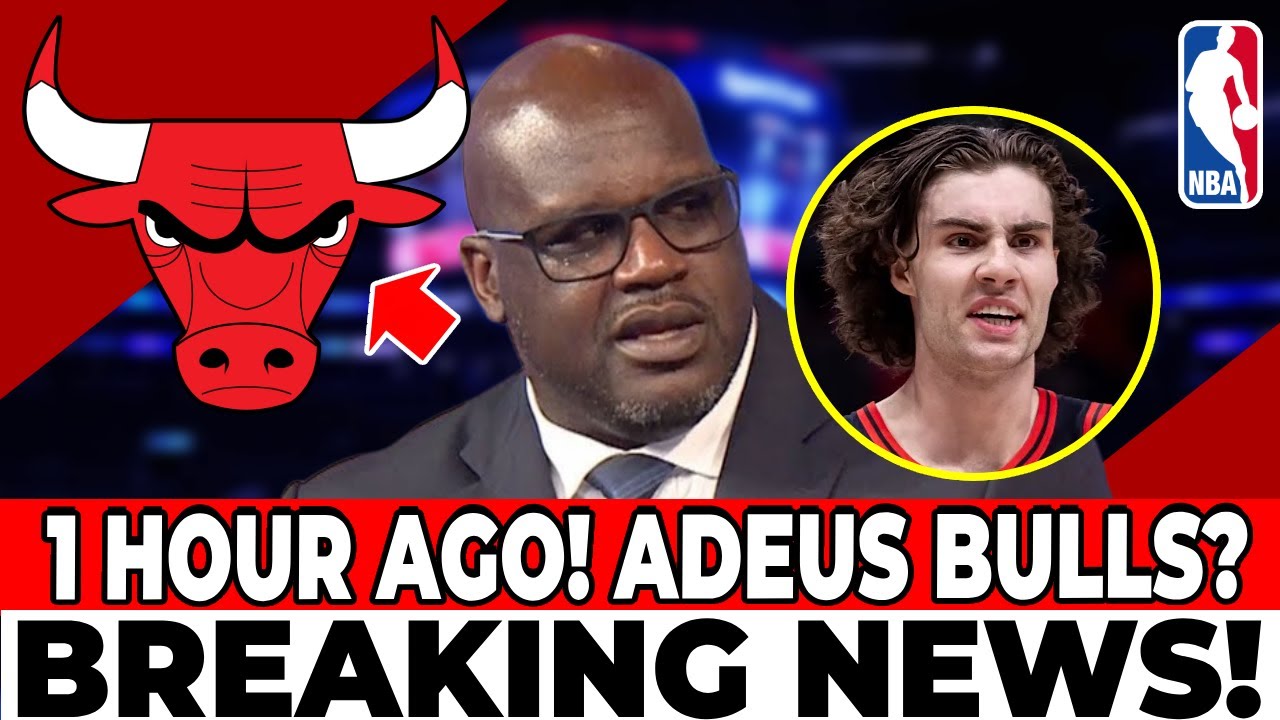
NBA SHOCK! RUMORS CONFIRMED! CAUGHT FANS BY SURPRISE! CHICAGO BULLS NEWS
Are you tired of the endless dance? That familiar feeling of watching a star player’s future hang in limbo? Caught between astronomical demands and a team’s steadfast refusal to budge. It’s a tale as old as time in the NBA. A negotiation stalemate that grinds on, promising a dramatic twist that more often than not turns out to be nothing more than a faint whisper in the wind. For the Chicago Bulls, this summer saga with Josh Giddy has become a masterclass in restricted free agency’s peculiar brand of purgatory. But as the clock ticks and the whispers of an offer sheet grow louder, are we truly on the precipice of a seismic shift or merely witnessing the predictable minations of a market unwilling to bend? Welcome back to the channel where we dissect the intricate chess game that is NBA free agency, revealing the hidden strategies and the cold, hard realities that shape a franchise’s destiny. Today we’re diving deep into the perplexing standoff between the Chicago Bulls and their talented young Australian guard Josh Giddy. This isn’t just about dollars and cents. It’s about leverage, market dynamics, and the often frustrating truth that sometimes the most dramatic possibilities are also the least likely. For weeks, the Chicago Bulls have been locked in a highstakes staring contest with Josh Giddy, a negotiation that has defined their off season more than any other. The air around the United Center has been thick with anticipation, a collective holding of breath as fans await a resolution to this crucial restricted free agency dilemma. The Bulls, true to their recent conservative form, have reportedly laid their cards on the table, a 4-year deal worth approximately $80 million. On the surface, that’s a substantial commitment, a clear indication that they value Giddy’s unique skill set and his potential to be a key piece of their future. It’s an investment, a vote of confidence in a player who has shown flashes of brilliance, particularly with his exceptional passing and court vision. However, as is often the case in these situations, there’s a significant chasm between what one side is offering and what the other is demanding. Giddy through his representation has reportedly set his sights considerably higher, seeking a deal closer to $30 million per year. This $10 million annual discrepancy is not merely a rounding error. It’s a king-sized gap that has brought negotiations to a grinding halt. The Bulls, it seems, are unwilling to budge, holding firm on their $20 million per year valuation. This steadfastness isn’t just about financial prudence. It’s a strategic play, a test of Giddy’s market value in a league where true cap space is a rare commodity. The unspoken message from Chicago’s front office is clear. Their offer isn’t an open-ended invitation, and the longer this stalemate persists, the greater the risk that their current proposal might not remain on the table indefinitely. This creates a fascinating tension, a delicate balance between a team’s desire to retain talent and its commitment to financial discipline. In the intricate dance of NBA free agency, restricted free agency RFA holds a unique, often frustrating position. Unlike unrestricted free agents who can sign with any team, RFAS are tethered to their current team who hold the right to match any offer sheet signed by another franchise. This mechanism is designed to give the original team a significant advantage in retaining their talent, but it also opens the door to potential complications and occasionally dramatic twists. Bleacher reports Andy Bailey recently delved into the various possible outcomes for Giddy, and among them, the prospect of him signing an offer sheet with an opposing team emerged as a distinct, albeit statistically rare possibility. It’s the kind of scenario that sends shivers down the spines of front office executives and ignites fervent debate among fan bases. The idea of another team swooping in, forcing the bull’s hand, adds a layer of intrigue to an already complex situation. However, the reality of the NBA’s financial landscape often tempers the romantic notion of a dramatic offer sheet. While the possibility exists, the practicalities of cap space make it an exceptionally difficult path for a player seeking a significant pay raise. As Bailey astutely pointed out, a thorough scan of the league reveals a stark truth. The Brooklyn Nets stand as virtually the only team with enough genuine cap space to even contemplate offering Giddy a deal anywhere near his desired $30 million per year. This immediately narrows the field of potential suitors to a single, albeit prominent, franchise. It’s a crucial piece of the puzzle, highlighting the limited leverage Giddy truly possesses in this restricted market without multiple teams capable of extending a competitive offer. The power dynamic firmly shifts back to the Bulls. But even the Net’s potential interest comes with a significant caveat, one that further diminishes the likelihood of a blockbuster offer sheet. Brooklyn has already made significant investments in their young playmaking core, accumulating talent that on paper might make another high price point guard a less than ideal fit. Teams are not simply collecting talent. They are building cohesive rosters and redundancy, especially at a premium position, can be a detriment. This leaves Giddy in a precarious position. If the Nets or any other team with limited cap space were to pursue him, the most realistic offer they could extend would likely fall squarely within the mid-level exception range, a figure hovering around $14 million per year. Now, let’s connect the dots and consider the implications of such an offer. The Bulls, remember, are reportedly comfortable offering Giddy around $20 million annually. If Giddy were to sign an offer sheet for $14 million per year, it would present the Bulls with an incredibly straightforward decision. Matching that offer would not only be financially palatable, it would represent a significant discount on their own stated valuation of the player. In essence, it would be an easy yes for Chicago, allowing them to retain a valuable asset at a price well below what they were prepared to pay. This scenario, while technically an offer sheet, would do little to truly help Giddy achieve his financial goals. It wouldn’t be the dramatic escape route he might be hoping for. Instead, it would be a forced acceptance of a lower market value with the Bulls still holding all the cards. Unless, of course, the Brooklyn Nets are prepared to take a significant financial risk, extending an offer that genuinely challenges the Bulls and aligns more closely with Giddy’s $30 million demand. But given their current roster construction and the overall cautious nature of NBA free agency, such a move appears increasingly improbable. teams are loathed to tie up significant cap space in a restricted free agent unless they are absolutely certain the player is a perfect franchise altering fit and even then the risk of having the offer matched is always present. Therefore, while the possibility of an offer sheet exists in the realm of restricted free agency, the practical realities of the market, coupled with the Bulls own willingness to pay a higher price than what other teams can offer, make it, as Andy Bailey concluded, probably pretty unlikely. It’s a twist that promises much, but delivers little. So, as the summer wears on, the Josh Giddy saga continues to unfold, revealing the intricate dance of power and leverage in the modern NBA. The Bulls, despite the prolonged negotiation, appear to be in a position of strength. Giddy’s desire for a higher annual salary clashes with a market that simply doesn’t have the cap space to meet his demands, leaving him with limited options outside of Chicago. The prospect of an offer sheet, while a theoretical possibility, seems destined to be a mere footnote in this story unlikely to provide the financial breakthrough Giddy seeks. Ultimately, this situation serves as a stark reminder of the unique challenges and inherent power imbalances within restricted free agency, a system designed to protect teams investments, often at the expense of a player’s immediate earning potential. The most likely outcome remains a resolution with the Bulls or a less favorable deal elsewhere. A testament to the cold, hard logic of the salary cap. What’s your take on this? Do you think Giddy should hold out for his desired salary or is it time for him to accept the reality of the market? Let us know your thoughts in the comments below. We love hearing your perspectives on these highstakes decisions. And if you found this deep dive into the Giddy situation insightful, don’t forget to hit that like button and subscribe for more exclusive analysis and breakdowns of the biggest stories in basketball. Your support keeps us in the game.
NBA SHOCK! RUMORS CONFIRMED! CAUGHT FANS BY SURPRISE! CHICAGO BULLS NEWS
SEE THE DETAILS IN TODAY’S VIDEO!
now In this video: Unpack the high-stakes standoff between the Chicago Bulls and star Josh Giddey. With his future in limbo and a significant gap in contract talks, the team holds firm, betting on a market with no cap space. Is Giddey’s best option a return to Chicago, or will a surprising offer sheet emerge?
Welcome to Bulls Beat News! 🏀 Your #1 source for everything Chicago Bulls in the NBA. Get the latest Bulls news, game analysis, player updates, trade rumors, and playoff insights. We cover United Center action, team history, and future prospects.
Subscribe for daily Bulls updates, in-depth discussions, and dedicated fan content. Join our community of passionate Bulls fans and never miss a beat! Whether it’s Zach LaVine, DeMar DeRozan, Coby White, or Nikola Vucevic highlights, Billy Donovan’s strategies, or Artūras Karnišovas’s moves, we’ve got you covered. Get the real scoop on Bulls free agency, draft news, and the path to the playoffs. Go Bulls! 🐂🔥
This description uses a mix of essential keywords, calls to action, and emojis to increase visibility and engagement on YouTube. Good luck with your channel!