
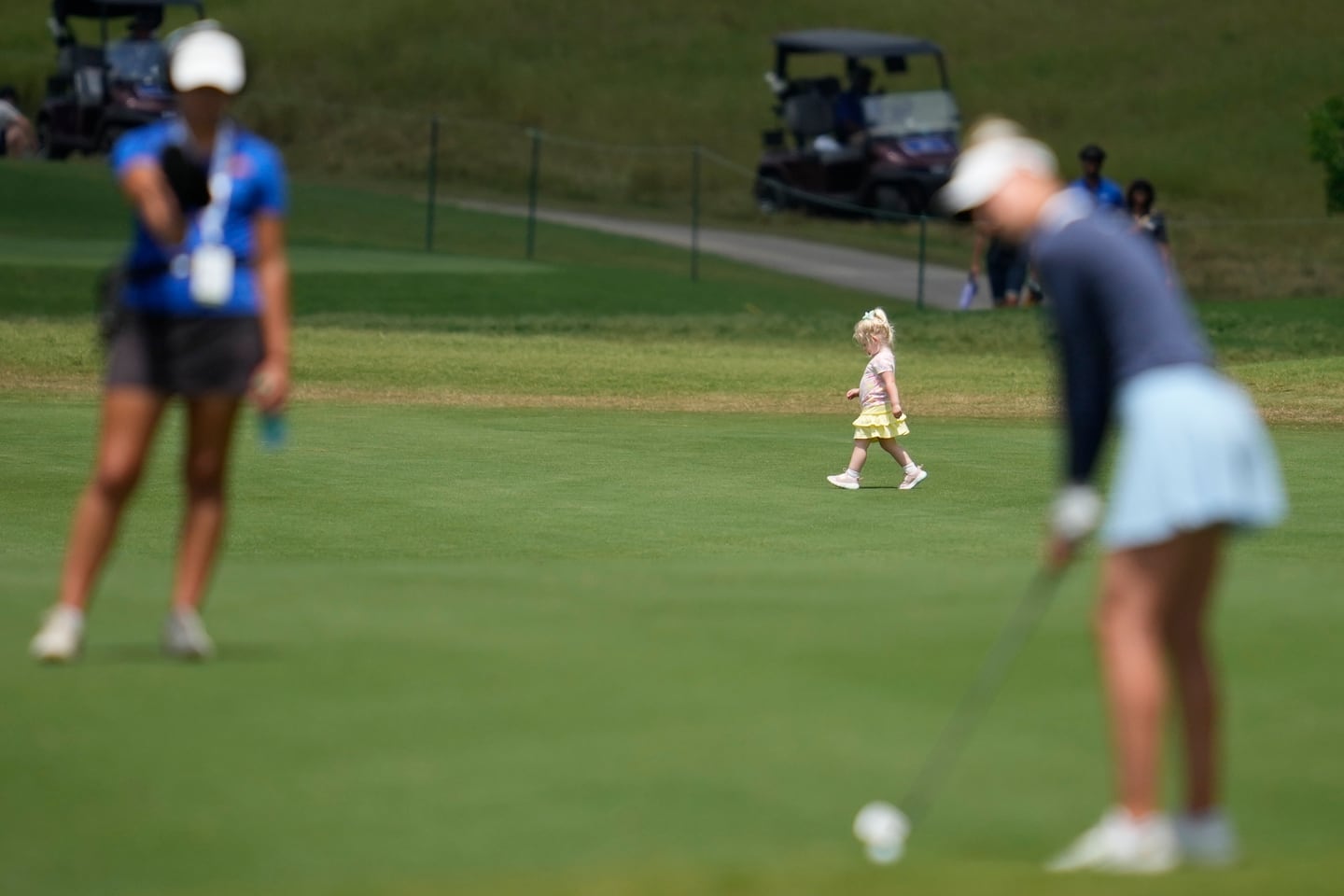
Five of the 144 players this week are mothers.
And while one of them, Shrewsbury’s Brittany Altomare, is not using the tour’s daycare center for her 17-month-old son, Wyatt, she appreciates that it’s there, as well as knowing the tour is behind her and her peers.
“Women don’t have to choose between having a successful career and starting a family, and I think our maternity policies out here have evolved in the 10-plus years I’ve been here for the better, to allow women not to have to choose between playing and having a family,” said Altomare, who has been a member of the tour since 2014.
The LPGA is leaning into its “Moms on Tour” program, which is as much a philosophy as a policy, and includes the traveling daycare center and permanent staff that has been with the tour since before the pandemic.
“I wouldn’t say that we have the puzzle totally solved, there’s a lot more that we can do to serve these players,” said Blake Henderson, the LPGA’s senior director of athlete policy and development. “It’s such a challenge, and anything that we can do to continue to help these moms be successful, that’s what we try to do with all the stuff we put forward for them.”
There are 21 LPGA players who are on maternity leave or pregnant.
Six years ago, the tour updated its policy to allow playing mothers more support and flexibility as they juggle parenthood and their profession.
Athletes have up to two years from the date of their baby’s birth to return to play. When they return, the mother keeps her pre-leave status for the next 12 months. Those mothers who qualified for one of the five majors but could not compete because of maternity are eligible to compete in that major upon return.
The policy “really provides them with a safety net to effectively return to play,” said Henderson. “Sometimes traveling with a 2- or 3-month-old is a lot easier than when your kid starts running around. We see different players do things differently, but we provide them the flexibility and not have to make a choice like, ‘Do I want to have kids?’ This allows them the ability to do so and then still return to their livelihood.”
Last summer, Altomare returned for a tournament 3½ months after her son was born.
She quickly learned she was not ready.
Her swing speed was down, plus her stamina and strength were overtaxed at her first tournament because she was playing without a caddie, pushing her own cart, plus had to play 30-plus holes in one day because of rain.
“Physically, I wasn’t there,” said Altomare, who returned home and hit the gym four to five days a week to regain her endurance and strength. By November, she felt like she was back. She returned to action again in February in Thailand, and played in a dozen more tournaments over the spring and summer leading up to the FM Championship.
For the first six or so, Wyatt didn’t travel with his mom. That soon changed.
“It was hard being out here alone with my son back there and I was like, ‘I’m not doing this, he’s coming on the road with me,’ ” said Altomare, 34, who lives in Tampa. “He’s been amazing in the air — I don’t know if he’s pulling a trick on us or something, but he’s been so good at flying and traveling.”
Knowing Wyatt is nearby is a plus, for Altomare’s peace of mind and her play.
That is the whole point.
“It’s definitely nicer coming off the golf course having something to look forward to,” said Altomare. “Wyatt keeps me busy. Instead of going back to the hotel room and sitting in my bed stewing about what happened on the golf course, it’s, ‘Oh, let’s go to a playground.’ He doesn’t care. He just wants to play and do whatever and see mommy.”
“It’s been more fun, thank God.”
And not just on the tough days.
“Even after a good day, it’s just nice to see his face,” said Altomare. “He’s a very happy boy.”
Michael Silverman can be reached at michael.silverman@globe.com.