
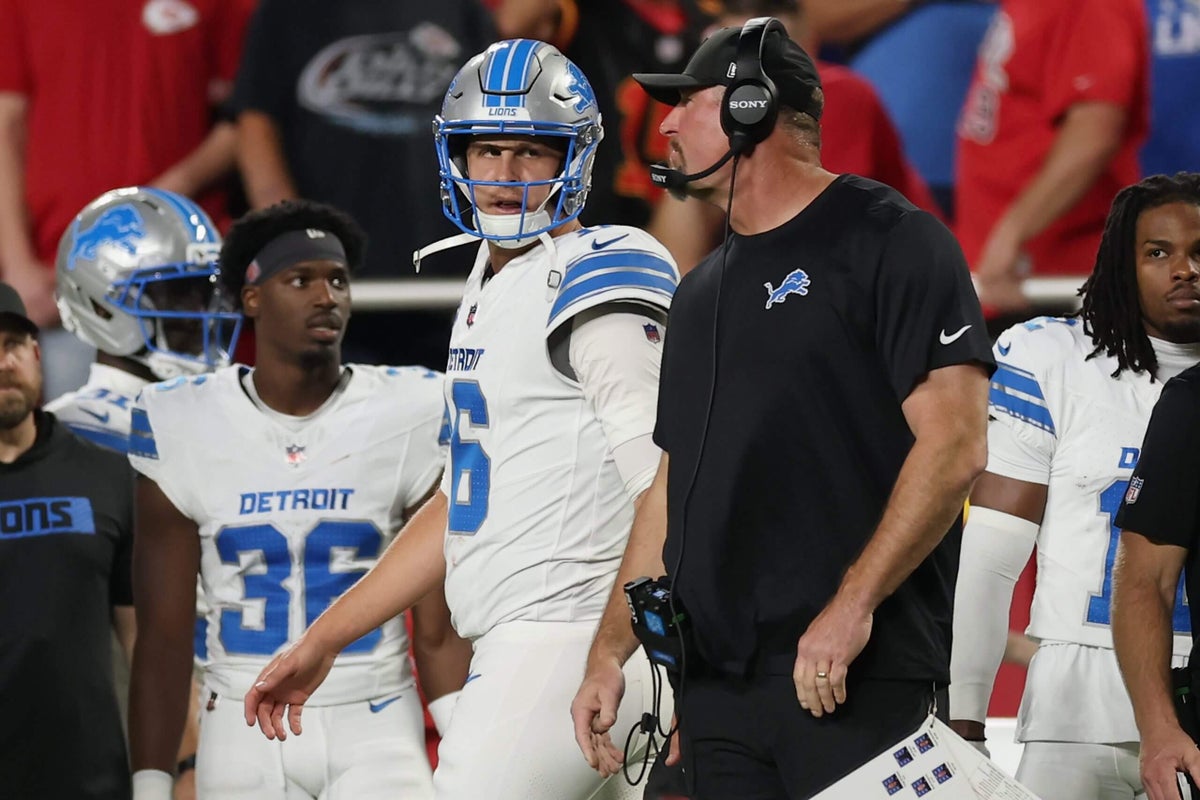
It was an interesting idea, but the execution was just a little bit off. And illegal.
The Detroit Lions scored a touchdown on a trick play in the first quarter against the Kansas City Chiefs on Sunday night — only they didn’t. It would have given them at least a 6-0 lead in a big prime-time showdown.
On fourth-and-goal at the Chiefs’ 1-yard line, Jared Goff lined up under center with running back David Montgomery and tight end Brock Wright behind him in a T-formation. But instead of taking the snap from center, Goff went in motion to the left. Montgomery, a former high school quarterback, got the snap in the backfield and threw to Goff, who powered his way into the end zone after a brief bobble.
However, after a conference between referees, the officials ruled that Goff’s movement was illegal. According to referee Craig Wrolstad’s explanation on the field, “The quarterback never got set, therefore it’s illegal motion, offense No. 16.”
According to Section 4, Item 3 of the NFL rulebook:
It is legal for a T-Formation Quarterback to go in motion, whether he has placed his hands under center, on his knees, or on the body of the center. However, it is a false start if the action is quick and abrupt. If the player fails to come to a complete stop for at least one full second prior to the ball being snapped, it is illegal motion.
The Lions were penalized 5 yards and later kicked a field goal for a 3-0 lead with 5:21 remaining in the first quarter. It wasn’t quite the ending Lions coach Dan Campbell hoped for after his team had consumed nearly 10 minutes on the opening drive.
Wrolstad further explained the ruling to a pool reporter following Kansas City’s 30-17 win over Detroit.
“There were a lot of moving parts on that play,” Wrolstad said. “We had a quarterback go up to the line of scrimmage. He paused momentarily in the quarterback position, didn’t get under center, but he walked up and stopped like he was the quarterback. Then, he went in motion, and they threw the ball to him for a touchdown. If the quarterback assumes the quarterback position and then goes in motion, he has to then stop for a second before they snap the ball. Because he gets out of the view of some of the officials, we had to piece it together as a crew as to whether he stopped initially and then whether he stopped when he went in motion. It was determined after a lengthy discussion that he stopped at the quarterback position and then went in motion. But when he does that, he has to stop when he goes in motion.”
Wrolstad was asked why it took so long after the play’s conclusion before the flag was thrown.
“It’s my job to see if the quarterback stopped initially,” he said. “The down judge watches the player in motion, and we had to communicate between him, my umpire, and my line judge whether or not he initially stopped at the quarterback position and then whether he stopped after he went in motion out of my view toward the left-hand side of the field. There was a little bit of confusion in our discussion about whether he had stopped initially or whether he had stopped at the end and what we were talking about. That’s why the flag came in so late.”
The referee also confirmed that there was no assistance on the play from the replay booth upstairs or the league office in New York.