
Hey y'all! Like all of us around these parts, my excitement for the upcoming season is starting to take on a feverish pitch, so I decided to harness that energy and direct it back at my keyboard. The result? A near-5000 word season preview that dials up the optimism and asks whether or not it might just be Orlando's time.
I'm not sure if anyone here used to lurk around Orlando Pinstriped Post back in the day, but if you did you might recognize my handle. For almost six seasons I used to churn out long form content for OPP/SB Nation, only stopping at the start of 2023 when the powers-that-be killed their support of our corner of the platform. Despite missing the community and conversation I ultimately decided to stop writing altogether and instead just take the personal time back, but the current itch of knowing that the team is likely on the verge of something special is something I haven't been able ignore these last few weeks. Hence the following slab of text!
Thanks for stopping in and taking a look, whether you ultimately work your way through either a little or a lot of what I've put together. If it's the type of written content that a chunk of this sub is interested in, I might see about chiming in at least semi-regularly once we're underway. Let's go Magic!
~ GT.
—
WHY NOT THE ORLANDO MAGIC?
Across 79 years of existence, the NBA’s championship race has never been so wide open.
How do I know? Well, the proof is in the banners. Across our seven most recent seasons we’ve seen seven different franchises crowned as kings (sorry, Sacramento), including two – or potentially three, depending on how you want to slice Seattle and Oklahoma City – for the very first time. We’ve genuinely witnessed the most diverse stretch of winners in league history.
So, is differentiation atop the NBA mountain now the new normal? Professional basketball in the United States has long been defined by otherworldly players talented enough to turn that first title into a second (or even, occasionally, a third or … eighth). However, the confluence of a globally-infused talent pool with a higher-variance style of play and a brutally punitive luxury tax may be the mix that leveled what is now seemingly a non-dynastic playing field.
I know that OKC are absurdly young and obscenely talented and the reigning champs for a good reason. I also know that Denver have re-loaded around the league’s best individual talent. Hell, I even know that Golden State and the Lakers are still lurking in the minds of sharps and squares alike.
But what if that’s just not how it goes in basketball in 2026? What if the NBA’s fresh frontier of parity and possibility is here to stay? If so, would it be crazy to think that this might be the year it finally all breaks right for an oft-overlooked team from Central Florida?
I don’t think it’s crazy at all. Let’s make the case.
Defense
Any chance the Orlando Magic have to emerge as genuine contenders this season will be anchored primarily in their ability opposite the ball. Thanks to the high level of roster continuity we already know what sort of defensive presence they project as: a tough and malleable outfit one through five, with waves of physicality that ensure they’re consistently punishing to play against.
Last season Orlando was the NBA’s second most-difficult team to score against, a defensive rating of 109.1 trailing only the eventual champs in OKC and grading out more than five whole points more effective than league average. They forced turnovers on a maniacal 15.0% of opponent possessions (1st league wide), while also locking down the glass to the tune of a 77.0% defensive rebounding rate (2nd). The team’s long limbs and willingness to bang bodies constricted the effective field goal percentage of opponents, the .538 mark surrendered ninth-best across the league, and only even that high because of how often they whacked shooters and sent them to the charity stripe (29th in opponent free throw rate). It was a tone-setting concession willingly made.
Can they do it again? Might they turn the screws of this existing strength even tighter? It’s certainly conceivable! The essential infrastructure largely remains in place, while the swap of Kentavious Caldwell-Pope for Desmond Bane doesn’t figure to mess with things too much (more on that later). Even if a little is lost with KCP’s departure, the strong possibility of more court time from the quartet of Jalen Suggs (47 games missed), Moe Wagner (52), Franz Wagner (22) and Paolo Banchero (36) – all of whom the advanced metrics peg as positive defensive impacts – suggests that the Magic could further consolidate their performance at this end of the floor.
Orlando have been one of the best defensive outfits in the game for a couple of seasons now, and with their core returning, the coaching staff established and the system locked in, the odds are in their favor to again repeat the feat. It’s rare that an NBA champion is crowned who doesn’t boast at least a top-ten defense – Denver are the only exception in recent memory, ranking fourteenth that season – which means that the Magic’s ruggedly-built pedigree in this space provides them with half of the necessary equation.
Ascendant stars
So if the defense is expected to land somewhere in the range of ‘ferociously great’ to ‘suffocatingly elite’, what’s holding anyone back from engraving the Larry O right now? Well, for the Magic it’s an unfortunately familiar issue: scoring. For the almost unfathomable thirteenth consecutive season, Orlando finished their last campaign with an offense that ranked in the league’s bottom third by efficiency. An anemic offensive rating of 109.4 landed them in 27th place, the team’s field goal percentage (44.5%, 27th), three-point percentage (31.8%, 30th), effective field goal percentage (.510, 29th) and true shooting percentage (.550, 28th) all similarly in the bottom four league-wide.
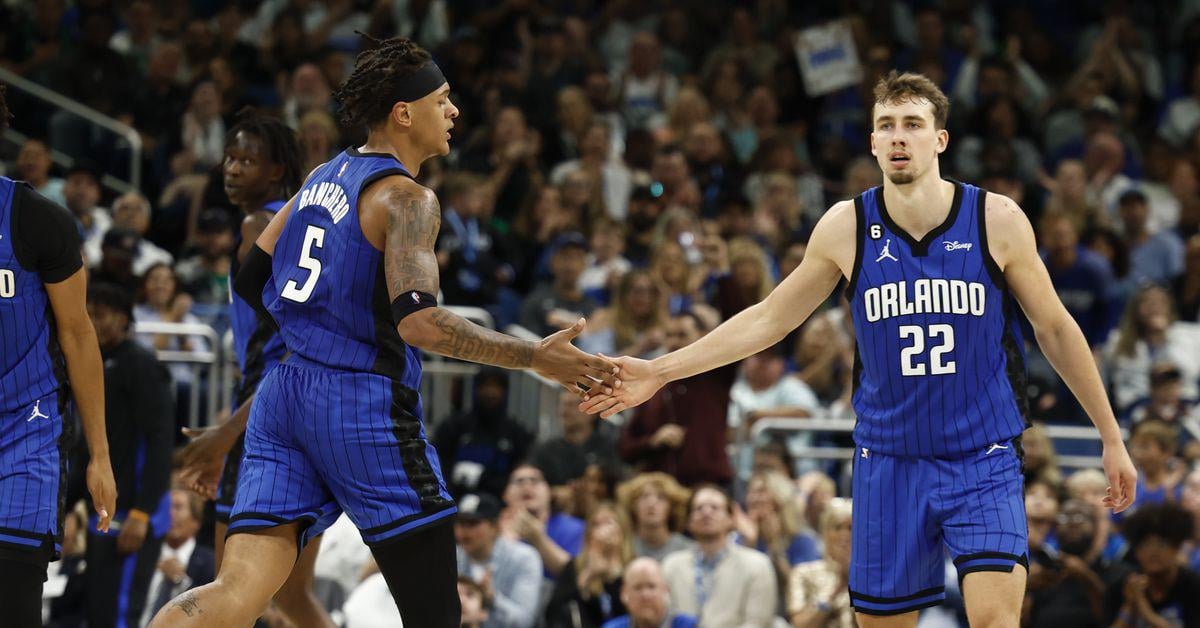
Thankfully, however, there is legitimate hope for the Magic’s offense. As a pair of jumbo-sized playmaking wings, the dual foundational pillars of Paolo Banchero and Franz Wagner promise much. Already locked in for the long-term and entering the early stages of their athletic prime together, the dynamic twosome are an offensive concept writ large that is poised to be actualised sooner rather than later. Each is capable of serving as the fulcrum of the team’s offense, high-powered threats that can get their own buckets, generate mismatches and produce meaningful opportunities for teammates. Most teams would kill for one such player. With two, Orlando is spoiled for choice on any given possession.
Banchero is the coveted prize to emerge from the Magic’s rebuild, an alpha scorer of a familiar mold. He combines overwhelming power with precise and poised movement, currently most comfortable hunting isolation opportunities against frequently overwhelmed defenders. Despite the interrupted nature of his last campaign – just 46 regular season games as he navigated an oblique tear and an elongated recovery period – Paolo still made strides as both an individual scorer and a franchise centerpiece.
Across 2024/25, Banchero further ratcheted up his usage rate (33.6%) and reaped the benefits, finishing the season with career-best figures of 25.9 points on a 55.1 true shooting percentage. His free-throw rate bounced back after a slight sophomore slump (up to .423 from .397), while his jump-shooting profile stretched ever so slightly further out, residing more frequently beyond the arc (.299) rather than in the mushy mid-to-long two-point range. He was also more likely to hit a teammate with an assist or haul in a rebound, generally picking his spots and reading the play more effectively on his way to a career-low turnover rate (11.2%). It was exactly the type of early-career growth any team would want to see from their budding superstar.
Paolo’s almost paradoxical bruising fluidity has seen him entrench himself as one of the game’s most dynamic threats attacking out of isolation. He finished his abbreviated regular season at a shade under a point-per-possession in such instances (0.97), recording points on 47.6% of these opportunities and landing right at the league’s 70th percentile. He ultimately finished 8th overall in terms of isolation possessions per game with an average of 5.0 each night, one of just fourteen players on an All-Star-studded list to rack up a frequency of 4.0 or greater. Of those, Banchero was 9th in points-per-possession, 4th in scoring frequency (47.6%), 7th in field goal percentage (44.3%), 5th safest in turnover frequency (8.3%), and 1st in his ability to absorb a foul and generate free-throw attempts (20.5%). It’s easy to see why the Magic are so willing to put the ball in Paolo’s hands and simply let him cook.
Banchero’s free-throw proclivity warrants further exploration. His average of 8.4 per-game was positively gargantuan, a career-best figure that placed him fourth league-wide behind just Giannis, Embiid and SGA (a trio who happen to represent three of the last four MVP winners). He generates almost half of those attempts (4.0) on his bullying drives to the hoop, second only to the 4.1 that Zion Williamson accrues on the same play type. However, it must be noted that Banchero is only 31st league-wide in drives per-game (11.9; Zion, by comparison, is 3rd), a fact that amplifies just how elite he is at creating contact as he barrels to the basket. It’s honestly not hyperbolic to state that Paolo is already the league’s premier talent when it comes to getting to the stripe courtesy of the driving game. He’s possessed of excellent footwork and a knack for using his first step to force his defenders onto his hip, the quick ball elevation evident in his gather forcing opponents to rise with him as he dictates the course of the contact. Banchero is a genuine free-throw magnet who is steadily shaping the Magic in his image.
The fourth-year forward has also improved as a playmaking hub, with Paolo’s passing out of double teams or just ahead of arriving rotations landing both a little more frequently and effectively in the hands of teammates. You can see the game starting to ever-so-slightly slow down for him, a trend which should continue as he gains experience and the lineups around him are possessed of greater shooting touch. And while his shooting efficiency isn’t yet where you would want it to ultimately sit, he has already significantly lifted his finishing from every distance range on the floor while also reducing his reliance on someone else to have set it up with an assist. These factors all suggest an offensive threat who has not yet reached their final form. Banchero is already a menace with the ball in hand, but one who promises more still to come.
While there are echoes of similar play evident in an evaluation of Franz, the younger Wagner brother is ultimately his own unique type of offensive threat. Due in large part to the extended injury absence of Banchero, the 2024/25 season demanded that Wagner further elevate his own performance and function for extended stretches – both in games and across the season – as the team’s number one option. By and large, it’s a role he thrived in.
At a basic box-score level this is evident in the career-best figures that Franz put up. 24.2 points, 5.7 rebounds, 4.7 assists and 1.7 ‘stocks’ are the type of well-rounded counting stats that would have made him an All-Star had he not been felled by his own oblique tear. It’s elsewhere in the numbers, though, that the impressiveness of his campaign is most evident.
Across the 2024/25 season, Wagner cemented himself as the Magic’s most impactful pick-and-roll weapon. He quarterbacked 6.4 of these sequences as the ballhandler each night, cashing in those opportunities to the tune of 0.94 points per-possession. That was a rate good for 17th league-wide among players with at least 6.0 such possessions per-game, an overall 71st percentile finish that placed him ahead of names such as Luka Doncic, James Harden, Cade Cunningham and Trae Young, among many others. When orchestrating the pick-and-roll Wagner easily paced the Magic by generating a score on 45.3% of such sequences, while also being the third-most likely on the team to draw a foul (an 11.7% frequency) and the second-least likely to cough the ball up (a 13.2% turnover frequency). He even held his own when operating as the roll man after setting a screen, landing in the 55th percentile for effectiveness in these moments. Simply put, the Magic were well-served whenever they decided to leverage Franz’s mismatchability by sticking him in a two-man game.
Wagner’s ability to generate offense that defied body type and traditional positional designation was also evident in other ways. Last season there were only 29 players league-wide who averaged at least 12.0 drives per game. Of those, exactly two stood 6’10 or taller: Franz and Giannis. In fact, returning to the full height-agnostic list reveals that there were only six forwards total who drove to the basket with this sort of elite regularity. The dribble-drive game has long been a defining characteristic of effective guard play, but Orlando has a near-7 foot pinstriped Magician wowing with the same tricks. It’s a matchup-shattering physical outlier that is coming to define Wagner’s offensive identity.
There’s a duality to Franz’s forays through the painted area that quickly becomes apparent. Notably, there exist moments when he attacks the basket with straight-line ferocity, soaking up contact as he seemingly ignores the proximity of defenders. We see this when he gets a step on a slower perimeter defender, a turned corner quickly shifting into a beeline for the bucket. Contrastingly, he’s also adept at employing a more circuitous route. When the necessary angle fails to emerge his gait takes on an irregular cadence, a staccato rhythm punctuating the patter of his footwork as he slices open a path previously unseen. It’s a euro-step built on equal parts hesitation, acceleration shifts, and directional deception. These dual driving identities merge to ensure he’s basically always a threat to get to the hoop.
So what’s the net result of this drive-centric offensive profile? Last season, Wagner averaged 13.3 drives per contest (18th most league-wide), converting those chances directly into 9.5 points (11th) on 48.8% finishing (20th among players with at least 12.0 drives per game). He bolstered these attempts from the floor with 2.3 trips to the free-throw line each night courtesy of his drives (15th among frequent drivers), while also tacking on 1.0 helpers to an open teammate during these sequences each game (26th, again among frequent drivers). It’s an impressive set of contributions stemming from this play type, made even more so by the combination of Wagner's 6’10 forward frame, finishing numbers that last season were actually a little below his career average, and that he was frequently operating in lineups bereft of outside shooting threats. Imagine what he might be able to achieve with just a little more open hardwood in front of him!
The increased demands on Wagner’s play can also be seen in the explosion of his usage rate, up to a full 31.0% on the season and pushing even higher in those games when he assumed complete command of the team in Banchero’s absence. With this extra responsibility he lifted his assist rate almost eight percentage points on the previous season (up to 26.6% from 18.8%), while actually decreasing his turnover rate by a hair (down to 9.6% from 10.0%). Despite shouldering a significantly heavier playmaking burden, Wagner was more likely to both create a bucket for a teammate and ensure that the team made it safely to the end of the possession. That’s a great combination for a burgeoning number one option.
The combination of Paolo and Franz provides the Magic with an enviable base from which to plan their attack. However, outside of the internal improvement that youth promises, is there reason to believe that Orlando’s offense has the capacity to find another gear? I’m glad you asked!
Desmond Bane
Considering the Magic are returning a roster that accounted for 72.4% of last season’s total minutes, it stands to reason that if the team is to emerge as this season’s surprise packet contender it’s an outcome that will almost certainly be shaped by the (shooting) hands of the recently arrived Desmond Bane. Orlando’s long-patient front office finally pushed their chips in over the summer, sending a haul of picks and matching salary to Memphis for the well-regarded backcourt bomber. Bane is the dose of talent injection that the franchise is banking on to effectively pair with existing expectations of internal improvement, and anyone with even a cursory interest in basketball in Central Florida can see why it was a bet worth making.
Of the ten Magic players who notched more than 1000 minutes last season, not one shot better than 35.3% from deep (the now departed Cole Anthony). Elsewhere, the roster’s retained continuity makes for grim long-range reading: Banchero shot 32.0%. Franz a ghastly 29.5%. The backcourt duo of Suggs (31.4%) and Anthony Black (31.8%) didn’t exactly strike terror into the hearts of opposition defenders. And dreams of a stretch big anywhere on the roster should probably be abandoned after the shooting campaigns turned in by Wendell Carter Jr. (23.4%) and Jonathan Isaac (25.8%). Bane is immediately positioned as the team’s most lethal – and perhaps only genuine – three-point threat.
It’s hard to understate how poor the Magic were from long range last season. No team was less accurate from beyond the arc (31.8%), nor did any side connect on fewer threes per game (11.2). In fact, that last figure represents an almost 7-point deficit that Orlando had to overcome on a nightly basis in terms of the average NBA team’s output from deep. Before a ball had even bounced on the hardwood, let alone found the bottom of a net, the Magic were looking to make up three successful possessions worth of basketball.
It stands to reason, then, that adding a bona fide shooter to the mix will at least get the three-point needle moving in the right direction. But what exactly should be expected of Bane in Orlando? Well, a comparison to the role and minutes he figures to absorb reveals a very different type of long-range threat.
Across 2024/25, Kentavious Caldwell-Pope and Cole Anthony combined to contribute 2.6 made threes per night on 34.7% shooting. Interrogate these numbers a little more closely and what you discover is that a full 77.0% of these made triples came with feet firmly planted, as the Magic’s most voluminous backcourt shooters were almost exclusively catch and shoot merchants.
Bane is a different beast entirely. Last season’s 39.6% shooting for 2.4 made threes on 6.0 attempts each game already compares favorably, but the manner in which he compiled these numbers makes for a stark contrast. Across 2024/25, more than half of his made threes came off the dribble, with the greatest weight of those coming after 3 to 6 dribbles. It’s a shot profile that has remained pretty constant for a few years now, an almost-metronomic trend also evident in his marksmanship from range. For his career Bane is a 41.0% shooter from three-point range, a percentage that doesn’t fluctuate all that much when splitting catch-and-shoot opportunities (43.2%) from those off-the-dribble (38.7%).
What the Magic have acquired this offseason is a backcourt shooter who is both deadly on volume and reliably capable of generating those shot attempts himself. Even for a team that projects to invest heavily in playmaking from the wings it’s an incredibly valuable skillset, and one that pairs intoxicatingly with the improved playmaking Bane has demonstrated over the last three seasons. A shade over 5.0 helpers per-game and an assist-to-turnover ratio north of 2:1 speaks to his growth as a facilitator, highlighting the multifaceted offensive threat he promises to be in Orlando. His shooting should keep defenses honest and create space for his new teammates, while his work with the ball-in-hand threatens to punish opponents who sell out on shutting down either Banchero or Wagner.
At the other end of the court, Bane figures to fit in perfectly with Orlando’s existing defensive identity as a physical, adaptable and ultimately taxing outfit to play against. Although not the tallest two-guard, his solid stature means he can switch both up and down with some success, the 1.5 ‘stocks’ he’s tallied per game over the last few seasons a measure of the effective interference he provides. The advanced metrics also like Bane’s defensive impact. 60% of the win shares he’s generated across his career have been attributed to defense. Last season’s 0.6 defensive box plus/minus number sits comfortably above league average for his position and was the strongest of his career. Direct matchups have consistently seen a reduction in their field goal percentages when hounded by him, while the fact that he draws more fouls than he commits speaks to a cleanliness in his contests. These numbers align with the eye test that grades him out as a quality defender who will take nothing away from the Magic’s intended calling card.
No roster addition is ever entirely without risk, and even amidst the slam-dunk hypothesizing about Bane’s fit with the Magic some potential cracks might be observed. Most significantly, it’s difficult to overlook the fact that he has missed 97 games since entering the league in 2020, and 77 in the last three years alone. That’s an alarming number for a franchise already sporting its own traumatic scars when it comes to player availability! There are also some valid questions about how effective he’ll be as the third option on offense, particularly when that takes the ball out of his hands in a way that hasn’t happened too much these last few years. Still, Orlando’s underlying reasoning in this instance is more than sound, and if the bet ultimately doesn’t pay off it won’t be because the odds were ever unfavorable.
Real depth
Something else that the Magic have going for them this coming season is the genuine depth of the roster. There are meaningful layers to the rotation at basically every spot on the floor, a situation that should generate healthy competition for minutes while also providing some level of minor injury insurance across a long regular season. There’s a twelve-man unit of contributors ready to roll out in Central Florida.
Suggs obviously leads the support of Orlando’s big three. He’s a tenacious on-ball defender with an indefatigable motor and a style of play that serves as the emotional heartbeat of the team. Last season he looked ready to further capitalize on his third-year ascent before, unfortunately, injury struck, limiting him to just 35 games. Still, in those contests he was putting up more points, rebounds, assists, steals, blocks and free-throw attempts than the previous campaign, and it was only his wobbly finishing numbers – 31.4% from deep, 50.6% on twos and a 16.2% turnover rate – that were holding his play back from being a full-on breakout. If he can stay healthy (gulp) while nudging those key metrics back towards where they landed in 2024 he’ll ensure the Magic’s core features a fourth dynamic running mate.
The big-man rotation of Wendell Carter Jr., Goga Bitadze and Jonathan Isaac again returns, a rugged triumvirate of physically sound 7-footers who combined last year to produce around 24 points and 16 rebounds per night while figuring among the team’s most effective defensive contributors via defensive win shares (a combined total of 8.5) and defensive box plus/minus (a combined average of 1.83). They lock down the interior of Orlando’s imposing defense, cleaning the glass, swatting shots and stymieing opponents with their length and physicality.
The other piece of the Magic’s bigs puzzle is Moe Wagner. The 28 year old was on his way to a career-best season last year before a torn ACL cruelly ended his campaign in December. After re-signing with the team on a one-year deal during the offseason the expectation is that he will return around the new year, and if he can work his way back into the type of form that he flashed pre-injury his scoring punch and general intensity will be a boon for a side that will be looking to generate points more effectively.
Anthony Black and Tristan da Silva are promising youngsters both with a chance to pop as they continue to acclimate to the league. Black is impressively long and tenaciously athletic, and if he can figure out the shooting side of things he would be a real menace at both ends of the floor. Da Silva plays a lot like a lower-usage Franz-lite forward, with a toolbox skillset and wing connector glue game that means he’ll likely always find minutes coming his way. Like so many on this team, though, the extent of that court time will almost certainly be determined by his capacity to improve the accuracy of his outside shot. Elsewhere among the youth, there’s even a timeline where Jase Richardson, Noah Penda or Jett Howard shoot their way into something more than mop-up minutes. If one or two of this crew hit in any meaningful way, the Magic promise to be one of the league’s deeper teams.
Finally, the addition of Tyus Jones, while not as splashy as the Bane trade, is a move that figures to shore up Orlando’s rotation in a genuinely meaningful way. The 10-year veteran gives the Magic a traditional point guard to both direct the second unit and provide some varied playmaking alongside the core when the circumstances call for it. He’s long been one of the league’s best in assist-to-turnover rate, a set-up skillset that this Magic side has been desperately craving to make life easier for Paolo and Franz. That he has also settled in during the second half of his career as a well-above average outside shooter only further aligns with this team’s needs. If he can hold up defensively and not compromise Orlando’s profile at that end of the court his acquisition has every chance to be similarly impactful as that of his higher-profile backcourt partner.
The final verdict
So, can the Magic actually win it all this coming season? Will the NBA’s era of equality continue with the crowning of a first-time champion from Florida?
Unfortunately, the answer is ‘probably not’.
Orlando currently sports the seventh-best title odds on the futures market and, honestly, even that is likely a little optimistic. Sure the team’s ceiling is still ascending alongside that of its youth, but the roster remains inexperienced in the cauldron that is postseason basketball in May (let alone June). History has shown us that even the greatest teams need to take their playoff lumps before breaking through, and at this stage the Magic are still largely an intoxicating outline of potential waiting to be realized. Although it’s a squad that certainly has an excellent chance to make some noise in a watered-down East, this coming season feels more like one that, in hindsight, will ultimately serve as their bridge to meaningful contention.
If, however, that leap comes a little earlier than expected, it wouldn’t be a complete shock. The Magic have assembled a genuinely deep and bruisingly physical roster around a pair of walking mismatches, both of whom are still teasing out the limits of their individual games. The defense is already rock solid, while the offense projects to be meaningfully improved. Put it all together and you’ve got a team that will very soon be knocking at – or even bashing down – that final door that stands between them and the truly elite contenders.
This season is likely just a dash too soon, but expect to be asking ‘why not the Orlando Magic?’ with regularity in the years to come.
2 comments
That was a long read, but it was well written and easy to get through. Thanks on taking the time to provide your insights, was a pleasure reading it.
I agree with your conclusion, but lets just hope the stars and moons align and by some higher power we hoist that Larry o Brien up at the end of the season. Who knows 😉
I’m down with OPP. Great read and welcome back!