
How Tall Are NBA Players?
Apparently, it depends on the year. And also on who is measuring. And also maybe on what time of day it is?
NBA player heights have always existed somewhere between fact and fiction. Every year, someone mysteriously grows or shrinks. Kevin Durant’s height has been a mystery for years. Victor Wembanyama’s is the new mystery, as he’s been listed at 7-4, then 7-3, then back to 7-4, but rumored to be 7-5.
You’d think this would be one of the easier things to standardize in a sport where height is arguably the most important physical trait. But the league’s relationship with measurement has never been particularly scientific.
Until the 2019–20 season, the NBA didn’t even have a consistent rule for how players should be measured. Some teams used height with shoes on, others went barefoot. The Draft Combine always recorded both, but once players joined their teams, each franchise was free to list whatever they pleased.
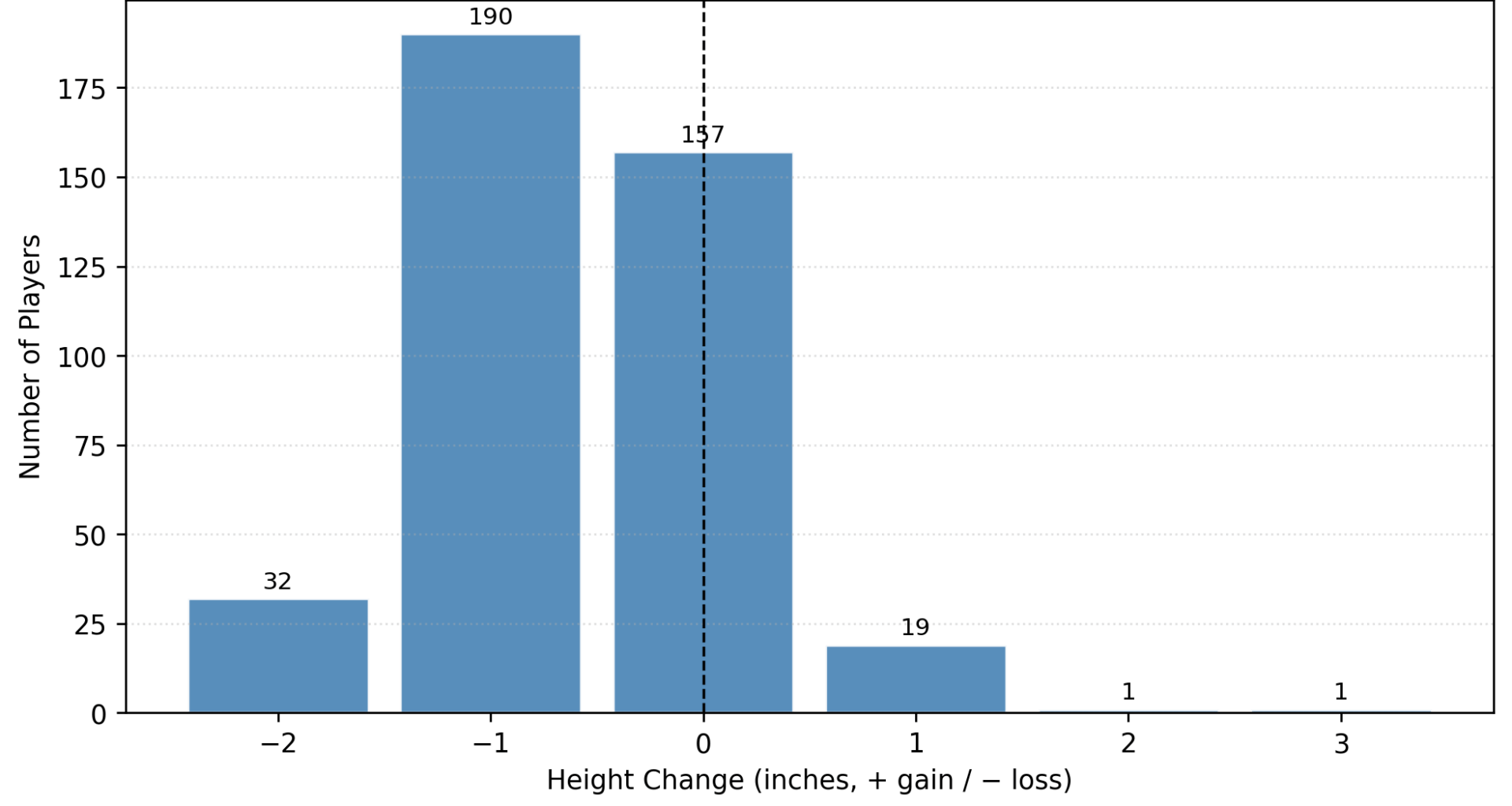
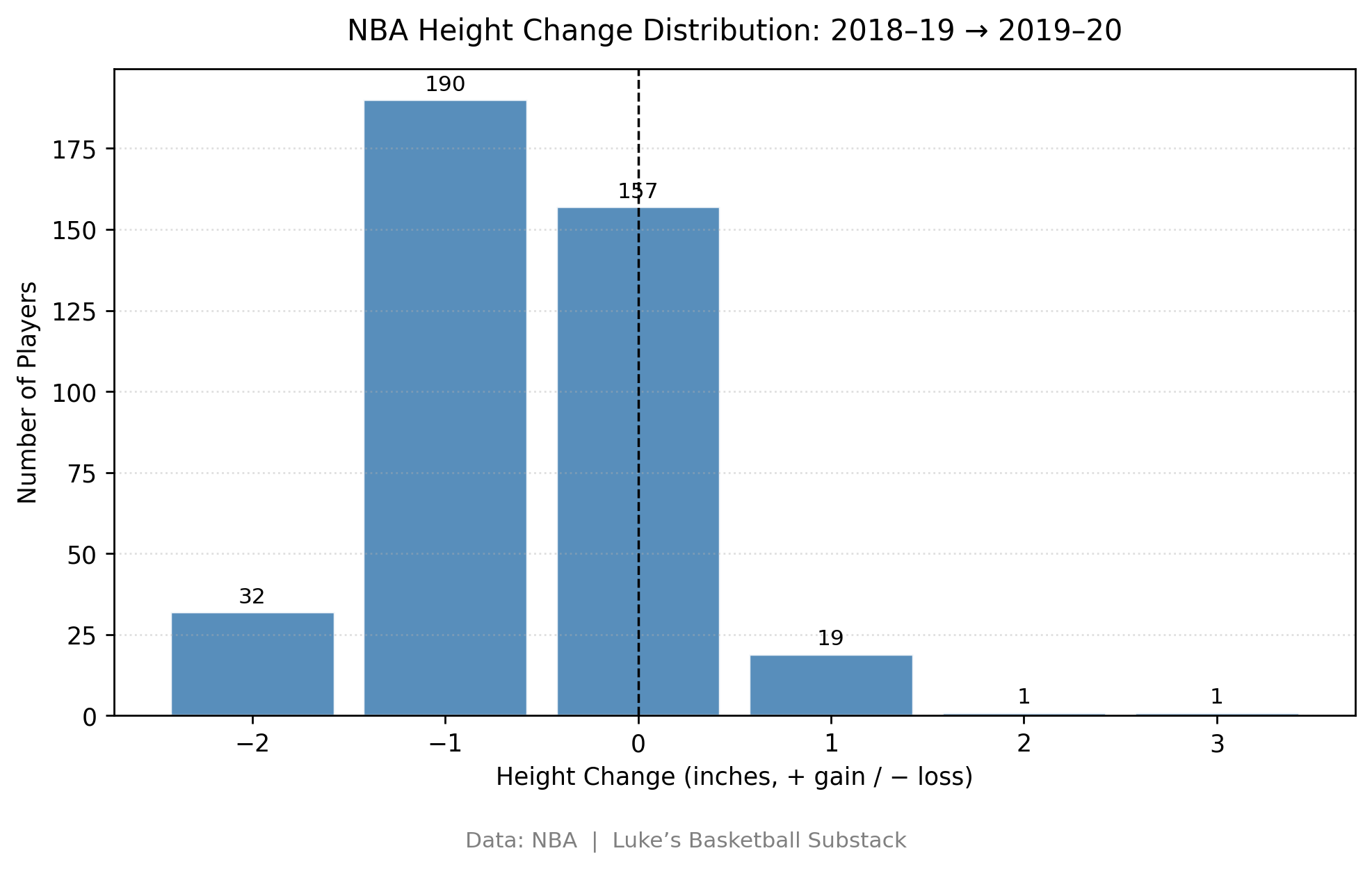
That changed in 2019, when the league instituted a new standard: all official measurements would be taken without shoes. The result was a virtually one-day mass shrinkage. Dwight Howard, Bradley Beal, Kemba Walker, J.J. Barea, and over 200 others officially lost one to two inches overnight. A few, somehow, grew.
But the reform didn’t completely solve the problem. Teams still self-report their numbers, often at different times of day (some studies suggest that height fluctuates naturally throughout the day), using different tape measures (I guess that might matter?), and under varying methods of how to measure players with tall hair. And we could imagine that teams and players have their own preferences and incentives. Guards probably want to look big enough to switch; some bigs probably want to look mobile enough to avoid being labeled centers; some bigs probably want to look as tall as humanly possible. Everyone has an angle.
So even in 2025, a league that tracks every pass, shot, and step with precision still can’t totally agree on how tall its players are.
Now, don’t get me wrong. An r value of 0.99 is about as close to perfectly predictive as real-world data gets. If a player was listed at 6’7” last season, you can be almost certain he will be 6’7” again this year. Still, it’s a little funny that it isn’t even closer to 1. You would think that the height of adults would be a number that rarely changes. Sure, some players grow, maybe some shrink, but those cases would seem few and far between. It’s a reminder that even simple data points are not quite as fixed as they seem.
Player Height Changes: 2024–25 vs. 2025–26
To see what changed this season, I pulled every listed height from NBA.com’s Player Bio tab last season and compared them to this year’s listings.
In total, 79 players shrank, 61 grew, and the vast majority stayed the same. At least it looks a lot more like a normal distribution than 2019 when the rule change sent everyone’s height into chaos.
Here are the biggest movers compared to last season:
What's Wrong With the Bulls?
We can get a decent sense of which teams deviate the most from the previous season by looking at the number and magnitude of player measurement changes from year N-1 to year N, grouped by the team responsible for those measurements in year N-1.
For example, 87.5% of the Bulls’ 2024–25 measurees were listed at a different height in 2025–26, with an average decrease of 1.1 inches.
Almost all of the Bulls got shorter! Or, more accurately, were listed shorter. It’s maybe even more interesting given how much roster continuity they’ve had. Fourteen players were measured by the Bulls roughly a year apart, and all but Tre Jones came in shorter. That’s kind of wild. Something clearly changed in how those measurements were taken.
Measurement Biases
While the Bulls chart suggests some funky internal inconsistency, the chart below shows which teams measured players taller or shorter than other teams, based on those who changed teams between the 2024–25 and 2025–26 seasons.
For every player who was measured by a different team in 2025–26 than in 2024–25, I calculated the change in their listed height from one team to the next.
- If a player was listed at 80 inches (6′8″) on Team A and 81 inches (6′9″) on Team B, Team B gets a +1.0 inch contribution.
- If the opposite happened, Team B gets –1.0 inch.
The chart averages those differences for each destination team, showing which teams’ new arrivals were, on average, listed taller or shorter than they were before.
Of course, the sample sizes are small. But there are still some interesting outliers. Cleveland listed its three new arrivals an average of 1.33 inches shorter than those players’ previous teams. Minnesota, on the other hand, listed its two new arrivals an average of 2.00 inches taller. Is this statistically significant? No. Is it interesting? I think so.
Here’s a look at measurements since 2019:
Cleveland, yet again, listed players shorter on average than those players’ previous teams. Maybe that’s notable.
Why this Matters
It doesn’t. I need basketball back on my TV.
3 comments
Holy shit dude
Tallest on team is 6’9″! Vuc, Zach, and…Trentyn Flowers!
Matas was measured at 6′ 8.75” at the combine. Now he’s listed at 6’8″.
Adem Bona measured 6′ 8.25” at the combine. Now he’s listed at 6’10”.
Ron Holland measured 6’5.5″ at the combine. Now he’s listed at 6’8″. He does not look as tall as Matas to me.
Some players still grow after the draft but I’m more inclined to trust the combine measurements. Team measurements seem to be all over the place. Good content.