
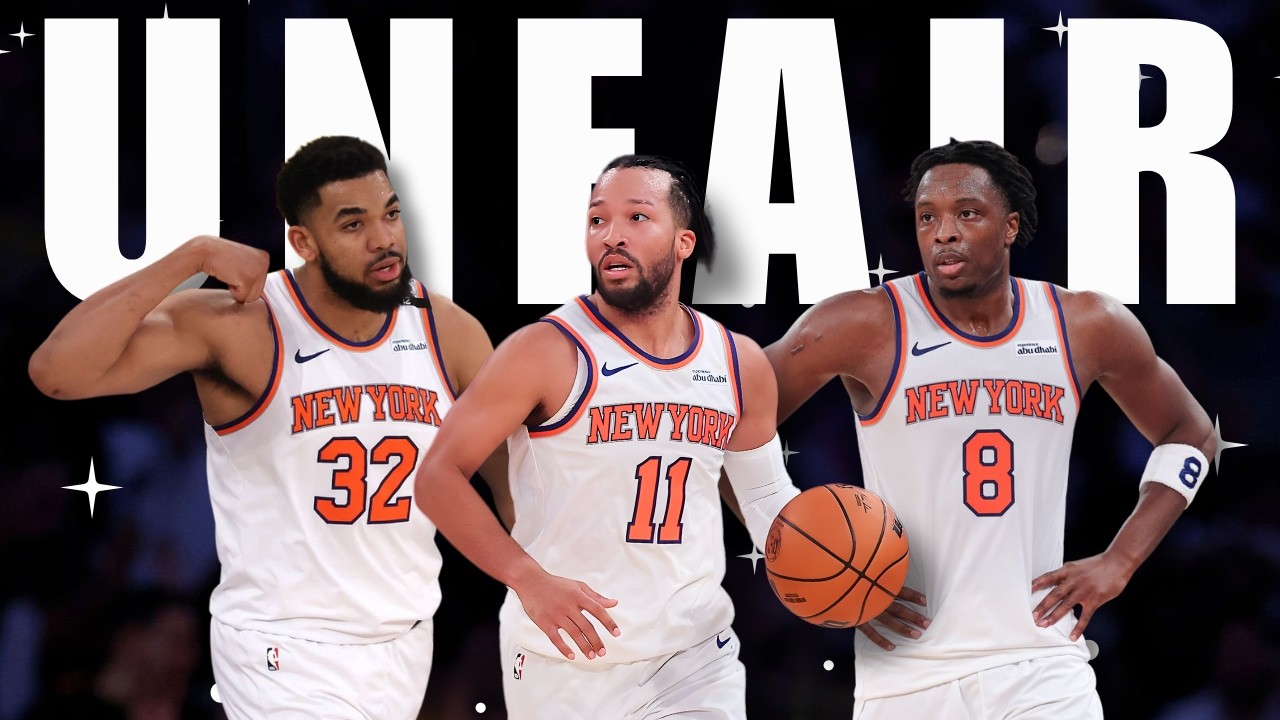
This Is Not The Same New York Knicks…
But can the New York Knicks represent the East in the NBA finals? Can the finals be at the Garden? You’re damn right. And I think it’s going to happen. I mean, and everybody in that organization, including Mike Brown, knows that that is the next step. That is the expectation and that’s exactly what they’re working toward. On paper, it looks like it should be achieved. The Knicks are riding a three-game winning streak and just put up 137 points against Minnesota in their most dominant performance of the season. And look, I know what you’re thinking. It’s early. Calm down. But here’s the thing. If you actually watch these games, you know this team looks nothing like what we saw last year. The pace is faster, the ball’s moving, and for once, New York doesn’t look like they’re grinding through mud every possession. This might actually be real. During the off season, the Knicks made one of the boldest moves in years when they fired Tom Thibido. This came right after their most successful season in over two decades, a run that ended in the Eastern Conference Finals. The front office clearly believed that Tibs grinded out style had taken them as far as it could. If the Knicks were ever going to make the jump from contenders to champions, they needed a whole new philosophy. So heading into the 2526 season, they brought in Mike Brown. Brown promised two things. Make this team look different and help them win at the highest level. Through the first eight games of the season, he’s delivered on both. Knicks plus six on the boards. Nice feet inside and an over. The Knicks are five and three after eight games. But more importantly, they’re surging. After stumbling to a two-3 start with a three-game losing streak, New York has rattled off three straight wins with an average win margin of 17 points. They figured something out and it’s showing up on both ends of the floor. Brown’s philosophy revolved around three core concepts. adding speed to the offense, improving depth off the bench, and introducing new offensive actions that give players more freedom. In five preseason games, they average just 5.4 seconds to get into their first action, the fourth fastest pace in the league, according to Second Spectrum. For context, they ranked 28th in that same stat last season. That slow tempo hurt them badly in last year’s conference finals when teams loaded up on Brunson and dared anyone else to beat them. This Knicks team has made that adjustment during their current three-game winning streak against Chicago, Washington, and Minnesota. They’ve played with purpose and precision. They’re pushing in transition, moving the ball, and winning convincingly. In their most recent win over Minnesota, the Knicks dominated the second half, outscoring the Timberwolves 8356 after trailing by four at halftime. They turned 21 offensive rebounds into 31 second chance points and never let Minnesota settle into their halfcourt defense. The final score, 137 to 114, was the Knicks highest scoring game of the season. Before that, they took down Washington 119 to 102 behind Carl Anthony Towns season high 33 points. And they snapped their three-game losing streak by torching Chicago, knocking down 20 of 42 from downtown in a 128 to 116 victory that handed the Bulls their first loss of the season. Brunson finds a spot two for two from downtown. The biggest change with this Knicks team has been their offensive identity. Last season, the Knicks had a top five offense, but everything ran through Brunson. Once teams keyed in on him, the offense stalled. Mike Brown’s philosophy from Sacramento was clear. Add speed and movement. That’s been on full display during this three-game winning streak. Multiple players are initiating offense. You’re seeing Bridges bring it up, Anobi push in transition, even Deuce McBride running sets. This isn’t just Brunson at the top of the key running pick and roll for 18 seconds. Against Chicago, the Knicks put on a shooting clinic. They fired up 42 three-pointers and knocked down 20 of them at a 47.6% rate, including 13 of 21 in the first half. Seven different players made at least two threes. Brunson led the way with 31 points, but Towns added 20 and 15 boards. And the bench chipped in 46 points after averaging just 18 during the losing streak. Against Washington, the Knicks showed they could win differently. After the Wizards shot 72.2% in the first quarter and led 32 to 22, New York didn’t panic. They responded with a 16-3 run to take control. The real dagger came in the third quarter with a 17 to0 run. Washington didn’t score for nearly six minutes. And when they finally ended the drought with Marvin Bagley’s free throws, the Knicks had already built a 9165 lead. They eventually stretched it to 9466 on Josh Hart’s three-pointer and cruised to a 119 to 102 victory. Against Minnesota, the Knicks took over in the second half after trailing 5854 at halftime. They scored 40 points in the third quarter alone. Brunson and Ananobi combined on a 100-0 run midway through the quarter to take a 7667 lead. And Brunson’s three late in the period capped a 21-9 run that gave them a 8776 advantage. Only get to the conference semiis, but after the trade, Towns helped them get to the conference finals, but Randall did the same with his team. They outscored the Timberwolves 40-28 in the third quarter and 43-28 in the fourth, turning a close game into a blowout. For most of the past two years, the offense revolved around Brunson bringing the ball up, sizing up his defender, and going one-on-one while everyone else stood around. He ranked 17th in isolation rate across the league and was top 11 in total isolation possessions per game. He was elite in that role, ranking fourth in points per isolation possession. But it also made the Knicks incredibly predictable. Teams started trapping him the second he crossed half court, which slowed everything down and killed their rhythm. This season, the Knicks are sharing the ball handling duties. Through eight games, Brunson is still the engine, averaging 28.2 points and 6.1 assists per game, but is spending more time off the ball. OG Anobi, Muel Bridges, Deuce McBride, and Tyler Kolk are all taking turns running the offense. Bridges and Anobi have looked way more confident because of this. During this three-game winning streak, Anobi has averaged 20 points per game and played lockdown defense. Against Minnesota, he scored 25 points with 18 coming in the second half when the Knicks pulled away. Bridges has been facilitating at a high level, dishing out nine assists in their win over Chicago and consistently making the right reads. When things get tight, the Knicks still have their closer. He recorded his first double double of the season against Minnesota with 23 points, 10 assists, and seven rebounds. But even then, it doesn’t feel like hero ball. It feels like balance. On the other end, one of the biggest changes has been how they defend the pick and roll. Under Thibido, New York’s bigs usually played drop coverage, sagging off the screen to protect the paint. It worked against certain matchups, but it also left shooters wide open and created confusion about rotations. Now, Mike Brown’s Knicks are switching everything. They’re mixing up coverages, keeping the ball in front, and forcing opposing guards to work for every shot. The bigs are switching onto smaller players and actually holding their own, which completely throws offensive rhythm. The Knicks are also picking up full court way more often. Guarding 94 ft has become trendy around the league, but last year the Knicks barely did it. According to Second Spectrum, they ranked 28th in pickup distance, and their first defender didn’t even touch the ball handler until 37 ft from the rim. This season, they’re pressing earlier, ball handlers in the back court, and throwing different looks at opposing guards. Sometimes it’s bridges, sometimes it’s heart, sometimes it’s Anobi. The idea is simple. Make every possession a grind. The rotation has changed too, which might be one of the most underrated changes. Last season, three Knicks, Josh Hart, Mikuel Bridges, and OG Anobi, all ranked inside the top six in the NBA in minutes per game. Each logging over 36 1/2 a night. Brunson wasn’t far behind at 35.4 minutes per game. It was a constant criticism of Thibido’s coaching. He rode his starters into the ground. This year, Brunson is averaging 34 minutes, Bridges 35 minutes, OG Anobi just under 34 minutes, and Towns 33 minutes. Still high, but more manageable. More importantly, the bench is contributing at a level they haven’t seen in years. Clarks it off the bounce, side step, finds McBride, and rattles out. Against Chicago, the bench exploded for 46 points after averaging just 18 during the three-game losing streak. Miles McBride, Jordan Clarkson, and Landry Shamut all chipped in, and the depth made a massive difference in the flow of the game. Against Minnesota, Josh Hart come off the bench and scored 18 points, showing that Brown is willing to adjust his rotation based on matchups and game flow rather than sticking to rigid substitute patterns. What Brown’s doing is about rhythm, chemistry, and versatility. By giving more guys touches and minutes, he’s figuring out which combinations work best while forcing defenses to adjust to different skill sets. He’s not subbing guys out at exact time times like clockwork every game. He’s reading the flow, keeping hot hands in longer, and making adjustments on the fly. The Knicks have gotten contributions from up and down the roster, and the numbers tell the story of a balanced team. Jaylen Brunson continues to be the heartbeat, averaging 28.3 points and 6.1 assists per game on the season. Against Minnesota, he recorded his first double double of the season with 23 points, 10 assists, and seven rebounds. What stands out is his patience. He’s not forcing things early, letting the offense come to him, then taking over when the team needs a bucket. Second quarter. They shot 55% in the first to the dribble drive. Contorts his body and finishes. Plus Carl Anthony Towns has been everything the Knicks hoped for when they acquired him. He’s averaging 19.8 points and 12.8 rebounds per game with five double doubles in eight games. His best performance came against Washington where he dropped a season high 33 points and grabbed 13 boards. He had 16 points and 10 rebounds by halftime alone. and he hit a massive four-point play right before the half. Against Chicago, he added 20 and 15 and he followed that up with 15 and 10 against Minnesota. The spacing he provides is opening up the entire floor. OG Anobi has been a revelation on both ends. He’s averaging 18.1 points, six rebounds, and a team leading 2.4 steals per game on the season. against Minnesota. He put up 25 points, including 18 in the second half when the Knicks pulled away. He scored eight straight points early in the fourth quarter to put the game out of reach. Defensively, he’s guarding the opposing team’s best perimeter player every night. Male Bridges has settled into his role as a secondary playmaker, averaging 16 points, 4.9 rebounds, and 5.3 assists per game. He led the team with nine assists in the win over Chicago and his ability to run the offense and take pressure off Brunson has been crucial. The bench has stepped up too. Josh Hart came off the bench against Minnesota and scored 18 points. Miles McBride has provided energy and scoring punch, averaging 9.7 points in 24 minutes per game. Jordan Clarkson has been a steady presence with 8.9 points per game. and Landry Sham has chipped in 6.9 points while spacing the floor. Up top, Towns goes inside once again. During this three-game winning streak, the Knicks have shown they can win with star power, with three-point shooting, with defense, and with depth. Even though we’re only eight games into the 2526 season, it’s clear that this version of the Knicks is drastically different from the team Tom Thibido coached over the last 5 years. They’re faster, deeper, and smarter. The system makes sense, and the buying from the top to the bottom has been real. After a 2-3 start that included a three-game losing streak, the Knicks have rattled off three straight wins, outscoring opponents by an average of 17 points per game during that stretch. They’re 5-0 at home, which shows they’re protecting their building, and they’ve shown they can win in multiple ways. The win over Chicago showed they could shoot the lights out against an undefeated team. The win over Washington showed they could dominate with defense and go on game-breaking runs when the offense wasn’t clicking early. The win over Minnesota showed they could take over in the second half and blow out a quality opponent on the road. There will still be moments of adjustment as they continue to learn Brown’s system and figure out rotations, but by the time everything clicks in the second half of the season, they could emerge as one of the most dangerous teams in the league. The pieces are there. The star power, the depth, the coaching, the defensive versatility. It all fits together better than it has in years. So, what do you think? Could the Knicks really grab the number one seed in the East and maybe go all the way? If you enjoyed this video, hit the like button and subscribe. Then check out one of these videos on your screen
The New York Knicks have completely reinvented themselves — and the rest of the NBA is starting to take notice. In this video, we break down why this version of the Knicks is nothing like the teams of the past and how they’ve quietly become one of the most dangerous, well-balanced squads in the league.
Led by Jalen Brunson’s leadership and elite shot-making, the Knicks have found their identity — tough, disciplined, and unrelenting on both ends of the floor. With Karl-Anthony Towns, Mikal Bridges, OG Anunoby, Josh Hart and co bringing shooting and defense, New York has transformed into a legitimate contender in the Eastern Conference.
#NewYorkKnicks #Knicks #NBA #NBABasketball #JalenBrunson
10 comments
Are the Knicks winning the East this season?
Knicks were home vs Minnesota not on the road.
I don't know what this video is about because once any of these videos start with a BS Ai voice is a automatic NO!
Analytics are gonna ruin the NBA's product in due time yall will see…..
Watched every game this year. I like what I am seeing but we gotta cut down on the turnovers and bad passes. Looks good though.
I believe the Knicks can make the finals. Our main competitors are in no order the bulls, pistons and bucks.
ChatGPT script 👎
If we could get Ja morant to run the second team and trade hart, would we?
How could a team trade away OG. He is like a perfect player. He does everything and never gets tired or complains about anything.
lol three straight wins against terrible teams