
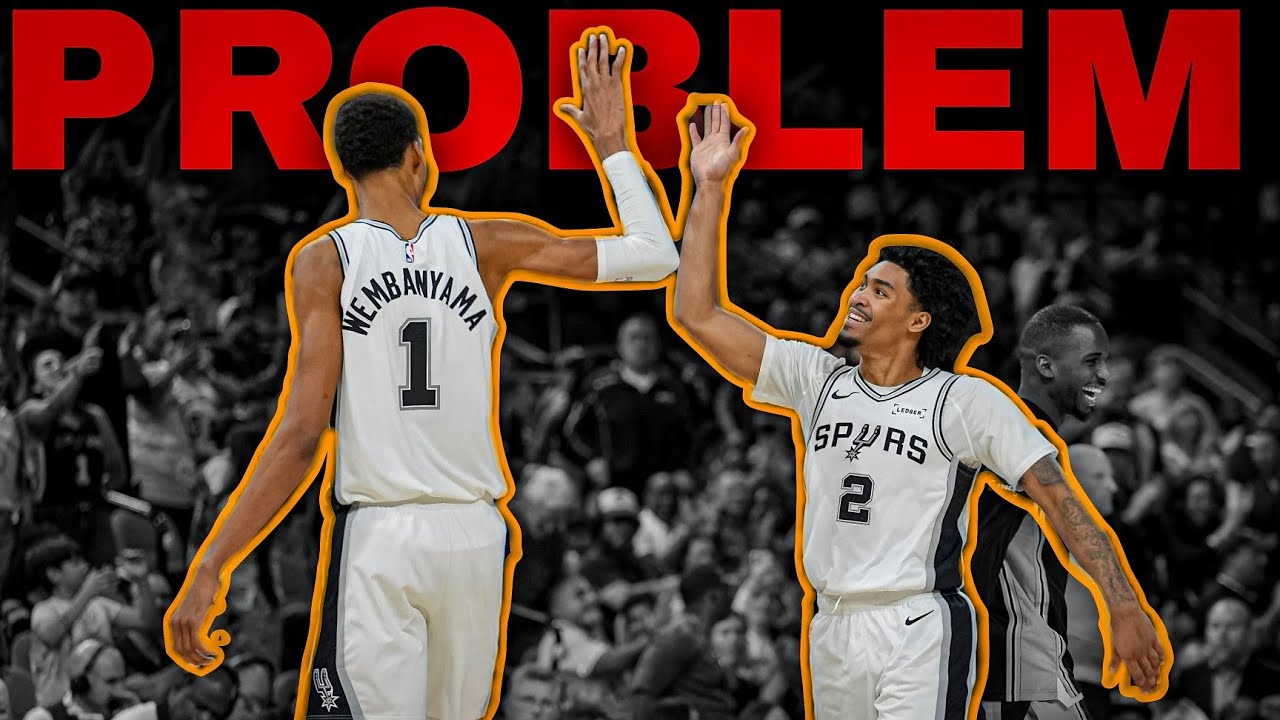
San Antonio Spurs Have A HUGE Victor Wembanyama And Dylan Harper PROBLEM…
The San Antonio Spurs have quietly assembled something that should send shock waves through every front office in the league. Dylan Harper averaged 14.4 points, 4.6 rebounds, and 4.6 assists over his first five games before a calf injury sidelined him. While Victor Webbyama is averaging 26.7 points, 13.7 rebounds, 3.2 assists, 1.3 steals, and a league leading 4.7 blocks per game. These numbers tell only part of the story about why this pairing represents a fundamental shift in how basketball can be played at the highest level. The synergy between these two players operates on a plane that most defensive coordinators have never had to consider. When Banyama praised Harper after their first game together, saying he looks ready, very comfortable, already throwing me passes. And the French stars assessment captures something crucial about their immediate chemistry. Over the 138 minutes Harper has been on the floor. The team is plus 20.8 points per 100 possessions of transition play, ranking in the 97th and 98th percentiles. This isn’t just good basketball. It’s basketball played at a velocity and efficiency that breaks traditional defensive schemes. What makes this duo particularly devastating is how they attack different dimensions of the game simultaneously. Harper’s ability to penetrate stems from an unusual combination of strength and craft rather than explosive speed. At Rutgers, Harper finished 67.5% of his shots at the rim with 47.4% of his attempts coming in the paint. He possesses what scouts describe as a herkyjerky handle where every move sets up the next, keeping defenders perpetually off balance. His craft in splitting pick and rolls and manipulating defenders makes him look more like an NBA veteran than a 19-year-old incoming rookie. This mature approach to getting downhill creates constant pressure that defenses must respect, which is precisely where Webyama becomes an unsolvable equation. The mathematical nightmare for opposing teams centers on a simple reality. You cannot help off Webyama. Webanyama is shooting 52.7% from the floor while leading the NBA in blocks by a massive margin with the second place Alex Sar at just 2.2 blocks per game. When Harper drives into the paint, defenders face an impossible choice. Commit to stopping the drive and Webama becomes a lob target that exists somewhere in the stratosphere. Harper admitted after his debut that he needs to throw passes higher, a lot higher when connecting with the 7 foot4 center, highlighting just how different the geometry becomes when your role man can catch passes at heights other players can’t reach. Stay home on Webanyama and Harper has proven he can finish through contact with a combination of footwork and body control that belies his age. Harper and Webyama combined for 51 of the Spurs 118 points in their home opener win against Brooklyn. In that game, Harper demonstrated the complete offensive package that makes him so dangerous alongside a player of Webanyama’s caliber. Harper had 20 points, eight assists, two steals, and zero turnovers, showcasing crafty finishing in transition and what some are already calling the best Euroep on the team. The zero turnover figure stands out because it speaks to Harper’s basketball IQ and his ability to make the right read even in chaotic situations. When defenses collapse on him, he finds Wimyama. When they stay home, he scores. This kind of decision-making at 19 years old, paired with a center who changes the entire calculus of rim protection and vertical spacing, creates problems that have no conventional solutions. The pick and roll between these two players represents something close to basketball’s theoretical apex. Harper averaged 1.18 points per possession as a pick and roll ball handler at Ruters, which would rank top five among current NBA starters. Now, imagine that efficiency amplified by playing alongside someone who can catch lobs at 12 feet and shoot over any closeout. Traditional pick and roll defense relies on having your big man either drop back to protect the rim or hedge aggressively to contain the ball handler. Against this pairing, dropping allows Harper to operate in space against a mismatched defender. While hedging leaves Webyama in a twoon-one situation where his length and mobility make him nearly impossible to prevent from scoring. Webanyama has averaged 21.3 points and 10.0 rebounds in 21.6 minutes per game in his last three preseason contests after recovering from the deep vein thrombosis that ended his previous season. The Frenchman’s health was the primary concern heading into this season, and his early performance has silenced those worries emphatically. More importantly, he’s demonstrating refinement in areas that were already elite. His block rate continues to defy logic, but the subtle improvements in his offensive game, particularly his footwork and his ability to make plays from the high post, suggest he’s nowhere near his ceiling. Harper’s family background adds another layer to why this partnership could become historic. His father, Ron Harper, won five NBA championships playing alongside Michael Jordan and Kobe Bryant, which means Dylan grew up understanding what elite basketball looks like at the highest level. This intangible quality shows in how he approaches the game with a calm that doesn’t match his age. Harper said after his debut, just being back out on the court with them guys, just getting the chemistry going before the season starts, it just felt good to play again. There’s no panic, no sense of being overwhelmed by the moment, just a workmanlike approach to building something special. The defensive side of this duo deserves equal attention because it’s where they could truly separate themselves from other young tandemss. Harper brings positional size at 6’4 1/2 in with a 6′ 10 1/2 in wingspan, giving him the tools to defend multiple positions. His steel rate of 1.4 per game at Ruters wasn’t overwhelming, but his defensive potential lies in his strength and processing speed. Meanwhile, Webyama’s defensive impact approaches absurdity. He’s already extended his streak of consecutive games with a block to 95. And his ability to protect the rim while also switching on to smaller players on the perimeter, creates defensive versatility that no other player in NBA history has offered. When you pair a guard who can pressure ball handlers with a center who can erase mistakes 30 ft from the basket, you’re building a defensive foundation that can anchor a championship contender. The context surrounding this duo makes their potential even more intriguing. The Spurs also feature De’arren Fox, who signed a four-year extension to lock himself in as Webyama’s running mate, and Stefon Castle, who won rookie of the year last season. This supporting cast means Harper and Webyama won’t face the burden of carrying the entire offensive load, allowing them to pick their spots and develop their chemistry without the pressure of having to win games single-handedly. Fox provides veteran playoff experience and another dynamic ball handler who can create advantages. While Castle offers two-way versatility that complements what Harper brings to the back court. What should terrify opposing teams most is the timeline. Harper is 19. Webyama just turned 21. The version we’re seeing right now, as impressive as it is, represents probably 60% of what they’ll become when they reach their primes. Harper’s shooting mechanics suggest he can develop into an above average three-point shooter with better shot selection and more space, which would add another layer to an offensive game already built on getting to the rim. Webyama is still figuring out how to use his body, how to leverage his strength more efficiently, and how to read defenses at NBA speed. The improvements both players will make over the next 3 to 5 years as they accumulate experience and continue developing chemistry could create something we’ve genuinely never seen before. The injury that has currently sidelined Harper actually reinforces the point about this duo’s long-term potential. Harper sustained a left calf strain in early November and is expected to miss multiple weeks. While frustrating in the short term, this setback won’t derail the bigger picture. The Spurs have positioned themselves to be patient to let these young players develop properly rather than rushing them back or forcing them into situations they’re not ready for. This organizational approach combined with the raw talent and complimentary skill sets of Harper and Webyama creates the foundation for sustained excellence. The historical parallels are hard to ignore. We’ve seen dynamic duos built around a dominant big man and a skilled guard. Stockton and Malone, Bryant and O’Neal, Curry and Durant in their brief but spectacular partnership. What makes Harper and Webyama different is the combination of youth, positional uniqueness, and two-way impact. Webyama isn’t just tall. He’s coordinated and skilled in ways that rewrite what we thought possible at that size. Harper isn’t just a good young guard. He’s someone who already processes the game at a level that usually takes years to develop. Put them together, add in the fact that they’re entering their partnership at ages when most players are still in college or barely entering the league, and you have the ingredients for something truly special. Advanced metrics support what the itest suggests. The Spurs added 6.4 points per 100 possessions overall through transition play with Harper on the floor. And this doesn’t even account for the halfcourt execution that will improve as their chemistry deepens. Models projecting their twoman game suggest they could generate plus 5.2 2 points per 100 possessions above league average by their third year together. These aren’t marginal improvements. They’re the kind of statistical edges that separate good teams from championship contenders. The spacing dynamic deserves deeper examination because it’s counterintuitive. Having Webyama on the floor should theoretically clog the paint and make it harder for a drive first guard like Harper to operate. Instead, the opposite happens. Defenses are so concerned about Webyama as a lob threat and as a shooter from the perimeter that they can’t pack the paint the way they would against a traditional big man.
The San Antonio Spurs are facing a huge Victor Wembanyama and Dylan Harper problem — but not in the way you’d think. These two young stars are so talented that the Spurs are struggling to balance their development and chemistry. Wembanyama’s dominance in the paint and Harper’s explosive scoring ability are creating a new identity for San Antonio that’s shaking up the entire league. The potential is scary, but managing this much star power could define the Spurs’ future. The NBA isn’t ready for what’s coming out of San Antonio.
Disclaimer:
This video is made for commentary, analysis, and educational purposes under fair use. All rights belong to their respective owners.
Title:
San Antonio Spurs Have A HUGE Victor Wembanyama And Dylan Harper Problem…
#VictorWembanyama #DylanHarper #SanAntonioSpurs #NBA #NBANews #NBAHighlights #Basketball #NBAToday #GreggPopovich #SpursNation
3 comments
I can hardly wait till Harper comes back. The Spurs are going to be a fun team to watch. Fox, Harper, and Castle can all run the point and they all bring different skills to the postion.
Y'all are sleeping on ROY Stephon Castle. The NBA has a Wemby and Castle problem.
We could have used harpers defense last night vs warriors. Castle did a solid job on curry buy nobody else did much guarding him. Harper would have done a better job, I'm sure.