
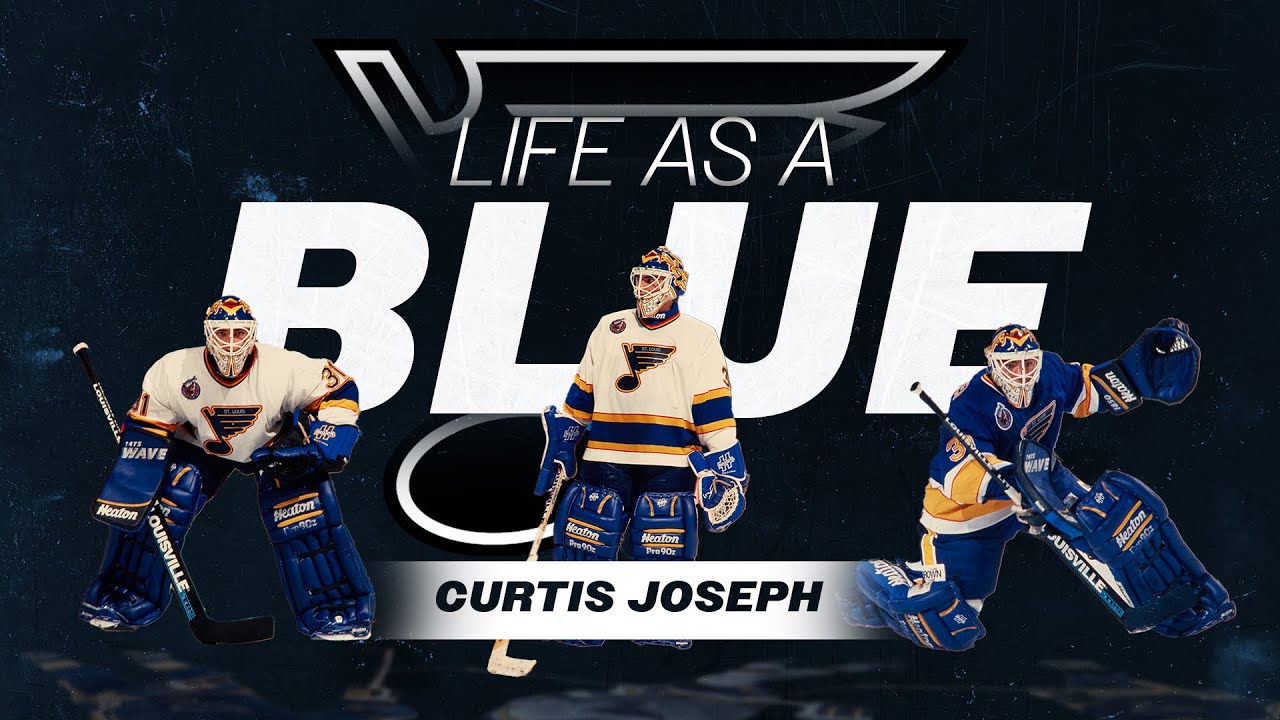
Life as a Blue: Curtis Joseph
the shot and crawled on the ice. Joseph makes the save. There’s the sire of Chicago making his second appearance tonight. Curtis Joseph [Applause] picks up his first of what I’m sure will be many National Hockey League victories. All right. Ready? I think we’re good. Starting from the beginning, you being undrafted goalie. How was that being undrafted? Was it Did you do you expect that or was it painful to watch? So, uh, being undrafted, I should have been undrafted. I wasn’t good enough yet. I played on a lot of teams that gave up a lot of shots. But my big break came when I played for two good teams when I was 20 or 19 and 20. Notre Dame Hounds, great team, made me look great as a goalie. Gave me a scholarship to Wisconsin. Great team in Wisconsin, great players, a lot of seniors. And there again, I was a rookie, but I was 21 years old and I looked great. So all of a sudden you’re undrafted. I was too old for the supplemental draft that they had back then to catch uh free agents. Talk about your freshman goalenders, but Joseph is is an older guy at about 21 years of age. He won the uh he was the reason that the team that he played on last year won the Centennial Cup, which is a tier 2 junior hockey championship in Canada. And he has done nothing to dispel those uh uh statistics from this year. He is an excellent goalender. Right now he’s rated number two in the league goalending wise. And we haven’t won. And then all of a sudden, like a month into the season in Wisconsin, the local writer comes to me and says, “Curtis, Bobby Clark’s going to be here tonight.” I go, “Oh, amazing. Who’s drafted uh by Philly? You know, who’s who’s he here to say?” He goes, and he was making a point. And he says, “No, he’s here to see you.” I say, “He’s here to see me.” I you know, he goes, “You’re a free agent and you’re too old for this supplemental draft. You’re creating a buzz and there’s a lot of scouts here.” I was like, “Wow, I was so happy to be at college and I had four years to play and that’s what I was thinking about. That was my dream was to make it to college.” And uh then all of a sudden that changed like you may have a I was never thinking about the NHL. Undersized guy, dislocating shoulder, uh just not a prospect. And uh and then all of a sudden all these teams became interested and St. Louis was one of them. How did the process go for St. Louis to be the one to sign you? So, at there was probably seven or eight teams interested in me and and I had never thought about making the NHL. I thought that was such a far-fetched dream, but uh the teams that came down to were St. Louis, Edmonton, uh New York Islanders, and Hartford Whalers. And I went on recruiting trips to all these places. When I went to Hartford, I met Gordy How. you know, he worked in the office. Um, I met Bill Tory from the Islanders, uh, Glenn Sther from Edmonton, and when I came here on a recruiting trip, uh, Brian Sutter picked me up in a limousine at the airport, and I was like, “Wow, this is different.” And Brian was such a a guy’s guy and very uh like your friend. I went to his house, met his wife and his kids. I was like, “Wow.” Cuz I had a difficult childhood also. So when somebody reaches out like that, it really had an effect on me and immediately I’m signing here. And Ron Kuran, God bless Ron Kuran, an amazing human being. He was instrumental. Him and Donnie Mian, uh, made a deal and the rest is history. I signed with the Blues and so happy to sign with the Blues. 22 years old, little veteran team and Holly was running the show. How did they treat you? I was never a prospect or I didn’t know anybody. Also, usually when you play junior or you play world junior, you know, guys in the NHL. I didn’t know anybody. So, I’m coming in blind. I don’t know a soul except for Rod Brymore. Um, and I come in and I didn’t play with anybody at any time, but Brett Hall is bigger than life. Are are you a tough guy? Are you also a bruiser and I’m a longer do you fight at all? Paul in right wing a shot. He scores. Brett Hall and it’s 32 Blues. Brett is Bobby Hall’s son and Bobby’s always around and Brett’s hockey royalty and he’s scoring 72 goals. He’s crushing it. So for me, I was quiet by nature at that time and I was even quieter because I took it all in. I I watched Adam Oats. I watched Brett Hall. I watch how they handle things, how they’re confident. Gino Cavalini. These guys rire of confidence and I took that into my own game and said I need to be more like these men. These are real men and I was just a I was a baby at the time and uh they taught me a lot about being a professional. I was wearing a Wisconsin tracksuit to practice every day and Gino pulled me aside and Gino says, “Curtis, see how I’m dressed? Nice jeans, nice sweater. You’re a professional now. don’t wear a Wisconsin tracksuit every day to practice. I was like, “Okay.” And from that day on, I never wore that tracksuit again. And I dressed nicely. And it was the best advice somebody could have given me. I was a professional. I think that first year, was it was it that the year Vinnie, Jabber, Milsy were all here? Yeah. How How were they towards you? Yeah. So, uh, Greg Melon’s a veteran uh when I got here. Uh, Vincent Rando’s another veteran. Uh, Patch Jablonsky. Ghee Bear actually who became a great goalie in the NHL actually. So I hurt my knee first training camp uh MCL so I needed a time in the minors and in the M in Poria was myself, Pat Jabonssky and Gui Bear all NHL goalies eventually and it was great. They were great guys. We were all young together and I remember that fondly. And of course you had Kelly Chase, Tony Twist. We’re all the same age and what a crew and they all we all played in the NHL. So, it was great. But, uh, Greg Mill was the veteran. You could tell he was the, you know, the incumbent and he was not going to let go, you know, you’re not going to let go of your job. Vinnie was a sweetheart. He became my friend. Um, but I really had a time wrestling with I was very driven and I wanted to play all the games and I wanted to be the guy because growing up I played in small towns and I was the guy uh at such a low level. But Vinnie was like, “Hey, Curtis, can you pick me up?” Marie Jose, you know, has to do something. And I was like, and for me it was like, I’m gonna be friends with this guy, but I’m gonna take his job. You know, that was hard. And Vinnie was such a sweetheart. So, I had to wrestle with that internally, how to be friends and also how to be a great player. That’s part of being a professional. So, Vinnie taught me a lot that you could be both. You could be a friend, but still play great. And uh that was something I remember fondly of of uh how am I going to be a pro and take his job essentially but still be his friend, you know. Remember your first NHL game? Oh, I remember my first NHL game. It was against Edmonton and it was a failure. All right, John Kelly, nice big crowd to begin the new year in the new decade. And Mahar and Messier, the two captains are ready to go. and Brown on defense in front of Joseph in the goal to our left. And and I remember not being able to sleep during the afternoon. And I was so wound up and so I remember scraping the crease like goalies do and I was like, “Oh, my legs are so heavy.” Like I had worn myself out mentally before the game and I was it was the worst possible game I could play. I was unprepared mentally to be able to handle that. Uh but I learned from it. Here’s Bukaboo. Fires one. He scores. Bukaboo from the right point. It was tipped in and post now. Messier in front. A pass. They score. Yari Curry in front. And with 5 seconds left in the period, the Oilers lead by two again. Two seconds to go. This one is over and the Edmonton Oilers win both games here at the arena this season. I mean, they’re scooping the the puck out of the net. Yuri Curry scored some milestone goal. It’s as a goalie when they’re scooping the puck out and keeping it and taping it up, you’re like, it’s not a good night. And I got throttled by Edmonton. Was it at home here, too? So, the best thing that could have happened, we went on the road and uh and I think it was the Islanders and I was good. And that was I remember the headline. Trying to recall I think it said Broadway Joe, which was a great headline. Whoever wrote that, whoever the editor was for the Post Dispatch, it was good. Anyway, it was premature, but I played two games. My first game wasn’t so good. The next two were real good. on the road here at the Nassau Coliseum and they come out to congratulate 22year-old goalie Curtis Joseph who in his second NHL appearance picks up his first of what I’m sure will be many National Hockey League victories. So that 89 year I mean Hull scoring 72 goals, Adamos 100 points. I mean what what you had to be in all watching these guys. Oh yeah. No, I had a front row seat to watch the the greatest score scorer that I ever saw. Brett was ahead of his time and he was scoring everything that he shot and he was loving life and he was larger than life and I was trying to get my footing in. I wanted to be a big part of what was happening here. Um, you know, we had great guys. Uh, Nelson Emerson probably at the time, Jeff Brown were friends and great great humans and I was just soaking it all in. But I was so, you know, when you get older and you’re a little more veteran, you see everything. Everything was such a whirlwind at that time. But I was a good athlete and and got better and better because I was on the ice every day. And uh being on the ice every day with that kind of talent, you want to get better and you want to be a part of it. And uh I wanted to be a star like Brett and uh cuz that looked good to me. And uh so I I worked hard at it and uh got better and better. So Holly was in his run of 72, 86, 70 goals. You had to look at that as a challenge in practice like I’m going to stop the greatest goal scorer right now in the league. It’s true. And most goals can tell you, but I know from my point, you take so many shots in practice, but the great players you actually get a little more ready for. Um, no offense to the other players, but when the great players came down, you wanted to stop them every time. That’s just how practice goes. You know who’s coming down and you know who’s shooting. And the thing about Brett is he was so accurate that he was never going to hit you in the face. Like guys would come down and they would take a a slapshot and you didn’t know if it was going to hit you high or hurt you. Brett never hit you in a vulnerable area because it was always on the corner, always off the post and in. So I tried. There wasn’t in all the years I played with Brett, there probably wasn’t one shot in practice that I took an ounce off. It was 100% trying to stop Brett Hall on every shot, every practice, every day for six years. That’s how I handled Brett in my mind. 1990 playoffs. Yeah. How was that? So, you know, I I had got some uh taste of playoffs. Uh but that was really my uh coming out as a player was uh was the 93 playoffs. It was uh we we played Chicago first round. I became the starter and Chicago was one of the Cup favorites and we beat Chicago four straight Blues fans. Um they loved it because it’s our big rivalry. You you could have thought we won the Stanley Cup. So it was great after we played Chicago and beat them out four straight and they had great players. Chelios, Belffor, Ronic, all Hall of Famers. 957 save percentage, two shutouts, series sweep. Yeah, that had to be that had to be pretty feel good. It felt amazing. And it felt amazing because my teammates would give me uh the response that I was craving. And the response that I was craving is great job, way to be there for us. And you can ask any player and for me in particular, I need to be needed. So when those guys would come back to me and go great job, I felt a sense of team. I felt a sense of family, which I hadn’t had in my entire life. So that experience probably that series gave me all of that. in like a twoe period. Everything that I needed in a life and it was it was great. Uh we played Toronto in Toronto. Um I think we started in Toronto and it was the first time that Toronto had a great team and they had been dying for a great team. So the buildup of their hockey team and their fan base was at an all-time high. You had Doug Gilmore, Wendell Clark, Dave Anderchuk, Felix the Cat. So they were the media was intense. You go into Toronto and it was another world and I’m from there and people are coming from high school and I see them and it but I was very focused and that was my coming out party probably that that that uh that series and uh played played extremely well and from there on you know I was a bonafide number one goalie and that was the back-to-back double overtime games between you and Felix. Yes. And the shot clocks are right above the net. So shot clocks are like at the end of the game they’re 7050 or whatever and you can see them. And so and it’s hot. There’s nowhere. It’s an old building. There’s no air conditioning and you are losing weight just standing there. I probably would lose 10 to 12 pounds each game. And if I had one regret, it was hydration. And if I could have hydrated a lot better, even uh I I don’t know if they had IVs back then, I would have been a lot we may have won the series, but I was so dehydrated by the end of the seven game series. Uh I wasn’t the same as when I started. And that’s you chuck that up to experience. Uh that told me I needed to hydrate, you know, every series after that. So I got better at that. But that was one of the one of the highlights of my lifetime and one of the highlights of my career. No question. So Curtis, you had your blue helmet when you first came here with the cage and then you went into the trumpet mask. How did that all that start? Who came up with that? So Greg Harrison was the big mask maker at the time and he was a guy who you could not get a mask from and it would take you three months to get a mask and I think I waited for that one for a long time. It was he’s the artist. the mask. Um, I have a buddy who’s the drummer for the Bare Naked Ladies, Tyler Stewart, and that’s his favorite mask. And every time I see him, he goes, “Hey, that mask, I love it with the trumpets and the notes. He’s a musician. It’s amazing.” And I go, “Yeah, it was good to me. It was great.” And uh, and then it transformed into the Kujo mask, which you carried your entire career. Yeah. And that’s one of my favorite masks. It looks It was one of the best looking masks that I have, and I have a lot of memories in it. So, Robert Dirk, uh, nicknamed me Kujo. Uh, Cu Jo first and last name. And of course, it stuck. Easy to say. Uh, kids loved it. It became my my handle. And then I made a mask. I remember with the artist, they would fax me over drawings, renderings of the mask. I’m like, “Oh, that’s amazing. You’re the artist. That’s great. Can we change this or this or put my name here or put my kids initials on the back?” Yes, let’s do it. And then it became very iconic. So, um, but in order for your mask to be one of the greats, you have to play up to that ability to, uh, so I kept it simple, too, so you could see it. It’s not too detailed. And, uh, I I feel like each mask represents me and who I was on the ice. A fierce competitor. And when I got off, I was hopefully a a good husband, a good father, and a nice guy to the fans. But when I stepped on the ice, that’s who I was. One thing I’ve kept as souvenirs, I’ve given away a lot of equipment, but I’ve kept all my masks. And to me, that’s what protected me. That’s what I look through. Uh that gave me courage obviously to stop shots. Um and they’re memories for me. Each one represents a different time in my life and different memory. I can look inside. I can still see missing hair, you know, sweat, blood, and my wife Stephanie saw all these old masks. She goes, “We need to put those up on a display.” I’m like, “Ah, you know, where are we going to put it?” “Right in the front room.” I’m like, “Really? We have this cool mask display in our house and it looks amazing and every time I walk by it, it gives me a little history lesson and a memory of what was accomplished in the past. So kudos to Stephanie. She made a she made a tremendous wall. Looks very classy. Also resigned Shanny as a free agent from New Jersey. So, the Scott Stevens Brendan Shanahan deal is a very interesting one because we had Scott Stevens, which I’m happy about. He’s great defensively. He’s going to make my job so much easier. And he was great. And Scotty was a great team leader and a warrior. And so, we signed Ron Kuran, very progressive. You got to give him credit for always trying. He signs Brendan Shanahan, a restricted free agent, to an offer sheet. The league, no. No, we don’t want teams doing that. They So, the team is offering myself, they have to make the package attractive young players, Rod Brenmore, myself as compensation to go New Jersey for Brennan Shanahan. And the and New Jersey says, “Hey, we have a goalie in the making, Marty Berd. We want Scott Stevens.” Guess what happened? The league sends a message to the rest of the league. don’t put offer sheets out there on restricted free agents. And it was one of the biggest uh everybody knew about it. Scott Stevens goes the other way. Brennan Shanahan comes this way. Brennan Shanahan turns out to be a great star. Um and definitely not a mistake. I still see Brennan Shanahan in Toronto. And our joke every time I see him, I go, “Shanny, did we ever get ripped off from that deal in St. Louis? We lost Scott Stevens. He looks at me straight in the eye. He goes, “We just didn’t offer enough [Music] me and Rod Bindar.” It turned out what a what a package. But his line back to me is great. I know you’ve talked about this a million times now, Curtis, but it really is probably the three most famous words in blues history is here comes Chev. Here comes Chevlet. Yeah, chaser, man. Great friend, but he started all that melee. But you can tell when you know a game uh there’s payback. This game leading up Blues, Red Wings, you knew there was going to be a few fights. There was a few paybacks from previous games and it started early in the game. Chaser started a fight and then Probert was out there. You can all you can tell who’s out there, what’s going to happen and it became a brawl and it escalated quickly and I remember sitting down the other end and watching this whole melee happen and then all of a sudden Tim Shovel Tim Shovel comes flying out from his end to center ice and now it’s an outnumbered situation. You have no choice but to go and take your man. So I skated quickly. Here comes Shovel Day. He’ll be thrown out of the game. Shovel Day. Now Joseph gets into it. Curtis Joseph grabs Chevel Day. And the two goalies go at it headto head. And Joseph with three great rights to Chevel Day. And we’ve got some terrific fights going on. and Cumins came out of the penalty box as well. There are sticks and gloves everywhere. The two goalies having a great fight at center ice for those of you watching. I’d only been in one other fight previous to that and it was in a baseball game when I was 18 and I got punched in the face hard a couple times. I led with my face, didn’t have my hands up and uh got embarrassed pretty pretty good. So my mindset after that fight in baseball was never let a guy get in your space and if he does start throwing punches as fast as you can and so that was my mentality and that’s what I did and it was very successful. Maybe a few other fights after that which I was the always the aggressor because I never wanted to lose a fight or lose a game. So that was my mentality and uh I got lucky enough to hit him with a couple early and I think it maybe threw him off a little bit and Tim Shovel is a wonderful guy and I seen him afterwards and I saw him afterwards and great guy but uh you win some and you lose some. Fortunately I won that that that tilt and uh Vincent Rando was his roommate at the time because Vinnie had been traded to Detroit and he called me in the morning. He goes, “Curtis Chevy can’t see out of his eye.” He’s in the bathroom. And Vinnie was such a great dude. I love Vinnie. But um yeah, I remember that fondly. And uh got a lot of uh notoriety from that. And and uh fights were part of the game back then. They’re part of the game, part of the fabric of what we did. And uh that was one of my most memorable moments uh that I remember of my career. Okay. So Mike Keenan. Yeah. Mike came to us uh and wielded a lot of power. He was the GM and coach and had just won a Stanley Cup. I mean, it doesn’t get any more uh powerful than that, but and Mike at that time um and he may tell you this that he was a bit over the top with his decisions. Uh I felt he was at the time the way he treated some players. He obviously had success in the past. He was a great motivator, but that’s how he got players to win was to motivate. And I didn’t agree with his tactics. And I wasn’t a player that could play angry. I wanted to play happy and confident. And those were my two things. So me and Mike, I had to, it was a big adjustment period for me to a coach who was trying to get the most out of you with with firing you up or being angry. And that’s not what I needed to be happy and confident. I didn’t need to be angry. I need to be thinking about stopping the puck. So, I didn’t play that well that year. And and so me and Mike really didn’t hit it off. And then I got traded. I got traded that summer, which was a kick in the gut for me because I was a St. Louis Blue. This is my team, my first love. It’s like your first love. And um yeah, it it didn’t end well for me uh with Mike. And I always tell my sons and whoever’s close to me that if I never got traded or Mike never got the job here, I probably would have been a blue. The way my career went, I probably would have been a blue for life 20 years. So, ironically, in the game of hockey, he ends your career in St. Louis and you end your career with him at 41 years old in Calgary. irony, as irony would have it. I’m re semi-retired, taking the kids to school, don’t want to be retired. Uh friend of mine in the game said, “Curtis, go play in the Spangler Cup and if you play well, you can be back in the NHL.” I’m like, “Oh, okay.” And I was out of shape. I think I played one game and I was like, “Oh my gosh.” and the altitude and the rink was at the top of a mountain in Davos, Switzerland. Beautiful, but you’re sucking air. It took me probably two games to actually feel okay. Got stronger. We split the games and I got better anyway. We ended up winning the tournament, playing a Russian team. I played really well. Had like seven offers to come back to the NHL at that point. came down to San Jose. Doug Wilson and Calgary, Mike Keenan. Mike Keenan picks up the phone. He goes, “Curtis, Mike Keenan here.” I go, “Hey, Mike.” Hadn’t spoken to him in 20 years. And he goes, “I’m not the same coach I used to be. I know you remember me in St. Louis. I’m a different guy. I coach differently. I’ve learned a lot of things along.” He was so open and so convincing about who he was now as opposed to before. I was like, I’ll sign with you. I He won me over like that. And when I got there and the way he coached was totally different. He was great. He held guys accountable. He sat in stalls beside guys. Said, “How are you going to be different? How you going to make a difference?” I really loved his approach and we had a great team. We didn’t win the cup, made the playoffs were great. I backed up Kippers off and um Mike was great. And finally, you go into the Blues Hall of Fame. Two of your kids were born in St. Louis. How great was it to have your entire family back and see what you meant to the city? You know, Mike, we were talking about this earlier. You can go to a great one of the greatest movies of all time and if you go by yourself, it’s great. It’s a great movie, but there’s nobody to share it with. It’s not the same. So, for me to come here and have such a great honor as being in the Blues Hall of Fame with my kids that watched every second of every game. They were all in all the time. and my best friends, my ride or die friends take the time out of their schedule to fly in here from all over the US and Canada and share that with them. Last night, two tables, I looked over at my friends table, looked at my family and my kids, my wife, and everybody was smiling and so happy. We have that memory together. And so I was so I was nervous at all. I get up on stage and I’m like, yeah, this is for my family and I get to share with the people that are closest to me for the rest of my life. And that’s how I looked at it and it was I’m very thankful and very grateful and what a great honor.
Blue Note Productions presents Life as a Blue: Curtis Joseph
After going undrafted through his freshman year at the University of Wisconsin, Curtis Joseph was signed to an entry-level free agent contract by the Blues and quickly rose to prominence on the NHL goaltending scene.
Joseph sat down with our crew to discuss the iconic masks and moments that shaped his career in St. Louis and beyond — from “here comes Cheveldae” to the 1995 trade that moved him to Edmonton, and all the behind-the-scenes moments and untold stories in between.
All available episodes of Life as a Blue can be found here ➡️ https://stlblues.me/4eOylfN
Subscribe to our channel and turn on notifications to be the first to know when new episodes are available.
22 comments
Cujo
Best video the Blues have put out . Even fans hated Mike Keenan.
CuJo is the reason I became a hockey and Blues fan at the age of 7. The saying is "never meet your heroes", but I got the chance to meet Curtis Joseph the night of his induction to the STL Sports Hall of Fame (10 years ago or so). I got to share a beer with him and just talk one on one for 10 minutes or so. It was an incredible conversation I'll cherish for the rest of my life. Incredible goaltender – better person.
All due respect to Binner, Mike Liut, Grant Fuhr, Glenn Hall, and all the rest, Cujo is my all time favorite.
I had the pleasure of meeting CuJo when I worked at the Galleria. Just a great dude. Seemed humble and happy. I saw most of that Toronto Series at the old barn too. What a run!!!
Such a great goalie, but such a regular guy. Nice as he was great.
The old barn on Oakland was electric back then, I will always cherish the memories of bleeding blue there.
Had a signed puck from Cujo, catching him after a practice at the old Brentwood rink. Signature silk jacket he frequently wore. Sadly, that was lost to time, but super guy.
Dude I need to see a Tony Twist one next!
I remember meeting Cujo, his wife and his first child was in a stroller after the open house of the now Enterprise Center afterwards, he and his wife were so nice and we’re proud that he is part of the Blues family. 💙
More of this content while the Blues suck right now 🙏🏻
I love the Life as a Blue series 💙
Growing up in St. Louis, I remember watching Cujo on the TV. I always wanted to be a goalie because of him. It took me a little longer to talk my parents into letting me transition from skater to goalie, but once I did, it was hard not to imagine myself as Cujo in the Blues net. Later, while playing Juniors in Canada, I got to billet with his neighbor. Never did get to meet him, sadly, but maybe someday I will. What a great career and even greater person. Cujo, you're an inspiration to many. I wouldn't be the goalie I am today without that inspiration. And a big kudos to the Blues and Blue Note Productions for such a well done documentary. Can't wait to see even more of them!
love that the clip of Twist you show is him fighting Berube! bravo
Absolute legend! I grew up in St. Louis watching Cujo, that was an incredible time to be a Blues fan. I always loved his playing, but this interview reveals a lot about who he is, what an amazing person!
Cujo did a poster signing at Schnucks at 8:00 at night on a Tuesday. My parents got me and my brother out of bed and took us over to stand in line to meet Curtis Joseph. He was my favorite player then and he still is today. Thanks, Cujo.
Love you Cujo. You are the reason I became a goalie. What a great time to have St. Louis as a hometown, be a Blues fan, a hockey player.
What an amazing man! Cujo was a great player in a great era for the Blues. If not for Keenan and Quinn who knows what the Blues could have accomplished?
Theres been a few times when I was pissed off enough at this team to quite them. When they traded Joseph was one of them. Liut was another
What an absolute legend!
On couple questions, the producer says, "I think." Those of the words of someone who does not know. That means the producer either did not take the time to do research or take notes. That's not the action of a professional.
Producer, through his awkward statements, implies that CuJo ended his career as member of Calgary Flames playing a game in STL. Not even remotely close to the facts.