
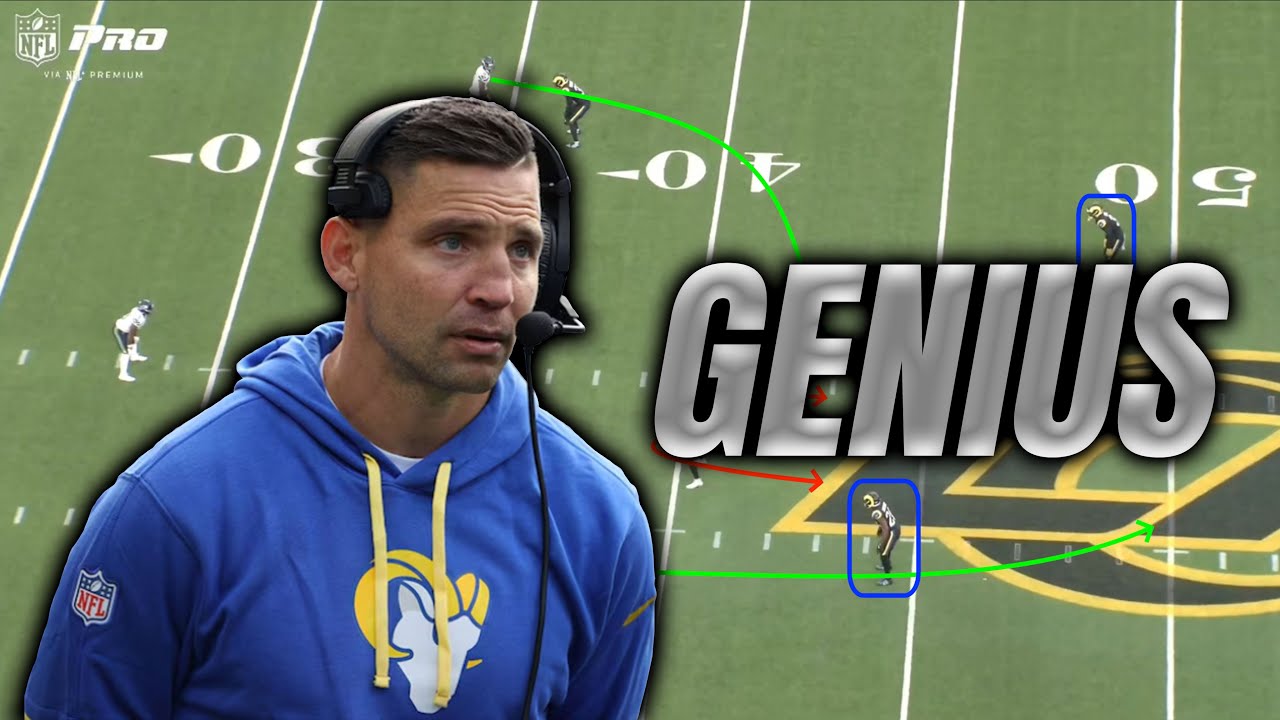
How Chris Shula made the Rams defense cool again
Back in 2021, the LA Rams went allin on their Super Bowl window by trading two first round picks for Matthew Stafford, then a second and third round pick for Von Miller after sending Jacksonville two firsts for Jaylen Ramsay two years earlier. The aggressiveness paid off in the form of a Super Bowl win. But these moves were expected to set the Rams back in the years that followed. Four years later, with Jaylen Ramsay, Von Miller, and Aaron Donald all gone, LA again looks like the best team in football. Thanks in part to their exceptional defense. Through 11 games, the Rams ranked second leaguewide in points allowed per game, third in EPA allowed per play, and seventh in yards allowed per play. They’ve assembled a defense almost as good as the 2021 championship unit, and have done so without the valuable draft capital that they sent away in pursuit of Ramsay, Stafford, and Miller. Sustaining success in this league requires a front office to hit on draft picks. Homegrown talent is almost a necessity in assembling a championship team because there’s so much value in good players on rookie deals. Drafting well relative to the rest of the league as a playoff team is difficult, period. Doing so without an annual firstround pick seems impossible, but that’s what the Rams have done to assemble another awesome defense. With only one first round pick in the last eight drafts, LA has stacked almost exclusively homegrown talent. Take a look at the starting unit they trotted out on Sunday against Seattle. On the defensive line, they have Jared Verse, LA’s only first round pick since 2017, and Braden Fisk, a 2024 second rounder, along with Kobe Turner and Byron Young, both 2023 third rounders. At linebacker, it’s Nate Landman, a 2025 free agency edition, and Omar Spates, a 2024 undrafted free agent. In the secondary, there are free agency acquisitions Emanuel Forbes and Cam Curl with 2022 fourthrounder Kobe Durant, 2024 thirdrounder Cameron Kitchens, and 2022 sixthrounder Quinton Lake. I would argue that all but one of the players I just named are at the very least above average performers at their positions. And that distinction extends beyond just the starting lineup. Not only is this defense free of liabilities, they’ve got real difference makers like Puna Ford, Tyler Davis, and Jaylen McCulla, who aren’t usually in the starting lineup. In 2021, this unit was defined by their future Hall of Famers. In 2025, without the means to acquire Hall of Fame talent, the Rams are defined by their depth. Hitting on draft picks is necessary for sustained success in the NFL, but not sufficient. It needs to be accompanied by good coaching, and Rams defensive coordinator Chris Schula’s development of a scheme that best fits his players is an equally important ingredient in the success of this Rams defense. Sunday afternoon’s game against Seattle was an awesome display of how Shoula’s scheme is tailored to fit his roster. But before I explain why LA’s defense was so effective on Sunday, let me first give you a quick summary of how Shoula’s defense is structured schematically. Defensive personnel packages are typically broken down into three categories, which are base, meaning four defensive backs, nickel, meaning five defensive backs, and dime meaning six defensive backs. The Rams have an almost even distribution of the rates at which they deploy base, nickel, and dime personnel, which is unique. They deploy base at a slightly below league average rate of 24%. They deploy nickel at a way below average rate of 42%. and they lead the league in dime usage by seven percentage points. LA’s deployment of these distinct packages is guided by both the offensive personnel and by the situation. The current offensive trend in pro football is the use of heavy personnel packages to force defenses out of their comfort zones. Shawn McVey has embraced it himself with an astronomical use of three tight end sets, which is a very interesting conversation for another day. But another proponent of this strategy is Seahawks offensive coordinator Clint Kubak. I talked about Kubak’s offense on the channel a couple weeks ago. So if you’re interested in a deeper dive into how Seattle creates explosive plays at an incredibly high rate, check that video out at the link in the description. But if Kubak’s scheme had to be reduced to one sentence, it would be a runheavy call sheet out of primarily heavy sets that force defenses into base personnel looks that are susceptible to explosive gains through the air. Now, there are a few ways to approach schemes like this defensively. Some play callers like to live in nickel so that even when offenses go heavy, the defense still has the speed and agility to play the pass with a light, agile fifth defensive back. The problem with this approach is it requires a hybrid nickel defender who can play the run like a heavier linebacker. Seattle, for example, deploys nickel personnel at the highest rate in the league because they can rely on Nick Emmanary, a defensive back to hold his own against the run. Baltimore can do it because they have Kyle Hamilton. Philly can do it with Cooper Deene, Houston with Jaylen Petri, etc. LA doesn’t have a hybrid nickel. So, they do tend to go heavy with base personnel when the offense puts an extra tight end or back on the field. In Sunday’s game against Seattle, LA deployed base on 26 of their 79 defensive snaps. When the offense went with a heavy personnel package, LA tended to match with a heavy package of their own, which was very effective against the run. Seattle ran the ball against base looks 18 times in this game and averaged just 2.9 yards per carry on such runs. Take a look at this play from early in the second quarter. Seattle deploys 12 personnel, meaning one running back, two tight ends, and two receivers on the field. And LA gets into base with five on the defensive line, two linebackers, and four defensive backs. Seattle calls a wide zone run to the left, which goes for a gain of just one yard. Despite the fact that LA was in base here, the look still favored run for the offense because the Rams had two safeties deep, which made them out gapped up front. Typically, when a defense is focused on stopping the run from heavy sets with multiple tight ends or backs, they’ll not only get into base, but also bring one of the safeties down into the box. LA didn’t do that much in this game. They deployed base, but also sat in two high safety shells. So that way they were able to defend the run without making themselves susceptible to explosive gains off of play action. Kubak tried to exploit these light boxes with the run, but LA’s front seven just outexecuted Seattle’s offensive line on those run calls. And because he couldn’t get LA out of these light boxes with the run, Kubak’s play action attack that makes his offense efficient was virtually non-existent. On this play from early in the fourth quarter, Seattle brings out 21 personnel with two backs, one tight end, and two receivers, which LA matches with base personnel, but they keep the box light with a two high safety shell. Two high shells are much better against deep shot play action concepts than one high shells because they allow the safeties to cover from depth and they allow for more diversity in coverage calls. From a base personnel one high shell, a defense is limited to cover three and cover one. From a two-h high shell, a defense can not only call a variety of three deep designs, but also two deep designs like Tampa 2 or cover two invert and match designs like quarters and quarter quarter half. Here, Seattle calls their bread and butter, a Yankee concept off of hard play action, which calls for a deep post route from the number one at the bottom and an over route from the number one up top. Usually second level defenders would have to work back to cover JSN’s over route after being pulled closer to the line of scrimmage by the playaction fake. But because the strong side safety is already 10 yardds deep, he can undercut the over route from depth. The weak side safety also has enough depth to bracket the deep post coming from Rasheed Shahed on the strong side. So Sam Darnold has no choice but to check this ball down. Ellie’s defensive personnel tendencies are guided not only by offensive personnel but also by the situation. When the situation favors a pass, the Rams won’t put base personnel on the field, even when the offense goes heavy. Here, for example, late in the third quarter of Sunday’s game, Seattle is facing first and 20 after a holding penalty on the previous snap. So, despite the fact that the Seahawks came out in heavy 12 personnel, the Rams stayave light with nickel personnel because Seattle is much more likely to pass than run on first and 20. According to Sumer Sports, there have been 115 first and 20 situations so far this year leaguewide, and teams have passed on 71% of those first and 20 situations. Unless you have an extraordinarily efficient run game, which the Seahawks do not have, it’s almost necessary to pass on first and 20 in order to stay ahead of the sticks. Despite the heavy package and a too high shelf from the defense, Seattle predictably calls a pass play. The concept calls for verticals on the front side and on the backside, a seam route from the number two and an out route from the number one. Postnap, Sam Darnold sees the front side safety bail into the deep half, which makes him think he can target the seam route from the tight end. But because that safety was able to watch this concept develop from depth, he was there to jump on the seam route when Darnold tried to fire it by the linebacker, carrying the tight end’s vertical. LA’s effectiveness from base and nickel packages on early downs force Seattle into third and longs all night. And those situations are where Schula’s creativity really shows up. So far this season on third and three or more, the Rams defense deploys dime at a rate of over 70%. That is unorthodox to say the least. There are more teams who deploy no dime at all than teams who deploy dime over 50% of the time on third downs. And those dime packages get so much speed on the field, which allows for exotic coverage rotations that confuse quarterbacks without sacrificing the threat that LA’s defensive line offers in the pass rush. On this play from the first quarter, Seattle faces third and eight, and LA deploys dime personnel with six defensive backs, one linebacker, and four defensive linemen. There is so much to this call, so bear with me because it’s going to take a minute to get through all of these layers. The first thing I want you to notice is the alignment of the defensive linemen. The right side of the offensive formation is overloaded with three defensive linemen and only one lined up to the left. So Darnold has to slide his protection to the right in order to prepare for a possible blitz from the linebacker. That’s what Darnold is communicating to his protectors when he walks up toward the line of scrimmage pre- snap. But one of those three defensive linemen on the overloaded side, Byron Young, is dropping into coverage. And the rush is coming from the nickel Quinton Lake. This is known as a simulated pressure. It’s not actually a blitz because the defense only sends four rushers at the quarterback, but it simulates a blitz look to the offensive line because an offball defender will rush the passer. Seattle is somewhat prepared for the pressure because the tight end’s assignment tells him to check in protection before crossing the line of scrimmage. So Lake doesn’t come in free, but he isn’t accounted for by the offensive line, which forces Darnold to rush his process. He has no time to decipher this coverage call on the back end, which is significant because this rotation is chaotic to say the least. It’s a three deep coverage, but LA gets to the three deep look in a ridiculous way. They send the post safety to the curl area by the sideline and the weak side apex defender to the post. Darnold had the right idea here to target Cooper Cup down the strong side seam, but Cup had to get around the post safety rotating down to the curl and Darnold had to rush his process, which leads to an inaccurate ball in a window tighter than it would have been against a vanilla cover three. Look, Schula can do things like this because he deploys dime. Linebackers aren’t agile enough to make such exotic rotations work without compromising the integrity of the coverage. With extra defensive backs on the field, the Rams can throw crazy looks at quarterbacks, which quarterbacks then have to decipher before the Rams lethal pass rush gets home. There was a play early in the third quarter where the Rams came out in dime and made a regular quarters call, but Darnold couldn’t even work through the concept because Byron Young came flying in as the looper on an ET stunt. This year, LA ranks 27th in blitz rate, but 13th in pressure rate because these guys up front can win one-on-one and execute stunts with perfect timing. Now, I do think that this defense has a ceiling. They’re not what they were in 2021 because they don’t have any Hall of Fame talents, let alone three of them all in their prime. Seattle has a much more talented receiver room than most of the teams LA will play down the stretch. But the Rams dime package did get beat up at the end of this game when Seattle was in their two-minute offense. If Jason Myers makes the 60-yard field goal at the end of the game, the narrative surrounding these two teams are completely different. There might be a couple defenses better than the Rams, but this unit combined with Matt Stafford’s level of play in the latest evolution of Shawn McVeyy’s offense makes this Rams team the best in football right now. We’ve got a long way to go, but Stafford is playing the best ball of his career, and the front office has surrounded him with the second best supporting cast he’s ever had. And they did it with only one first round pick. A masterclass in team building and coaching that could very well get Stafford and this Rams staff a second ring. Thank you guys so much for watching this week’s video. If you enjoyed, please hit that subscribe button to help us reach 60,000 by the end of the season. It’s free and it’s the best thing that you can do to help me continue making these videos. But that’s all I’ve got for today. So until next time, take care. [Music]
Patreon – https://www.patreon.com/billystephens
Twitter: @BillyStephens__
Tik Tok: https://vm.tiktok.com/TTPd6h6YcA/
Today, I’ll explain how Los Angeles Rams General Manager Les Snead, Head Coach Sean McVay, and Defensive Coordinator Chris Shula have assembled one of the league’s best defenses. This unit held Sam Darnold and the Seattle Seahawks offense to just 19 points in week 11.
Klint Kubiak’s offensive scheme – https://youtu.be/rC1J0X_0qBA
27 comments
really good video
Next giants HC
Nice video Billy! I learn something new every time I watch 🙂
The only bad part about this is that another team will yoink him away for a head coaching job
Love this
Emmanuel Forbes has turned out to be a very impressive reclamation project. Washington gave up on a 1st rounder because the coaches didn't know what to do with him. The Rams accepted that challenge and are now reaping the rewards of their faith in him.
Content is fire bro
Eagles still stomping this team when it matters. Patullo just needs to be halfway decent with our improved defense
Excellent and educational analysis. Thank you
Landman!!
Awesome analysis keep it up!!!
Love watching your videos, man keep it up🫡🫡🫡
This defense is better than 2021 already. 2021 was pretty mid by the numbers, but there was name recognition and a couple guys who could make things happen solo because of their level of talent.
This defense is a unit. It’s one organism that is perfect coordinated and timed. Also… you say there are no hall of famers on the defense. Considering a big chunk of the starters are early in the careers, maybe a bit too early to say
Quentin lake was they box man
Kam Kitchens 😂
Even with constant poaching of coaches by rival teams, I am in awe of how Rams management always finds great coaches who mesh within Rams system well.
Forbes was picked up off waivers from Washington
Next HC of the Miami Dolphins 🙏🏽
Go Rams 💪🏈 !!!
Rams bend don’t break philosophy was in full gear this game. Gave up only 1 TD to the most explosive offense this year and hung on long enough to win the game
Hopefully Chris won't leave for a head coaching job 😔
Giants should be taking notes
The next NY Giants Head Coach, Chris Shula!
I was there at the game defense definitely won that game. It wasn’t Matt’s best game, but he did enough to get the win. I would only wish that our turnovers the foreign receptions we had that we scored more points off it. PICK sixes would’ve been nice win championships definitely
Please come to the Giants. So much potential for an elite pass rush.
Quentin Lake surgery might hurt us a little
Shula has made this D "cool" for a while now lol