
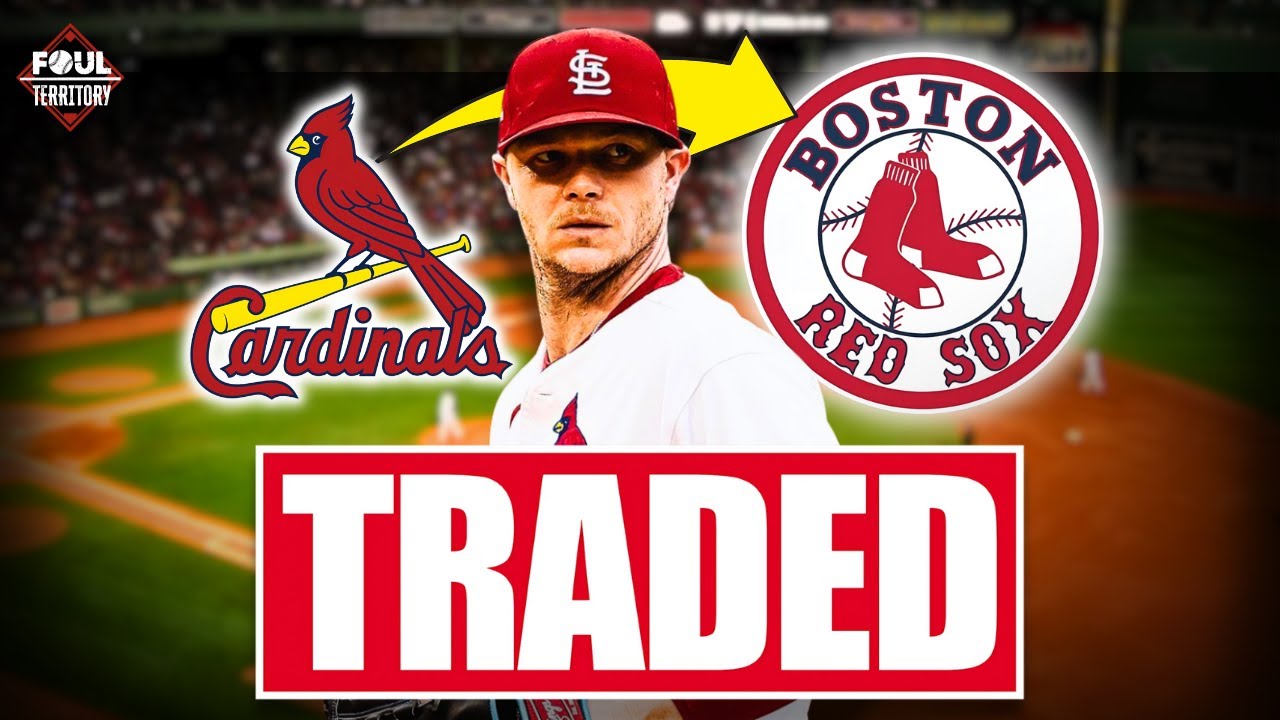
Breaking News: Sonny Gray Traded to Red Sox from Cardinals | Instant Reaction
Sunny Gray moving over from the Cardinals to the Red Sox. And the Cardinals are going to cover about half of what he’s due for 2026. That’s $20 million. They’re also going to uh receive Brandon Clark, who is a left-handed pitching prospect from the Red Sox system, and Richard Fitz, who made some starts last year for Boston. They both go over to St. Louis. The Red Sox are on the hook for $21 million for 2026. There’s some complications with how the salary works for 26 and the buyouts and all that, but all you need to know is that this is a starter crat that the Red Sox will have for one year and $21 million. They were looking for someone that can be a playoff starter. Do you feel like that was accomplished? Man, he is right on that fringe. I mean, they didn’t Obviously, they said they’re looking for ones and twos. They’re looking for somebody to slot in behind crochet. I I don’t know. I don’t know if I can say he’s a playoff starter. I just feel like can he start games in the playoffs? Yes. His track record of not going past the fifth inning makes me leery. Makes me feel like, man, you got to have an absolutely banger bullpen, which the Red Sox do to say yes, we trust him to be a playoff starter. But I think I think he’s I think he’s got the ability to. I don’t know that that length is going to necessarily bode well for the playoffs. But maybe, hey, nobody goes over five innings. You know, you go right to your Garrett Whitlocks, your Araldis Chapman’s, and the game’s over. Yeah, I think Sunny, I think the name may be a little sexier than the the guy, but I think you got to believe in Andrew Bailey over there and what he’s been able to do with some some pitchers. And I don’t think they’re going out and spending this much money if they don’t believe that he is a number two. I think you got to believe in the process, the people that they have in place. Um, you know, what they believe Sunny can kind of, you know, either turn back to or turn into. I mean, I was looking at his numbers today. They’re not overly impressive, but he did strike out over 200 guys. You know, maybe changing the pitch arsenal a little bit. Um, you know, pitching behind a Garrett Crochet may help him. I just like that it’s two Tennessee boys at the the top of the uh the food chain for them over there. Okay. Okay. I like that. I like Yeah. Vanderbilt. You know, you have Sunny Gray has something that not a lot of guys have and I don’t know how this ages. I don’t know how this even works for pitchers later in their career. He’s really athletic. He is super athlet. We were talking about it in our production meeting. Like this dude can sling the football. And people be like, “Well, what does that matter?” You have to be able to change. You have to be able to make adjustments. And if you look at his pitch usage, which I’ll kind of talk about when we bring up the whole like big market, small market type of pitcher, but his pitch usage has changed significantly throughout his career. And I think it’s him adapting to what he needs to do. Like he used to be he used to be like almost equal sinker slider. he’d mix that slider into a cutter and then he started working in a ton more curve balls. Now that cutter is one of his more predominant pitches. Like it’s something that he’s able to some people would say, you know, he can spin the ball, but he can really manipulate it and change it. And I think that’s just it’s a testament to his athleticism. So if there’s something and Andrew Bailey says, “Hey, you know what? Try this. Hey, you know what? Do this physically.” He’s a guy that can pick it up super quick because he knows how his body works. This is a much higher floor than the same price they paid for Walker Beller last year on a one-year deal. Around the same number, right? This is a much higher floor. I think the floor for Sunny Gray is what, a number three, maybe a number four starting pitcher if you do think he’s going to decline. This past season of 428 RA, he made 32 starts. Very healthy year for him. Fielding independent pitching was much lower. expected RA lower, right? So, some of the results maybe didn’t go his way. Maybe look at the defense. Not that it’s necessarily going to be better over in Boston. They still have work to do to improve that, but the strikeout to walk ratio was literally the best in the National League. And like you mentioned, Kratz, I mean, he’s still getting elite results on some of those pitches. Curveball and sweeper in particular. So, there’s a lot to like here. And KP, it’s only for one year. Sunny does have a little bit of a track record of struggle in a big market. That is a factor. That was the one part where I looked initially and said, “Oh, really? He’s waving his no trade clause for Boston, but he wanted to be on the East Coast to be close enough to Tennessee where he’s from.” And also, he wanted to pitch for a contender and he probably learned from his teammate, now former teammate Nolan Aronado, that if you’re too picky and you say no early on, you might end up in St. Louis next year on a team that’s somewhat in a rebuild mode under high bloom who takes over. Yeah, I mean I love the durability aspect. At the very least, like you said, if the floor is getting 32 starts at a four RA, it’s a very valuable pitcher to have. And you you weren’t here last time I was on, Scott, but me and Ky went back and forth about um there’s no such thing as a one bad one-year deal. there is a price you teams are are willing to go to. And apparently for the Red Sox, 21 million is not too much for them to go to for a one-year deal. So hopefully Sunny is a guy that they think that he has, like Crazy mentioned, the athleticism. They can, you know, manipulate some things with him a little bit, you know, maybe get his ERA down a little bit. But, you know, I love the fact he’s willing to uh get rid of his no trade clause to go to a place um like Boston, which historically has kind of been a big market, but I think it’s a lesser a tear down from a New York. And maybe there’s still some bitterness in Sunny from his failures in New York. And maybe it’s an opportunity for him to go back and feel like he can really stick it to the Yankees. Him and Chapman, I think. Yeah. I mean, that’s a chance. Chapman Chapman lives Chapman lives in that land. Chappie is like, “Yeah, you know what? I’ll sign with who? The Yankees hate Boston and I hate the Yankees, so I’m gonna go there.” No, I don’t think that’s how I don’t think that’s how and and if I wasn’t there, maybe I would jump on board with the whole camp pitch in the big market thing cuz he’s got that country accent. That’s just a narrative. I was there. I saw it. It was a It was a contradiction of pitch usage. Larry Rothschild was the pitching coach, and I’ve said this on before, and it’s definitely been something that’s gotten gotten play, but he wanted him to throw more of what was considered as slider registers more as a curveball when he was more slider and curveball. And if you talk to and maybe remember to to ask Stephen vote when he comes on next time what it was like to catch Sunny Gray in Oakland. He’s like it was it was a guessing game because there would be times where I’d call a sinker and he’d throw a cutter and voters like why on earth did you throw a cutter or he’d call a cutter you know cutter slider and he’d throw the he’d throw the opposite. He’s like, “Well, you know, man.” He says, “Sometimes I just get to the top of my motion and I’m like, “No, I think I’m going to do this instead.” And voters like, “Well, I’d like to know.” And so when he goes over to New York, they kind of took away some of that like, “Hey, I want to feel this out. I want to manipulate this. I want to throw the way I want to throw.” And it was more of like a strict like, “This is what works. We need to throw more of this.” And if you go look at his usage while he was there, it didn’t work. And and or it didn’t work as well as it was working. And everybody’s real quick to play the narrative of big market. The pressure got to him. I was there watching him. It wasn’t the pressure of the market. He’s like he we were sitting in the bullpen in the playoffs and he’s like, I just want to throw how I want to throw. I’ve had success. Why do they want to change me? So it is it’s not a fear of a big market. It’s not it’s not anything like that. He wouldn’t have accepted it if he was like Boston scary. What about the home road splits though back then? I don’t know. I’m I’m only telling you what what he told me helped him, you know, have the most success and, you know, home road splits. So, so because he’s in in Yankee Stadium, he feels like, “Oh, I can’t handle this. The guys the, you know, the fans are booing me.” I don’t know. KP, did you ever feel like you couldn’t play somewhere because fans were on you? No, never. I mean, everyone’s a little bit different. I mean, I think a starting pitcher is a little bit different. I think a starting pitcher home road splits are maybe a little bit different because as you could probably attest because you’ve stood on the mound more than I have Kratzy coming out to talk to pitchers every mound’s a little bit different too. So I mean there is a an element of things being a little bit different you know from a hitter perspective every box feels a little bit different but you know I never kind of went into a specific city and was like oh I I can’t hit here because of the fans I can’t do something on the road. There’s obviously some elements that, you know, played a factor that made certain road ballparks a little bit more difficult. Whether it was the visual off the hitter’s eye, the way the sun was in the outfield, maybe you weren’t used to, but it had never had anything to do with the fans. Kratz, we picked you to talk about MeUndies. Not just because they’re ridiculously comfortable, but also because they are very festive. When the holiday season hits, you go on the website and there are just so many more designs to check out and they just scream Eric Kratz getting little matching sets with everybody that he knows. You know what they’re called? Me undies, not you undies. So you go in and you say, “This one’s for me. This set is for me. This is what is good for me. Not you undies, me undies.” A lot of different ones to choose from. I’m so confused. But what I do know is that you can knock out all of your holiday gifting needs today with MeUndies. And to get the exclusive holiday deals up to 50% off, meundies.com/foul. Enter promo code foul. That’s meundies.com/fol. Promo code is ful for up to 50% off. Matching holiday prints with your person. You can’t beat that. Do you think that things change when he goes over to Boston or do you believe what Kratz is talking about here? It didn’t really have to do with the size of the market. I do think even though you guys don’t feel this way, there are definitely players that we’ve seen in the past who cannot handle certain markets. Do we all agree on that? We’ve seen some players look like the same person in terms of their skill set, but move over to a team like the Yankees or even the Mets or the Red Sox and really struggle. Don’t you feel like you’ve seen some cases like that? I don’t put the Red Sox in that same tier, though. I mean, I I was there. Granted, it was the COVID year, so it was a little bit different, but you could always get a feel. I played in I played in New York with the Mets and I also played in the Red Sox. And even precoid, just judging off of spring training, the amount of media that was around, the amount of, you know, kind of feel of the bigger market. I mean, I don’t put Boston up there. I mean, it is one of the bigger markets in the game, but in terms of like that kind of external pressure you feel from a market, Boston was way different than New York in my opinion. KP, what do you think? What do you think about like when people say the big market, what I think of when I hear guys struggle or when I think like how I was uncomfortable at places, it was your environment that you lived in. Some people don’t like living in the city. So you play for the Yankees, you got to drive out to White Plains, you got to drive out, you know, north of Yner, so you’re not in a city. You know, some people don’t enjoy that part of it, but do you feel like do you feel like there was ever a place when you were in when you were in Queens? Were you ever like, man, I can’t handle this because these media guys, they’re just always all over me? No, it’s a fair point. I mean, the media wasn’t like the bigger thing. It’s obviously maybe some like external pressure from like the way that the fans are a little bit and obviously the media in New York’s just a little bit different. Like there was things where you may feel like you’re having a conversation with a player and next thing you know it’s on the cover of the New York Post, right? So like things like that bothered me a little bit about New York, but I think you nailed it perfectly. When it comes to bigger markets, let’s just call them bigger cities. Yeah. I I I felt like at the end of my tenure of being in New York, the Mets, it weighed on me a little bit. I was commuting from Long Island City to Flushings every day, which you know, if you look at your map, it says it’s eight miles, but it could take you up to an hour and a half and you’re sitting in bumper-to-bumper traffic and it’s just, you know, by the time you get to the ballpark and I was commuting every day. I was driving Aaron Loop, who lived in my same building. I drive him, his wife would drive my wife and kids. We kind of carpooled that way, but I was the one driving him every day. And there would be times I get to the field, I just have to sit in my chair for like 30 minutes and just kind of decompress. And I hadn’t even played the game yet and I was already worn out from the drive. And then I think about other places I played in my career where, you know, Atlanta has some bad traffic, but I’m thinking about like my setup in Atlanta. I was living in a nice house and a neighborhood. I had a backyard. My family was really happy. I was happy. Like I think that’s a bigger factor in certain places that you play when you talk about big markets or big cities is just kind of your living arrangements and the way you commute to the stadium. Um maybe that’s kind of something that wait on Sunny a little bit but Crabsy you would know more you were in the clubhouse with him. Yeah. Yeah. For sure. And for me the place where I didn’t feel comfortable it was such a it was such a burdensome drive to the field where I was staying. I forget even where where did we stay when we were out in San Francisco because it took me forever to get there. Lafayette maybe or Walnut Creek. Lafayette maybe. Walnut Creek. Cuz I drove by and I’d pick you up in the morning one or two times for like a day game. And I’m like, man, when my wife comes out here, she’s going to come out to watch me play in a day game. And I remember it thinking like it’s going to take her an hour and a half to get to the game. The only day I play. Like the day games were the only days I play. So that’s when she would come in to see the game. And I’m like, that’s gonna suck. She’s not even going to be out here. So, yeah. All all that stuff goes into it. But rarely rarely rarely is it is it the fans that are really getting on you. I remember Carl Crawford said some things about playing in Boston where he was like, it was 100% the fans that were getting on me. The Boston fans when he became a Red Sox. Yeah. I I I mean there’s certain there’s definitely certain places you go there’s definitely certain places you go where the the fan engagement is different. Like Philly is obviously a tough environment to go into as a visiting player. Going into Yankee Stadium is a tough environment to go in. But I never like went into a game or like on the bus ride over. I wasn’t like, “Oh, I can’t perform here because the fans.” It’s just you knew it was going to be part of the environment that you were going to play in and you know, you just had to have tough skin to do it. All right, last layer here. So, for me, Red Sox get a guy who has a high floor, uh, a nice signing here in Sunny Gray. He’s definitely going to slot nicely into the rotation. There’s a decent chance that he would be a guy who has a nice year and then as a playoff starter for them as they have their eyes set on the playoffs. Crochet at the top, then Grayer Beo, Cutter Crawford, Patrick Sandival maybe could emerge this year, Pton and Connelly early. They have options here, right? It might not be the the co- ace that they were looking for, but it maybe it’s one notch down and there is still a lot of offseason to
Kevin Pillar, Erik Kratz, and Scott Braun break down the Sonny Gray trade as the St. Louis Cardinals send their number 1 starter to the Boston Red Sox. The crew reacts to Boston taking on one year and $21 million, whether Gray can actually be a playoff starter, how his pitch mix has evolved, and whether big-market pressure was really ever the issue. Plus, KP and Kratz share personal stories about market fit, living situations, and how environment impacts performance.
Go to https://MeUndies.com/foul and enter promo code foul for up to 50% off!
Subscribe to the podcast!
https://apple.co/3KWKFNo
Follow all our social media channels for more content!
Tweets by FoulTerritoryTV
https://www.instagram.com/foulterritoryshow/
@foulterritory
https://www.facebook.com/FoulTerritoryShow
https://www.twitch.tv/foulterritoryshow
6 comments
This can’t be the #2 they were hunting for. More like a #3 or #4
This is a win for the Cardinals as they save $15 million. AND they get 2 arms.
0:59 this is NOT the #2 deal they were looking for. This is the Giolito replacement we need for depth + a guy that averages 180IP/season (not sure where you get the notion that he averages 5ip/game when you throw 180innings avg/season.
Cards gave up on him still paying half his salary
"I played in Boston, granted it was the covid year" bro said there was no external pressure during a season where there wasn't fans allowed into the park and a last place finish. got it 👍
You think he wanted to move to the East Coast, because it’s closer to Tennessee than St Louis?